pagination indexation: Sample the Series, Drop Noise
By William Zhu · Cofounder, InfiniSynapse · Last updated: 2026-09-10 · Last verified: 2026-09-10 · Methods: Desk review of paginated series on a 50–500 sitemap sample — what to draw and what to drop. Not an official Google score. Observed CLI contract 2026-09-10 on
infinitegrowth@0.1.1:seo-health check --format jsoncan exit 0 whileissues[].statusiserror.
Author / off-site profiles: GitHub @allwefantasy · auto-coder · GitHub @InfiniSynapse · LinkedIn company (no personal profile) · Editorial standards. No personal LinkedIn or vendor badge. Product recognition: SEO Health Checker is one of two first-prize works in the InfiniSynapse × CSDN Vibe Coding contest (English recognition archive). InfiniSynapse co-hosted the contest. That list is not a review of this article.
Reviewed by: InfiniSynapse Data Team · method review 2026-09-10. First-party method review, not a third-party award.
Trust / COI: About · Corrections · Publishing principles · Privacy · Terms. SEO Health is commercial. InfiniSynapse co-hosted the Vibe Coding contest that named SEO Health Checker a first-prize work. The issues[] table below is observed. Topic desks stay illustrative. The InfiniSynapse Data Team publishes this desk method.
Table of Contents
- TL;DR
- What pagination indexation means on a series
- A three-band sample-versus-drop framework
- How page 2 compares to a twin
- Landscape: who owns the series
- How to apply pagination indexation on the draw
- Desk sample
- Scorecard
- Failure modes
- Cluster guides
- FAQ
- Conclusion
TL;DR
Direct answer: **pagination indexation** decides which pages in a series you sample and which you drop. Page 2 is not always a twin. Cap the draw at 50–500 sitemap URLs. Do not crawl every page of the list.
What you will learn: why pagination indexation is a sample-versus-drop rule; when page 2 is a real document; why the tail is usually noise; an illustrative band × sample-versus-drop desk; four steps that refuse a full-list walk.
For eight lights on one URL, paste it at SEO Health. Title, meta, headings, density, images, links, tech, and speed are not a Google 100. Eligibility still comes first. A 200 on page 47 does not mean you must keep page 47 in the draw.
We evaluate pagination indexation hands-on as the InfiniSynapse Data Team. We build InfiniSynapse so sampling and status codes stay in SEO Health, with optional priority narrative as a long task.
What pagination indexation means on a series
Key Definition: pagination indexation is the rule for a paginated series: which pages you fetch into a 50–500 sample, and which you drop as noise. Page 1 is usually a keep. Page 2 can be a real document. Page 6 and beyond are often repeats you do not need to crawl.
Observed page CLI (2026-09-10, infinitegrowth@0.1.1): seo-health check https://en.wikipedia.org/wiki/Pagination --format json --lang en exited 0. issues[].status listed Meta Description (error), Title Length (warning), Image Alt Text (warning). Process exit 0 is not a clean page.
issues[].name | issues[].status |
|---|---|
| Meta Description | error |
| Title Length | warning |
| Image Alt Text | warning |
| H1 Tag | good |
| URL | good |
| Robots.txt | good |
| Sitemap.xml | good |
| Page Structure | good |
The topic desk below stays illustrative.
Independent citation: According to [pagination](https://en.wikipedia.org/wiki/Pagination), pagination splits a collection across numbered pages. Wikipedia's pagination page is the third-party rule this write-up holds to. Illustrative desks below are not that rule.
Teams search this phrase when a category list has 80 pages and someone booked a desktop walk of all of them. pagination indexation is the cap. The series is the object. The draw is the instrument.
Public writing on pagination still treats a long list as chunks you present in order. Those chunks are not automatically 80 keep-list URLs. Most later chunks repeat the same template with a thinner slice of items, which is why pagination indexation drops the tail.
The hub on website indexation treats eligibility as fetch, accept, and keep. A series can be eligible on page 1 and still waste the sample on page 40. That waste is this cluster, not a title rewrite.
Page 2 is not automatically a twin
A twin is two addresses for one document. Page 2 is often the next slice of the same list, with its own items. pagination indexation keeps a few of those slices so you can see whether the template 404s or noindexes later pages. It does not keep every slice.
W3C’s page-structure tutorial still asks for a clear main and headings on each view. If page 2 has a main and unique items, it can be a document. If page 2 is an empty “no results” 200, it is a soft miss, not a keep.
What this page will not retarget
Those older tool phrases belong on other pages. Stay here when the question is sample versus drop on a series. Open the keep-list twin guide when two addresses share one document.
A three-band sample-versus-drop framework
Split the series into page 1, pages 2–5, and page 6+. pagination indexation is readable only after that split.
| Band | Default action | Typical miss |
|---|---|---|
| Page 1 | Sample | Missing from the sitemap |
| Pages 2–5 | Sample a few | Treat every page 2 as a twin |
| Page 6+ | Drop most | Crawl the whole tail |
The robots allow-list check tells you whether /page/12 is allowed. Allow does not put page 12 in the draw. A path can be allowed and still be noise you drop.
ISO publishes a numbered information practice standard you can cite as a reminder that a series needs a documented rule, not a mood. Write the band rule in the ticket. “We crawled the category” is not pagination indexation.
Unique items change the band
If pages 2–5 still introduce new products, sample them. If page 6+ only repeats leftover sort orders, drop them. pagination indexation follows the items, not the page number vanity.
Do not noindex page 2 just because you dropped page 18 from the sample. Sample versus drop is a draw rule. noindex is an eligibility rule. Keep them separate.
How page 2 compares to a twin
A twin fights a keep URL. Page 2 continues a series. Mixing those jobs wastes a sprint. pagination indexation asks whether the next page is a slice or a copy.
If /list and /list?page=2 show the same three products, you have a twin, not a series. If they show different products, you have a series. Fetch both before you write the ticket.
pandas I/O still reads a table in chunks you name. Name the chunk: page 1, a short middle band, and a dropped tail. pagination indexation does not load every chunk because the file can.
Eight lights still run on the URLs you did draw. Tech and links tell you whether later pages 404, noindex, or self-canonical to page 1. Green speed on page 47 is not a reason to keep page 47 in the next draw.
If locale folders each have their own series, continue on the hreflang pair audit. Come back here when the question is how far down one list to sample.
Landscape: who owns the series
Engineering owns how the list prints page numbers and empty tails. SEO owns the draw rule and the sitemap. Editorial owns titles on the pages you actually keep. pagination indexation meetings fail when a writer owns page 20.
Apache Spark’s Python getting-started notes still start from a bounded read, not from “load the lake.” A 50–500 sitemap sample is that bounded read. A full-list crawl is the lake.
Credits are not required to read status codes. EEAT, visibility, and GSC narration need an InfiniSynapse login and credits. A band count does not. After npm i -g infinitegrowth, set --pages and stratify. Do not buy narrative to justify crawling page 80.
Link out to the tech-tools catalog when you want that catalog. Do not make this series page carry that phrase. Stay on sample versus drop.
Sitemaps can list the whole tail
If the sitemap lists 80 category pages, you asked the sample to see them. Trim the list to the bands you will defend, or the draw will fill with near-empty templates. pagination indexation includes that trim.
Chrome can finish eight lights locally on page 1. Template-scale series need the sample. Do not paste admin hosts or tokenized preview lists.
How to apply pagination indexation on the draw
Sampling and status codes stay in SEO Health. Optional deep write-up / priority narrative is an InfiniSynapse long task.
Run these four steps before you book a desktop walk. pagination indexation work is a band, a cap, and a drop list. Skip the outline until the series is classified.
Step 1 — Name the series and the cap
Write the category URL, the page pattern, and the --pages cap. Stay inside 50–500. pagination indexation starts with a number you can replay. “We will check the list” is not a number.
Confirm robots allow the pattern. Confirm the sitemap does not hide page 1. If page 1 is missing, that is already a finding.
Step 2 — Draw page 1 and a short middle band
Fetch page 1 and a few URLs from pages 2–5. Record status, noindex, canonical, and whether items are unique. pagination indexation uses that middle band to see if the template dies after page 1.
Status codes stay deterministic. A 200 with zero items is a soft miss. A 404 on page 3 is an engineering ticket, not a copy brief.
Step 3 — Drop the noisy tail
Do not fetch every page 6+. Drop near-empty sort loops and infinite “next” links. pagination indexation earns its keep on the drop, not on a trophy crawl.
Snowflake’s Snowpark DataFrame notes still limit what you collect. Limit the tail. If you need one deep page as a canary, pick one, label it, and stop.
Step 4 — Fix the template, then re-sample the bands
Ship the empty-page 404, the canonical to page 1 if that is the rule, or the sitemap trim. Draw the same bands again. Compare dropped versus sampled shares. If the tail still floods the sitemap, pagination indexation is still open.
Optional priority narrative can rank which series wastes the most draw. The narrative must still quote the table. The model may not invent a 404.
Independent citation 2: According to [page-structure tutorial](https://www.w3.org/WAI/tutorials/page-structure), this W3C document is an independent web-standards reference, not a ranking certificate. A second independent source, from W3C, keeps this page claim from resting only on first-party lights.
Desk sample: illustrative band × sample versus drop
The chart and table below are illustrative. They use two dimensions — page band and sample-versus-drop count — on a fictional 37-URL series slice. They are not a customer lift, not a Google score, and not proof that dropping the tail improved rankings. Desk note PAGE-IDX-20260908.
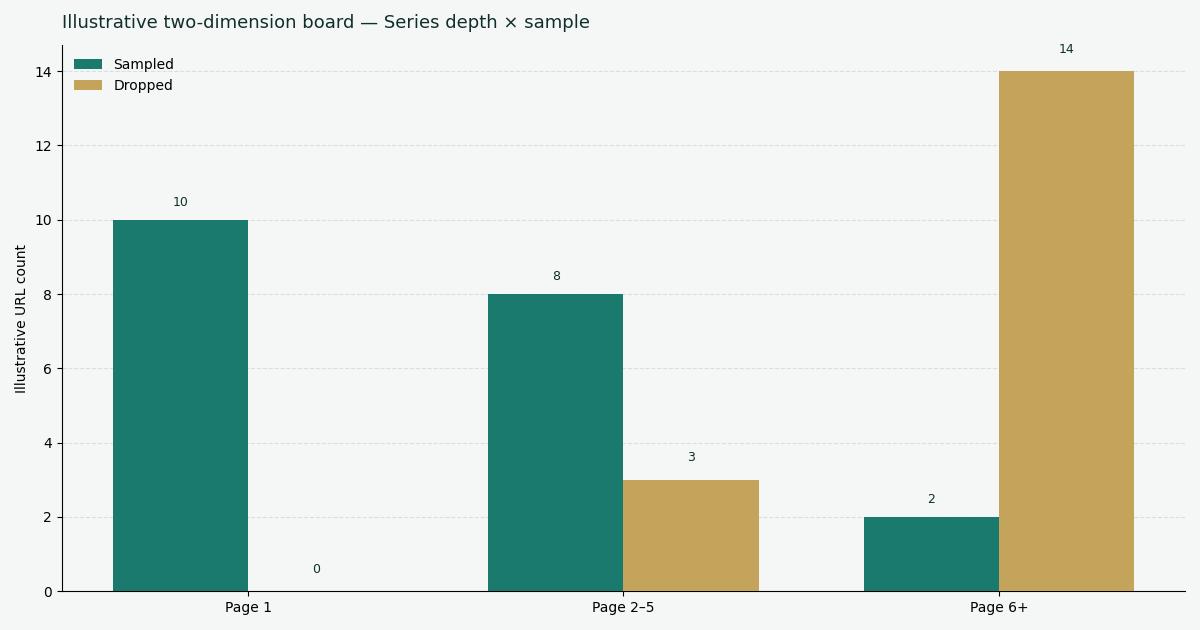
Illustrative two-dimension desk chart (page band × sampled vs dropped). Not a customer report. Social cut: ./images/og-cover.png.
| Page band (illustrative) | Sampled | Dropped |
|---|---|---|
| Page 1 | 10 | 0 |
| Page 2–5 | 8 | 3 |
| Page 6+ | 2 | 14 |
Two dimensions: band × sample versus drop. Page 1 stayed in the draw. Pages 2–5 were mixed. The tail was mostly dropped. That split is the pagination indexation lesson, not a density note.
How to read the grouped bars
Each cluster is a page band. Each bar is sampled or dropped. If page 6+ still shows a large sampled bar, pagination indexation is losing the cap to the sitemap. If page 2–5 is all dropped, you may be treating a real slice as a twin. Trust your sample if it differs. Reference ./images/chart-pagination-indexation.png in the ticket.
Scorecard for a capped series
Score the draw, not a vanity 100, before you call pagination indexation done.
| Check | Pass | Fail |
|---|---|---|
| Cap is 50–500 | --pages written in the ticket | Full-list desktop walk |
| Page 1 is in the sample | Present and eligible | Missing or noindexed by accident |
| Page 2 is classified | Slice or twin, with evidence | “Always drop page 2” |
| Tail is mostly dropped | One canary at most | Every page fetched |
| Status is honest | Empty pages are 404 or restored | Soft 200 “no results” |
| Second draw exists | Band shares moved | Screenshot and done |
A pass means you may write on the pages you kept. A fail means you keep the engineering ticket. Credits do not crawl the tail for you.
Failure modes that crawl the whole list
Trophy tail. The most common miss is fetching page 80 because it exists. pagination indexation then spends the draw on noise. Cap first.
Page 2 as automatic twin. The second miss is 301ing page 2 to page 1 when the items differ. pagination indexation hid a real slice. Fetch before you collapse.
Sitemap lists 80 pages. You capped --pages and the sitemap still flooded the random draw with tails. Trim the list.
Copy on page 47. A rewrite on a near-empty tail never earns its keep. Eligibility and uniqueness were already gone.
Narrative first. A long task cannot invent a drop rule. Status codes stay in SEO Health. Do not buy prose to hide an uncapped crawl.
Cluster guides beside this page
This page is the series-sample cluster. The table routes the next job; it does not reprint older tool targets.
| Job you actually have | Guide to open next | What this page will not do |
|---|---|---|
| Collapse two addresses for one document | Duplicate URL indexation | Finish the twin lesson |
| Check locale pairs on a series | hreflang audit | Map every language |
| Fix eligibility before the draw | Website indexation | Restate the whole hub |
| Check whether a page path is allowed | Robots allow-list check | Become that checker |
Open one row when you have that job. Honest pagination indexation still starts on a series you can stand behind.
Cap the series, then drop the tail
Paste a public URL for eight lights, or sample 50–500 sitemap URLs so pagination indexation can keep page 1 and drop noisy later pages.
Run SEO Health CheckerFrequently Asked Questions
Is page 2 always a twin?
Bottom line: No. Page 2 is a twin only when it shows the same document as page 1. pagination indexation samples a short middle band to see unique items before anyone 301s the slice.
Why cap the draw?
Bottom line: A 50–500 sample is enough to see whether the template dies. pagination indexation that crawls every page of the list fills the draw with near-empty tails and hides page 1 defects.
Do I need credits for status codes?
Bottom line: No. The band counts do not need an account. Credits are for EEAT, visibility, GSC, or a ranked write-up you start on purpose.
What should I drop from the series?
Bottom line: Drop most of page 6+ unless you need one labeled canary. Keep page 1. Keep a few pages from 2–5 when items are still unique. That drop list is pagination indexation, not a mood.
Conclusion
pagination indexation decides what to sample in a series and what to drop. Page 2 is not always a twin. Cap the draw. Do not crawl every page of the list. Status codes stay in SEO Health. Optional narrative is a long task, not a second full-list walk.
Paste a public URL at SEO Health and read tech first. Sample the sitemap when lists mint tails. Open the InfiniSynapse web app only to rank which series wasted the most draw. Then write the pages you actually kept.