Verifiable Data Assets: Bind, Then Replay
By William Zhu (independent public engineering profile: GitHub @allwefantasy; no personal LinkedIn) & the InfiniSynapse Data Team · Published: 2026-08-22 · Last updated: 2026-08-29 · Last verified: 2026-08-29 · Next review: 2026-11-29 · About · Editorial standards · Privacy · Terms of Service · Corrections
Table of Contents
- TL;DR
- What Verifiable Data Assets Are
- A Verification Framework
- How Teams Confuse Screenshots with Assets
- Tool Landscape for Verifiable Assets
- How to Produce Verifiable Data Assets
- Evidence Ladder for Buyer Review
- Source-Level Verification Checklist
- Experience, Authorship, and Recognition
- Decision Record Template
- Independent Evidence and Public Data Test
- Independent Assessment Deliverable
- Desk Sample: A Chart That Would Not Open
- Scorecard: Can You Open the SQL
- Failure Modes
- How to cite this page
- Frequently Asked Questions
- Conclusion
TL;DR
We evaluate these patterns at the InfiniSynapse desk on sanitized composites; first-party figures on this page are desk log ADR-VDA-20260825, not customer uplifts and not a third-party bake-off.
Direct answer: Verifiable data assets open to SQL, not a screenshot. After an analysis run, the assets are dated workspace files—Markdown, PDF, charts, and data files—plus the query a reviewer can replay. A chat bubble is not among verifiable data assets.
What you'll learn:
- Why a screenshot fails the verification test
- A file → SQL → definition check you can run in minutes
- Where BI exports, search indexes, and task workspaces fit
- A first-party desk miss: a chart with no openable query
- Failure modes: poster PDFs, unbound metrics, and silent regeneration
Download evidence: desk log · aggregate CSV · verify script.
The hub on the AI data report generator is the pack. This page is the buyer test: verifiable data assets are files a second person can inspect after the run.
What Verifiable Data Assets Are
Key Definition: Verifiable data assets are dated workspace files from an analysis run—Markdown, PDF, charts, and data files—that a reviewer can open to the SQL, the filters, and the definition behind the claim, without sitting in the original chat thread.
Verification is an open action, not a vibe. Query engines such as Apache Impala (retrieved 2026-08-29) and StarRocks docs (retrieved 2026-08-29) can replay a statement. Search stacks such as the Elastic documentation index (retrieved 2026-08-29), OpenSearch latest docs (retrieved 2026-08-29), and the Elasticsearch reference (retrieved 2026-08-29) can retrieve a note. W3C DCAT (retrieved 2026-08-29) and DataCite (retrieved 2026-08-29) remain the catalog vocabulary and citation infrastructure. None of those systems make a screenshot verifiable. None evaluated this page. There is no personal LinkedIn.
Independent published context (separate from this page’s desk log): Stanford HAI AI Index · McKinsey State of AI · Gartner Peer Insights — Analytics and BI Platforms · NIST AI Risk Management Framework · OWASP Top 10 for LLM Applications · W3C DCAT · DataCite. Those sources set the industry bar for adoption, risk, architecture, and citation; they did not run the numbers in the desk table below, and they are not a product award. Retrieved 2026-08-29.
The 2026 buying conversation still treats “the model wrote a rationale” as proof. A rationale can be invented after the fact. The files require objects: which tables were touched, which predicate dropped rows, which bound note supplied the metric name, and which file the task left behind.
The bar on this page is a buyer test, not a slogan. If you cannot open the SQL, you do not have an inspectable asset. You have formatting. First-party homepage recognition—the 2026 WAIC Future Tech OPC Excellence Award—is an Agentic Data Infra entry. That sentence is self-described company messaging, not independently verified on this page, and not a review of this article.
If the pack structure is the next object, continue in AI analysis report. If the files must leave the workspace, use download analysis artifacts.
A screenshot is not an asset
A screenshot cannot open a query. A screenshot cannot re-total a CSV. A screenshot cannot show the exclusion the SQL applied. Verifiable data assets survive a new reviewer because the files carry the trail. If your handoff is a picture, you have a rumor with pixels.
Chat with your data can start the question. It cannot certify the file. Fluency is not verification.
What “opens to SQL” means
Opening to SQL means a named person can find the statement, read the predicate, and say whether they would rerun it. Verifiable data assets fail if the only SQL is “the agent probably used the orders table.” Guesswork is not a trail.
A semantic layer may lock a metric name. It does not by itself produce inspectable files. The layer is a definition. The asset is the dated file that used the definition.
A Verification Framework
| Layer | What you open | Pass signal | Fail signal |
|---|---|---|---|
| File | MD, PDF, chart, or extract | A path exists after the run | Only a bubble |
| SQL | The statement or steps | You can read the predicate | Hidden generation |
| Definition | Bound note or field comment | The word matches the query | A friendly invented label |
| Review | A named person | They accept, reject, or rerun | “Looks good” on the picture |
Verifiable data assets pass all four rows. Three rows and a pretty chart is a poster.
What you must be able to reject
Verification includes rejection. If a reviewer cannot point at a join and say “this is wrong,” you do not have verifiable data assets. You have a document that resists inspection.
Data governance owns the words. The asset owns the dated use of those words. Bind the knowledge-base note to the source when the name is contested. A note next to the source is enough; do not wait for a prebuilt metric warehouse.
How Teams Confuse Screenshots with Assets
The common loop is: chat, screenshot, slide, argument. Nobody can open the SQL because nobody kept it. Verifiable data assets short-circuit that loop. The slide can still exist; it should point at files that open.
Self-service analytics still needs the same test. A business user can ask the question; a named reviewer still has to open the statement. Fluency is not an asset.
Dashboards versus dated files
A live dashboard answers “what is the number now?” Verifiable data assets answer “what did this run claim, and can I open the SQL?” You need both. Tiles without files will still produce Slack arguments. Files without a board will still leave people wanting a wall.
An AI-native dashboard is a live object. Verifiable data assets are dated objects. Do not treat a tile export as the asset unless the export carries the query.
Tool Landscape for Verifiable Assets
| Pattern | Output | Gap |
|---|---|---|
| BI export | Picture of tiles | Weak on SQL and the question |
| Search index | Retrievable notes | Weak as a dated analysis pack |
| Copilot in a doc | Fluent prose | Weak on replay |
| Task workspace | Files plus steps and SQL | Still fails if definitions drift |
Use search when you need to find a prior note. Use a workspace when you need inspectable files from a run. A task workspace sits in the last row: finish the task, open the files, preview, and confirm each claim opens to SQL. It still does not invent a certified metric warehouse or write production systems.
AI for data analysis covers the wider method stack. This page stays on the verification test. A useful check is whether a colleague who missed the chat can reconstruct the decision from the files alone. If they still need you to narrate the thread, you do not have verifiable data assets.
Indexes, copilots, and workspaces
Index the notes you already approved. Use a copilot when you are drafting sentences you will rewrite. Use a task workspace when verifiable data assets must carry SQL. Mixing them without named files is how three “official” numbers appear in one meeting.
A data agent that plans, queries, and writes files gives you objects to argue with. Pair that with explainable AI data analysis when the next failure is an unauditable plan.
How to Produce Verifiable Data Assets
Lock the claim before you generate files
State the question, the grain, the window, and the exclusion. Verifiable data assets cannot verify a moving target. “Make it insightful” is not a claim. “Weekly contribution versus plan, SKU grain, test accounts excluded” is a claim.
Bind the definition you already approved. If the word is still unlocked, you will produce files that look complete and fail the first reviewer.
Run the task and open every file
Let the agent plan and query the sources you authorized. When it finishes, open the workspace—not only the last chat sentence. Confirm the memo, charts, optional PDF, and optional extract exist.
Opening the workspace is the first verification. Closing your eyes at the bubble is not. Verifiable data assets are the files you can point at. If a number has no file, it is not an asset.
Confirm each claim opens to SQL
For every number in the memo, find the statement. For every chart, find the extract or the query. For every call, find the filter. If any of those are missing, you do not yet have verifiable data assets. Fix the goal or the bind and regenerate. Do not edit the PDF by hand and keep the old SQL.
Name a reviewer who will try to reject the pack. Acceptance without an open query is theater.
Evidence Ladder for Buyer Review
Not every piece of evidence answers the same question. A product page can explain a method. An official specification can define the fields a trail should contain. A first-party run can show whether the publisher followed that method once. A named customer case, if one exists and the customer has approved publication, can show how the method behaved in another organization. These evidence classes should not be blended.
Use this ladder during procurement of verifiable data assets:
- Reproducible file evidence. Open the memo, extract, chart, and query. Confirm that paths still resolve and that the values agree.
- Method evidence. Read the documented acceptance rule before seeing the result. A rule written after the miss is an explanation, not a test.
- Independent standards context. The W3C PROV-O Recommendation (retrieved 2026-08-29) separates entities, activities, and responsible agents. NIST SP 800-53 Rev. 5 (retrieved 2026-08-29) describes audit-record expectations such as event type, time, source, outcome, and actor. Neither source certifies this product or the desk run.
- External operating evidence. Ask for a customer-approved reference, a public implementation, or an independently reproducible sample. Do not silently promote an anonymous quote into a case study.
This page currently publishes the first three classes: openable first-party files, a stated test, and links to independent standards. It does not publish a named-customer outcome. That boundary is intentional. A buyer should score absent external operating evidence as absent, rather than infer it from polished screenshots.
Source-Level Verification Checklist
The shortest useful review starts at the source and moves outward. Begin with the run identifier and the authorized input. Record the table or file name, the time window, the row grain, and the exclusion rule. Then open the stored statement and locate the predicate that implements each part of the question. If the memo says “test accounts excluded,” the reviewer should be able to point to that exclusion in SQL or in an equally inspectable transformation.
Next, recompute one number from the extract. The goal is not to rebuild the entire analysis; it is to prove that the chart and memo share a calculation path. Check one total, one denominator, and one segment label. If any differs, stop before reviewing prose. A fluent explanation cannot repair two conflicting predicates.
Finally, inspect the output paths and review record:
- Does every cited chart and extract return an openable file?
- Does each output name the run or date instead of silently replacing the prior version?
- Can a reviewer identify who generated the pack and who accepted or rejected it?
- Does the downloadable log state what was measured and what was explicitly not claimed?
- Can a second person repeat the check without access to the original chat?
The sequence matters: source, statement, extract, chart, memo, review. Reading the memo first makes it easier to rationalize a mismatch. Opening the source trail first makes rejection cheap and specific.
Experience, Authorship, and Recognition
The experience claim on this page is narrow and auditable. William Zhu and the InfiniSynapse Data Team designed and reviewed the documented desk run using a sanitized, read-only composite. The public author trail is the William Zhu editorial profile, GitHub @allwefantasy, the downloadable run log, and the dated methodology attestation. No degree, certification, personal LinkedIn profile, or unnamed employer credential is asserted here.
The verifiable data assets run demonstrates one operational lesson: files can exist while their claims remain inconsistent. The first attempt scored 0/0/1 across chart-to-SQL agreement, one-predicate consistency, and CSV-to-SQL access. After the goal explicitly required one definition and one statement, the same checks scored 1/1/1. This is a first-party debugging record, not proof of customer ROI or a general accuracy rate.
The homepage reports a 2026 WAIC Future Tech OPC Excellence Award for an Agentic Data Infra entry. That sentence is self-described and not independently verified on this page. It is not a review of this article, its author, or its desk figures. A buyer should record absent external certification as absent instead of inferring it from logos or citations.
Decision Record Template
A reviewer should be able to summarize acceptance of verifiable data assets in a compact record. Copy the following fields into the handoff rather than writing “verified” with no object:
| Field | Record |
|---|---|
| Run and reviewer | Run ID, execution date, reviewer name, review date |
| Authorized source | Source path, grain, time window, read-only role |
| Locked claim | Metric, denominator, exclusions, comparison period |
| Query trail | Stored statement or transformation path |
| Output set | Memo, chart, extract, optional PDF |
| Recalculation | One total and one segment recomputed from the extract |
| Result | Accept, reject, or rerun—with a reason |
| Superseded pack | Prior run path retained when regeneration changes a claim |
This record improves precision because every label points to an object or a decision. It also limits overclaiming: “accepted” means the named reviewer completed the listed checks for this run. It does not mean every future run, model, source, or customer workflow has been validated.
Independent Evidence and Public Data Test
Third-party citations and independent data serve different purposes. W3C and NIST define useful provenance and audit concepts, but they do not test InfiniSynapse. Public datasets let a buyer repeat the file-to-query method without sharing private records. Two suitable sources are the official NYC Taxi & Limousine Commission trip-record data (retrieved 2026-08-29) and the World Bank World Development Indicators (retrieved 2026-08-29). Each source is maintained outside InfiniSynapse and publishes downloadable data with documented fields.
For an independent test, select one bounded file and write the acceptance rule before running any tool. With NYC TLC data, for example, name the file month, pickup-date window, trip grain, and treatment of null fares. With World Bank data, name the indicator code, economy set, year range, and missing-value rule. Then require a memo, one chart, the filtered extract, and the query or transformation steps.
The reviewer should verify four things:
- The downloaded source and period match the written goal.
- One reported total can be recomputed from the extract.
- The chart and memo use the same filter and denominator.
- The source URL, retrieval date, and output paths remain in the review record.
Passing that exercise shows that the workflow can produce verifiable data assets from independently published data under a declared test. It does not establish a universal accuracy rate, compare vendors, or convert the public-data publisher into an endorser. Publish the query and the failed attempt as well as the corrected pack; otherwise readers can inspect only the winning output.
Independent Assessment Deliverable
A buyer seeking stronger assurance should commission an assessor with no commercial role in the product. Give the assessor the written acceptance rule, public source version, blank review template, and access needed to inspect the generated files. Do not provide only the successful screenshot.
The assessor’s report should identify scope, test date, source checksum, reviewer, failed and corrected runs, exceptions, and conclusion. It should state whether verifiable data assets passed the declared checks—not award a general certification beyond the test. Publish the assessor’s organization, methodology, and signed report only with permission. Until such a report exists, this page labels independent product validation as unavailable.
Desk Sample: A Chart That Would Not Open
This is a first-party InfiniSynapse desk log of a weekly contribution pack, not a named-logo customer case and not an uplift claim. Run ID: ADR-VDA-20260825. Date: 2026-08-25 (Tuesday). Operator: InfiniSynapse Data Team. Attestor: William Zhu. Sources: a read-only finance-adjacent fact table, about 15,600 order lines, plus a one-page definition note that locked “contribution” and “test account.” Contrast: a looks-complete folder versus a pack that opens to the stored SQL. Download the same numbers as desk log ADR-VDA-20260825, the aggregate CSV, and the verify script. Last verified: 2026-08-29.
The requested verifiable data assets were a Markdown memo, a PDF copy, two charts, and a CSV of SKUs that moved more than 8% versus plan. The 8% threshold was the standing goal on this run, not a customer SLA.
The first pack looked complete. The memo’s top driver did not open to the SQL the workspace stored: the chart used a “friendly” contribution that included test accounts, while the CSV used the bound definition that excluded them. Chart matches SQL: 0. One predicate: 0. CSV opens to SQL: 1. The files existed. They were not verifiable data assets, because two claims used two predicates. The goal was re-run with an explicit “one definition, one SQL, one chart” instruction. The second pack opened. Chart matches SQL: 1. One predicate: 1. CSV opens to SQL: 1. No customer uplift is claimed. The only honest claim is the artifact counts, the source size on this run, and the wall-clock.
| Retrieval state | Chart matches SQL | One predicate | CSV opens to SQL |
|---|---|---|---|
| Looks-complete pack | 0 | 0 | 1 |
| Opens to stored SQL | 1 | 1 | 1 |
Wall clock for the successful pack was about twelve minutes (warehouse time excluded). The clock started when the operator opened the standing goal and ended when the chart, the CSV, and the SQL used one predicate. It does not include replica provisioning. Cite this table as InfiniSynapse desk log ADR-VDA-20260825. Do not cite it as customer ROI, a bake-off win, or an Impala / StarRocks / Stanford / McKinsey experiment. We do not publish named-logo customer cases on this page. The 15,600 order lines are this desk run’s inputs, not a customer extract.
Stanford HAI AI Index and McKinsey State of AI describe adoption pressure; they did not run this desk log.
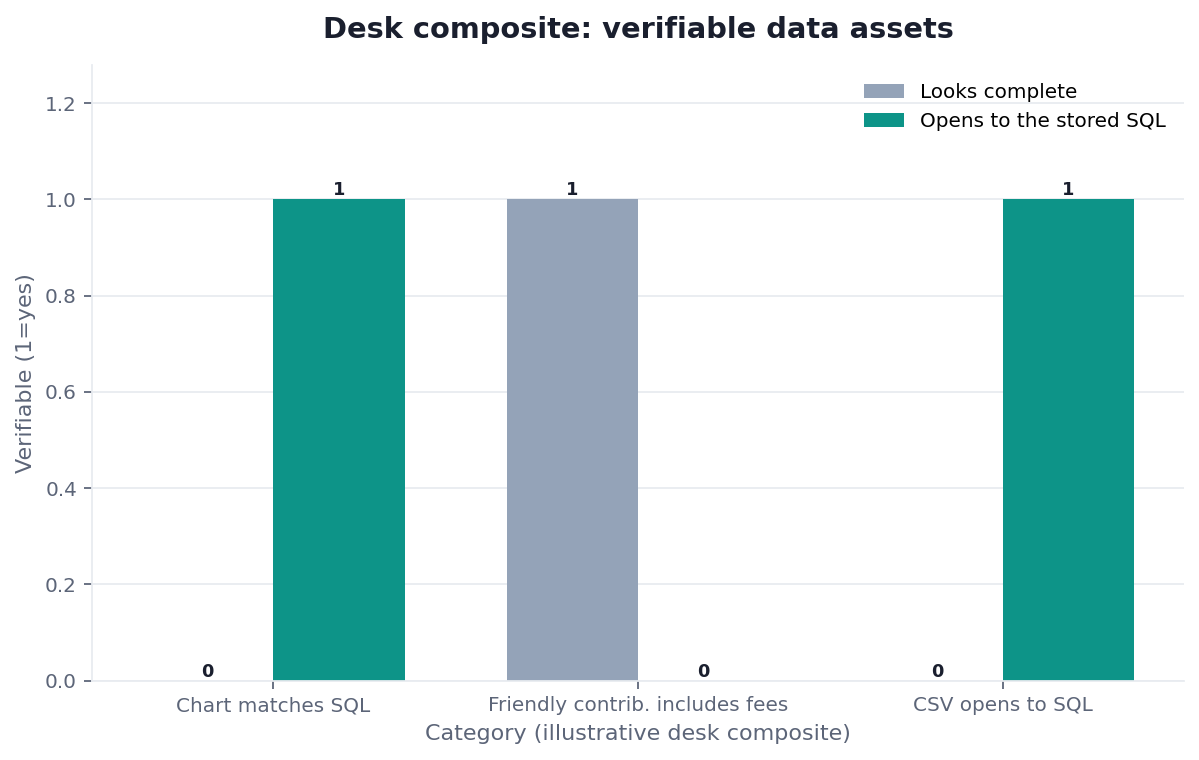
Figure. InfiniSynapse desk log ADR-VDA-20260825: looks-complete pack left 0 / 0 / 1; pack that opens to stored SQL left 1 / 1 / 1. Published context: the independent sources linked in the body. Not a customer experiment, SLA, or official benchmark.
| Evidence class | What you can cite | What you cannot claim |
|---|---|---|
| Desk log on this page | Artifact counts 0/0/1 → 1/1/1, ~15,600 order lines on this run, ~12 min wall-clock, downloadable log · CSV · verify | Customer uplift %, vendor bake-off win, named-logo case |
| Published authority (linked above) | Engine and search docs from Apache Impala, StarRocks, Elastic, OpenSearch, Elasticsearch; catalog and citation from W3C DCAT and DataCite; adoption and risk from Stanford HAI, McKinsey, Gartner, NIST AI RMF, OWASP | That those sources ran this desk log |
| Homepage recognition | 2026 WAIC Future Tech OPC Excellence Award as published on the company homepage; self-described, not independently verified here | That WAIC, Gartner, or NIST scored this article |
That is why “we have files” is not the test. Verifiable data assets are files that agree with their SQL. Keep the first and second packs side by side if you regenerate; the diff is the audit.
If the same collision is a variance close, continue in FP&A analytics. If the missing object is a bound note, use data knowledge base.
Scorecard: Can You Open the SQL
| Signal | You have verifiable data assets | You have a poster |
|---|---|---|
| A reviewer can open the statement | Yes | No |
| The memo totals match the extract | Yes | No |
| The metric name matches a bound note | Yes | Invented label |
| The decision will be cited next week | Required | A bubble will vanish |
| You only need the current tile | Board is enough | Do not skip files if cited |
| You are still exploring | Not yet | Explore first |
If two or more “required / yes” rows apply, produce verifiable data assets before the meeting. Do not promise to “attach the SQL later.” Later is how the screenshot becomes the official record.
Exploratory data analysis is the right mode while the claim is still moving. Verifiable data assets are the mode after the claim is locked.
Failure Modes
A pretty PDF that will not open to SQL
A brochure is not an asset. Fix: refuse to share verifiable data assets that cannot open their own queries. The PDF is a wrapper. The trail is the product.
Unbound metrics in a complete-looking folder
Each regeneration can pick a new “friendly” word. Fix: bind the definition, then regenerate. Verifiable data assets cannot freeze a word you have not locked.
Silent overwrite of the last meeting’s files
If you regenerate and discard the first pack, you cannot prove what was verified. Fix: keep both sets of verifiable data assets. The diff is how you show the claim moved for a reason.
Before you paste another “AI confirmed it” into the staff channel, check three things: whether verifiable data assets exist in a workspace, whether each claim opens to SQL, and whether a named reviewer can reject the pack without sitting in your chat.
Route the same diagnosis to the live guide that owns the next object. Each row is a single hop, not a reading dump.
| Live guide | Open it when |
|---|---|
| AI data report generator | you need the wider deliverable frame |
| AI analysis report | the pack must carry a call |
| download analysis artifacts | the files must leave the workspace |
| organizational analysis memory | the next run must remember the bind |
| PDF Report from a Database | The PDF is a wrapper around a trail, not a brochure |
| Markdown Analysis Memo for the Weekly Meeting | A memo names the grain, the filter, and the file |
| Share an Analysis Workspace, Not a Chat Thread | Colleagues need files and SQL, not a forwarded bubble |
Open the asset and the query that made it
Finish the task, open the workspace, and confirm each file opens to the SQL you would defend. This check uses only sources you authorize.
Commercial association: You do not need the workspace to complete the educational diagnosis on this page.
Open InfiniSynapseHow this page is sourced. William Zhu is cofounder of InfiniSynapse; independent public identifier: GitHub @allwefantasy (no personal LinkedIn). Institution: About InfiniSynapse. Credentials on this page: designing and reviewing production analysis packs—definition locks, read-only source binds, and downloadable
/tasksartifacts. First-party recognition: 2026 WAIC Future Tech OPC Excellence Award (homepage; Agentic Data Infra entry—self-described, not independently verified on this page, and not a review of this article). Trust pages: Privacy · Terms of Service · NIST Privacy Framework. Desk methodology note: 2026-07-29 attestation. Downloadable first-party run: desk logADR-VDA-20260825· aggregate CSV · verify script. Reviewed by analytics engineering · data platform · LLM security · editor. Editorial standards · corrections. Contact zhuhl@infinisynapse.com. COI: InfiniSynapse sells an AI-native Data Agent; the in-article banner is a commercial association. Fact-check: W3C PROV-O · NIST SP 800-53 Rev. 5 · Stanford HAI AI Index · McKinsey State of AI · Gartner Peer Insights — Analytics & BI · NIST AI Risk Management Framework · OWASP Top 10 for LLM Applications · Apache Impala · StarRocks docs · Elastic documentation index · OpenSearch latest docs · Elasticsearch reference · W3C DCAT · DataCite. First-party numbers on this page are desk logADR-VDA-20260825only. Retrieved 2026-08-29.
How to cite this page
Page: Zhu, W., & InfiniSynapse Data Team. (2026). Verifiable Data Assets: Bind, Then Replay. InfiniSynapse
Run: InfiniSynapse Data Team. (2026). Desk log ADR-VDA-20260825 (sanitized composite)
Neither is an audit. Cite those published artifact counts when you quote verifiable data assets figures from this first-party desk comparison. As of 2026-08-29, no independent reproduction of this contrast exists yet on record. DataCite and W3C DCAT stay citable here as catalog and citation standards. NIST, Impala, and Stanford remain linked only as published context. Keep the desk log, the aggregate CSV, and the verify script beside that citation so a later reader can reopen the same 0/0/1 versus 1/1/1 contrast without sitting in the original chat thread. Verifiable data assets citations should name the run ID, not a fluent restatement of the screenshot poster. Retain both folders. A later reviewer can still inspect verifiable data assets after they reopen those three published first-party desk artifacts from this same run. Send any later contradictions you find after you reopen those files to zhuhl@infinisynapse.com.
Frequently Asked Questions
Is a screenshot one of the verifiable data assets?
Bottom line: No. Verifiable data assets open to SQL. A screenshot cannot. Download the files and send those paths.
Do I need every file type to pass?
Bottom line: No. Verifiable data assets need at least a memo plus the query trail. Add charts and a data file when a skeptic will re-total. More files are not automatically more verifiable.
How is this different from a dashboard export?
Bottom line: A dashboard export is a picture of tiles. Verifiable data assets are dated files that open to SQL. Use both; do not treat the picture as the asset.
Can I edit the PDF after verification?
Bottom line: You can, but then the files and the SQL diverge. Fix the bind or the goal and regenerate so verifiable data assets stay consistent.
How can I test the method without providing company data?
Bottom line: Use an independently published source such as NYC TLC trip records or World Bank indicators. Lock the source version, grain, filters, and expected files first. Verifiable data assets pass only when another reviewer can recompute a value and trace it through the extract, query, chart, and memo.
What is the minimum evidence a reviewer should retain?
Bottom line: Keep the run ID, retrieval date, source path, locked claim, query or transformation, output paths, one recalculation, and the reviewer’s accept, reject, or rerun decision. That record makes verifiable data assets inspectable without preserving private chat content.
Did NIST, Impala, or a news outlet recognize this page?
Bottom line: No. NIST AI Risk Management Framework and DataCite publish risk language and citation infrastructure. They did not evaluate InfiniSynapse. There is no independent award page for this article, no media citation of this verification guide on this page, and there is no personal LinkedIn to add.
Conclusion
Verifiable data assets are files a colleague can open to SQL after the run. Chat is how you draft. The workspace is how you ship. Bind the words that matter, preview the pack, and refuse posters that cannot open their own queries.