Audit MongoDB Atlas Before You Connect
By William Zhu & the InfiniSynapse Data Team · Published: 2026-08-22 · Last updated: 2026-09-27 · Last verified: 2026-09-27 · Next review: 2026-11-30 · Editorial standards · Corrections
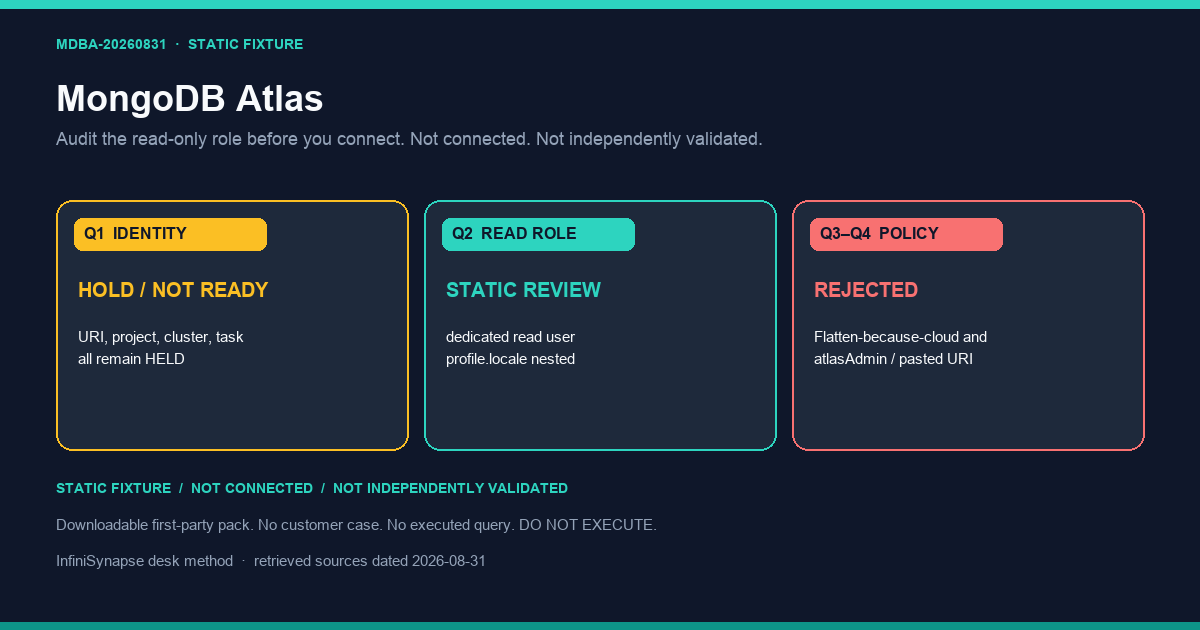
Table of Contents
- TL;DR
- What this audit checks
- What MongoDB Atlas is for an analyst
- Evidence Boundary
- A framework: hosted store, same read-only contract
- Methods: authorize Atlas versus flatten Atlas
- Tool landscape for a hosted document cluster
- Implementation steps you can audit
- Desk sample: Atlas users collection, still nested (illustrative)
- Scorecard: ready Atlas client versus hosted warehouse fantasy
- Practical Static Replay
- Sources and Limited Claims
- Failure modes that treat Atlas as a mart
- Frequently Asked Questions
- Conclusion
TL;DR
Direct answer: Audit MongoDB Atlas before you connect: name the project, use a dedicated read user, restrict the allow-list, keep the URI in the connector, and bind the nested note. Atlas Database Auditing, the activity log on M10 and larger clusters, is a separate feature. This static pack is still HOLD / NOT READY FOR CONNECTION: no URI, Atlas user, or task id was observed. Replay the authored read-only note and two policy rejects offline. The verifier proves file agreement only.
Hosting in the vendor cloud does not turn nested fields into warehouse columns. Flatten later if a second team needs a frozen table. Join Postgres only on a written shared key. This is not a customer study, SLA, or third-party audit.
What this audit checks
Audit MongoDB Atlas on five objects before an analyst client connects.
| Object | Pass | Fail |
|---|---|---|
| Project | The project and cluster are named | The client points at last year's sandbox |
| Role | A dedicated read user on the named databases | atlasAdmin, or the application user |
| Network | An allow-list and TLS | A URI that works from any IP |
| URI | Stored in the connector | Pasted into chat |
| Notes | Nested paths are bound | A flatten job because the cluster is in the cloud |
Atlas Database Auditing is a different product. On M10 and larger clusters, Atlas can record authentication, access, and DDL events. Filter setup and the log screen are in MongoDB's database auditing documentation (retrieved 2026-09-27). This page does not configure those filters. A cluster with auditing enabled and an atlasAdmin connection string is still not ready for an analyst client.
The parent method lives on MongoDB analytics. This page is narrower: the hosted cluster is still documents. Connect MongoDB to AI is the sibling for the first role. NoSQL data analysis is the sibling for asking those documents as stored.
What MongoDB Atlas is for an analyst
Key Definition: MongoDB Atlas is a hosted document cluster you authorize as a read-only source: collections stay nested, notes bind paths, and the analyst client does not flatten the project into a warehouse before the first question. Atlas is the network and billing surface. It is not a new grain.
Teams hear “managed cloud” and file a copy job. That is a category error. MongoDB Atlas still stores BSON documents the app writes. profile.locale is still nested. Arrays still explode if you unwind before the grain. The hosting brand does not invent columns. MongoDB’s Atlas database users page (retrieved 2026-09-04) describes the hosted user surface. It does not inspect this fixture.
What is a data agent is the client you add to the hosted cluster. Self-service analytics still applies: a product manager can ask a goal if the notes exist. Neither habit is a license to grant atlasAdmin to a chat window.
The Research Data Alliance (retrieved 2026-09-04) publishes independent work on sharing data without silently reshaping it. Treat MongoDB Atlas the same way: the payload stays in the producer’s shape until a documented consumer needs another shape. Hosting is not that consumer.
Hosting is not a flatten license
If the architecture slide says MongoDB Atlas and the next ticket is “export to the warehouse so BI can see it,” you skipped the first honest question. Ask the collection. File the mart if finance needs a frozen grain next quarter. Tuesday’s locale share does not wait on Atlas-to-warehouse plumbing.
AI for data analysis programs that already federate sources can add MongoDB Atlas as one authorized client. Federation is not ETL. It is a read with a trail.
The role is still the first control.
A hosted cluster makes secrets easier to paste and roles easier to over-grant. MongoDB Atlas database users still need read on named databases, not readWriteAnyDatabase. Network access still needs an allow-list. The connection string still lives in the connector, not in a prompt. Atlas does not weaken those rules. It makes them more visible because the URI looks “official.”
FORCE11’s community (retrieved 2026-09-04) work on research communication is an independent reminder that a citable object needs a stable identity and a reuse rule. Your Atlas project id is not a reuse rule. The bound note is.
Evidence Boundary
This is a synthetic, static, NON-CONNECTING identity fixture (MDBA-20260831). No Atlas URI, host, TLS path, project, cluster, database user, executed query, recalled passage, warehouse hop, or production workflow was observed.
The package does not claim that anyone minted a live read-only user, stored a URI, listed analyst egress, projected profile.locale, filed no flatten job, reused notes on a second run, or left a memo in draft. To operationalize the hosted store, each claim needs environment evidence.
Do not prove a negative privilege by writing to production Atlas. First review the role catalog and grant list. Any later negative test needs separate authorization. TLS is not optional because the path looks private.
This page has no customer case, no industry benchmark, and no independent institutional endorsement. The first-hand object is the authored pack you can download and lint offline.
A framework: hosted store, same read-only contract
Four objects decide whether the hosted cluster is safe to ask.
| Object | What you must know | Failure if missing | Fixture state |
|---|---|---|---|
| Project | Which Atlas project and cluster hold the collections | The agent points at a sandbox with last year’s keys | HELD |
| Role | Read named databases; cannot write or drop | A “fix it” prompt becomes a write | authored policy / HELD |
| Network | IP allow-list, TLS, where the URI is stored | The URI lands in a chat log | HELD |
| Notes | Id, nested paths, aliases, forbidden keys | The agent queries a ghost path on a hosted cluster | authored profile.locale |
Atlas user versus application user
Do not reuse the app’s Atlas user for analysis. The app writes. The analyst reads. MongoDB Atlas makes it easy to mint a second database user; use that. Name it for analysis. Scope it to the databases you will ask. If the first question is users, do not grant the whole project.
W3C RDF 1.1 concepts (retrieved 2026-09-04) describe statements with identity, not blobs you reshape on a whim. Collection notes are your statements: this path is locale, this path is leftover. Bind them to the MongoDB Atlas source so recall has something to retrieve.
Network allow-lists are part of the bind
A string that can reach the cluster from any IP is a wider incident when it leaks. Restrict the MongoDB Atlas network access list to the analyst egress you actually use. Confirm TLS. Rotate if anyone already pasted the URI into Slack. Data governance still owns who may see production documents, hosted or not.
Methods: authorize Atlas versus flatten Atlas
Two methods compete after the cluster moves to MongoDB Atlas.
| ID | Candidate | Outcome | Why |
|---|---|---|---|
MDBA-Q1-IDENTITY | uri, host, project, cluster, task | HOLD / NOT READY | all identity fields HELD |
MDBA-Q2-READONLY-NOTE | dedicated read plus profile.locale | QUALIFIED FOR STATIC REVIEW | policy text; DO NOT EXECUTE |
MDBA-Q3-FLATTEN-CLOUD | flatten because it is in the cloud | REJECTED AS UNSUPPORTED | hosting is not a warehouse |
MDBA-Q4-ADMIN-OR-PASTE | atlasAdmin or URI in chat | REJECTED AS UNSUPPORTED | over-grant and secret echo |
Authorize, bind, ask nested
Create the read-only Atlas user. Store the URI. Bind the collection note. Ask one grain-bounded goal. Open the task. Confirm the path. That method treats MongoDB Atlas as the same document store you already operate, with a managed control plane. MongoDB schema recall still names the money field. Hosting does not infer it. This pack did not run that ask.
The Library of Congress MODS (retrieved 2026-09-04) standard is an independent map for written descriptive records. Your Atlas UI is not that record. The note is. If the note is missing, MongoDB Atlas Search and Charts will not save the first analyst question from a ghost key.
Flatten the hosted cluster “because it is in the cloud”
Cloud location is not a warehouse. Copying MongoDB Atlas into a mart so SQL can see columns is a platform project. It can be correct later. It is the wrong first ticket. Analyze nested JSON in Mongo still applies: nested arrays need a grain before a group-by, on Atlas or on a VM.
OCLC research (retrieved 2026-09-04) publishes independent work on how libraries describe holdings without flattening every record into a single spreadsheet. Describe the collection. Do not wait for a copy job to make MongoDB Atlas “real.”
Optional Postgres remains a neighbor.
Identity in the hosted cluster and orders in PostgreSQL is a normal split. Join after each side aggregates to the same user_id. Mongo plus Postgres analysis is the page for that key. Do not dump Atlas collections into Postgres “so we only have one database.” That is flatten-first with extra cloud invoices.
Tool landscape for a hosted document cluster
Keep writes in the app that already talks to the hosted cluster. Keep analysis on a dedicated read-only user.
What hosting changes and what it does not.
Hosting changes backups, patching, and the URI format. It does not change grain, notes, or least privilege. What is data management still applies: ownership, retention, and field meaning. MongoDB Atlas is a place those controls attach, not a substitute for them.
Document database reporting can stay on the Atlas collection for ops packs. A hosted cluster is not a reason to stand up a second BI suite.
What InfiniSynapse does and does not do
InfiniSynapse connects MongoDB Atlas the same way it connects a self-hosted cluster: source, string in the connector, bound notes, one task. It can join a SQL neighbor. It is a professional AI data analyst, not NLP2SQL and not ChatBI. It does not auto-write Atlas documents. It does not invent a metric warehouse. It does not replace Atlas Search, Charts, or your warehouse program. Private installs can wait; the first proof is a web task on an authorized, sanitized Atlas database. That product surface is not evidence this pack connected. MongoDB Atlas in that product means: add the hosted source, bind the note, ask one nested goal, open the recall.
Implementation steps you can audit
These steps replay the identity pack offline. Skipping the user is how people treat the hosted cluster as a shared app credential.
- Open
identity-register-MDBA-20260831.csvand confirm every sensitive field isHELD. - Compare the accepted collection note as policy text. Do not execute. Review the role catalog; do not write to Atlas to prove a negative grant.
- Reconcile
identity-decision-register-MDBA-20260831.csv: Q3–Q4 rejected; Q1 held; Q2 static-only. No row is selected. - Read the assumption register and held-evidence list. Leave cluster facts unresolved. TLS stays required.
- Run
python3 verify-MDBA-20260831.pyfrom the downloads directory.
A passing local check does not authorize MongoDB Atlas as a live source. It reports file agreement among the authored downloads only.
For a later authorized review, collect owner approval, the project, the dedicated read grant, TLS evidence, the allow-list, the bound note, one nested-path goal, and—only after authorized execution—the opened recall. Until those exist, keep HOLD on MongoDB Atlas. If you cannot show the grant in the catalog, you are not ready to connect MongoDB Atlas to an analyst client.
The NIST AI Risk Management Framework (retrieved 2026-09-04) treats secret handling as a design requirement; hosting does not waive it. Semantic layer contracts can wait; “amountCents is money” does not.
Desk sample: Atlas users collection, still nested (illustrative)
Static fixture, not a customer uplift and not a latency SLA. Source: an authored MongoDB Atlas users note with nested profile.locale. Notes defined locale as profile.locale and marked email_raw as forbidden. Goal text: last-7-day new users by locale, users as the grain.
The lint register rejects flatten-because-cloud and rejects atlasAdmin or a pasted URI. MongoDB Atlas is static-ready where role policy, nested path, and forbidden keys are named, and held where identity is missing. No executed projection, no flatten ticket, and no second-run reuse is claimed.
| Evidence class | What you can cite | What you cannot claim |
|---|---|---|
| Static pack on this page | Role policy, notes, inspectable artifacts | Customer uplift %, minutes, filed warehouse job |
| Published authority (linked) | Frameworks and definitions from the cited sources | That those sources ran this fixture |
Labels stay illustrative, not a measured cluster result. Published context: Research Data Alliance, FORCE11, RDF 1.1 concepts, Library of Congress MODS, OCLC Research, NIST AI RMF, MongoDB Atlas users, retrieved 2026-09-04.
The phrase mongodb atlas is the object under test. If a file cannot show how mongodb atlas named the stored path and the dedicated role, reject the number.
Scorecard: ready Atlas client versus hosted warehouse fantasy
| Signal | Ready to ask MongoDB Atlas | Wait |
|---|---|---|
| Role | Dedicated read on named databases | App user or atlasAdmin |
| Secret | URI in the connector | URI in a prompt or ticket |
| Network | Allow-listed analyst egress | 0.0.0.0/0 “just for the demo” |
| Notes | Id, paths, aliases, forbidden keys | “Atlas will infer the schema” |
| Warehouse | Optional later consumer | Blocked on flatten-from-Atlas |
Stay on the hosted documents when the app still writes the nested field. Project when other systems need a frozen table. Both can exist. Starting with the project is how people never ask the hosted cluster.
Treat MongoDB Atlas as a control you can audit: user, URI location, network list, bound notes, first goal. If any of those five is missing, you are not ready.
Practical Static Replay
Replay MongoDB Atlas as a file comparison: freeze MDBA-20260831, confirm held identity fields, confirm the accepted note names profile.locale and a dedicated read user, confirm Q3–Q4 are policy rejects, then keep verifier output and hashes.
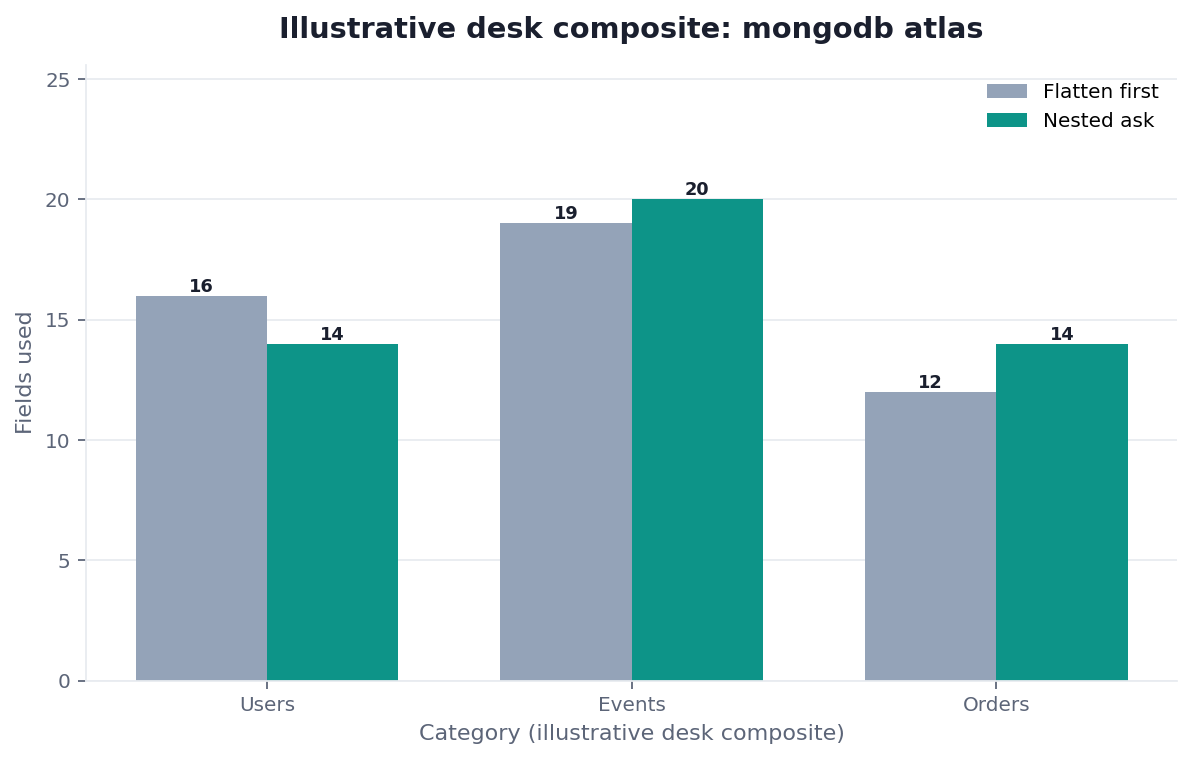
Figure. STATIC FIXTURE / NOT CONNECTED / NOT INDEPENDENTLY VALIDATED. Authored identity and policy labels only; no runtime or customer result.
Passing this replay means the MDBA files agree. It does not prove reachability or production suitability. Record Python version, OS, hashes, and HOLD output. Record freeze date beside HOLD.
Sources and Limited Claims
Direct official sources were retrieved on 2026-08-31, and the database auditing page on 2026-09-27. Research Data Alliance, FORCE11, W3C RDF 1.1 concepts, Library of Congress MODS, OCLC Research, NIST AI RMF, MongoDB Atlas database users, and MongoDB Atlas database auditing are cited here. They describe sharing without silent reshape, stable identity, written records, secret handling, and the hosted user surface. They do not validate this fixture. Re-check those URLs later.
None audited MongoDB Atlas on this page. Some hosts may be retained without a fresh 200; keep the original URLs.
Internal review is not independent validation. A qualified reviewer would need owner approval, live URI and TLS evidence, the role catalog, the bound note, one authorized nested statement, and versions. Until then this pack is not a third-party audit, certification, award, media mention, or customer case. GitHub profiles are public engineering traces, not a published resume or independent endorsement. If a reviewer only reran Python, say so.
How to cite. InfiniSynapse, Audit MongoDB Atlas Before You Connect, MDBA-20260831, HOLD / NOT READY FOR CONNECTION, not independently validated. Name the downloaded files used.
Downloads:
- Identity register
- Accepted collection note
- Decision register
- Expected readiness
- Review rules
- Held evidence
- Assumptions
- Source check
- Reproduction protocol
- Verifier
Failure modes that treat Atlas as a mart
Hosted clusters punish the same habits as self-hosted ones, plus URI paste. This pack did not run a live ask. A missing role or note is how MongoDB Atlas gets treated as a mart.
Granting atlasAdmin because “it is just analytics”
MongoDB Atlas roles that can write or manage the project are production clients. The agent does not need to create indexes to answer a locale share. Temp artifacts belong in the task workspace. Reject tasks that ask to “fix the collection in Atlas.”
Flattening Atlas first because it is in the cloud
Cloud is not a columnar warehouse. Copying MongoDB Atlas into a mart delays the first honest question and still needs notes. Ask nested. File the mart if a second team needs it.
Pasting the Atlas URI into chat
If the string is in the prompt, it is in the log. Rotate. Move it to the connector. Treat the paste as an incident even if the cluster is a sandbox. You cannot connect MongoDB Atlas safely with a secret the model can echo.
Before you connect, list the Atlas project, the database user, the allow-list, the collection paths, and the SQL neighbor if any. If you cannot fill that list, you are not ready. If you can, bind the notes and ask one grain-bounded question on MongoDB Atlas.
Route the same diagnosis to the live guide that owns the next object.
| Live guide | Open it when |
|---|---|
| MongoDB analytics | you need the parent document method |
| Connect MongoDB to AI | the first control is the read-only role |
| NoSQL data analysis | the document is being asked as rows |
| Mongo plus Postgres analysis | the next object is a shared key |
Connect Atlas read-only and bind collection notes
Add a read-only MongoDB Atlas source, store the URI in the connector, bind the collection note, and ask one nested-field question you can inspect. This check uses only sources you authorize.
Commercial association: You do not need the workspace to complete the educational diagnosis on this page.
Open InfiniSynapseHow this page is sourced. William Zhu is cofounder of InfiniSynapse (GitHub @allwefantasy); InfiniSynapse on GitHub. Company self-description, not independent authority. No personal LinkedIn is published. Desk experience: designing and reviewing analysis-pack methods—definition locks, read-only source binds, and downloadable
/tasksartifacts. Reviewed internally by analytics engineering · data platform · LLM security · editor. Editorial standards · corrections · publishing principles · About · Privacy · Terms · Contact zhuhl@infinisynapse.com. Company About. COI: InfiniSynapse sells an AI-native Data Agent; the banner is a commercial association. Fact-check: rd-alliance.org · FORCE11 · w3.org · loc.gov · oclc.org · nist.gov · mongodb.com. No external organization audited it. This page is not third-party recognition.
Frequently Asked Questions
Is Atlas Database Auditing the same check?
Bottom line: No. Database Auditing records cluster activity on M10 and larger clusters. This page checks whether an analyst connection is read-only. A log trail does not replace the read user, the allow-list, or the nested note.
Does MongoDB Atlas replace a warehouse?
Bottom line: No. MongoDB Atlas hosts documents. A warehouse is a later consumer of a frozen grain. Ask the collection first.
Do I still need a read-only user on MongoDB Atlas?
Bottom line: Yes. Hosting does not make write access safe. MongoDB Atlas analysis starts with a dedicated read user, not the app user.
Can I join Postgres to MongoDB Atlas the same day?
Bottom line: Yes on a stable id, after each side aggregates. The join does not require flattening MongoDB Atlas into Postgres.
Is Atlas Search enough instead of collection notes?
Bottom line: Search finds documents. Notes name meaning. MongoDB Atlas without bound notes still guesses locale on a profile.locale collection.
Conclusion
MongoDB Atlas is a hosted document store with a read-only role, a URI that never enters the prompt, and notes that name nested paths. Hosting is not a flatten license. Ask one goal. Inspect recall. Join Postgres only on a written key.
InfiniSynapse describes itself on About. Privacy and Terms apply. If you later use the workspace, open InfiniSynapse only with authorized, sanitized inputs.