Document Database Reporting: Audit the Ops Grain First
By William Zhu & the InfiniSynapse Data Team · Published: 2026-08-22 · Last updated: 2026-08-31 · Last verified: 2026-08-31 · Next review: 2026-11-30 · Editorial standards · Corrections
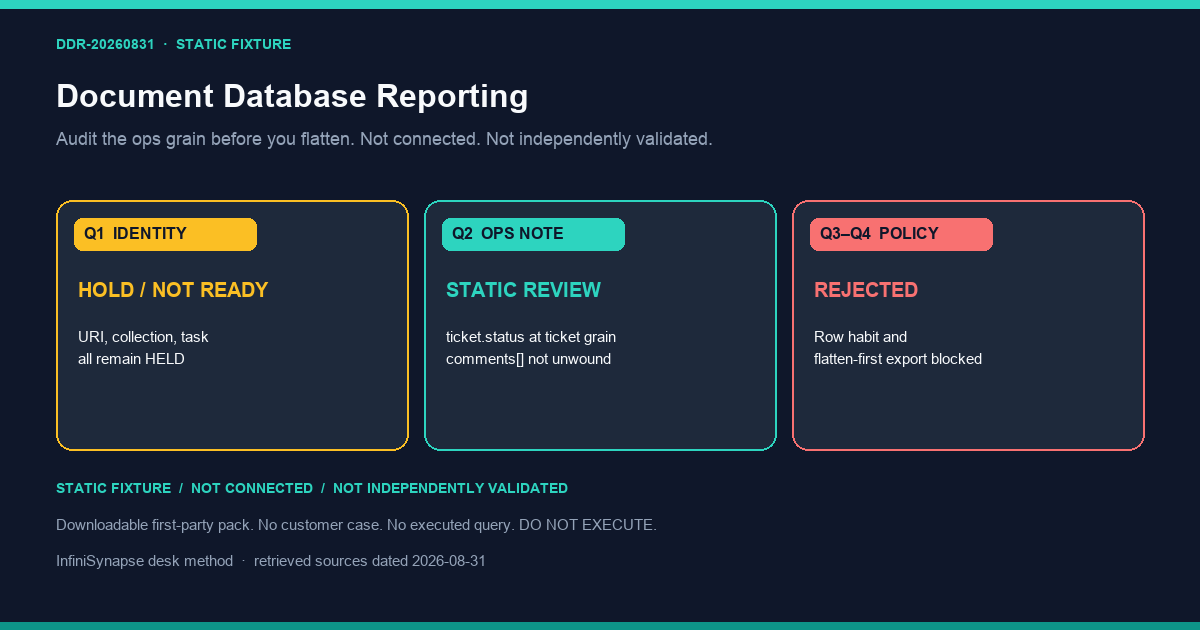
Table of Contents
- TL;DR
- What document database reporting means for ops
- Evidence Boundary
- A framework: the report stays on the collection
- Methods: stay-on-collection versus flatten-first
- Tool landscape for document-shaped ops
- Implementation steps you can audit
- Desk sample: weekly ops status on tickets (illustrative)
- Scorecard: collection report versus a flatten project
- Practical Static Replay
- Sources and Limited Claims
- Failure modes that break document database reporting
- Frequently Asked Questions
- Conclusion
TL;DR
Direct answer: Document database reporting is an ops pack that stays on the Mongo collection you already write. This static pack is HOLD / NOT READY FOR CONNECTION: no URI, executed query, or task id was observed. Replay the authored
ticket.statusnote and two policy rejects offline. The verifier proves file agreement only.
Flattening into a warehouse is optional later. It is not the ticket that unblocks Tuesday’s queue report. This is not a customer study, SLA, or third-party audit.
The parent method lives on MongoDB analytics. The first control is still connect MongoDB to AI. Asking the document the way it is stored continues in NoSQL data analysis. This page is the ops report that does not wait on a mart.
What document database reporting means for ops
Key Definition: Document database reporting means producing an operations pack—counts, statuses, exceptions—from a document collection with bound notes and a stated grain, without flattening that collection into a warehouse first. The document store remains the system of record. An optional Postgres join is a later task, not a prerequisite.
Operations already live in documents: tickets, devices, sessions, checkout states. MongoDB documentation (retrieved 2026-09-04) is the independent contract for collections, aggregation, and nested fields. Document database reporting uses that shape. It does not pretend every ticket is a rectangular row before the first Monday pack.
A knowledge base (retrieved 2026-09-04) in the independent sense is a store of claims you can retrieve. Collection notes are that object bound to the source: which field is status, which array is comments, which id is the ticket. Document database reporting without those notes is a fluent guess.
What is a data agent is the identity of the client: plan, recall, artifact. A ChatBI box that exports JSON to a sheet is not document database reporting. The collection still holds the truth. The task still holds the pack.
Evidence Boundary
This is a synthetic, static, NON-CONNECTING identity fixture (DDR-20260831). No MongoDB URI, host, TLS path, database, user, executed query, recalled passage, warehouse hop, or production workflow was observed.
The package does not claim that anyone aggregated a live ticket grain, wrote a memo, filed no warehouse job, reused notes the next week, or left a backlog item on the roadmap. To operationalize document database reporting, each claim needs environment evidence.
Do not prove a negative privilege by writing to production Mongo. First review the role catalog. Any later negative test needs separate authorization. TLS is not optional because the path looks private.
This page has no customer case, no quantified queue reduction, and no independent institutional endorsement. The first-hand object for document database reporting is the authored pack you can download and lint offline. Do not treat this download as a measured operations result or a customer post-mortem from an on-call week.
A framework: the report stays on the collection
Four objects decide whether the ops pack is safe.
| Object | What you must know | Failure if missing | Fixture state |
|---|---|---|---|
| Collection | The ops documents you already write | A shadow export becomes “the report” | authored tickets |
| Grain | Ticket, device, or account—one noun | Unwound comments multiply open tickets | authored ticket |
| Notes | Status path, id, forbidden arrays | The agent guesses ticket.state | authored ticket.status |
| Role | Read-only on the collection | A prompt “fixes” a production document | HELD |
Ops grain versus a warehouse book
An ops grain is what the on-call needs this week: open tickets by status, devices failing health, carts stuck in pending. A warehouse book is what finance certifies on a close calendar. Wikipedia’s data warehouse (retrieved 2026-09-04) overview is the independent map for that second object. Document database reporting is the first object. Do not delay the queue pack until the mart exists.
Self-service analytics still applies: an operator can ask a dated goal. The grain note is what keeps that ask from becoming a row explosion.
Notes that name the nested path
Write the sentence: status is ticket.status, id is ticket_id, do not unwind comments[] when counting open tickets. Bind it to the Mongo source. Document database reporting depends on that bind. If locale or owner lives under assignee.profile, say so. Do not hope the model remembers a Slack thread.
IANA’s public registries (retrieved 2026-09-04) are a reminder that published identifiers are meant to be cited. Field paths in your collection are not public identifiers until you write them in notes. Publish the path to the agent. Do not publish secrets.
Methods: stay-on-collection versus flatten-first
Two methods compete. The expensive one copies Mongo into a warehouse and waits on a model review.
| ID | Candidate | Outcome | Why |
|---|---|---|---|
DDR-Q1-IDENTITY | uri, host, collection, task | HOLD / NOT READY | all identity fields HELD |
DDR-Q2-OPS-NOTE | ticket.status at ticket grain | QUALIFIED FOR STATIC REVIEW | policy text; DO NOT EXECUTE |
DDR-Q3-ROW-HABIT | treat every document as a sheet row | REJECTED AS UNSUPPORTED | JSON-to-sheet is a stale copy |
DDR-Q4-FLATTEN-FIRST | export the collection to start the report | REJECTED AS UNSUPPORTED | ops pack stays on the collection |
One ops pack on the live collection
Authorize read-only. Bind notes. Ask “last-7-day open tickets by status, ticket as the grain.” The agent aggregates, writes a memo, and leaves recall in the trail. That is document database reporting without a mart. Chat with your data is the habit; the store is still a document cluster. This pack did not run that ask.
If orders live in Postgres and identity lives in Mongo, that is a later join on one key—not a reason to flatten the ops collection before Tuesday’s pack. Mongo plus Postgres Analysis in One Task owns that key.
When a warehouse copy still wins
Flatten when many teams will join the same grain blindly, or when finance needs a frozen snapshot. Until those consumers exist, a flatten is a moving target. Document database reporting keeps that ticket on the platform roadmap and still answers the on-call.
The Databricks Genie data agents (retrieved 2026-09-04) post is one vendor’s warehouse-agent framing. This page is collection-first ops. Use a lakehouse when you already have that program. Do not start document database reporting by copying tickets “so SQL can see them.”
Tool landscape for document-shaped ops
Two systems can appear. Only one is required for the first pack.
Document stores and optional SQL neighbors
Keep ticket writes in Mongo. Keep an optional Postgres neighbor for orders or accounts if a later join needs it. Analyze a database without ETL is the no-migration habit for each side. Document database reporting is that habit on the collection that already holds ops state.
InfiniSynapse connects MongoDB, binds collection notes, and writes a Markdown pack plus charts into the task workspace. It does not auto-write the collection. It does not replace a warehouse program. Private installs can wait; this page’s check still starts on the web so recall is visible. That product surface is not evidence this pack connected.
Agents that bind notes and leave a pack
If the product cannot show which path it used for status, you do not have document database reporting. You have a paragraph. Data governance still decides who may read the collection. The agent consumes that role. It does not invent a second writer.
A generic dashboard can display the pack. The system of record stays the collection. Do not let the chart become a third copy of status.
Implementation steps you can audit
These steps replay the identity pack offline. Skip notes and the pack will invent a path.
- Open
identity-register-DDR-20260831.csvand confirm every sensitive field isHELD. - Compare the accepted collection note as policy text. Do not execute. Name the grain, the status path, and the forbidden unwind.
- Reconcile
identity-decision-register-DDR-20260831.csv: Q3–Q4 rejected; Q1 held; Q2 static-only. No row is selected. - Read the assumption register and held-evidence list. Leave cluster facts unresolved.
- Run
python3 verify-DDR-20260831.pyfrom the downloads directory.
A passing local check does not authorize document database reporting as a live pack. It reports file agreement among the authored downloads only.
If you cannot name the status path, you are not ready for document database reporting. For a later authorized review, collect owner approval, the URI, TLS evidence, the dedicated read grant, the bound note, one dated ops goal, and—only after authorized execution—the opened recall. Until those exist, keep HOLD.
When the next failure is a nested array that must be counted at element grain, use analyze nested JSON in Mongo. When identity must join orders, that is a shared-key task—not a flatten of the ops collection. MongoDB Schema Recall from Bound Notes still names money when the next object is finance, not ops status.
Desk sample: weekly ops status on tickets (illustrative)
Static fixture, not a customer uplift and not a latency SLA. Source: an authored tickets note with nested ticket.status and a comments[] array. Notes defined status as ticket.status and forbade unwinding comments when counting open tickets. Goal text: last-7-day open tickets by status, ticket as the grain.
The lint register rejects a spreadsheet-row habit and rejects exporting the collection to start the report. Document database reporting is static-ready where grain, status path, and forbidden unwind are named, and held where identity is missing. No executed aggregate, no posted memo, and no second-run reuse is claimed.
MongoDB’s $unwind operator (retrieved 2026-09-04) documents how an array becomes many documents. That page does not run this fixture. It is the independent map for the class of error the note forbids.
| Evidence class | What you can cite | What you cannot claim |
|---|---|---|
| Static pack on this page | Grain, notes, inspectable artifacts | Customer uplift %, queue minutes, vendor bake-off |
| Published authority (linked) | Frameworks and definitions from the cited sources | That those sources ran this fixture |
Labels stay illustrative, not a measured cluster result. Published context: Wikipedia data warehouse, Wikipedia knowledge base, MongoDB docs, Databricks Genie, IANA, retrieved 2026-09-04.
The phrase document database reporting is the object under test. If a file cannot show how document database reporting named the ticket grain, reject the number.
Scorecard: collection report versus a flatten project
| Signal | Document database reporting | Flatten-to-warehouse first |
|---|---|---|
| Consumer | Ops, this week | Many teams, certified metrics |
| Shape | Nested status still written by the app | Frozen columns others join blindly |
| Notes | Bound to the collection | A model review replaces notes |
| Join | Optional later, one key | Required before the first pack |
| Risk | Read-only role and grain hold | Downstream SLAs on a table |
Stay on the collection when notes can keep up and one grain is honest. Project when other systems need a frozen table. Both can exist. Starting with the mart is how document database reporting never ships.
Practical Static Replay
Replay document database reporting as a file comparison: freeze DDR-20260831, confirm held identity fields, confirm the accepted note names ticket.status and forbids unwinding comments[], confirm Q3–Q4 are policy rejects, then keep verifier output and hashes.
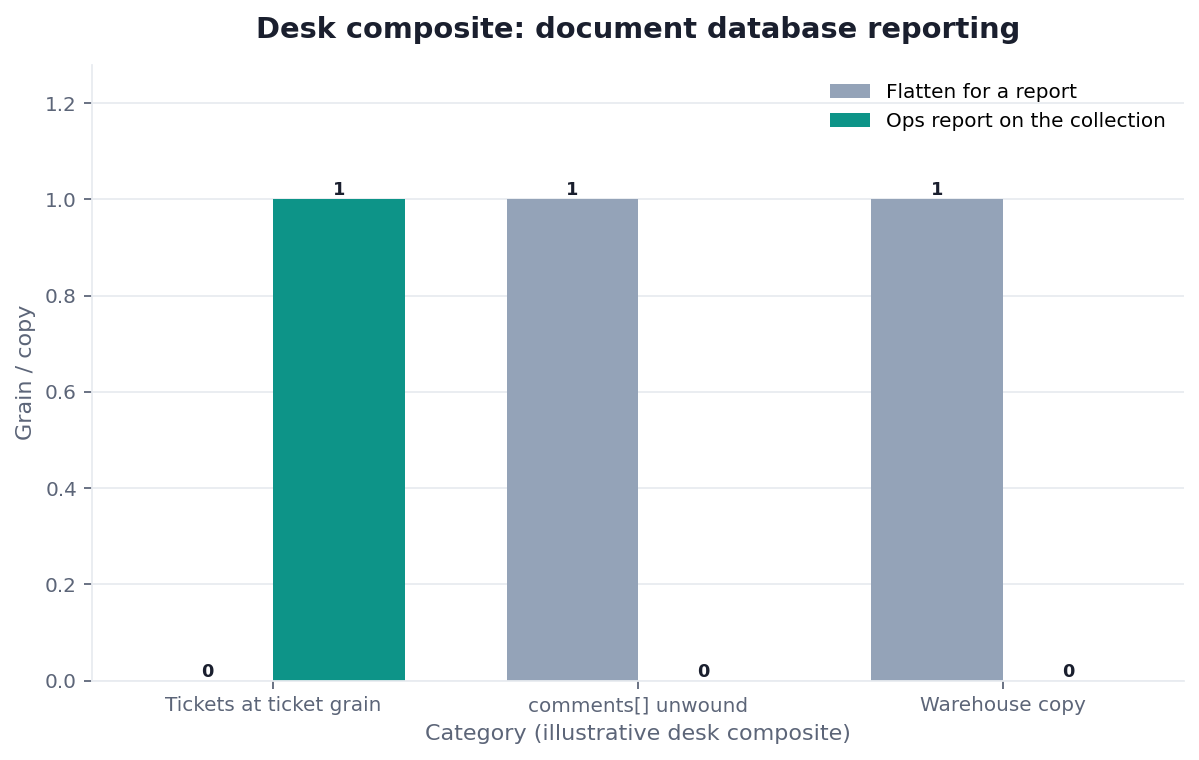
Figure. STATIC FIXTURE / NOT CONNECTED / NOT INDEPENDENTLY VALIDATED. Authored identity and policy labels only; no runtime or customer result.
Passing this replay means the DDR files agree. It does not prove reachability or production suitability. Record Python version, OS, file hashes, and the exact HOLD output. Record the freeze date beside the HOLD line.
Sources and Limited Claims
Direct official sources were retrieved on 2026-08-31. MongoDB documentation, Wikipedia knowledge base, Wikipedia data warehouse, IANA, Databricks Genie, and MongoDB $unwind are cited here. They describe collections, retrievable claims, warehouse books, published identifiers, warehouse-agent framing, and array explosion. They do not validate this fixture. Re-check those URLs later.
None audited document database reporting on this page. Some hosts may be retained without a fresh 200; keep the original URLs.
Internal review is not independent validation. A qualified reviewer would need owner approval, live URI and TLS evidence, the bound note, one authorized ops statement, and versions. Until then this pack is not a third-party audit, certification, award, media mention, or customer case. GitHub profiles are public engineering traces, not a published resume or independent endorsement. If a reviewer only reran Python, say so.
How to cite. InfiniSynapse, Document Database Reporting: Audit the Ops Grain First, DDR-20260831, HOLD / NOT READY FOR CONNECTION, not independently validated. Name the downloaded files used.
Downloads:
- Identity register
- Accepted collection note
- Decision register
- Expected readiness
- Review rules
- Held evidence
- Assumptions
- Source check
- Reproduction protocol
- Verifier
Failure modes that break document database reporting
Ops packs punish row habits and file habits. This pack did not run a live ask. A missing grain is how document database reporting breaks.
Treating every document as a spreadsheet row
If you treat document database reporting as exporting JSON to a sheet, you lose arrays and you freeze a copy. Ask the collection. Bind the path.
Unwinding arrays before the ops grain
$unwind comments, then count tickets, multiplies the queue. Aggregate to the parent id first. Write the forbid in the notes.
Exporting the collection to start the report
A CSV or warehouse dump is a stale third copy. Document database reporting uses the authorized live collection. If the task does not show recall, do not send the memo.
Before you brief, list the collection, the grain, the status path, and the forbidden unwind. If you cannot fill that list, you are not ready. If you can, bind it and ask one dated ops question.
Route the same diagnosis to the live guide that owns the next object.
| Live guide | Open it when |
|---|---|
| MongoDB analytics | you need the parent document method |
| Connect MongoDB to AI | the first control is the read-only role |
| NoSQL data analysis | the document is being asked as rows |
| Analyze nested JSON in Mongo | the next failure is an unwound array |
| Mongo plus Postgres Analysis in One Task | Users in Mongo and orders in Postgres can share a key |
| MongoDB Schema Recall from Bound Notes | Collection notes tell the agent which field is money |
Ask the ops report on the Mongo collection
Add a read-only Mongo source, bind the collection note that names status and grain, and ask one dated ops question you can inspect in the task. This check uses only sources you authorize.
Commercial association: You do not need the workspace to complete the educational diagnosis on this page.
Open InfiniSynapseHow this page is sourced. William Zhu is cofounder of InfiniSynapse (GitHub @allwefantasy); InfiniSynapse on GitHub. Company self-description, not independent authority. No personal LinkedIn is published. Desk experience: designing and reviewing analysis-pack methods—definition locks, read-only source binds, and downloadable
/tasksartifacts. Reviewed internally by analytics engineering · data platform · LLM security · editor. Editorial standards · corrections · publishing principles · About · Privacy · Terms · Contact zhuhl@infinisynapse.com. Company About. COI: InfiniSynapse sells an AI-native Data Agent; the banner is a commercial association. Fact-check: mongodb.com · wikipedia.org · iana.org · databricks.com. No external organization audited it. This page is not third-party recognition.
Frequently Asked Questions
Do I have to warehouse Mongo before document database reporting?
Bottom line: No. Flatten when many teams need a frozen grain. For the weekly ops pack, document database reporting authorizes the collection, binds notes, and asks.
Can document database reporting join Postgres in the same task?
Bottom line: Yes, later, on one documented key after each side aggregates. It is optional. Do not delay the collection report for that join.
What grain should an ops pack use?
Bottom line: One noun the on-call already uses—ticket, device, or account. Document database reporting fails when comments or devices are unwound first.
Is a CSV export a valid document database reporting method?
Bottom line: No. A CSV is a stale file. Document database reporting uses the authorized live collection and inspectable recall.
Conclusion
Document database reporting is an ops pack on the collection you already write. Bind notes. State the grain. Ask a dated goal. Inspect recall. Keep documents nested until a warehouse consumer actually exists.
InfiniSynapse describes itself on About. Privacy and Terms apply. If you later use the workspace, open InfiniSynapse only with authorized, sanitized inputs.