Embedding Agent: Audit the Host Goal First
By William Zhu & the InfiniSynapse Data Team · Published: 2026-08-22 · Last updated: 2026-08-31 · Last verified: 2026-08-31 · Next review: 2026-11-30 · Editorial standards · Corrections
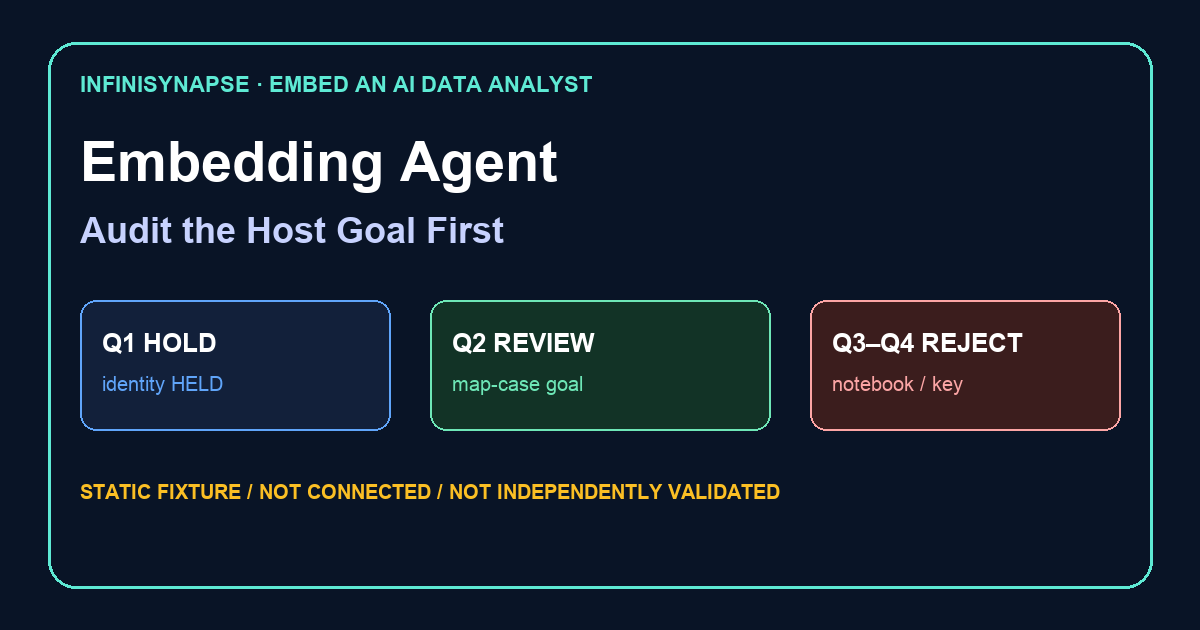
Table of Contents
- TL;DR
- What an embedding agent is in a product
- Evidence Boundary
- A framework: host goal, same id
- Methods: product embed versus vector tutorial
- Tool landscape around a host-app agent
- Implementation steps you can audit
- Desk sample: a map case that needed a task (illustrative)
- Scorecard: embedding agent versus a vector demo
- Practical Static Replay
- Sources and Limited Claims
- Failure modes that fake an embedding agent
- Frequently Asked Questions
- Conclusion
TL;DR
Direct answer: An embedding agent is a long task in the host app. This static pack is HOLD / NOT READY FOR CONNECTION: no API key, task id, or host call was observed. Replay the authored map-case goal and two policy rejects offline. The verifier proves file agreement only.
Your product captures a dated goal. Your backend starts the job. /tasks is the same id. This page is a product embed, not a vector-database tutorial. Keys stay on the server. This is not a customer integration, latency SLA, award, or third-party endorsement.
What you'll learn:
- What an embedding agent places in a product you already ship
- A host-goal frame: noun in the app, trail in
/tasks - Why a vector tutorial is the wrong article for this keyword
- Steps: write the host goal, inspect the authored reject rules
- A static map-case identity fixture
- A scorecard and failure modes: vector notebooks, published keys, dual timelines
The hub for embedding an AI data analyst is the product picture. The wire is the data agent API. Duration is the long-task agent layer. This page is the disambiguation: an embedding agent here is the analyst sitting in your app, not a lesson on dense vectors.
What an embedding agent is in a product
Key Definition: An embedding agent in this pillar is a professional data analyst you place in a host app: the UI captures a goal, a backend starts a cancelable long task on authorized sources, and a reviewer opens the same
/tasksid. It is not a vector-index tutorial and not an iframe of a notebook.
Searchers who type “embedding agent” often expect chunking, cosine similarity, and a new store. That is a different discipline. An embedding agent you can ship in a product is a long task for the case already on the screen. The product does not become a vector warehouse. It starts a job for a noun you already store.
What is a data agent already separated a professional analyst from a chat toy. An embedding agent is that analyst behind a control you already own. The host UI is a door. The trail is the record.
W3C ActivityPub (retrieved 2026-09-04) is the independent map for actors that live in a host and exchange activities with identifiers. Treat the embedding agent the same way: an actor in your product that starts an activity with an id, not a silent model call.
If the missing object is the host screen, continue in analyze inside your app. If the slot sits in an ops screen you already ship, the sibling picture is an embedded workflow slot.
Readers who arrived here from a vector search should stop at this paragraph. This page will not teach chunk size, cosine distance, or how to stand up a new collection. Those topics can exist in another stack. The product question is whether the case already on the screen becomes a cancelable job with a /tasks id. If your ticket is “build an index,” close this article. If your ticket is “explain this case in the app we ship,” keep reading.
Evidence Boundary
This is a synthetic, static, NON-CONNECTING identity fixture (EMAG-20260831). No API key, host URI, task id, executed SQL, warehouse hop, or production workflow was observed.
The package does not claim that anyone ran a live /tasks goal, opened SQL that matched a region filter, posted a memo, or reused a bound definition a second week. To operationalize an embedding agent, each claim needs environment evidence.
Do not prove a negative privilege by writing to a production host. First review the key store and the role catalog. Any later negative test needs separate authorization. TLS is not optional because the path looks private.
This page has no customer case, no measured SLA, no media mention, no award, and no independent institutional endorsement. The first-hand object is the authored pack you can download and lint offline. The company About page is a self-description, not third-party recognition.
A framework: host goal, same id
Three objects stay distinct when you ship an embedding agent. Collapsing them is how a product embed becomes a science project.
| Object | Owns | Must not own | Fixture state |
|---|---|---|---|
| Host app | The case, the goal, visible status | The API key, a new vector store | HELD |
| Your backend | Create call, secret store | A cached paragraph as the audit | not executed |
| /tasks | Plan, SQL, files, key mint | A public README snippet | policy text only |
The host owns the noun
The host already knows the case id, the map extent, and the tenant. An embedding agent that asks the operator to paste those fields into a notebook has failed the embed. Pass identifiers. Do not pass a connection string. Chat with your data is the habit; the door is your product.
RFC 6902 (retrieved 2026-09-04) is the independent JSON Patch map: send a small, named change, not a new document. The host payload for an embedding agent should look like that—goal family plus case ids—not a dump of the whole tenant.
The console owns the trail
The host shows started, running, ready, or failed. The plan, SQL, and files live in /tasks. An embedding agent that caches only a paragraph will lose the join after the first retry. Data governance still decides who may start the slot. The console is where a human can revoke the key.
IANA’s HTTP status code registry (retrieved 2026-09-04) is the independent list for the create-and-status wire. An embedding agent that invents private codes the host cannot explain will fail support.
Methods: product embed versus vector tutorial
Two search intents share a phrase. Only one belongs on this page.
| ID | Candidate | Outcome | Why |
|---|---|---|---|
EMAG-Q1-IDENTITY | api key, task id, host URI | HOLD / NOT READY | all identity fields HELD |
EMAG-Q2-MAP-GOAL | map-case slot + four host fields | QUALIFIED FOR STATIC REVIEW | policy text; DO NOT EXECUTE |
EMAG-Q3-NOTEBOOK | vector notebook sold as the embed | REJECTED AS UNSUPPORTED | a lab is not a host job |
EMAG-Q4-PAGE-KEY | key in the host page | REJECTED AS UNSUPPORTED | obfuscation is not a control |
Wire one goal to /tasks
Pick one screen. Pick one dated goal family: “explain last-week incident density for this region id on the authorized replica.” Prove it in /tasks. Then place the control. The backend creates the job. The screen shows the id. That is an embedding agent. Dashboard tiles can later show a downloaded artifact. They are not the agent.
The Open Geospatial Consortium’s GeoSPARQL standard (retrieved 2026-09-04) is independent context for asking a store you already run. An embedding agent queries authorized sources. It does not require you to stand up a new vector index first.
Why this page is not a vector guide
A vector tutorial teaches embeddings as numbers: chunk size, distance, a new collection. That work can exist elsewhere in a stack. It is not the product embed this pillar ships. If your roadmap item is “add RAG over PDFs,” say so and bind a knowledge base to a source. If your roadmap item is “explain this case in the app we already have,” you want a long task with an id.
PostGIS documentation (retrieved 2026-09-04) stands in for a spatial store you may already operate. An embedding agent can read that store read-only. It does not replace it with a vector database, and this page will not walk you through index build parameters.
Do not invent a preset metric warehouse. Do not write production rows. Do not publish keys. Those remain product facts whether or not someone expected a cosine-similarity lesson.
Tool landscape around a host-app agent
Host UI, backend, console. Optional private deploy later.
Small payloads, public status
Keep login in the host. Keep the analysis key in a secret manager. Validate the noun the slot sends—region id, not a free SQL string. An embedding agent is a parameterized goal, not an open query box. Self-service analytics still applies for the operator.
InfiniSynapse’s educational path is: prove the goal on the web, then place the slot, then call the same job. That product surface is not evidence this pack connected. Private deployment and desktop exist; this page’s check still starts on /tasks so the trail is visible.
Sources you already run
If the vendor’s pitch is a notebook that builds a vector index and /tasks never lists the click, you do not have a product embed. You have a tutorial. What is data management still owns the sources the slot may read. The slot does not become a second store.
Keep the host payload small on purpose. Send the case id, the date window, the timezone, and the goal family you already proved. Do not send a dump of every document in the tenant “so the model can embed it.” That dump is how a product embed turns into an unofficial index build, and how secrets leak into a lab the security team never approved.
When the partner must be created without emailing a secret, use partner silent provisioning. When both doors must share a timeline, use same task in web and api.
Implementation steps you can audit
These steps replay the identity pack offline. Skip the authored host goal and the notebook will look cheaper.
- Write the one goal family the host screen will send, including noun, date window, timezone, and source.
- Compare the accepted host note as policy text. Do not execute. Confirm steps, SQL, and files are named as required artifacts, not as a live run.
- Confirm the authored rule rejects a vector notebook sold as the embed and rejects a key in the host page.
- Open
identity-register-EMAG-20260831.csvand confirm every sensitive field isHELD. - Run
python3 verify-EMAG-20260831.pyfrom the downloads directory.
A passing local check does not authorize an embedding agent on any host. It reports deterministic file agreement among the authored downloads only.
The host record can stay four fields: tenant, requester, task id, status. Resist copying the memo into your primary database. The workspace is the file cabinet. Your database is the pointer. Until an authorized console proof exists, keep HOLD.
Desk sample: a map case that needed a task (illustrative)
Static fixture, not a customer count and not a latency SLA. Host note: a field-ops map case the operator already had open. Goal family text: “explain last-week incident density for this region id on the authorized replica.”
The lint register rejects a vector-notebook sidebar and rejects a host-page key. An embedding agent is static-ready where the region noun and four host fields are named, and held where they are not.
| Evidence class | What you can cite | What you cannot claim |
|---|---|---|
| Static pack on this page | Slot, id contract, inspectable artifacts | Customer uplift %, opened SQL, posted memo |
| Published authority (linked) | Protocol and source definitions from the cited sources | That those sources ran this fixture |
Labels stay illustrative, not a measured product result. Published context: ActivityPub, RFC 6902, IANA status codes, GeoSPARQL, PostGIS docs, retrieved 2026-09-04.
The phrase embedding agent is the object under test. If a file cannot show how an embedding agent named the region id already on the case, reject the number.
Scorecard: embedding agent versus a vector demo
| Signal | Embedding agent in the host | Vector tutorial |
|---|---|---|
| Object | Long task for this case | A new index and a notebook |
| Audit | /tasks trail | A local experiment |
| Key | Server store | Often in the notebook |
| Source | Authorized store you already run | A new vector collection |
| SQL | Opened before the brief | Often none |
If a pitch cannot show the last click as a task in /tasks, score it as a tutorial. The listing is the evidence, not the cosine demo.
A buying conversation can still mention private deployment or a desktop client. The educational check on this page does not. Prove the dated host goal on the web console first, then place the control, then create the same job from a staging server. If that sequence fails, a new vector collection will not invent a trail.
Practical Static Replay
Replay an embedding agent as a file comparison: freeze EMAG-20260831, confirm held identity fields, confirm the accepted note names the map-case goal family and four host fields, confirm Q3–Q4 are policy rejects, then keep verifier output and hashes.
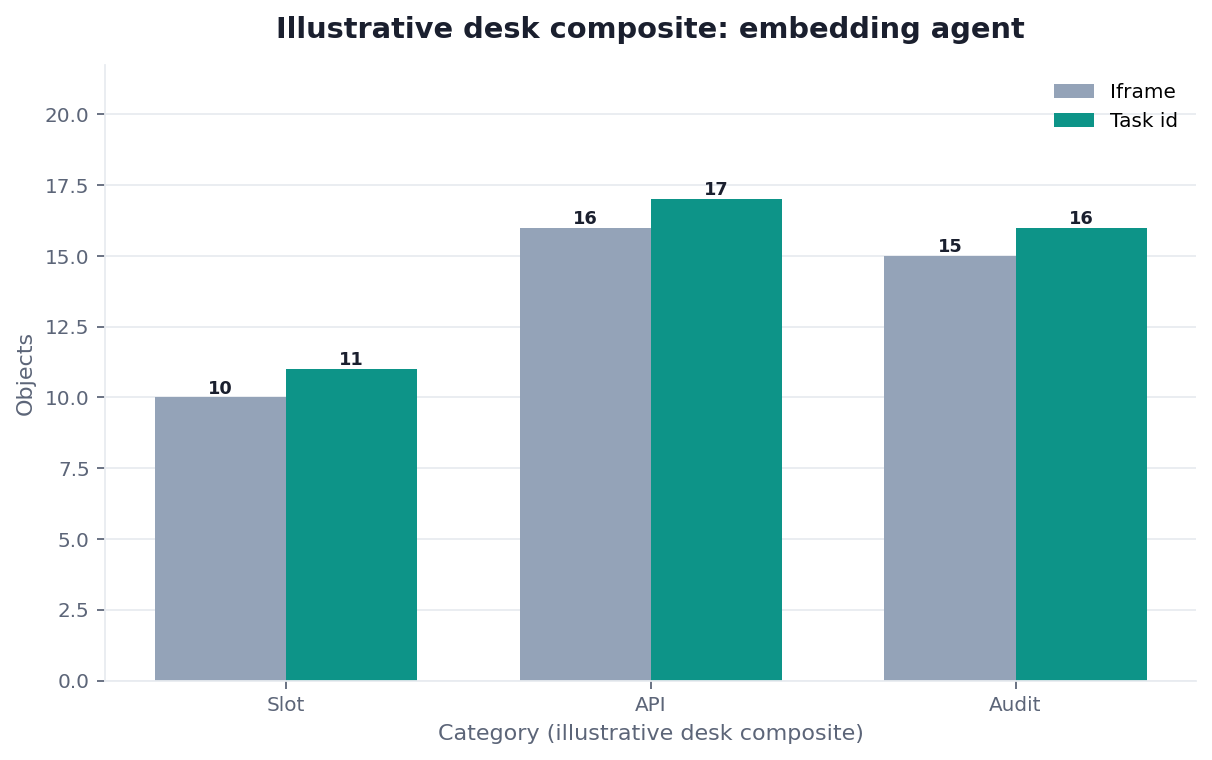
Figure. STATIC FIXTURE / NOT CONNECTED / NOT INDEPENDENTLY VALIDATED. Authored identity and policy labels only; no runtime or customer result.
Passing this replay means the EMAG files agree. It does not prove reachability or production suitability. Record Python version, OS, file hashes, and HOLD output. Record the freeze date beside the HOLD line. Keep that disclaimer on every copied identity file. Record the reviewer name, the freeze date, the Python version, and the exact HOLD line beside the downloaded hashes so a later owner can see this was file agreement only and not a live product bind. Write the OS name next to those hashes and keep one extra paper copy of that written disclaimer nearby for a later file owner review today as well as also noted here once for the same folder owner later this week after the hash list is printed and filed beside the freeze date card on the desk shelf once. Do not treat a passing lint check as a live product bind or a latency promise.
Sources and Limited Claims
Direct official sources were retrieved on 2026-08-31. W3C ActivityPub, RFC 6902, IANA HTTP status codes, OGC GeoSPARQL, and PostGIS documentation are independent maps for host actors, small named payloads, public status codes, and a store you may already run. They did not run this fixture. Some hosts may be retained without a fresh 200; keep the original URLs. Re-check those URLs later.
None of those pages audited an embedding agent on this page. Internal review is not independent validation. A qualified reviewer would need owner approval, a server-held key, TLS evidence, one authorized console-proven goal, and versions. Until then this pack is not a third-party audit, certification, award, media mention, or customer case. GitHub profiles are public engineering traces, not a published resume or independent endorsement. If a reviewer only reran Python, say so.
How to cite. InfiniSynapse, Embedding Agent: Audit the Host Goal First, EMAG-20260831, HOLD / NOT READY FOR CONNECTION, not independently validated. Name the downloaded files used.
This pack is one of 12 published static fixtures inventoried in InfiniSynapse Data Team, Desk Review 2026-Q3, Corpus E (n=12; freeze 2026-08-31; first-party; not independently validated; not a customer sample).
Downloads:
- Identity register
- Accepted host note
- Decision register
- Expected readiness
- Review rules
- Held evidence
- Assumptions
- Source check
- Reproduction protocol
- Verifier
Failure modes that fake an embedding agent
Most fakes are notebooks and secrets. This pack did not run a live ask.
A vector notebook sold as the embed
A pretty similarity search that cannot open this case’s predicate is not a product embed. Place a slot that starts a job. If /tasks never lists the click, you have a lab.
A key in the host page
View-source is enough. The host-app job never publishes the key. Mint in /tasks. Store on the server. Obfuscation is not a control.
A second timeline
A chat log in the host and a different story in a notebook is not a product embed. One id. One pack. If you cannot fill the authored host-goal list, you are not ready for an embedding agent. If you can, bind the list as notes and prove one console goal later.
Route the same diagnosis to the live guide that owns the next object.
| Live guide | Open it when |
|---|---|
| embed an AI data analyst | you need the product embed picture |
| data agent API | the create-and-stream wire is next |
| long-task agent layer | duration is still being denied |
| analyze inside your app | the host screen is the next object |
Wire one goal from the host to the same /tasks id
Prove one dated host-app goal in the web task console, start that same job from a staging backend, and reopen the id without publishing a key. This check uses only sources you authorize.
Commercial association: You do not need the workspace to complete the educational diagnosis on this page.
Open InfiniSynapseHow this page is sourced. William Zhu is cofounder of InfiniSynapse (GitHub @allwefantasy); InfiniSynapse on GitHub. Company self-description, not independent authority. No personal LinkedIn is published. Desk experience: designing and reviewing analysis-pack methods—definition locks, read-only source binds, and downloadable
/tasksartifacts. Reviewed internally by analytics engineering · data platform · LLM security · editor. Editorial standards · corrections · publishing principles · About · Privacy · Terms · Contact zhuhl@infinisynapse.com. Company About. COI: InfiniSynapse sells an AI-native Data Agent; the banner is a commercial association. Fact-check: w3.org · IETF RFC · iana.org · ogc.org · postgis.net. No external organization audited it. This page is not third-party recognition.
Frequently Asked Questions
Is an embedding agent a vector-database tutorial?
Bottom line: No. This page is a product embed. An embedding agent is a long task in the host app, audited in /tasks, not a cosine-similarity lesson.
Does an embedding agent write into production?
Bottom line: No. An embedding agent reads authorized sources and writes artifacts in the workspace. It does not update production rows.
Where does the key live for an embedding agent?
Bottom line: In a secret manager, minted under /tasks. An embedding agent never puts the key in the host page.
Do I need a new vector store to ship an embedding agent?
Bottom line: No. Prove one goal on a source you already authorize. An embedding agent that starts as a new index is a different project.
Conclusion
An embedding agent is a long task in the host app: one case, one dated goal, one /tasks trail. It is not a vector-database tutorial. Keys stay off the page. Duration stays a job. When a reviewer can open the last click without opening a notebook, the embed is an operating step rather than a lab.
InfiniSynapse describes itself on About. Privacy and Terms apply. If you later use the workspace, open InfiniSynapse only with authorized, sanitized inputs.