Partner Silent Provisioning: Audit the Key Path First
By William Zhu & the InfiniSynapse Data Team · Published: 2026-08-22 · Last updated: 2026-08-31 · Last verified: 2026-08-31 · Next review: 2026-11-30 · Editorial standards · Corrections
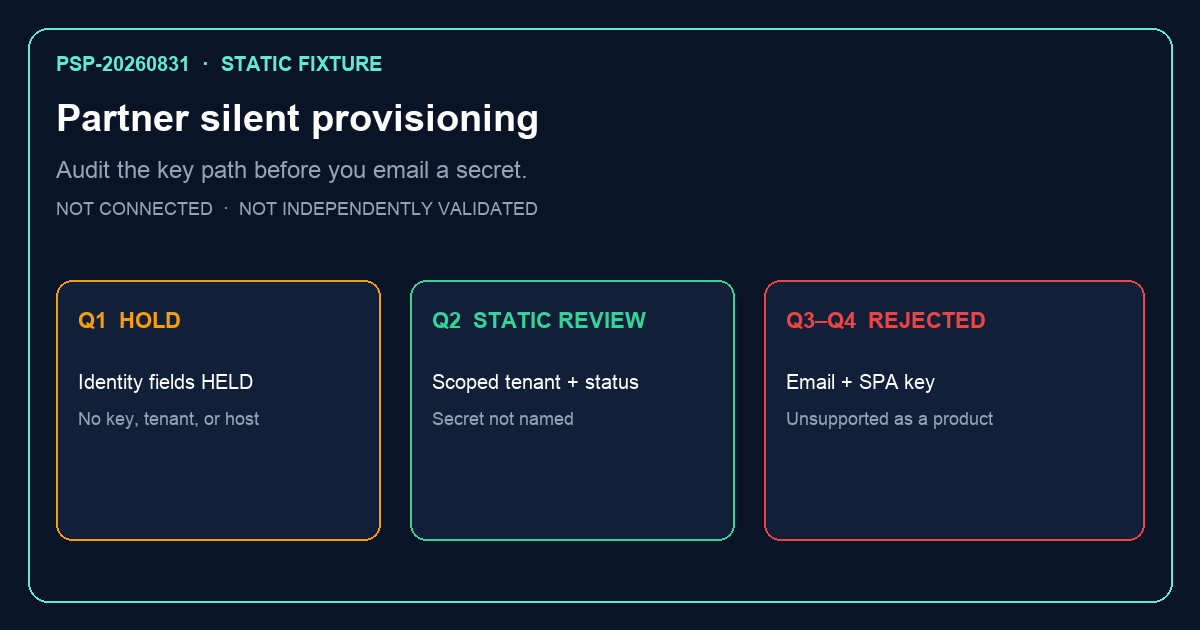
Table of Contents
- TL;DR
- What partner silent provisioning actually is
- Evidence Boundary
- An ops framework that keeps keys off the page
- Why emailing a key is not onboarding
- Tool landscape for partner-created tenants
- Implementation steps for a silent create path
- Desk sample: a partner admin that never saw the secret (illustrative)
- Selection scorecard
- Practical Static Replay
- Sources and Limited Claims
- Failure modes that publish the key
- Frequently Asked Questions
- Conclusion
TL;DR
Direct answer: Partner silent provisioning is an operations path. This static pack is HOLD / NOT READY FOR CONNECTION: no API key, tenant id, or host call was observed. Replay the authored scoped-tenant goal and two policy rejects offline. The verifier proves file agreement only.
Your server creates the tenant and a scoped key. The partner’s UI never displays the secret. Email, README, and the browser are not key channels. /tasks remains the console where a human creates and rotates keys. This is not a customer integration, latency SLA, award, media endorsement, or third-party evaluation.
What you'll learn:
- What partner silent provisioning owns versus what a product README must never own
- A four-object frame: partner, your server, scoped key, shared
/tasksaudit - Why “hide the key in the SPA” is still a leak
- A static reseller-admin identity fixture that names status only
- Failure modes: emailed secrets, frontend keys, and unscoped god keys
The hub for embedding an AI data analyst is the product picture. This page is the onboarding path. Partner silent provisioning exists so a reseller or ISV can start a tenant without shipping a secret through a human inbox.
What partner silent provisioning actually is
Key Definition: Partner silent provisioning is the server-side creation of a tenant and a scoped API key so a partner product can start long analysis tasks without placing that key in email, a README, or the browser. It is an ops path, not a marketing page, and not a published secret.
“Silent” means the end user does not complete a second signup for analysis. It does not mean the key is invisible to your security team. Partner silent provisioning still issues the key in a console a human can open, stores it in a secret manager you operate, and rotates it. Silence is for the partner’s customer, not for your audit.
IANA (retrieved 2026-09-04) is the independent home of public identifiers—media types, port numbers, registries that are meant to be published. API keys are the opposite class of object. Partner silent provisioning fails the moment a key is treated like a public identifier. IANA did not audit this pack.
If the missing object is the call itself, continue in the data agent API. If the missing object is duration, use the long-task agent layer.
W3C’s tabular data model (retrieved 2026-09-04) is a reminder that published tables have annotations you can cite. Keys do not belong in those tables. When partner silent provisioning writes a row, write tenant id and status—not the secret. W3C did not run this fixture.
Provisioning is not a UI widget
A “Get API key” button that dumps a token into a <pre> in the partner admin is a leak with extra CSS. Partner silent provisioning creates the secret on a server, stores it on a server, and lets the partner admin show only “connected” or “needs rotation.” Humans who must see a key open /tasks, not a marketing PDF.
Keys stay off the page
Off the page means off the README, off the onboarding email, off the SPA bundle, and off the support ticket. Partner silent provisioning can still tell a partner that a tenant exists. It must not attach the token. If a human needs a key, they create it in the console and paste it into a secret store—not into Slack.
Evidence Boundary
This is a synthetic, static, NON-CONNECTING partner silent provisioning identity fixture (PSP-20260831). No API key, host URI, tenant id, executed SQL, warehouse hop, or production workflow was observed.
The package does not claim that anyone emailed a key, forwarded a thread, opened /tasks for a reseller tenant, or rotated a live store. To operationalize partner silent provisioning, each claim needs environment evidence.
Do not prove a negative privilege by writing to a production host. First review the key store and the role catalog. Any later negative test needs separate authorization. TLS is not optional because the path looks private.
This page has no customer case, no measured SLA, no media mention, no award, and no independent institutional endorsement. The first-hand object is the authored pack you can download and lint offline. The company About page is a self-description, not third-party recognition.
An ops framework that keeps keys off the page
Four objects stay distinct. Collapsing them is how partner silent provisioning becomes “we emailed the key.”
| Object | Owns | Must not own | Fixture state |
|---|---|---|---|
| Partner admin | Tenant status, “analysis connected” | The raw key | HELD |
| Your backend | Create, scope, rotate, revoke | A copy of the key in logs | not executed |
| Secret store | The token | A ticket attachment | HELD |
/tasks | Human create and review | A public README snippet | policy text only |
ISO’s standard page 74306 (retrieved 2026-09-04) publishes assessment methods in a public catalog. That is the right pattern for evaluation criteria and the wrong pattern for secrets. Partner silent provisioning copies the discipline—written methods, named owners—and refuses the publication habit for tokens. ISO did not endorse this page.
Scope the tenant before you mint a key
A god key that can see every partner’s sources is not silent. It is a blast radius. Partner silent provisioning mints a key scoped to one tenant and the sources that tenant authorized. Rotation is a first-class action, not a later ticket.
MySQL documentation (retrieved 2026-09-04) is the independent reminder that privilege is granted per account, not “because the app is ours.” Treat the analysis key the same way. When partner silent provisioning talks to a customer’s authorized replica, the key is still not a database password, and it is still not published. MySQL docs did not certify this pack.
Why emailing a key is not onboarding
Email is a forwarding system. README files are git history. Both are archives you cannot un-send. Partner silent provisioning exists because those channels have already failed in every industry that ships APIs.
A welcome PDF with a token looks helpful and trains the partner to paste secrets into chat. A “temporary” key in the ticket becomes the production key. When you need partner silent provisioning, you need a create call your server makes and a status the partner admin can show—nothing else.
Pandas documentation (retrieved 2026-09-04) is a public reference for tables a partner might later analyze. It is not a place to store credentials, and neither is a notebook you email. If a partner’s first artifact is a notebook with a key at the top, you did not provision silently. You published. Pandas did not run this fixture.
Silent is not “hide it in JavaScript”
Obfuscation is not a control. A partner SPA that calls the analysis API directly has a published key, even if the string is split. Partner silent provisioning always hops through a backend the partner operates or that you operate on their behalf. The data agent API is that hop.
Tool landscape for partner-created tenants
| Pattern | Fits | Breaks |
|---|---|---|
| Email the key | Never | Every forward, every hire |
| README in the repo | Never | Git clones and screenshots |
| Key in the partner SPA | Never | Browser extensions, XSS, view-source |
| Console create + server store | Humans who must mint | Teams with no secret manager |
Server create + scoped store + /tasks audit | Partner silent provisioning | God keys, shared inboxes |
| ID | Candidate | Outcome | Why |
|---|---|---|---|
PSP-Q1-IDENTITY | api key, tenant id, host URI | HOLD / NOT READY | all identity fields HELD |
PSP-Q2-SCOPED-TENANT | one tenant + status fields, no secret | QUALIFIED FOR STATIC REVIEW | policy text; DO NOT EXECUTE |
PSP-Q3-EMAIL-KEY | key in welcome email or README | REJECTED AS UNSUPPORTED | archives cannot be un-sent |
PSP-Q4-FRONTEND-KEY | key in the partner SPA | REJECTED AS UNSUPPORTED | obfuscation is not a control |
InfiniSynapse’s educational path is the last landscape row: a human can still create a key in /tasks for their own tenant. Partner silent provisioning is the same object created by a server you trust, then used to start long tasks. Private deployment can be a later conversation. Do not skip the web console proof. That product surface is not evidence this pack connected.
What a data agent is does not change because a partner started the tenant. Data governance still asks who can create keys and who can see SQL. MCP for data analysis is an IDE door, not a partner onboarding door. Do not put a partner key in an MCP config checked into git.
Rotate without paging the partner’s customer
The end user should not receive a new secret. Partner silent provisioning rotates on the server, updates the store, and leaves the host button working. If rotation requires emailing a token, the path was never silent.
Implementation steps for a silent create path
These steps replay a partner silent provisioning identity pack offline. Do not point production traffic at a live create path on day one.
- Decide who is the tenant: one partner customer, one environment. Name it in policy text.
- Compare the accepted host note as policy text. Do not execute. Confirm status fields are named and the secret is not.
- Confirm the authored rule rejects an emailed or README key and rejects a key in the partner SPA.
- Open
identity-register-PSP-20260831.csvand confirm every sensitive field isHELD. - Run
python3 verify-PSP-20260831.pyfrom the downloads directory.
A passing local check does not authorize partner silent provisioning on any host. It reports deterministic file agreement among the authored downloads only.
The first key you ever mint should be a human-created console key for a sandbox. Partner silent provisioning copies that shape. If you cannot find the key in /tasks, you will not find it after an incident either.
Access logs that print Authorization headers undo the entire path. Partner silent provisioning includes a logging rule: tenant, actor, result. If a vendor’s sample prints the token, throw the sample away. Until an authorized console proof exists, keep HOLD.
Desk sample: a partner admin that never saw the secret (illustrative)
Static fixture, not a customer count and not a partner tally. A reseller admin needs “analysis connected” for one customer tenant. The rejected draft emails a key and asks the reseller to paste it into a settings field. The authored note does not claim two contractors forwarded a thread.
The accepted design for partner silent provisioning is a reseller backend that creates the tenant, stores the scoped key, and shows a green status. The customer never sees a token. A later reviewer can open /tasks for that tenant and compare the same goal the in-app button would send. This pack did not run that open.
Nothing in the sample is an uplift claim. The only honest result you can copy is that partner silent provisioning removes the inbox from the key path. A later rotation would update the store; the reseller admin would still show “connected.”
| Evidence class | What you can cite | What you cannot claim |
|---|---|---|
| Static pack on this page | Channel rule, named status fields | Customer uplift %, forwarded thread, opened SQL |
| Published authority (linked) | Frameworks and definitions from the cited sources | That those sources ran this fixture |
Labels stay illustrative, not a measured product result. Published context: IANA, W3C tabular data model, ISO 74306, MySQL docs, Pandas docs, retrieved 2026-09-04.
The phrase partner silent provisioning is the object under test. If a file cannot show how the admin names status without naming the token, reject the number.
Selection scorecard
Score partner silent provisioning the way you would score a secrets program, not a signup form.
| Criterion | Weak | Strong |
|---|---|---|
| Channel | Email, README, SPA | Partner silent provisioning on a server |
| Scope | One key for all customers | One tenant, one key |
| Human view | Token on the page | Status only; console for operators |
| Logs | Headers printed | Tenant and result only |
| Audit | “It should work” | Same /tasks timeline |
| Rotation | New email | Store update, user sees no secret |
If a vendor’s partner guide begins with “paste this key,” you do not have partner silent provisioning. If the first screen is a status pill and the key never appears, you might.
Practical Static Replay
Replay partner silent provisioning as a file comparison: freeze PSP-20260831, confirm held identity fields, confirm the accepted note names one tenant and status fields without a secret, confirm Q3–Q4 are policy rejects, then keep verifier output and hashes.
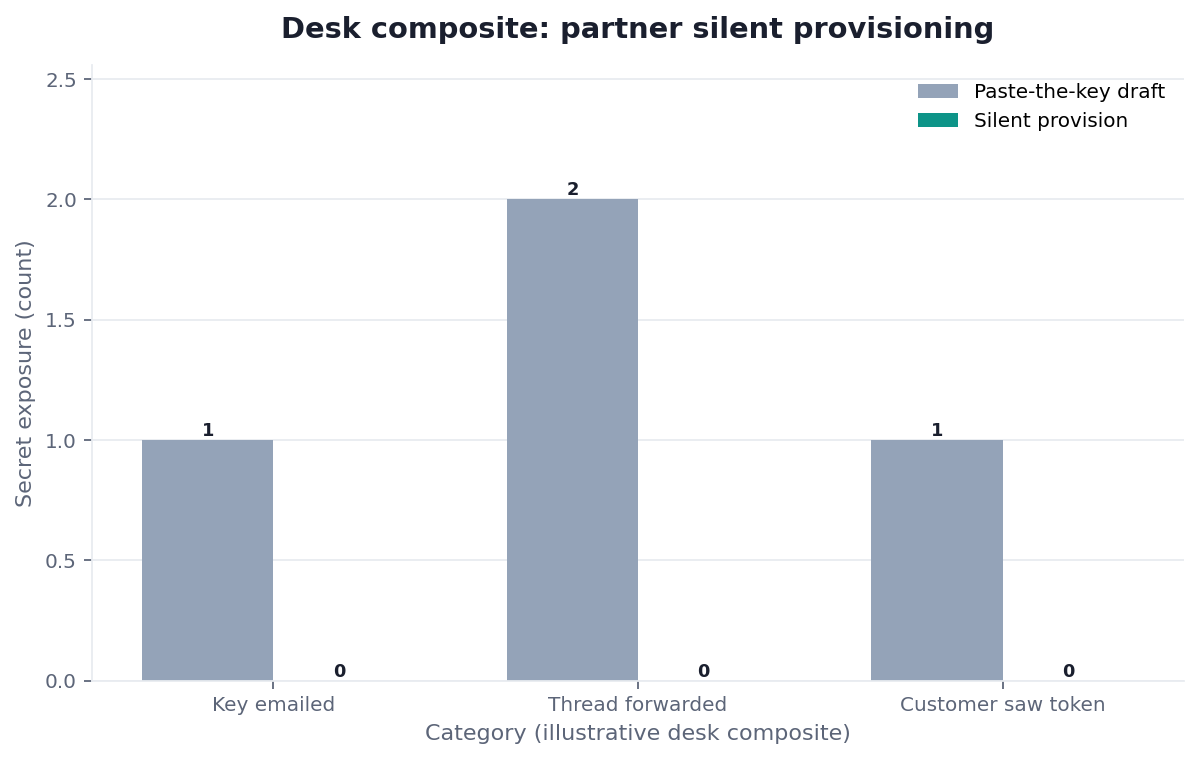
Figure. STATIC FIXTURE / NOT CONNECTED / NOT INDEPENDENTLY VALIDATED. Authored identity and policy labels only; no runtime or customer result.
Passing this replay means the PSP files agree. It does not authorize partner silent provisioning or prove reachability. Record Python version, OS, file hashes, freeze date, and the exact HOLD line beside the downloaded hashes. Do not treat a passing lint check as a live product bind or a latency promise. Record hashes here.
Sources and Limited Claims
Direct official sources were retrieved on 2026-08-31. IANA, W3C tabular data model, ISO standard 74306, MySQL documentation, and Pandas documentation are independent maps for public identifiers, published tables, assessment catalogs, per-account privilege, and analysis tables that must not hold credentials. They did not run this fixture. Some hosts may be retained without a fresh 200; keep the original URLs. Re-check those URLs later.
None of those pages audited this partner silent provisioning pack, and none of them endorsed partner silent provisioning on this page. Internal review is not independent validation. A qualified reviewer would need owner approval, a server-held key, TLS evidence, one authorized console-proven goal, and versions. Until then this pack is not a third-party audit, certification, award, media mention, or customer case. GitHub profiles are public engineering traces, not a published resume or independent endorsement. If a reviewer only reran Python, say so.
How to cite. InfiniSynapse, Partner Silent Provisioning: Audit the Key Path First, PSP-20260831, HOLD / NOT READY FOR CONNECTION, not independently validated. Name the downloaded files used.
This pack is one of 12 published static fixtures inventoried in InfiniSynapse Data Team, Desk Review 2026-Q3, Corpus E (n=12; freeze 2026-08-31; first-party; not independently validated; not a customer sample).
Downloads:
- Identity register
- Accepted host note
- Decision register
- Expected readiness
- Review rules
- Held evidence
- Assumptions
- Source check
- Reproduction protocol
- Verifier
Failure modes that publish the key
Most failures are channel failures, not model failures. This pack did not send a live email.
Shipping a key in the welcome email
The thread will be forwarded. Partner silent provisioning that starts with SMTP has already failed. Create on the server. Say “connected.”
Putting the key in the partner frontend
View-source is enough. XSS is extra. If you need partner silent provisioning, you already admitted the browser is not a vault.
One shared key for every tenant
A leak then reads every customer. Scope the key. Partner silent provisioning without scope is a single password with a nicer name.
Before you write a line of partner integration, name a sandbox key in the web console, store it in a secret manager, and list one goal you would allow a partner to trigger. If that list fails, you are not ready for partner silent provisioning. If it holds, automate the same create—never the same email.
Route the same diagnosis to the live guide that owns the next object. Each row is a single hop, not a reading dump.
| Live guide | Open it when |
|---|---|
| embed an AI data analyst | you need the product embed picture |
| data agent API | the create-and-call wire is next |
| long-task agent layer | duration is still being denied |
| same task in web and api | the partner call must match the console |
| data governance | access review is the next gate |
| what is data management | ownership of the tenant record is unclear |
| Analyze inside Your App without a New BI Suite | Your UI takes the question; the agent keeps the trail |
| Workflow-Embedded Analytics in an Existing Product | The analysis slot is a task, not a hidden iframe chart |
Create a key in the console, never in a README
Mint a sandbox key in the web task console, store it off the page, and run one authorized goal before you automate any partner create path. This check uses only sources you authorize.
Commercial association: You do not need the workspace to complete the educational diagnosis on this page.
Open InfiniSynapseHow this page is sourced. William Zhu is cofounder of InfiniSynapse (GitHub @allwefantasy); InfiniSynapse on GitHub. Company self-description, not independent authority. No personal LinkedIn is published. Desk experience: designing and reviewing analysis-pack methods—definition locks, read-only source binds, and downloadable
/tasksartifacts. Reviewed internally by analytics engineering · data platform · LLM security · editor. Editorial standards · corrections · publishing principles · About · Privacy · Terms · Contact zhuhl@infinisynapse.com. Company About. COI: InfiniSynapse sells an AI-native Data Agent; the banner is a commercial association. Fact-check: iana.org · w3.org · ISO 74306 · dev.mysql.com · pandas.pydata.org. No external organization audited it. This page is not third-party recognition.
Frequently Asked Questions
Is partner silent provisioning the same as hiding a key in JavaScript?
Bottom line: No. Hiding a string in a bundle is a published key. Partner silent provisioning creates and stores the secret on a server the partner or you operate.
Can I email a key “just for the pilot”?
Bottom line: No. Pilots get forwarded. If you need partner silent provisioning, the pilot uses the same server path.
Where should a human create the first key?
Bottom line: In the web task console. Partner silent provisioning automates that shape. It does not replace /tasks as the place a human can mint and revoke.
Does provisioning write into the customer’s production database?
Bottom line: No. Partner silent provisioning creates a tenant and a key. Analysis still reads sources the tenant authorizes and writes artifacts in the workspace.
What does the partner admin show?
Bottom line: Status, not the token. If the admin can reveal the key, you do not have partner silent provisioning—you have a settings page that publishes secrets.
Conclusion
Partner silent provisioning is an ops path: create a scoped key on a server, keep it off every page, and audit long tasks in the same /tasks console. Email and README are archives. The browser is not a vault.
Prove one sandbox goal on the web first. InfiniSynapse describes itself on About. Privacy and Terms apply. If you later use the workspace, open InfiniSynapse only with authorized, sanitized inputs, and keep keys out of every document you would be willing to commit after you claim partner silent provisioning.