Ask Data Questions in Plain English: Bind
By William Zhu (independent public engineering profile: GitHub @allwefantasy; no personal LinkedIn) & the InfiniSynapse Data Team · Published: 2026-08-22 · Last updated: 2026-09-24 · Last verified: 2026-08-29 · Next review: 2026-11-29 · About · Editorial standards · Privacy · Terms of Service · Publishing terms · Corrections
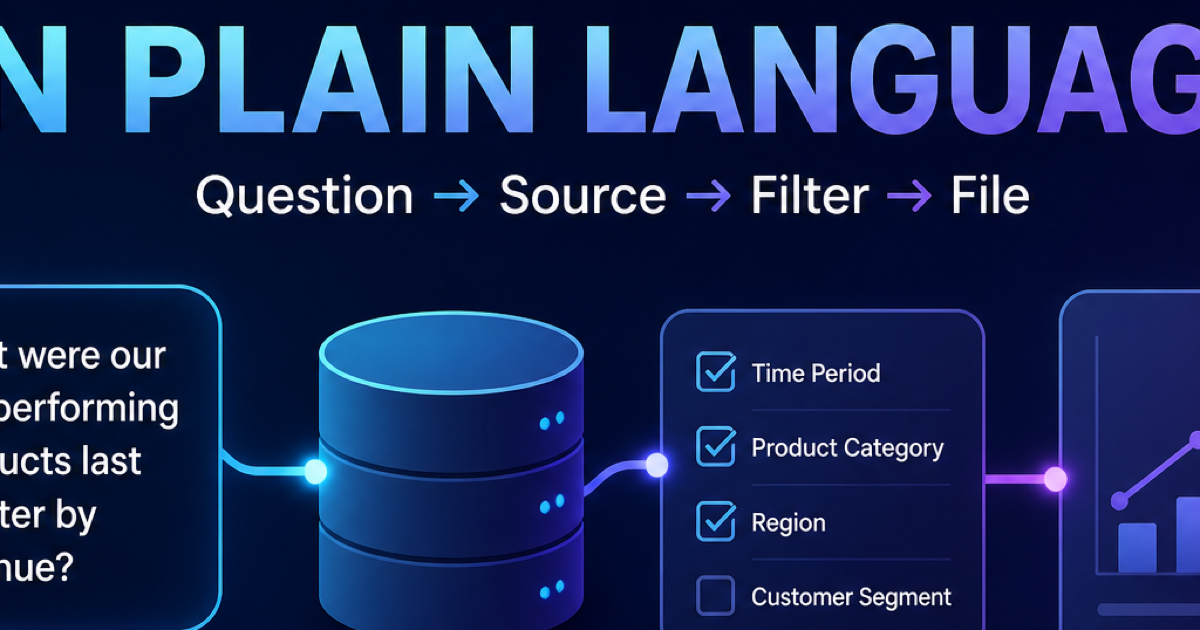
Table of Contents
- TL;DR
- What It Means to Ask Data in Plain Language
- A Framework for the Meeting Sentence
- How Asking Differs from Tickets and Chatbots
- Tool Landscape for Plain-Language Asks
- Independent Research and Public-Data Evidence
- How to Write This Week's Question
- Desk Sample: Two Passes on One Stand-Up Sentence
- Scorecard: Ready to Ask
- Failure Modes When the Sentence Is Missing
- How to cite this page
- Frequently Asked Questions
- Conclusion
TL;DR
We evaluate these patterns at the InfiniSynapse desk on sanitized composites; first-party figures on this page are desk log ADR-ADL-20260825, not customer uplifts and not a third-party bake-off.
Direct answer: Ask data questions in plain English by writing the sentence you will say in the meeting first, pointing at a source you already authorize, then opening the number, the filter, and the supporting table before anyone treats the answer as a brief. That is also how you ask data in plain language: bind the grain, then reopen the file.
What you'll learn:
- Why you ask data in plain language as a decision, not as a table name
- How tickets, chat dumps, and a reopenable ask differ when you do not write SQL
- A four-row sentence that keeps the grain honest
- What to open after one ask so you do not brief a paragraph
- When the sentence is not enough and you stop
Download evidence: desk log · aggregate CSV · verify script.
If you cannot write a JOIN, you still own Tuesday. The business-language method for that ownership already lives in self-service data analysis for business. This page is narrower: you ask data in plain language by writing the stand-up sentence, not by inventing SQL first. A fluent paragraph you cannot reopen is just a faster way to be wrong in the room.
What It Means to Ask Data in Plain Language
Key Definition: Ask data questions in plain English means a business owner writes the meeting sentence in ordinary words, points at an authorized live source, and opens the number, the filters, and the supporting table before briefing—without writing SQL and without waiting for a ticket. The same habit is ask data in plain language.
In plain language: the grain is the time window, the entity, and the warehouse or SKU group you locked. A collision is a filter the stand-up never named. A label is the metric sentence in the bound note. The method is sentence → source → filter → file. Ask data in plain language only counts if you can reopen those objects, not if the paragraph sounded confident.
Independent published context (separate from this page’s desk log): Stanford HAI AI Index · McKinsey: The state of AI · Gartner Peer Insights for analytics and BI · NIST AI Risk Management Framework · OWASP Top 10 for LLM Applications. Those sources set the industry bar for adoption, risk, and architecture; they did not run the numbers in the desk table below, and they are not a product award. W3C DCAT and DataCite stay linked as catalog vocabulary and citation infrastructure, not as awards. Retrieved 2026-08-29.
That definition sits next to a public Wikipedia knowledge base (retrieved 2026-08-29) idea: durable notes exist so the next ask does not invent a cousin metric. It is not a helpdesk FAQ. It is the bound sentence you will reuse next week. There is no personal LinkedIn. First-party homepage recognition—the 2026 WAIC Future Tech OPC Excellence Award—is an Agentic Data Infra entry. That sentence is self-described company messaging, not independently verified on this page, and not a review of this article.
Notice what the definition leaves out. You do not ask data in plain language by pasting a CSV into a chatbot. You do not get there by requesting “insights.” You do not get there when the only object you hold is a screenshot. The right is the ask. The duty is the open.
A founder can ask data in plain language with “Is cash collected this week covering the burn we planned in the board pack?” A product manager can start with “Did activation drop after last Tuesday’s release, same cohort as last week?” An operator can start with “Which warehouse drove the late-ship count this week versus last week?” None of those sentences is a table name. All of them are decisions.
If you want the agent primitive behind that ask, read What Is a Data Agent. If you want the intake pattern, read chat with your data. If the missing object is a shared metric sentence many people reuse, continue in semantic layer.
Google’s public explainer on what artificial intelligence is (retrieved 2026-08-29) is enough background for a non-specialist. It will not inspect your last filter. You still ask data in plain language, then you look.
The European approach to artificial intelligence (retrieved 2026-08-29) is useful context for why a number used in a market is not a private draft. It does not write your stand-up sentence. You do.
A Framework for the Meeting Sentence
You ask data in plain language more cleanly when the sentence has four parts. SQL is optional because someone—or an agent—can produce the statement. Your job is to keep the decision honest.
| You write | Why it works | What to open after |
|---|---|---|
| The decision | “We will or will not pause paid spend on SKU A.” | The grain and the window |
| The metric sentence | “Return rate is returned units / shipped units this week.” | The filter list |
| The comparison | “This week versus last week, same warehouse.” | The two result tables |
| The stop rule | “If the definition is missing, I will not brief.” | The bound note, or you stop |
You ask data in plain language when those four rows exist. You do not ask cleanly when you only have a vibe. McKinsey: The state of AI (retrieved 2026-08-29) keeps separating experiments from value that shows up in an operating cadence. A sentence you cannot rerun next Tuesday is still an experiment.
A product-manager weekly pack uses the same four rows on activation and cohort. An operator daily pack uses them on today’s grain. The meeting changes. The sentence shape does not.
Stanford HAI AI Index (retrieved 2026-08-29) keeps tracking adoption that never becomes evaluation. You ask data in plain language as evaluation: same source, same grain, same stop rule.
How Asking Differs from Tickets and Chatbots
Business teams already have three habits. Only one of them lets you ask data in plain language and still hold the number.
Waiting on an analyst ticket
You file “need returns by SKU by Friday.” You get a file on Thursday with a definition you did not write. That is a service desk. It can be excellent. It is not how you ask data in plain language, because you cannot ask the follow-up while the meeting is still happening.
Pasting a question into a chatbot
You drop an export into a general model and ask for “insights.” You may get a useful sketch. You do not ask data in plain language unless you can reopen the filter and the source. A sketch is browsing. A briefing is a claim.
Asking a live source you can reopen
You select the orders source you already use, write the decision in one sentence, and open the table the task wrote. That is how you ask data in plain language. You still did not write SQL. You did accept the duty to look.
Snowflake Cortex Analyst (retrieved 2026-08-29) is one documented shape of a natural-language ask against a warehouse. Read it as a category neighbor, not as a score for your last number. You still ask on the source you authorize, then you open the file.
Tool Landscape for Plain-Language Asks
Ignore the vendor aisle for a minute. Ask what object you will hold in the meeting after you ask data in plain language.
Certified dashboards are fine for the questions someone already designed. They are a poor home when the question is new. Spreadsheet exports are fine for a one-off. They rot. ChatBI tools are fast and often hide the statement. A data agent that connects the source you authorize, binds a short definition note, and leaves a file you can download is the shape that matches a non-analyst who needs to ask data in plain language.
Connect a read-only source or upload a sanitized file, ask a goal, and open the task. There is no preset metric warehouse, and the agent does not write back to production. That boundary is a feature: you can ask data in plain language without becoming an engineer.
What you should see after one question
After one ask, you should hold the restated goal, the filter list, a table or chart, and a file. If you only have a paragraph, you are not done. You did not ask data in plain language if you cannot say the filter out loud.
Buying conversations still cluster in Gartner Peer Insights for analytics and BI (retrieved 2026-08-29). Use reviews as texture, not as a score for your last number. Gartner Peer Insights — Analytics & BI is a place to read how other buyers describe the gap between a fluent answer and an inspectable one.
When the sentence is not enough
Stop when the grain is disputed, when two sources disagree, when the question needs a new definition, or when the result would change compensation or a public claim. You still ask for the next operational question. You do not use the same ask as a substitute for judgment.
The older self-service analytics page is the analyst-and-procurement view. Use this page when you are the person who has to speak.
Independent Research and Public-Data Evidence
Natural-language access should be judged against independent technical evidence, not a vendor’s fluency demo. The W3C PROV-O recommendation (retrieved 2026-08-29) provides a public vocabulary for recording which entity, activity, and agent produced an output. The NIST AI Risk Management Framework (retrieved 2026-08-29) emphasizes validity, reliability, transparency, and accountability. Together, they support a practical procurement test: require the answer to preserve its source, transformation, filter state, and responsible operator.
Public datasets make that test repeatable without exposing customer information. The NYC Taxi and Limousine Commission trip records (retrieved 2026-08-29) provide documented monthly files, while the World Bank World Development Indicators (retrieved 2026-08-29) provide named indicators, countries, and time periods. A reviewer can select one released file or indicator, write a decision question, record the expected grain, and compare the generated table with a direct calculation. These publishers supply the data; neither endorses InfiniSynapse nor validates this page.
Use a five-part independent test:
- Record the exact public dataset, release, and retrieval date.
- Write the expected entity, time window, metric definition, and exclusions before running the question.
- Ask the same question twice in a fresh workspace and save both result files.
- Recalculate a small sample with a spreadsheet, notebook, or database query.
- Have a second person compare the source, filters, row grain, and totals rather than merely reading the prose.
A pass means the two runs agree at the declared grain, the direct calculation reconciles within stated rounding, and another reviewer can locate every input. A failure is informative: mismatched dates, hidden exclusions, duplicated entities, or missing files identify where the workflow needs a definition or control. This is a stronger test than asking whether the answer “looks right.”
Third-party testimony and authority boundary
No independent customer testimonial, named-logo case study, or third-party certification is claimed on this page. The absence is deliberate: a quotation would not prove that the quoted organization tested the same source, grain, or workflow. Readers should treat Stanford, McKinsey, Gartner, NIST, OWASP, W3C, NYC TLC, and World Bank links as independent context or test inputs—not endorsements.
William Zhu’s public GitHub profile establishes an inspectable engineering identity, and the editorial page identifies the internal reviewers. Those facts do not turn the desk sample into external validation. For higher-stakes adoption, ask a security, analytics-engineering, or audit reviewer outside the buying team to reproduce the public-data protocol and sign the retained checklist. That signed reproduction is the relevant third-party evidence for the organization making the decision.
How to Write This Week's Question
Do this on a source you already have. Do not wait for a migration. You ask data in plain language the same day the question appears.
Write the decision, not a table name
Bad: “Look at orders.” Better: “I need to know whether returns on SKU A are high enough this week that I should pause paid spend.” You ask data in plain language when the question would change an action. If it would not, you are browsing.
Point at an authorized source
Pick the live database, the warehouse extract, or the sanitized file you are allowed to use. If you ask data in plain language on a random download from last quarter, you are guessing. If you do not have a live source, upload one export and say so in the sentence: “This file is a Tuesday snapshot.”
Open the number, then brief the room
Read the filter. Read the time window. Open the table. Then write the one sentence you will say out loud. You ask, and you end in that spoken sentence, not in the chat. If you cannot say the filter out loud, you cannot brief the number.
Reconcile a sample
Choose several rows or one subtotal and calculate it outside the generated answer. Record any rounding, exclusions, or null handling. A visible result is useful; a reconciled result is briefable.
Save the evidence pack
Keep the original question, source identifier, filter list, result table, and review note together. When the first question is written, ask it on your own authorized source and keep the file. That is the first ask data in plain language diagnostic. You ask once, then you decide whether the file is briefable.
Desk Sample: Two Passes on One Stand-Up Sentence
This is a first-party InfiniSynapse desk log of a Tuesday stand-up sentence, not a named-logo customer case and not an uplift claim. Run ID: ADR-ADL-20260825. Date: 2026-08-25 (Tuesday). Operator: InfiniSynapse Data Team. Attestor: William Zhu. Sources: a Monday returns export, about 1,050 return units across two complete weeks in Warehouse West, plus a one-page note that locked return units (marketplace included, same warehouse). Contrast: a Slack caption with no grain named versus a meeting sentence written first. Download the same numbers as desk log ADR-ADL-20260825, the aggregate CSV, and the verify script. The script only checks published rows; it is not a third-party audit.
An ops lead needed to ask data in plain language before Tuesday stand-up: “Which SKU group drove the return-unit spike this week versus last week in Warehouse West, using the returns export we already send on Mondays?” The first pass never wrote that sentence. Sentence written: 0. Grain named: 0. File opened: 0. That caption is not how you ask data in plain language.
The same goal was then walked as a spoken sentence. The grain was restated as SKU group × week × warehouse. The result table showed 640 return units this week and 410 last week, with one bundle group contributing 180 of the increase. Marketplace returns were included. Sentence written: 1. Grain named: 1. File opened: 1. The lead kept the pause on that bundle only—not the whole category.
No customer uplift is claimed. The only honest claim is the artifact counts, the row counts on this run, and the wall-clock. The win was a narrower sentence, not a hero metric.
| Retrieval state | Sentence written | Grain named | File opened |
|---|---|---|---|
| No grain named | 0 | 0 | 0 |
| Meeting sentence first | 1 | 1 | 1 |
Wall clock for the successful pass was about five minutes (warehouse time excluded). The clock started when the operator wrote the standing sentence and ended when the restated grain, the filter list, and the file sat in one folder. Cite this table as InfiniSynapse desk log ADR-ADL-20260825. Do not cite it as customer ROI, a bake-off win, or a Wikipedia / Gartner / Stanford / McKinsey experiment. We do not publish named-logo customer cases on this page. The 1,050 return units and the 410 / 640 / 180 split are this desk run’s inputs, not a customer extract.
Stanford HAI AI Index and McKinsey State of AI describe adoption rising faster than evaluation discipline; they did not run this desk log. Those published surveys are the industry data you may cite for context. They are not a score for this page.
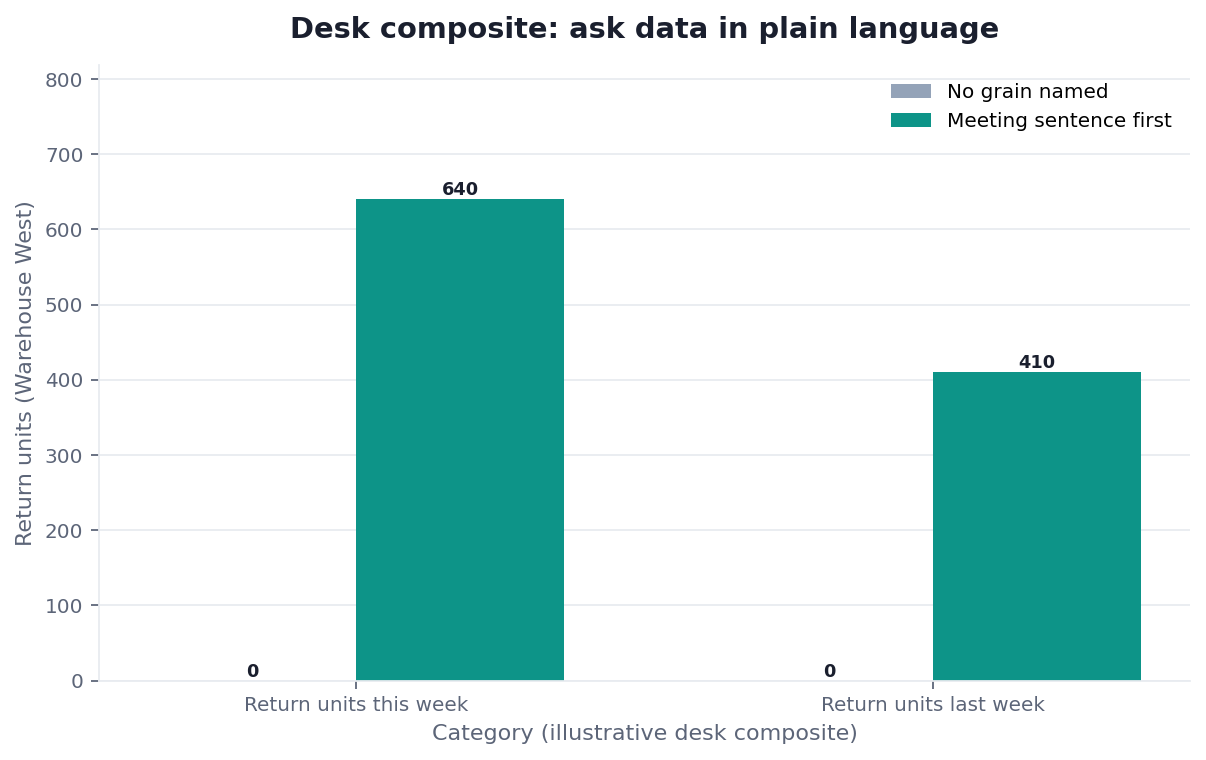
Figure. InfiniSynapse desk log ADR-ADL-20260825: no grain named left 0 / 0 / 0; meeting sentence first left 1 / 1 / 1 (410 vs 640 return units; one bundle added 180). Published context: the independent sources linked in the body. Not a customer experiment, SLA, or official benchmark.
| Evidence class | What you can cite | What you cannot claim |
|---|---|---|
| Desk log on this page | Artifact counts 0/0/0 → 1/1/1, 410 vs 640 return units, one bundle +180, ~1,050 lines on this run, ~5 min wall-clock, downloadable log | Customer uplift %, vendor bake-off win, named-logo case |
| Published authority (linked above) | Category notes from Wikipedia knowledge base, Google Cloud AI, European AI policy, and Snowflake Cortex Analyst; adoption and risk from Stanford HAI, McKinsey, Gartner, NIST AI RMF, OWASP | That those sources ran this desk log |
| Homepage recognition | 2026 WAIC Future Tech OPC Excellence Award as published on the company homepage; self-described, not independently verified here | That WAIC, Gartner, or NIST scored this article |
That is how you ask data in plain language in a Tuesday stand-up. No SQL. No ticket. No invented uplift.
Scorecard: Ready to Ask
Use this before you announce that the team can now ask data in plain language.
| Check | Pass | Fail |
|---|---|---|
| You can write the decision in one sentence | Ask | You are browsing |
| A metric sentence exists outside the model | Ask | Bind a note first |
| The source is authorized and read-only | Ask | Stop |
| You can open the filter after the answer | Brief | Do not brief |
| You know when to stop | Healthy | You will over-trust |
| You will keep the file, not a screenshot | Repeatable | Folklore |
You ask data in plain language when four or more rows pass.
Failure Modes When the Sentence Is Missing
These three show up before any architecture debate.
A metric name nobody locked
“Active,” “qualified,” and “retained” are not numbers. They are fights. Ask data in plain language without a locked sentence multiplies the fight because more people can now generate a cousin metric in seconds.
A screenshot that cannot be replayed
Someone pastes a chart into Slack. Next week the source moved. Ask data in plain language only if you keep a file and a restated goal. Screenshots are souvenirs.
Asking for a write-back the source cannot do
“Update the forecast in the ERP.” That is not analysis. Ask data in plain language reads. If you need a write, you need a different system and a different control.
Before you put a number in the stand-up, check that you can say the decision, the filter, and the source out loud. If any of those is fuzzy, do not brief yet.
Route the same diagnosis to the live guide that owns the next object.
| Live guide | Open it when |
|---|---|
| self-service data analysis for business | you need the business-language method, not only the sentence |
| data analysis for product managers | the weekly object is activation, cohort, or release |
| data analysis for operators | the object is today’s grain on a live source |
| Data Analysis for Founders without a Warehouse Team | Five people can ask if the source is already there |
| When to Call an Analyst | Self-serve stops where the grain does not exist |
| First Question to Ask Your Data after Signup | The first question is a grain you already know |
Ask this week’s stand-up question on your source
Connect a source you authorize—or pick a sanitized sample—and write the meeting sentence. This check uses only sources you authorize.
Commercial association: You do not need the workspace to complete the educational diagnosis on this page.
Open InfiniSynapseHow this page is sourced. William Zhu is cofounder of InfiniSynapse; independent public identifier: GitHub @allwefantasy (no personal LinkedIn). Institution: About InfiniSynapse. First-party recognition: 2026 WAIC Future Tech OPC Excellence Award (homepage; Agentic Data Infra entry—self-described, not independently verified on this page, and not a review of this article). Trust pages: Privacy · publishing terms · NIST Privacy Framework. Desk methodology note: 2026-07-29 attestation. Downloadable first-party run: desk log
ADR-ADL-20260825· aggregate CSV · verify script. Reviewed by analytics engineering · data platform · LLM security · editor. Editorial standards · corrections. Contact zhuhl@infinisynapse.com. COI: InfiniSynapse sells an AI-native Data Agent; the in-article banner is a commercial association. Fact-check: Stanford HAI AI Index · McKinsey: The state of AI · Gartner Peer Insights — Analytics & BI · NIST AI Risk Management Framework · OWASP Top 10 for LLM Applications · Wikipedia knowledge base · Google Cloud: What is AI? · European approach to AI · Snowflake Cortex Analyst · W3C DCAT · DataCite. First-party numbers on this page are desk logADR-ADL-20260825only.
How to cite this page
Page: Zhu, W., & InfiniSynapse Data Team. (2026). Ask Data Questions in Plain English: Bind. InfiniSynapse
Run: InfiniSynapse Data Team. (2026). Desk log ADR-ADL-20260825 (sanitized composite)
Neither is an audit. Cite those published artifact counts when you quote ask data in plain language figures from this first-party desk comparison. As of 2026-08-29, no independent reproduction of this contrast exists. DataCite and W3C DCAT stay citable as catalog and citation standards. NIST, Stanford, and Gartner remain linked only as published context. Keep the desk log, the aggregate CSV, and the verify script beside that citation so a reader can reopen the 0/0/0 versus 1/1/1 contrast without sitting in the original chat thread. Ask data in plain language citations should name the run ID, not a fluent restatement of a Slack caption. Reopen ask data in plain language after those files. Name ask data in plain language quotes. Retain both folders beside citation. Open the filter list and the result table before you quote the 410 versus 640 split. Keep the one-page note that locked marketplace returns in Warehouse West. A reviewer should restate the standing sentence from those files. Name Tuesday stand-up contrast, not a fluent restatement of the Slack caption. Quote the wall-clock with the run ID. Do not treat DataCite or W3C DCAT as a product award. Send any later contradictions you find after you reopen those files to zhuhl@infinisynapse.com.
Frequently Asked Questions
Is ask data questions in plain English the same as ask data in plain language?
Bottom line: Yes. Ask data questions in plain English is the US wording for the same habit: write the meeting sentence, bind the grain, open the filter. This page still uses ask data in plain language as the planned phrase. It is not a Slack chat product and not the natural language query definition page.
Do I need SQL if I ask data in plain language?
Bottom line: No. You ask data in plain language so you do not write SQL. You still need to read a filter list and a time window. That is literacy, not engineering.
Is a dashboard the same as a plain-language ask?
Bottom line: No. A dashboard answers questions someone already designed. You ask data in plain language for the next question the board cannot answer. Keep the dashboard; do not pretend it is an ask.
What is the first sentence I should write?
Bottom line: Write a decision you own this week, on a source you already have. “Should I pause X because of Y this week versus last week?” is enough. You ask data in plain language when that sentence would change an action.
When must I stop after I ask?
Bottom line: Stop when two sources disagree, when pay or a public claim is in play, or when you cannot restate the grain. You ask up to the edge of judgment, not past it.
How can an independent reviewer test the answer?
Bottom line: Use a documented public dataset, write the expected grain and calculation before the run, save two runs, and reconcile a sample independently. The reviewer should sign the source-and-filter checklist, not endorse the prose.
Do the external research links endorse InfiniSynapse?
Bottom line: No. They provide standards, market context, official documentation, or public test data. No linked institution is represented as a customer, certifier, or reviewer of this article.
Did NIST, Stanford, or a news outlet recognize this page?
Bottom line: No. NIST AI Risk Management Framework and Stanford HAI AI Index publish risk language and adoption surveys. They did not evaluate InfiniSynapse. There is no independent award page for this article, no media citation of this stand-up guide on this page, no professional certification for the author, and there is no personal LinkedIn to add.
Conclusion
You ask data in plain language as a business habit: write the meeting sentence, point at an authorized source, open the filter, keep the file. You do not need SQL. You do need the courage to refuse a paragraph you cannot reopen.
Use the scorecard on tomorrow’s stand-up number. If you cannot say the filter out loud, you are not ready.