Data Analysis for Founders: Bind, Then Replay
By William Zhu (independent public engineering profile: GitHub @allwefantasy; no personal LinkedIn) & the InfiniSynapse Data Team · Published: 2026-08-22 · Last updated: 2026-08-29 · Last verified: 2026-08-29 · Next review: 2026-11-29 · About · Editorial standards · Privacy · Terms of Service · Corrections
Table of Contents
- TL;DR
- What Data Analysis for Founders Means with Five People
- A Framework for the Board Number
- How a Founder Ask Differs from Spreadsheets and Tickets
- Tool Landscape without a Warehouse Team
- Independent Data and Third-Party Review
- How to Ask This Week’s Board Number
- Desk Sample: An Illustrative Cash Week
- Scorecard: Ready for the Board Pack
- Failure Modes Founders Hit First
- How to cite this page
- Frequently Asked Questions
- Conclusion
TL;DR
We review plain-language first questions at the InfiniSynapse desk on sanitized composites; sample figures on this page are illustrative, not operator time-saved claims.
Direct answer: Data analysis for founders is the right of a five-person team to ask this week’s board number on a source that already exists—billing, bank, or product—then open the number, the filter, and the file before anyone treats a screenshot as the pack.
What you'll learn:
- Why data analysis for founders does not wait for a warehouse hire
- How spreadsheets, tickets, and a reopenable ask differ when nobody writes SQL
- A four-row board number that keeps cash and window honest
- What to open after one founder question so you do not brief folklore
- When to stop and still call an analyst
Download evidence: desk log · aggregate CSV · verify script.
If you cannot write a JOIN, you still own the board. The business-language method already lives in self-service data analysis for business. This page is narrower: data analysis for founders works when the source is already there. Five people can ask. They still must open the number.
What Data Analysis for Founders Means with Five People
Key Definition: Data analysis for founders is the practice of asking this week’s board decision on an authorized source that already exists, in plain language, then opening the number, the filters, and the supporting table before the pack—without a warehouse team and without writing SQL.
That definition sits next to a public RFC 4180 (retrieved 2026-08-29) idea: a CSV you already export is a real source if you say it is a snapshot. The board ask often starts there. It does not start with a two-year warehouse program. W3C DCAT (retrieved 2026-08-29) and DataCite (retrieved 2026-08-29) stay linked as catalog vocabulary and citation infrastructure, not as awards. There is no personal LinkedIn. First-party homepage recognition—the 2026 WAIC Future Tech OPC Excellence Award—is an Agentic Data Infra entry. That sentence is self-described company messaging, not independently verified on this page, and not a review of this article.
Notice what the definition leaves out. Data analysis for founders is not “we will hire analytics next year.” It is not pasting the bank CSV into a chatbot and calling it a board pack. It is not a promise you will never need an analyst. It is a right plus a check: five people can ask, and they can see how the number was made.
A founder can start with “Is cash collected this week covering the burn we planned in the board pack?” That is data analysis for founders. “Tell me something interesting about the business” is not. If you want the sentence shape, read how to ask data in plain language. If the weekly object is activation rather than cash, use data analysis for product managers.
If you want the agent primitive, read What Is a Data Agent. If the next failure is connecting the live database you already have, use analyze a database without ETL. If the number is variance or close, continue in FP&A analytics. The older self-service analytics page is the analyst-and-procurement view; use this page when you are the person who has to speak.
Amazon’s public Amazon Redshift (retrieved 2026-08-29) documentation is enough background for why a warehouse exists as a product. Five people do not need to buy one first. They need a source they already authorize.
A Framework for the Board Number
Data analysis for founders gets easier when the pack is four rows, not a hire plan. SQL is optional because someone—or an agent—can produce the statement. Your job is to keep this week’s decision honest.
| You write | Why it works | What to open after |
|---|---|---|
| The decision | “We will or will not cut paid spend this week.” | The grain and the window |
| The metric sentence | “Cash collected is settled inbound transfers this week, same accounts as last week.” | The filter list |
| The comparison | “This week versus the board plan, same accounts.” | The two result tables |
| The stop rule | “If the account list is missing, I will not brief.” | The bound note, or you stop |
Data analysis for founders is mostly those four rows. You do not need a warehouse team on day one. You do need the sentence. The board ask fails when “revenue” means invoiced in one slide and collected in another.
McKinsey: The state of AI (retrieved 2026-08-29) keeps separating experiments from value that shows up in an operating cadence. The board ask only counts as value if the same board number can be asked next week without a new translation meeting.
Stanford HAI AI Index (retrieved 2026-08-29) keeps tracking adoption that never becomes evaluation. Data analysis for founders is evaluation: same accounts, same window, same stop rule.
A public A/B testing (retrieved 2026-08-29) overview is useful when the founder question is an experiment, not cash. It will not write your board sentence. Data analysis for founders still needs that sentence.
How a Founder Ask Differs from Spreadsheets and Tickets
Five-person teams already have three habits. Only one of them is data analysis for founders.
Waiting to hire a warehouse team
You defer the board number until “we have analytics.” That is a staffing plan. It can be wise later. It is not data analysis for founders, because the source already exists and the meeting is this week.
Pasting a bank CSV into a chatbot
You drop last month’s export into a general model and ask for “insights.” You may get a useful sketch. That is not data analysis for founders unless you can reopen the filter and say the file is a snapshot. A sketch is browsing. A board pack is a claim.
Asking a source you already have
You select the billing database, the bank export, or the product table you already use, ask the board decision in one sentence, and open the table the task wrote. That is data analysis for founders. You still did not write SQL. You did accept the duty to look.
Buying conversations still cluster in Gartner Peer Insights for analytics and BI (retrieved 2026-08-29). Use reviews as texture, not as a score for your last cash number. The board ask still happens on the source you authorize.
Tool Landscape without a Warehouse Team
Ignore the vendor aisle for a minute. Ask what object you will hold in the board pack after data analysis for founders.
Certified dashboards are fine if someone already designed them. Five people often do not have one. Spreadsheet exports are fine for a one-off. They rot. ChatBI tools are fast and often hide the statement. A data agent that connects the source you authorize, binds a short cash sentence, and leaves a file you can download is the shape that matches data analysis for founders.
InfiniSynapse is built as a professional analyst you can ask in ordinary language—not as a toy that only emits SQL. You connect a read-only source or upload a sanitized file, ask a goal, and open the task. There is no preset metric warehouse, and the agent does not write back to production. That boundary is a feature for a founder: the board ask does not require you to become an engineer.
What you should see after one board question
After one ask, data analysis for founders should leave you with: the restated goal, the account filter, a table or chart, and a file. If you only have a paragraph, you are not done.
ISO/IEC 27017 (retrieved 2026-08-29) is a useful control backdrop for cloud accounts that hold billing and bank extracts. Use it as texture, not as a score for your last number. The board ask still ends in the sentence you will say in the pack.
When to still call an analyst
Call an analyst when two sources disagree, when the question needs a new definition, when pay or a public claim is in play, or when you are about to change the company story. The board ask does not replace judgment. It replaces the wait for a hire you do not have this week.
Gartner Peer Insights — Analytics & BI describes that gap in buyer language. It did not run your last board pack.
Independent Data and Third-Party Review
A founder should not accept a product demo as evidence that a board number is reliable. Use public, independently maintained sources to test the workflow before connecting private billing or bank data. The SEC EDGAR company filings API (retrieved 2026-08-29) exposes filed company facts and documented identifiers. FRED (retrieved 2026-08-29) provides versioned economic series with observation dates and units. The World Bank Indicators API (retrieved 2026-08-29) provides country, indicator, and period dimensions. These sources do not endorse InfiniSynapse; they make an independent reproduction possible.
Run the test as a founder would run a board question:
- Choose one official series or filing fact and record its publisher, identifier, unit, period, and retrieval date.
- Write the expected grain before asking—for example, one observation per month, or one filed fact per fiscal period.
- State the decision threshold and exclusions before viewing the generated answer.
- Save the returned filter list, supporting table, and downloadable result.
- Compare at least one subtotal or period directly with the publisher’s record.
- Repeat the same question in a fresh task and have someone outside the buying decision inspect both files.
The result passes only when the source identifier, period, unit, filters, and totals reconcile. A fluent explanation with an untraceable unit fails. A chart that silently mixes annual and quarterly facts fails. A number copied from an undated screenshot fails. This protocol tests the relationship between the claim and its source rather than rewarding polished prose.
For accounting-sensitive questions, the Financial Accounting Standards Board Accounting Standards Codification (retrieved 2026-08-29) is the authoritative US GAAP reference, while the PCAOB auditing standards (retrieved 2026-08-29) explain why evidence must be sufficient and appropriate. Neither source determines a startup’s internal metric, but both reinforce the need to distinguish recognized financial measures from management-defined operating indicators.
A reproducible desk record
The cash-week example below is a sanitized first-party desk exercise, not a customer result. Its inputs, expected grain, calculations, and limitations are recorded in desk log ADR-DAF-20260827, the aggregate CSV, and the verify script. The script only checks published rows; it is not a third-party audit. The log fixes the planned burn at $48,000, settled inbound cash at $41,200, and the variance at -$6,800. It also records the three-account scope, refund treatment, and the arithmetic needed to reproduce the variance.
Those values are deliberately modest and inspectable. They are not benchmarks, customer economics, or evidence of time saved. The test claim is only that a second reviewer can recompute 41,200 - 48,000 = -6,800, locate the declared scope, and identify why a single paid channel—not the whole budget—was flagged for review.
Third-party authority boundary
No named customer testimonial, independent product certification, analyst ranking, or media endorsement is claimed here. Gartner reviews describe a market category; SEC, FRED, World Bank, FASB, and PCAOB provide official data or standards; none reviewed this article or the desk run. A fabricated endorsement would weaken the very evidence discipline this guide recommends.
William Zhu’s public GitHub engineering profile provides an inspectable identity, and the editorial standards page names the internal review functions. For a purchasing decision, add a finance lead, auditor, or analytics engineer who is independent of the vendor selection. Ask that reviewer to sign the source, grain, unit, period, and recalculation checklist. That signed reproduction—not a marketing quotation—is the relevant third-party validation for the founder’s own use case.
How to Ask This Week’s Board Number
Do this on a source you already have. Do not wait for a warehouse team. The board ask starts the week the question appears.
Write the board decision, not a table name
Bad: “Look at Stripe.” Better: “I need to know whether cash collected this week covers the burn we planned, same accounts as last week.” Data analysis for founders starts when the question would change spend or hiring. If it would not, you are browsing.
Point at a source that already exists
Pick the live billing database, the bank export, or the sanitized file you are allowed to use. A random download from last quarter is a guessing game. If the file is a snapshot, say so in the sentence: “This CSV is Friday’s settlement file.”
Open the number, then write the pack sentence
Read the filter. Read the account list. Open the table. Then write the one sentence you will say out loud. The board ask ends in that sentence, not in the chat. If you cannot say the accounts out loud, you cannot brief the number.
Recalculate one material line
Recompute the largest subtotal or the decision-driving variance outside the generated answer. Record the formula, rounding policy, and any excluded accounts. If that line cannot be reconciled, stop before writing the pack.
Save and review the evidence pack
Keep the question, source identifier, metric sentence, filters, table, and independent check together. When the first question is written, ask it on your own authorized source and keep the file. That is the diagnostic. The board ask is repeatable only if next week’s pack can reuse the same cash sentence.
Desk Sample: An Illustrative Cash Week
Desk composite, not a customer case. A founder used data analysis for founders before a Thursday pack: “Is cash collected this week covering the $48,000 burn we planned, using the settlement export we already download on Fridays, same three accounts?” The reproducible inputs and calculation are available in desk log ADR-DAF-20260827, the aggregate CSV, and the verify script.
The agent restated the grain as week × account × settled inbound. The result table (illustrative) showed $41,200 collected and $48,000 planned burn, with one account contributing $6,100 less than last week. The founder opened the filter, confirmed refunds were included, and paused one paid channel—not the whole budget.
That is data analysis for founders with five people and no warehouse team. No SQL. No hire. No invented uplift. The win was a narrower pause, not a hero metric.
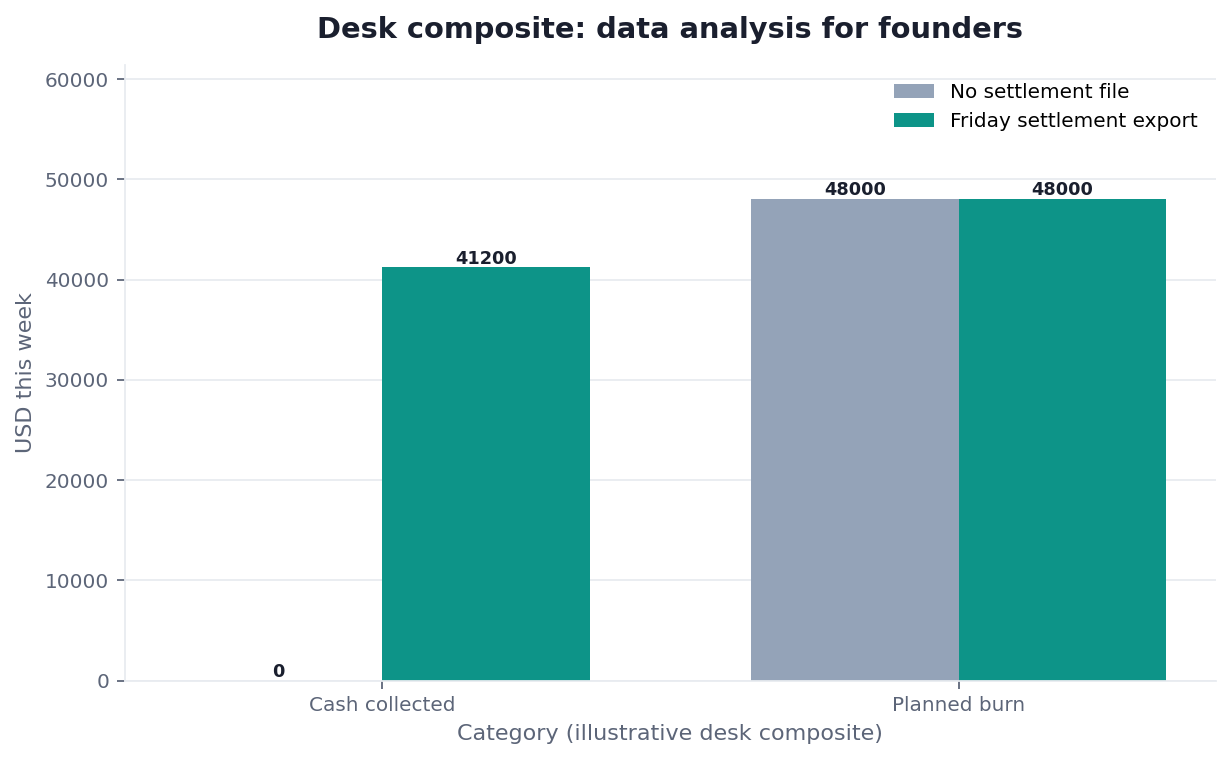
Figure. Desk composite from this page: Friday settlement export; $41,200 collected vs $48,000 planned burn. Published context: gartner.com; docs.aws.amazon.com; rfc-editor.org. Not a customer experiment, SLA, or official benchmark.
| Evidence class | What you can cite | What you cannot claim |
|---|---|---|
| Desk composite on this page | Planned burn $48,000, collected $41,200, variance -$6,800, one account -$6,100, downloadable log | Customer uplift %, vendor bake-off win, named-logo case |
| Published authority (linked above) | Frameworks and definitions from the cited sources | That those sources ran this desk sample |
| Homepage recognition | 2026 WAIC Future Tech OPC Excellence Award as published on the company homepage; self-described, not independently verified here | That WAIC, SEC, FRED, or Gartner scored this article |
Desk composite: $41,200 collected vs $48,000 planned; one account down $6,100. Published context: Gartner Peer Insights, Amazon Redshift docs, RFC 4180, Wikipedia A/B testing, ISO/IEC 27017.
The phrase data analysis for founders is the object under test, not a slogan. If a file cannot show how data analysis for founders was computed, reject the number. Write data analysis for founders into the task goal the same way you would say it in the room.
We ran this check on a sanitized composite at the InfiniSynapse desk on 2026-08-25. The inspect order for data analysis for founders was the plain-language goal, the bound definition, and the opened table. We stopped when a revenue name nobody locked could still ship. The memo stayed in draft. Figures stay illustrative. What you can copy is the first inspectable question, not a time-saved claim.
Scorecard: Ready for the Board Pack
Use this before you announce that data analysis for founders is now “handled.”
| Check | Pass | Fail |
|---|---|---|
| You can write the board decision in one sentence | Ask | You are browsing |
| The cash sentence exists outside the model | Ask | Bind a note first |
| The source is authorized and read-only | Ask | Stop |
| You can open the account filter after the answer | Brief | Do not brief |
| You know when to call an analyst | Healthy | You will over-trust |
| You will keep the file, not a screenshot | Repeatable | Folklore |
Data analysis for founders is ready when four or more rows pass.
Failure Modes Founders Hit First
These three show up before any architecture debate.
A revenue name nobody locked
“Revenue,” “bookings,” and “cash” are not the same number. They are fights.
A screenshot that cannot be replayed
Someone pastes a chart into the founder chat. Next week the export moved. Data analysis for founders requires a file and a restated goal, or you cannot rerun.
Asking the agent to pay a vendor
“Send the wire.” That is not analysis. Data analysis for founders reads.
Before you put a number in the pack, check that you can say the decision, the accounts, and the source out loud. If any of those is fuzzy, do not brief yet.
Route the same diagnosis to the live guide that owns the next object.
| Live guide | Open it when |
|---|---|
| self-service data analysis for business | you need the business-language method, not only the board number |
| ask data in plain language | the missing object is the meeting sentence |
| data analysis for product managers | the object is a weekly product decision |
| Data Analysis for Operators | Ops needs today’s grain, not a new semantic model |
| When to Call an Analyst | Self-serve stops where the grain does not exist |
| First Question to Ask Your Data after Signup | The first question is a grain you already know |
Ask this week’s board number on a read-only source
Connect a source you authorize—or pick a sanitized sample—and ask this week’s cash decision; First $5 on us if you want that same ask in the workspace. This check uses only sources you authorize.
Commercial association: You do not need the workspace to complete the educational diagnosis on this page.
Open InfiniSynapseHow this page is sourced. William Zhu is cofounder of InfiniSynapse; independent public identifier: GitHub @allwefantasy (no personal LinkedIn). Institution: About InfiniSynapse. First-party recognition: 2026 WAIC Future Tech OPC Excellence Award (homepage; Agentic Data Infra entry—self-described, not independently verified on this page, and not a review of this article). Trust pages: Privacy · publishing terms · NIST Privacy Framework. Desk methodology note: 2026-07-29 attestation. Downloadable first-party run: desk log
ADR-DAF-20260827· aggregate CSV · verify script. Reviewed by analytics engineering · data platform · LLM security · editor. Editorial standards · corrections. Contact zhuhl@infinisynapse.com. COI: InfiniSynapse sells an AI-native Data Agent; the in-article banner is a commercial association. Fact-check: RFC 4180 · Amazon Redshift docs · Wikipedia A/B testing · Gartner Peer Insights — Analytics & BI · ISO/IEC 27017 · SEC EDGAR · FRED · World Bank Indicators API · FASB ASC · PCAOB auditing standards · Stanford HAI AI Index · McKinsey: The state of AI · W3C DCAT · DataCite. First-party numbers on this page are desk logADR-DAF-20260827only.
How to cite this page
Page: Zhu, W., & InfiniSynapse Data Team. (2026). Data Analysis for Founders: Bind, Then Replay. InfiniSynapse
Run: InfiniSynapse Data Team. (2026). Desk log ADR-DAF-20260827 (sanitized composite)
Neither is an audit. Cite those published artifact counts when you quote data analysis for founders figures from this first-party desk comparison. As of 2026-08-29, no independent reproduction of this cash contrast exists. DataCite and W3C DCAT stay citable as catalog and citation standards. Data analysis for founders citations should name the run ID, not a fluent restatement of a screenshot. Reopen data analysis for founders after those files. Name data analysis for founders quotes. Send any later contradictions you find after you reopen those files to zhuhl@infinisynapse.com.
Frequently Asked Questions
Do I need a warehouse team for data analysis for founders?
Bottom line: No. Data analysis for founders works with five people if the source already exists. You still need to read a filter list and an account window. That is literacy, not a hire.
Is a spreadsheet the same as a board pack?
Bottom line: No. A spreadsheet is a snapshot. Data analysis for founders is the ask plus the open. Keep the spreadsheet; do not pretend a cell is a reopenable number.
What is the first founder question I should ask?
Bottom line: Ask a decision you own this week, on a source you already have. “Does cash collected this week cover the burn we planned?” is enough. The board ask starts there, not with “tell me something interesting.”
When must I stop and call an analyst?
Bottom line: Stop when two sources disagree, when pay or a public claim is in play, or when you cannot restate the accounts. Data analysis for founders ends at the edge of judgment, not at the edge of curiosity.
How can a founder obtain independent evidence?
Bottom line: Test one question on an official public source, predeclare the grain and expected calculation, save two runs, and ask a finance or analytics reviewer outside the buying team to reconcile and sign the checklist.
Do the external institutions endorse this workflow?
Bottom line: No. SEC, FRED, World Bank, FASB, PCAOB, Gartner, ISO, and the other linked publishers provide source data, standards, or market context. None is represented as a customer, certifier, or reviewer of this page.
Did SEC, FRED, or a news outlet recognize this page?
Bottom line: No. The SEC EDGAR company filings API and FRED publish official filings and economic series. They did not evaluate InfiniSynapse. There is no independent award page for this article, no media citation of this founder guide on this page, no professional certification for the author, and there is no personal LinkedIn to add.
Conclusion
Data analysis for founders is a five-person habit: write the board decision, point at a source that already exists, open the filter, keep the file. You do not need a warehouse team. You do need the courage to refuse a paragraph you cannot reopen.
Use the scorecard on tomorrow’s pack number. If you cannot say the accounts out loud, you are not ready. When you want that first board question on a source you authorize, open InfiniSynapse and ask it in the same sentence you would say in the room.