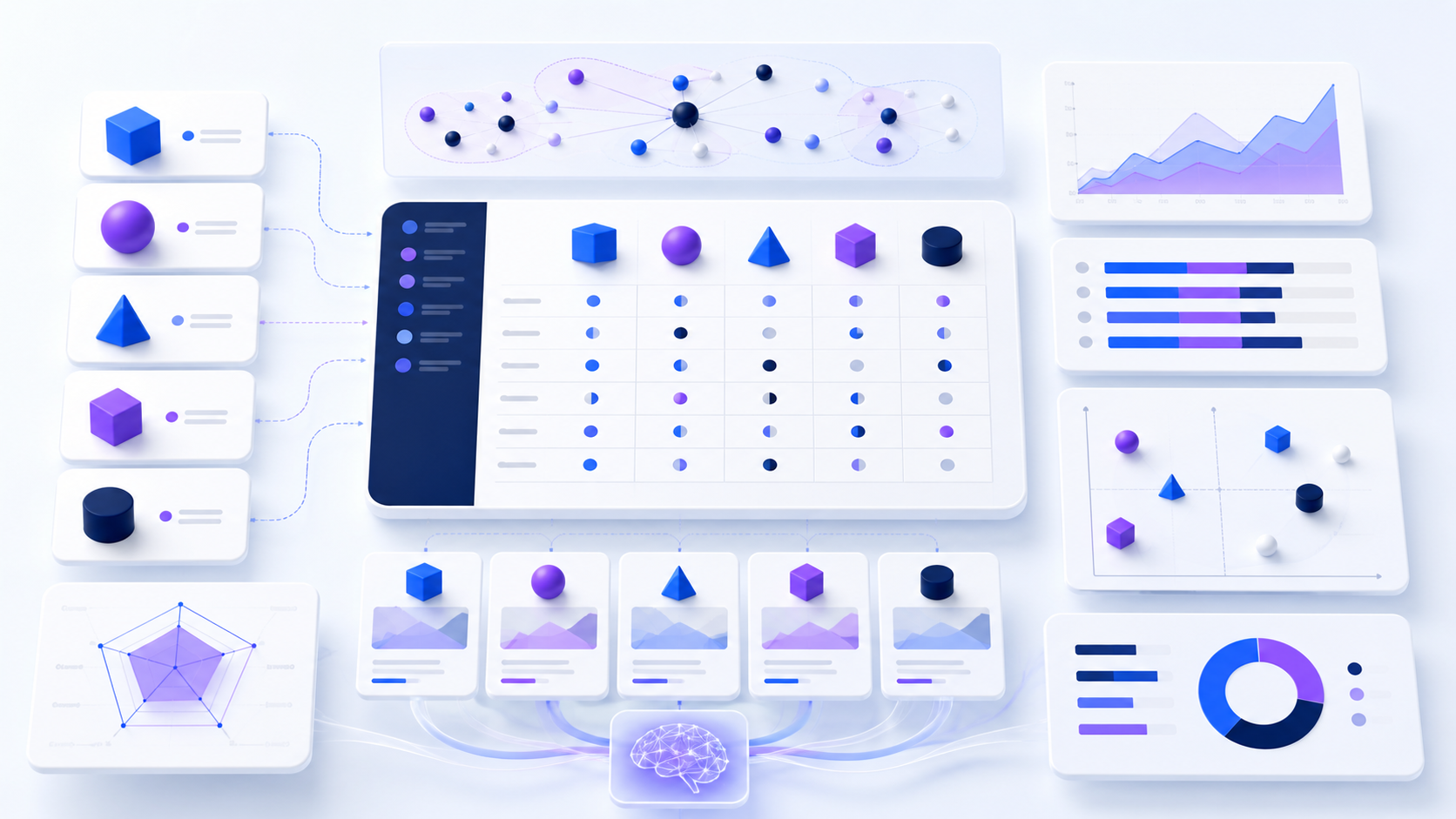
1. What Is Competitor Analysis1. 什么是 Competitor Analysis
Competitor analysis is a repeatable decision process: define the rivals and substitutes that matter, collect dated and verifiable evidence, compare their choices against consistent criteria, and translate meaningful differences into action. It is not a one-time spreadsheet, a collection of screenshots, or a hunt for facts that make your own product look superior.
竞品分析是一套可重复的决策流程:界定真正相关的竞争者与替代方案,收集带日期且可验证的证据,以一致标准比较各方选择,再把有意义的差异转化为行动。它不是一次性的表格、截图合集,也不是只寻找有利于证明自家产品更好的材料。
A useful analysis begins with a decision. A product team may need to decide which workflow to improve next. A marketing team may be refining category language. A sales team may need a defensible answer to a recurring objection. Leadership may be testing whether a new segment is attractive. The decision determines which competitors, dimensions, evidence, and time horizon belong in the study. Without that anchor, research expands indefinitely and produces a broad report that nobody can use. Teams should also document who requested the analysis, which decision deadline applies, and how feedback will be incorporated, so research remains accountable, timely, reviewable, and useful after final delivery.
有效分析必须从一个决策问题开始。产品团队可能要决定下一步改善哪个工作流;市场团队可能要优化品类语言;销售团队可能需要回答反复出现的客户异议;管理层可能正在判断某个新细分市场是否值得进入。这个决策决定研究中应纳入哪些竞争者、比较维度、证据和时间范围。缺少这个锚点,研究就会无限扩张,最后形成没人能使用的宽泛报告。团队还应记录谁提出分析需求、适用的决策截止时间以及如何吸收反馈,从而确保研究在最终交付后仍然可负责、及时、可复核且实用。
The unit of competition is usually a customer task, not a company label. A direct competitor serves a similar audience with a similar product. An indirect competitor solves the same higher-level job through a different product type. A substitute may be a spreadsheet, an internal process, an agency, an open-source project, or simply doing nothing. These alternatives matter because buyers compare outcomes, effort, risk, and switching cost—not only feature lists. A narrow brand-only view can therefore miss the option that wins most deals.
竞争的基本单位通常是客户任务,而不是公司标签。直接竞争者以相似产品服务相近受众;间接竞争者通过不同产品类型完成同一个更高层任务;替代方案还可能是电子表格、内部流程、咨询机构、开源项目,甚至“维持现状”。这些选择之所以重要,是因为买家比较的是结果、投入、风险和切换成本,而不仅仅是功能清单。只盯着同类品牌,往往会漏掉真正赢走客户的选择。
A bounded comparison designed to answer a specific product, market, positioning, or investment question.
围绕明确的产品、市场、定位或投资问题开展的有限范围比较。
The ongoing, ethical system for collecting, validating, distributing, and refreshing market and competitor signals.
持续、合规地收集、验证、分发并更新市场及竞争信号的体系。
The two practices reinforce each other. Analysis converts evidence into a decision at a point in time; competitive intelligence maintains the sensing system that keeps important evidence current. The distinction protects teams from two common failures: intelligence with no decision attached, and analysis built from stale or unverified material.
两者相互支持:分析把某一时点的证据转化为决策,而竞争情报则维护持续感知系统,让重要证据保持更新。区分二者可以避免两种常见失败:收集了大量情报却没有决策用途,或者基于陈旧、未经核实的材料做分析。
Set boundaries explicitly. Use lawful public sources, licensed research, approved customer feedback, and authorized internal data. Do not misrepresent identity, evade access controls, collect personal data without a valid purpose, or request confidential information from employees and partners. Separate facts from interpretations: “the pricing page showed three tiers on August 20” is an observation; “the company is moving upmarket” is an inference that requires additional evidence. Give each conclusion a confidence level and record what would change it.
还要明确伦理与数据边界:使用合法公开来源、已获许可的研究、经过批准的客户反馈和有权限的内部数据;不要伪造身份、绕过访问控制、无正当目的收集个人信息,也不要向员工或合作伙伴索取机密。必须区分事实与推断:“8 月 20 日的定价页显示三个套餐”是观察;“该公司正在向高端市场移动”则是需要更多证据的推断。每个结论都应附置信度,并说明什么新证据会改变判断。
2. How to Identify Competitors2. 如何识别竞争对手
Start with the customer’s situation: who is trying to accomplish what, under which constraints, and what happens if the task remains unsolved? Describe the job in neutral language before naming vendors. “A research team needs to compare product evidence across ten vendors before a quarterly planning meeting” produces a more accurate field than “companies selling competitor-analysis software.” The first framing reveals manual research, consultants, databases, internal analysts, and AI-assisted workflows; the second reveals only products that use a particular category label.
先从客户情境出发:谁要完成什么任务、受到哪些限制、如果问题得不到解决会发生什么?在写出厂商名称之前,用中性语言描述任务。例如,“研究团队需要在季度规划会前比较十家厂商的产品证据”,比“销售竞品分析软件的公司”更能界定真实竞争范围。前者会揭示人工研究、咨询机构、数据库、内部分析师和 AI 辅助流程;后者只会找到使用某个品类标签的产品。
- Define the decision arena. Specify audience, customer task, geography, price band, deployment model, buying trigger, and time horizon. Record exclusions so the scope remains stable.界定决策场域。明确受众、客户任务、地区、价格带、部署方式、购买触发点和时间范围,并记录排除条件以保持范围稳定。
- Build a long list from independent signals. Combine customer interviews, sales-loss notes, search results, marketplaces, analyst categories, review sites, public filings, partner ecosystems, communities, and procurement documents.用独立信号建立长名单。综合客户访谈、丢单记录、搜索结果、应用市场、分析机构分类、评论网站、公开文件、合作生态、社区和采购文件。
- Classify each alternative. Label direct competitors, indirect competitors, substitutes, emerging entrants, adjacent players, internal solutions, and the status quo. One company may occupy several labels across segments.给每种选择分类。标记直接竞争者、间接竞争者、替代方案、新进入者、邻近玩家、内部方案和维持现状;同一公司在不同细分市场中可能有不同角色。
- Prioritize the short list. Score customer-task overlap, audience overlap, deal frequency, growth signal, switching proximity, and strategic threat. Deep analysis should focus on the alternatives most likely to change the decision.筛选重点名单。按客户任务重合、受众重合、交易出现频率、增长信号、切换接近度和战略威胁评分;深度分析只聚焦最可能改变决策的对象。
Use at least two independent discovery routes before treating the list as complete. Search visibility can overrepresent companies that invest heavily in SEO. Review sites can overrepresent established SaaS categories. Sales notes may reflect only late-stage deals. Customer interviews can overrepresent memorable recent experiences. When several sources independently surface the same alternative, confidence increases; when only one source mentions it, keep the candidate but label the uncertainty.
在认为名单完整之前,至少使用两种相互独立的发现路径。搜索结果会高估重视 SEO 的公司,评论网站会高估成熟 SaaS 品类,销售记录可能只反映后期交易,客户访谈又容易偏向近期且印象深刻的经历。多个来源独立指向同一替代方案时,置信度才会上升;若只有单一来源提及,也可保留,但必须标记不确定性。
| Type类型 | Identification test识别方法 | Why it matters重要性 |
|---|---|---|
| Direct直接竞争者 | Similar buyer, job, product form, and budget买家、任务、产品形态和预算相近 | Appears in active evaluations and win/loss decisions直接出现在采购评估及输赢单中 |
| Indirect间接竞争者 | Same outcome, materially different method结果相同,但方法明显不同 | May reset price, workflow, or category expectations可能改变价格、流程或品类预期 |
| Substitute替代方案 | Customer can choose it instead of buying客户可以用它替代采购 | Often explains why otherwise qualified deals stall常常解释看似合格的交易为何停滞 |
| Emerging新进入者 | New model, funding, adoption, or technology signal出现新模式、融资、采用或技术信号 | Could alter future economics before share is visible可能在市场份额显现前改变未来经济结构 |
Visualize the result with market mapping. A map can organize players by customer segment and solution type, plot them by price and specialization, or show how value moves from data suppliers through platforms to end users. Its purpose is not decoration. A good map makes omissions, clusters, white space, and boundary assumptions visible so stakeholders can challenge them before deeper research begins.
随后通过市场映射把结果可视化。地图可以按客户细分和解决方案类型组织玩家,也可以按价格与专业化程度定位,或展示价值如何从数据供应商经平台流向最终用户。它不是装饰;一张好地图应让遗漏、聚类、空白机会和边界假设变得可见,以便相关人员在深度研究前提出质疑。
3. Competitive Landscape Analysis3. 竞争格局分析
A competitor profile explains one company. A competitive landscape explains the system around all relevant players: how demand is segmented, where value is created, which capabilities are becoming standard, how buyers choose, and what forces could change the field. This broader lens prevents a team from copying an individual rival while missing the structural change that made the rival successful.
竞品档案解释一家公司的情况,而竞争格局解释所有相关玩家所处的系统:需求如何细分、价值在哪里产生、哪些能力正在成为标配、买家如何选择,以及哪些力量可能改变市场。这个更宽的视角能避免团队只模仿某个对手,却错过让对手成功的结构性变化。
Describe market structure with observable dimensions. How concentrated is the field? Are leaders integrated suites, focused specialists, service providers, open ecosystems, or low-cost utilities? Do network effects, proprietary data, distribution, certification, switching costs, regulation, or implementation expertise create defensibility? Which complements—cloud platforms, agencies, resellers, data providers, or integration partners—shape adoption? Avoid assigning a precise market-share percentage unless the denominator, geography, period, and source are known.
应使用可观察维度描述市场结构:市场集中度如何?领先者属于一体化套件、专业工具、服务商、开放生态还是低价基础工具?网络效应、专有数据、分销、认证、切换成本、监管或实施经验是否形成防御能力?云平台、代理商、经销商、数据提供者或集成伙伴等互补方如何影响采用?除非清楚分母、地区、周期和来源,否则不要给出精确市场份额。
Segment the market by variables that change buying behavior. Firm size, regulated status, technical maturity, workflow complexity, data sensitivity, procurement model, and urgency often matter more than broad industry labels. A small team may value speed and transparent self-service pricing; an enterprise may value governance, identity controls, deployment options, and vendor continuity. The same competitor can be strong in one segment and irrelevant in another, so score fit by segment rather than declaring an overall winner.
市场细分应使用真正改变购买行为的变量。企业规模、受监管程度、技术成熟度、流程复杂度、数据敏感度、采购模式和紧迫性,通常比宽泛行业标签更重要。小团队可能重视速度和透明的自助定价;大型企业则可能重视治理、身份控制、部署方式和供应商持续经营能力。同一个竞争者可能在某一细分市场很强,在另一市场却无关紧要,因此应按细分适配度评分,而不是选出笼统的“总冠军”。
Concentration, business models, barriers, complements, economics, regulation, and switching dynamics.
集中度、商业模式、进入壁垒、互补方、经济性、监管与切换机制。
Leaders, specialists, challengers, substitutes, emerging entrants, partners, and gatekeepers.
领导者、专业厂商、挑战者、替代方案、新进入者、合作伙伴和守门人。
Groups whose needs, constraints, buying criteria, willingness to pay, or routes to adoption differ.
需求、限制、购买标准、支付意愿或采用路径不同的客户群体。
Directional changes supported by repeated evidence—not a single announcement or a fashionable narrative.
由重复证据支持的方向性变化,而不是一条公告或流行叙事。
Track trends as hypotheses with evidence thresholds. For example, “buyers increasingly expect AI-assisted summaries” should be tested against product releases, procurement language, customer interviews, usage data, and changes in packaging. Record the earliest signal, supporting observations, contradictory evidence, affected segments, expected time horizon, and what strategic choice the trend could alter. This makes the trend falsifiable rather than inevitable.
趋势应作为带证据门槛的假设来追踪。例如,“买家越来越期待 AI 辅助摘要”需要用产品发布、采购语言、客户访谈、使用数据和套餐变化共同验证。记录最早信号、支持性观察、反证、受影响细分市场、预期时间范围,以及它可能改变的战略选择。这样趋势就可以被证伪,而不是被当作必然事实。
Maintain two layers: a stable competitive landscape that explains the category, and a dated competitive landscape analysis that evaluates current movement. The stable layer may be refreshed twice a year; volatile evidence such as pricing, packaging, releases, partnerships, and campaigns may need monthly or quarterly review. Label every snapshot with a source date so readers do not mistake historical evidence for the present.
建议维护两层内容:一层是解释品类的相对稳定竞争格局,另一层是评估当前变化且带日期的竞争格局分析。稳定层可每半年更新一次;定价、套餐、产品发布、合作与营销活动等高波动证据则可能需要每月或每季度复核。每个快照都必须标注来源日期,防止读者把历史信息误当成现状。
4. Competitor Information Framework4. 竞品信息框架
A reliable framework keeps every researcher answering the same decision question with comparable evidence. Begin with a short research charter: decision, audience, scope, competitors, period, owners, permitted sources, output, and review date. Then organize evidence into dimensions that describe how a competitor creates, communicates, delivers, and captures value. The framework should be consistent enough to compare, but flexible enough to mark a field “not applicable” instead of forcing false equivalence.
可靠框架能让所有研究人员围绕同一个决策问题,以可比较证据作答。先写一份简短研究章程:决策、受众、范围、竞争对象、周期、负责人、允许使用的来源、输出形式和复核日期。随后按竞争者如何创造、传递、交付与获取价值组织证据。框架既要足够一致以支持比较,也要允许把不适用项目标为“不适用”,避免制造虚假的等价关系。
| Dimension维度 | Questions核心问题 | Useful evidence可用证据 |
|---|---|---|
| Company and strategy公司与战略 | Which markets, customers, outcomes, and growth paths appear to matter?哪些市场、客户、结果和增长路径似乎最重要? | Official filings, leadership statements, hiring, partnerships, acquisitions官方文件、管理层表述、招聘、合作与收购 |
| Product and workflow产品与工作流 | What job is supported from input through output, and where does human work remain?产品从输入到输出支持什么任务,哪些环节仍需人工? | Documentation, trials, release notes, demos, accessibility and API references文档、试用、更新日志、演示、可访问性及 API 资料 |
| Pricing and packaging定价与套餐 | What is the value metric, entry point, upgrade trigger, and enterprise gate?价值计量方式、入门门槛、升级触发条件和企业版限制是什么? | Dated pricing pages, order forms, procurement records, partner listings带日期的定价页、订单、采购记录和合作平台页面 |
| Positioning and proof定位与证明 | For whom, against what alternative, and supported by which proof?面向谁、相对什么替代方案、由什么证据支持? | Homepages, campaigns, case studies, reviews, comparison pages首页、营销活动、案例、评论和比较页 |
| Distribution and adoption分销与采用 | How do users discover, buy, implement, integrate, and expand?用户如何发现、购买、实施、集成和扩展? | Search, marketplaces, partner programs, onboarding, integrations, communities搜索、应用市场、伙伴计划、引导流程、集成和社区 |
| Risk and constraints风险与限制 | What technical, operational, legal, trust, or switching barriers affect fit?哪些技术、运营、法律、信任或切换障碍会影响适配? | Security pages, terms, status history, data policies, documented limitations安全页面、条款、状态历史、数据政策和公开限制 |
For every observation, capture source URL or document, access date, relevant excerpt or normalized note, segment, confidence, and researcher. Use confidence labels with defined meaning: “confirmed” may require an official source or direct reproducible test; “supported” may require two independent sources; “unverified” means a plausible statement that should not drive a decision. A field left blank is better than an invented answer. Missing data can itself reveal opacity, but it cannot be treated as proof of weakness.
每条观察都应记录来源 URL 或文档、访问日期、相关摘录或标准化笔记、适用细分市场、置信度和研究人员。置信标签必须有清晰定义:“已确认”可要求官方来源或可复现测试;“有支持”可要求两个独立来源;“待验证”表示合理但不能据此决策的陈述。空白字段好过虚构答案。数据缺失可以说明信息不透明,却不能直接证明对手存在弱点。
Use source hierarchy rather than treating every page equally. Official documentation and reproducible product behavior usually support capability claims better than promotional copy. Public filings and registries can support corporate facts. Customer reviews and communities reveal perceived experience but contain selection bias and may describe old versions. Search results show visibility, not market share. Job postings can suggest investment direction, not a shipped roadmap. Triangulate important conclusions across source types.
应建立来源层级,而不是把所有网页视为同等可信。官方文档和可复现产品行为通常比宣传文案更能支持功能判断;公开申报文件和注册信息适合确认公司事实;客户评论和社区能揭示体验感知,但存在选择偏差,也可能描述旧版本;搜索结果反映可见度,不代表市场份额;招聘信息可提示投入方向,却不等于已经交付的路线图。重要结论必须跨来源验证。
Evidence rule: write “what we observed,” “what it may mean,” and “what we should do” as separate fields. This simple separation prevents an attractive interpretation from being copied into later reports as though it were an original fact.
证据规则:把“我们观察到什么”“它可能意味着什么”“我们应该做什么”写成三个独立字段。这个简单分离能防止一个听起来合理的解释在后续报告中被当作原始事实反复引用。
Research governance should be defined before evidence collection begins. Specify permitted source types, access methods, storage locations, retention periods, reviewer roles, and escalation paths for ambiguous or sensitive material. Public availability does not automatically make every collection method appropriate, and a technically accessible page may still carry contractual, privacy, or usage restrictions. Researchers should record access dates and preserve enough context to understand each claim without copying unnecessary personal information. High-impact conclusions should receive independent review, while estimates and inferences should remain visibly labeled. When evidence conflicts, retain both records, investigate differences in time, geography, segment, plan, and methodology, and document why one interpretation was selected. This governance layer improves reproducibility, protects contributors, and makes later updates faster overall.
在开始收集证据前,应先定义研究治理规则,包括允许使用的来源类型、访问方式、存储位置、保留期限、审核角色,以及处理歧义或敏感材料的升级路径。公开可见并不代表所有收集方式都合适;技术上可以访问的页面仍可能受到合同、隐私或使用条款限制。研究人员应记录访问日期,保留足以理解陈述的语境,同时避免复制不必要的个人信息。高影响结论应接受独立复核,估算和推断则必须保持明确标记。证据冲突时,应保留双方记录,调查时间、地区、细分市场、套餐和方法差异,并记录最终选择某种解释的原因。这一治理层能提高可复现性、保护参与者,并让后续更新整体更高效。
A reusable competitor analysis framework should also record change. Save snapshots, compare evidence to the previous review, and mark additions, removals, reversals, and unresolved conflicts. The goal is not to archive the internet; it is to preserve the minimum evidence trail needed to reproduce important conclusions and understand why the team changed its mind.
可复用的竞品分析框架还应记录变化:保存快照、与上次复核对照,并标记新增、删除、反转和未解决冲突。目标不是存档整个互联网,而是保留足以复现重要结论、理解团队为何改变判断的最小证据链。
5. Competitive Benchmarking5. 竞争对标
Benchmarking is the disciplined comparison of entities against defined measures. It becomes useful only when a difference can influence a decision. “Competitor A has 120 integrations and we have 80” is not yet an insight. Ask whether the additional integrations serve the target segment, are maintained, materially reduce implementation effort, and affect win rates or retention. Counting what is easy can distract from measuring what customers value.
对标是按照预先定义的衡量标准进行系统比较。只有当差异能够影响决策时,它才有价值。“对手 A 有 120 个集成,我们只有 80 个”还不是洞察。还需判断新增集成是否服务目标细分市场、是否持续维护、是否显著降低实施成本,以及是否影响赢单率或留存。只统计容易统计的项目,会让团队忽视客户真正重视的结果。
Choose a small set of dimensions tied to the research question. For a product decision, these might include task coverage, time to first useful output, output quality, error recovery, collaboration, governance, integration effort, accessibility, and total cost. For a go-to-market decision, dimensions might include ideal customer profile, entry offer, value metric, sales motion, proof, distribution, ecosystem, and message consistency. Define each measure before gathering scores so evidence is not bent to a preferred conclusion.
应选择少量与研究问题直接相关的维度。产品决策可以比较任务覆盖、首次产出时间、输出质量、错误恢复、协作、治理、集成投入、可访问性和总成本;市场决策可以比较理想客户画像、入门产品、价值计量、销售方式、证明材料、分销、生态和信息一致性。在收集评分前先定义每个指标,避免证据被扭曲以迎合预设结论。
- Define the metric and direction. State what is measured, unit, population, period, and whether higher is actually better.定义指标及方向。说明衡量对象、单位、样本、周期,以及数值更高是否真的更好。
- Normalize the test. Use the same task, input, environment, account level, device, and observer guidance wherever possible.统一测试条件。尽量使用相同任务、输入、环境、账号级别、设备和观察说明。
- Attach evidence and confidence. Keep the source and date beside every value; distinguish measured, reported, estimated, and unknown.附证据与置信度。每个数值旁保留来源和日期,区分实测、官方披露、估算与未知。
- Weight by segment need. A regulated enterprise and a solo creator should not receive the same weighting model.按细分需求加权。受监管大型企业和个人创作者不应使用同一套权重。
- Run sensitivity checks. Change plausible weights or uncertain values and see whether the recommendation survives.做敏感性检查。调整合理权重或不确定值,观察建议是否仍然成立。
Use ordinal scores cautiously. A five-point score can compress complex evidence into a decision view, but its labels must describe observable states. For example, collaboration might range from “single-user export only” to “shared workspace with roles, comments, history, and approval controls.” Avoid pretending that a subjective 4.2 is scientifically more accurate than a well-explained “strong for enterprise review, weak for rapid external sharing.” Preserve the raw notes behind every score.
使用等级评分时要谨慎。五分制可以把复杂证据压缩成决策视图,但每个等级必须描述可观察状态。例如,协作能力可以从“仅支持单用户导出”到“支持角色、评论、历史记录和审批控制的共享空间”。不要假装主观的 4.2 分一定比“企业复核能力强,但快速外部分享较弱”更科学。每个分数背后都必须保留原始笔记。
| Evidence status证据状态 | Meaning含义 | Decision use决策用途 |
|---|---|---|
| Measured实测 | Reproducible test under recorded conditions在已记录条件下可复现测试 | Can support direct comparison within test boundaries可在测试边界内支持直接比较 |
| Reported披露 | Claim from an official or identifiable source来自官方或可识别来源的陈述 | Use with source attribution and scope注明来源与适用范围后使用 |
| Estimated估算 | Derived from assumptions or incomplete data基于假设或不完整数据推导 | Use for scenarios; test sensitivity用于情景分析,并检查敏感性 |
| Unknown未知 | Insufficient reliable evidence缺少可靠证据 | Do not silently score as zero不得默认为零分 |
Interpret a gap in context. A feature gap can be a must-fix, a segment-specific trade-off, an intentional simplification, or irrelevant noise. A price gap may reflect different service, limits, risk transfer, contract length, or cost structure. A distribution gap may be more strategically important than a feature gap because customers never encounter the product. Link the analysis to competitive benchmarking and competitor benchmarking methods, but conclude with choices: close, differentiate, partner, reframe, monitor, or deliberately ignore.
差距必须结合语境解释。功能差距可能是必须修复的问题、只影响某一细分市场的权衡、刻意简化,或完全无关的噪声;价格差距可能来自服务、额度、风险承担、合同周期或成本结构差异;分销差距甚至可能比功能差距更重要,因为客户根本看不到产品。分析可结合竞争基准对标和竞品对标方法,但最终必须落到选择:补齐、差异化、合作、重构叙事、继续观察或有意识地忽略。
6. Product Benchmarking6. 产品对标
Product benchmarking moves beyond a feature checklist to compare the complete path from promise to outcome. A feature can exist yet be difficult to discover, restricted to an expensive plan, unreliable with realistic data, disconnected from the surrounding workflow, or inaccessible to important users. Test the same representative task across products and document the setup, steps, decisions, waiting, failure modes, output, and follow-up work.
产品对标不能停留在功能打勾表,而要比较从承诺到结果的完整路径。某个功能即使存在,也可能难以发现、只在昂贵套餐中开放、对真实数据不可靠、与上下游工作流脱节,或无法被重要用户群使用。应在不同产品中执行同一个代表性任务,记录设置、步骤、决策、等待、失败方式、输出和后续工作。
Build the feature matrix around user jobs. Group capabilities into “prepare,” “perform,” “verify,” “collaborate,” “govern,” and “integrate,” or another workflow-specific sequence. For each cell, record availability, plan, maturity, evidence, limitations, and test date. Separate table-stakes requirements from differentiators and emerging bets. A long matrix without prioritization rewards products that accumulate options, even when those options create complexity without improving outcomes.
功能矩阵应围绕用户任务组织。可以按“准备、执行、验证、协作、治理和集成”分组,或采用更符合具体流程的顺序。每个单元格记录可用性、所属套餐、成熟度、证据、限制和测试日期。区分基础必备、差异化能力和新兴投入。没有优先级的超长矩阵会奖励堆积选项的产品,即使这些选项只增加复杂度、没有改善结果。
Can the product complete the important job, including exceptions and handoffs?
产品能否完成重要任务,包括异常处理和交接?
How much learning, navigation, waiting, correction, and duplicate work is required?
需要多少学习、导航、等待、修正和重复劳动?
Can users inspect evidence, understand uncertainty, recover errors, and control data?
用户能否检查证据、理解不确定性、恢复错误并控制数据?
Do price, implementation, administration, and switching costs fit the segment?
价格、实施、管理和切换成本是否适合目标细分市场?
Compare positioning with the same discipline. Capture the target customer, frame of reference, promised outcome, differentiator, proof, and call to action from each product’s public materials. Then test message-product consistency: does onboarding deliver the promised first outcome? Do proof points support the stated segment? Does packaging reinforce the value metric? A competitor may have polished messaging that the product does not yet substantiate, or a strong product whose value is difficult to understand.
定位比较也要采用同样纪律。从公开材料中记录各产品的目标客户、参照品类、承诺结果、差异点、证明和行动号召,再检查信息与产品是否一致:引导流程是否交付承诺的首次结果?证明材料是否支持目标细分市场?套餐是否强化价值计量方式?有的竞争者信息包装精致,但产品尚未兑现;也有产品很强,却难以让用户理解其价值。
Treat usability observations as evidence, not universal truth. Use realistic scenarios and representative users when possible. Record device, accessibility settings, expertise, and account level. Count consequential friction rather than every click: an extra verification step may improve trust, while a hidden error state may destroy it. For AI-assisted products, test output variability, grounding, editability, provenance, failure recovery, privacy controls, and the work required to verify results.
可用性观察是证据,但不是普遍真理。应尽可能使用真实场景和代表性用户,并记录设备、可访问性设置、专业程度和账号级别。关注会影响结果的摩擦,而不是机械计算点击次数:额外验证步骤可能提升信任,隐藏的错误状态却可能摧毁信任。对于 AI 辅助产品,还要测试输出波动、依据、可编辑性、来源追踪、失败恢复、隐私控制,以及验证结果所需的人工工作。
The output of product benchmarking and competitive product analysis should be an opportunity portfolio, not a cloning list. Classify opportunities as parity requirements, simplifications, differentiated strengths to amplify, underserved workflow gaps, trust improvements, ecosystem plays, or experiments. Score each by customer evidence, strategic fit, expected impact, effort, uncertainty, and reversibility. The best opportunity may be to remove friction around an existing strength rather than add the feature a competitor recently launched.
产品基准对标与竞争产品分析的输出应该是机会组合,而不是抄袭清单。把机会分为基础补齐、流程简化、应强化的差异优势、未被满足的工作流缺口、信任改进、生态合作或实验,并按客户证据、战略适配、预期影响、投入、不确定性和可逆性评分。最佳机会可能不是复制对手的新功能,而是减少用户使用现有优势时的摩擦。
A structured competitor comparison turns scattered evidence into a reviewable decision asset for teams. Prepare the competitors, decision question, comparison dimensions, and dated evidence you want to review. The Competitor Benchmarking Analyzer can help organize the comparison; verify every source and keep final strategic judgment with your team.
结构化竞品比较可以把零散证据转化为团队可复核的决策资产。准备好竞争者名单、决策问题、比较维度和带日期的证据。竞品对标分析器可以辅助组织比较;所有来源仍需人工核验,最终战略判断应由团队负责。
7. Templates and Reports7. 模板与报告
A template is valuable when it preserves reasoning, not when it merely standardizes appearance. The first page should state the decision, intended reader, scope, date, competitors included and excluded, research method, and important limitations. Every later chart should be traceable to evidence. If the audience cannot tell which claims are measured, reported, estimated, inferred, or unknown, the report creates confidence without accountability.
模板的价值在于保留推理,而不仅是统一外观。第一页应说明决策问题、目标读者、范围、日期、纳入与排除的竞争者、研究方法和重要限制。后续每张图都必须能够追溯到证据。如果读者无法判断哪些陈述来自实测、官方披露、估算、推断或未知,报告就会制造没有责任基础的信心。
| Report component报告组成 | Purpose用途 | Quality check质量检查 |
|---|---|---|
| Executive decision brief决策摘要 | State the question, answer, confidence, and immediate action说明问题、答案、置信度和即时行动 | Can a decision owner act without reading every appendix?决策负责人不读全部附录也能行动吗? |
| Market and competitor map市场与竞品地图 | Show scope, segments, alternatives, and relationships展示范围、细分、替代方案与关系 | Are axes meaningful and omissions explicit?坐标轴是否有意义,遗漏是否明确? |
| Evidence-backed profiles证据型档案 | Summarize strategy, product, pricing, distribution, proof, and risks概括战略、产品、定价、分销、证明和风险 | Is every material claim dated and sourced?每条重要陈述是否带日期与来源? |
| Comparison and scorecard比较与评分卡 | Normalize evidence against segment-specific criteria按细分市场标准统一比较证据 | Are definitions, unknowns, and weights visible?定义、未知项和权重是否可见? |
| Implications and actions影响与行动 | Convert gaps and patterns into owned choices把差距和模式转化为有人负责的选择 | Does each action have owner, timing, evidence, and validation?每项行动是否有负责人、时间、证据和验证方式? |
Keep the evidence register separate from the presentation layer. The register is a durable table with observation, source, date, scope, confidence, tags, and notes. The scorecard normalizes selected observations. The report explains the meaning for a particular audience. One evidence record can support several reports without copying unsupported text, and a changed source can be updated once. This architecture also makes review and audit easier.
证据台账应与展示层分开。台账是一张持续维护的表,包含观察、来源、日期、适用范围、置信度、标签和笔记;评分卡对选定观察进行标准化;报告则面向特定受众解释含义。一条证据可以支持多份报告,无需复制未经支持的文字;来源变化时也只需更新一次。这种结构更便于复核与审计。
Scorecards need a legend. Show the definition for every dimension, weight, scale, evidence status, and treatment of missing data. Never convert “unknown” to the lowest score merely to complete a chart. Add a confidence view beside the performance view: a competitor with a high score based on weak evidence should not look more certain than one with a moderate score based on direct testing. Run an unweighted view or alternate segment weights to reveal conclusions that depend on one assumption.
评分卡必须有图例。展示每个维度的定义、权重、评分尺度、证据状态和缺失数据处理方式。绝不能为了填满图表就把“未知”换算成最低分。在表现评分旁增加置信度视图:一个基于薄弱证据的高分竞争者,不应显得比一个基于直接测试的中等分竞争者更确定。还应运行无权重视图或不同细分市场权重,暴露依赖单一假设的结论。
Write recommendations as testable choices. “Improve onboarding” is too vague. A stronger recommendation states the target segment, observed friction, supporting evidence, proposed change, expected outcome, owner, timing, cost or dependency, success measure, and stop condition. Distinguish “no-regret” actions from larger bets and monitoring items. A gap is not automatically a roadmap priority; it competes with customer pain, company strategy, product coherence, opportunity cost, and the option to differentiate elsewhere.
建议应写成可验证的选择。“改善新手引导”过于模糊。更好的建议要说明目标细分市场、观察到的摩擦、支持证据、拟议改变、预期结果、负责人、时间、成本或依赖、成功指标和停止条件。区分低后悔行动、大型投入和观察事项。竞品差距不会自动成为路线图优先级;它还要与客户痛点、公司战略、产品一致性、机会成本和在其他方面差异化的选择竞争。
A practical competitor analysis template should end with a decision log. Record what was decided, what was deferred, which evidence mattered, objections raised, assumptions accepted, owners, and the next review trigger. This closes the loop between research and action and helps future teams understand whether a conclusion failed because the evidence was wrong, the environment changed, or implementation did not match the decision.
实用的竞品分析模板应以决策日志结束。记录已决定、暂缓和否决的事项,关键证据、异议、被接受的假设、负责人及下次复核触发条件。这样才能闭合研究与行动之间的循环,也帮助未来团队判断某个结论失效,是因为证据错误、环境变化,还是执行没有落实决策。
8. Tool and Software Selection8. 工具与软件选型
Tool selection should follow the workflow, not precede it. Map how the team discovers signals, captures evidence, validates claims, normalizes fields, compares entities, collaborates, approves conclusions, distributes outputs, monitors change, and measures decisions. Then identify the steps where software reduces repeated work or error. Buying an all-in-one platform before defining this operating model often produces another repository of links with low trust and weak adoption.
工具选型应服从工作流,而不是先买工具再定义流程。先梳理团队如何发现信号、保存证据、验证陈述、标准化字段、比较对象、协作、审批结论、分发输出、监控变化并衡量决策,再判断哪些步骤适合用软件减少重复劳动或错误。在运营模式尚未明确前购买“一体化平台”,往往只会得到另一个低信任、低采用率的链接仓库。
Alerts, search, release tracking, public-record monitoring, web-change detection, and source feeds.
提醒、搜索、版本跟踪、公开记录监控、网页变化检测和来源订阅。
Source capture, timestamps, permissions, excerpts, tagging, deduplication, and version history.
来源保存、时间戳、权限、摘录、标签、去重和版本历史。
Entity normalization, matrices, scoring, mapping, clustering, change detection, and scenario views.
实体标准化、矩阵、评分、映射、聚类、变化检测和情景视图。
Briefs, battlecards, reports, alerts, workflow integrations, ownership, feedback, and impact tracking.
简报、销售卡片、报告、提醒、工作流集成、责任、反馈和影响追踪。
Evaluate competitive intelligence tools and competitor analysis software with realistic tasks. Measure source coverage, freshness, traceability, duplicate handling, entity accuracy, permissions, export, API or integration options, search, collaboration, customization, accessibility, administration, security, retention, support, and total cost. Ask what happens when the tool is wrong, when a page changes, when a teammate leaves, and when the organization must explain where a conclusion came from.
评估竞争情报工具和竞品分析软件时要使用真实任务。衡量来源覆盖、新鲜度、可追溯性、重复处理、实体准确性、权限、导出、API 或集成、搜索、协作、自定义、可访问性、管理、安全、保留政策、支持和总成本。还要询问:工具出错时怎么办?网页变化时怎么办?成员离职时怎么办?组织需要解释结论来源时怎么办?
AI can accelerate repetitive cognition. It can extract fields from documents, cluster similar claims, propose entity matches, summarize changes, compare evidence against a rubric, generate questions, surface contradictions, translate notes, and draft audience-specific briefs. It can also invent facts, merge different companies, lose qualifiers, misread dates, overstate weak evidence, and produce fluent recommendations that do not follow from the source. Treat AI output as a work product to inspect, not an authority.
AI 可以加速重复性的认知工作,例如从文档提取字段、聚类相似陈述、建议实体匹配、概括变化、按评分标准比较证据、生成问题、发现冲突、翻译笔记并起草面向不同受众的简报。但它也可能虚构事实、混淆不同公司、丢失限定条件、误读日期、高估薄弱证据,并生成虽然流畅却无法由来源推出的建议。因此 AI 输出是需要检查的工作成果,不是权威。
AI control checklist: preserve source links and excerpts; require structured output; separate extraction from interpretation; display uncertainty; sample and verify results; restrict confidential inputs; document model and prompt changes when they affect reproducibility; and assign a human owner to every final conclusion.
AI 控制清单:保留来源链接与摘录;要求结构化输出;分离信息提取与解释;展示不确定性;抽样并核验结果;限制机密输入;在影响可复现性时记录模型和提示词变化;为每个最终结论指定人工负责人。
Pilot software with a bounded dataset and a decision your team already understands. Compare time, completeness, correction effort, confidence, adoption, and downstream usefulness against the current process. Include the effort required to configure taxonomies, resolve duplicates, maintain integrations, train users, and govern data. A fast first summary can still be expensive if experts must reconstruct every source before trusting it.
软件试点应使用范围明确的数据集和团队已经理解的决策。与现有流程比较时间、完整度、修正投入、置信度、采用率和下游实用性,并计入配置分类体系、解决重复、维护集成、培训用户和治理数据的成本。即使首次摘要生成很快,如果专家必须重新寻找每个来源才能相信结果,整体成本仍然很高。
9. AI Competitor Benchmarking Workflow9. AI 竞品对标工作流
The safest and most useful AI workflow keeps evidence and judgment visible at every stage. Begin with a decision brief and a data model before uploading or collecting anything. Decide which fields are factual, which require interpretation, which sources are permitted, which data is confidential, and who approves the output. AI should operate inside this structure, not define it implicitly from whatever documents happen to be available.
安全且有效的 AI 工作流必须在每个阶段保持证据与判断可见。上传或收集材料前,先建立决策简报和数据模型;确定哪些字段属于事实、哪些需要解释、允许哪些来源、哪些数据属于机密,以及谁负责批准输出。AI 应在这个结构中工作,而不是根据碰巧拿到的文档隐式决定分析框架。
- Frame the decision. Write one decision question, target audience, segment, geography, time horizon, alternatives, exclusions, and success criteria.界定决策。写出一个决策问题、目标受众、细分市场、地区、时间范围、替代方案、排除项和成功标准。
- Design the comparison schema. Define entities, dimensions, evidence fields, allowed values, confidence rules, and the treatment of missing or conflicting information.设计比较结构。定义实体、维度、证据字段、允许值、置信规则,以及缺失或冲突信息的处理方式。
- Collect lawful, dated evidence. Save official sources, reproducible observations, approved internal signals, access dates, excerpts, and scope. Respect permissions and access controls.收集合规且带日期的证据。保存官方来源、可复现观察、获准内部信号、访问日期、摘录和范围,并遵守权限及访问控制。
- Use AI for structured extraction. Ask for JSON or tabular fields, source references, exact qualifiers, and explicit unknowns. Do not ask the model to fill gaps plausibly.用 AI 做结构化提取。要求输出 JSON 或表格字段、来源引用、准确限定条件和明确未知项;不要让模型“合理补全”空白。
- Resolve entities and contradictions. Check company names, products, plans, dates, currencies, geographies, and versions. Queue conflicts for human review rather than averaging them away.解决实体与冲突。检查公司名、产品、套餐、日期、币种、地区和版本;把冲突送交人工复核,而不是用平均值掩盖。
- Compare under a defined rubric. Apply segment weights, retain raw observations, separate unknown from absent, and run sensitivity scenarios.按明确标准比较。应用细分市场权重,保留原始观察,区分未知与不存在,并运行敏感性情景。
- Generate hypotheses, not verdicts. Ask AI to propose implications, alternative explanations, missing evidence, and disconfirming tests. Require reviewers to accept, revise, or reject each proposal.生成假设而非裁决。让 AI 提出可能影响、替代解释、缺失证据和反证测试,再由审核人接受、修改或否决。
- Publish an evidence-linked brief. Tailor depth to executives, product teams, marketers, or sales, while preserving sources, limitations, confidence, and update date.发布证据可追溯的简报。针对管理层、产品、市场或销售调整深度,同时保留来源、限制、置信度和更新时间。
- Connect action and monitoring. Assign owners, validation metrics, stop conditions, and update triggers. Feed new evidence into the register instead of restarting from scratch.连接行动与监控。指定负责人、验证指标、停止条件和更新触发器,把新证据加入台账,而不是每次从头开始。
Before using an AI comparison tool, prepare a focused set of competitors, the question you need to answer, meaningful dimensions, the target customer segment, and trustworthy source material. Remove personal or confidential information unless its use is authorized and the tool’s data handling is acceptable. After generation, check every material claim against the cited evidence, test whether a different segment or weight changes the result, and have the decision owner sign off.
使用 AI 比较工具之前,应准备明确的竞争者集合、需要回答的问题、有意义的比较维度、目标客户细分和可靠来源材料。除非已经授权且工具的数据处理方式符合要求,否则删除个人或机密信息。生成后,逐条用引用证据核验重要陈述,测试不同细分市场或权重是否改变结论,并由决策负责人最终确认。
Measure the workflow, not just the document. Useful indicators include time from question to reviewed brief, percentage of material claims with valid sources, correction rate, duplicate rate, reviewer agreement, evidence freshness, number of decisions influenced, action completion, and outcomes of the resulting experiments. Do not optimize for the number of competitors tracked or reports produced if teams do not trust or use them.
衡量对象应是完整工作流,而不仅是文档。可用指标包括从提出问题到形成审核简报的时间、重要陈述具备有效来源的比例、修正率、重复率、审核人一致性、证据新鲜度、受影响决策数、行动完成率,以及后续实验结果。如果团队不信任或不使用报告,就不要追求跟踪竞争者数量或报告产量。
Finally, establish refresh triggers. Review pricing and packaging after a documented change; update product comparisons after material releases; revisit market structure after entry, exit, regulation, acquisition, or platform shifts; and reopen strategic conclusions when customer evidence contradicts them. Good analysis is versioned. It shows what the team knew, what it inferred, what it decided, and what changed.
最后建立更新触发条件:有明确变化时复核定价与套餐;重大版本发布后更新产品比较;出现进入、退出、监管、收购或平台变化时重审市场结构;客户证据与原结论冲突时重新打开战略判断。好的分析具有版本记录,清楚展示团队当时知道什么、推断什么、决定什么,以及后来发生了什么变化。
Worked example: choosing a workflow opportunity. Imagine a B2B research product team deciding whether its next quarter should focus on evidence capture, comparison, or executive reporting. The team defines the target as mid-market strategy groups that compare five to fifteen vendors several times a year. It includes two direct SaaS competitors, one research agency, a spreadsheet-and-browser workflow, and the option to continue with existing internal analysts. This scope prevents the study from becoming a general review of every market-intelligence platform.
示例:选择工作流机会。假设一个 B2B 研究产品团队要决定下季度重点投入证据保存、比较分析还是管理层报告。团队把目标界定为每年多次比较 5–15 家厂商的中型企业战略部门,纳入两个直接 SaaS 对手、一家研究咨询机构、电子表格加浏览器的工作流,以及继续使用内部分析师的选择。这个范围避免研究演变成对所有市场情报平台的泛泛评测。
The team defines six outcomes before collecting data: time to capture a defensible source, ability to preserve date and context, effort to normalize entities, speed of producing a comparison, reviewer confidence, and effort to turn findings into an executive brief. It creates observable scales for each outcome and gives trust and evidence traceability twice the weight of presentation polish because interviews show that reviewers reject attractive reports when they cannot inspect the underlying source. That weighting decision is documented, not hidden inside a formula.
团队在收集数据前定义六个结果:保存可辩护来源所需时间、保留日期与语境的能力、实体标准化投入、形成比较的速度、审核人信心,以及把发现转化为管理层简报的投入。每项结果都有可观察评分标准。由于访谈显示审核人会拒绝无法检查底层来源的精美报告,因此团队把信任与证据可追溯性的权重设为展示美观的两倍,并公开记录这一权重决定。
Researchers then execute the same scenario in each alternative. They capture a pricing page, a release note, a documentation claim, and a customer comment for each fictional vendor; normalize product and plan names; identify a contradiction; build a five-column comparison; and prepare a one-page recommendation. They record setup time, active work, correction time, missing fields, errors, and points where an expert must intervene. Public claims are marked “reported,” reproducible behavior is marked “measured,” and any assumed service cost is marked “estimated.” Unknown data remains unknown.
研究人员随后在每个方案中执行同一情景:为每个虚构厂商保存定价页、版本说明、文档陈述和客户评论;统一产品与套餐名称;识别一处冲突;建立五列比较;并制作一页建议。记录设置时间、实际操作、修正时间、缺失字段、错误和必须由专家介入的节点。公开陈述标为“披露”,可复现行为标为“实测”,假设的服务成本标为“估算”,未知数据继续保持未知。
An AI assistant extracts fields and drafts the first comparison, but every row must retain its source. During review, the team finds that the model merged similarly named product plans and converted an annual price into a monthly value without preserving the commitment assumption. Those errors are corrected, added to a review checklist, and used to improve the extraction schema. The error rate and correction time become part of the workflow benchmark; they are not concealed because the final table looks right.
AI 助手提取字段并起草首次比较,但每一行都必须保留来源。复核时,团队发现模型混淆了名称相似的产品套餐,还把年付价格换算成月费却没有保留年度承诺假设。团队修正错误、把它们加入审核清单,并改进提取结构。错误率和修正时间成为工作流基准的一部分,而不会因为最终表格看起来正确就被隐藏。
The initial scorecard suggests that a direct competitor leads in report presentation, while the manual workflow provides the strongest source control and the agency provides the deepest interpretation at the highest cost. Sensitivity analysis shows that the apparent overall winner changes when presentation weight rises, but the evidence-capture result remains stable across plausible weights. Customer interviews also show repeated frustration with recreating lost source context. The team therefore avoids copying the competitor’s report designer and prioritizes a structured evidence register with faster capture, clear provenance, and export into existing executive templates.
初始评分卡显示,一个直接对手在报告展示方面领先,人工流程拥有最强来源控制,咨询机构则以最高成本提供最深入解释。敏感性分析发现,当展示权重提高时,总体优胜者会变化,但证据保存结论在合理权重范围内保持稳定。客户访谈也反复提到丢失来源语境后重新查找的痛苦。因此团队没有复制对手的报告设计器,而是优先建设更快保存、来源清晰、且能导出到现有管理模板的结构化证据台账。
The recommendation becomes a four-week prototype rather than a roadmap commitment. The product owner must demonstrate that users can capture and retrieve dated evidence faster, that reviewers can trace at least 95 percent of material claims in the test brief, and that the export works with the team’s current reporting workflow. The team sets a stop condition: if users still rely on manual screenshots because capture interrupts research, the design must be reconsidered. It also assigns a monitoring item for the competitor’s reporting feature instead of treating it as irrelevant forever.
该建议被转化为四周原型实验,而不是直接承诺进入路线图。产品负责人必须证明用户能够更快保存并找回带日期证据,审核人能追溯测试简报中至少 95% 的重要陈述,且导出能适配现有报告流程。团队还设定停止条件:如果保存过程打断研究,导致用户仍依赖手工截图,就必须重新考虑设计。同时继续监控对手的报告功能,而不是永久忽略它。
After the prototype, the decision log records the original question, evidence set, weighting model, observed AI errors, customer validation, chosen action, rejected alternatives, owner, success measures, and next review trigger. Three months later, a new integration from a competitor can be added to the evidence register and assessed against the same customer outcome without rebuilding the whole analysis. This illustrates the core benefit of a disciplined framework: it creates a renewable decision asset, not a static deck that expires after one meeting.
原型结束后,决策日志记录原始问题、证据集、权重模型、发现的 AI 错误、客户验证、选定行动、被否决方案、负责人、成功指标和下次复核触发条件。三个月后,即使对手发布新集成,也可以直接把证据加入台账,用相同客户结果重新评估,无需重做整份分析。这正是系统框架的核心价值:形成可持续更新的决策资产,而不是一次会议后就过期的静态演示文稿。
The example also shows why an AI tool should not be evaluated by generation speed alone. A ten-second answer that loses assumptions, dates, and source boundaries can create hours of verification work or lead to a confident mistake. Measure the complete reviewed path: preparation, extraction, correction, comparison, approval, distribution, and learning from the resulting action. Automation is valuable when it reduces total decision cost while preserving or improving evidence quality.
这个示例也说明,不能只用生成速度评估 AI 工具。一个十秒生成却丢失假设、日期和来源边界的答案,可能制造数小时核验工作,甚至导致自信但错误的决策。应衡量从准备、提取、修正、比较、批准、分发到行动后学习的完整审核路径。只有在保持或提高证据质量的同时降低总决策成本,自动化才真正有价值。
A final governance review should ask whether the analysis is proportionate to the decision. A reversible messaging experiment needs less evidence than a costly platform migration or market entry. Increase review depth when decisions affect regulated users, personal data, long contracts, public claims, or major capital. Record conflicts of interest, access restrictions, and known blind spots. Share only the detail each audience needs, but never remove caveats in a way that changes the meaning. Archive superseded reports with visible version labels so old recommendations are not reused accidentally. When evidence remains weak, recommend a discovery step—an interview, prototype, pricing test, or technical evaluation—rather than using a polished scorecard to disguise uncertainty. Review the final brief with someone who did not perform the research; fresh questions often expose hidden assumptions, ambiguous labels, and unsupported leaps. This keeps competitor analysis connected to learning and prevents it from becoming a political instrument for defending a decision that has already been made.
最后还应进行治理复核,判断分析投入是否与决策风险相称。可逆的营销信息实验所需证据少于高成本平台迁移或市场进入。若决策涉及受监管用户、个人数据、长期合同、公开陈述或重大资本,应提高复核深度。记录利益冲突、访问限制和已知盲区。针对不同受众分享必要细节,但不能通过删除限制条件改变原意。用清晰版本标签归档旧报告,避免过时建议被误用。当证据仍然薄弱时,应建议客户访谈、原型、定价测试或技术评估等探索步骤,而不是用精美评分卡掩盖不确定性。还应让未参与研究的人复核最终简报,新视角常能发现隐藏假设、含糊标签和缺乏支持的推断。这样才能让竞品分析服务于学习,而不是成为替既定结论辩护的政治工具。
Use the InfiniSynapse Competitor Benchmarking Analyzer to structure competitors and dimensions into a comparison. Treat the result as decision support: confirm sources, review uncertainty, and keep human ownership of conclusions.
使用 InfiniSynapse 竞品对标分析器,把竞争者和比较维度组织成结构化结果。该结果仅用于决策辅助:确认来源、复核不确定性,并由人工对结论负责。
Frequently Asked Questions常见问题
Competitor analysis is a repeatable process for defining relevant rivals and substitutes, gathering verifiable evidence, comparing their choices and performance, and converting differences into decisions. It should begin with a decision question and preserve the source, date, scope, and confidence behind every important conclusion.
竞品分析是一套可重复流程:界定相关竞争者与替代方案,收集可验证证据,比较其选择和表现,再把差异转化为决策。它应从决策问题出发,并为每个重要结论保留来源、日期、范围和置信度。
Update volatile evidence such as pricing, packaging, releases, and campaigns monthly or quarterly. Review the broader market map and strategic conclusions at least twice a year, or after a major release, acquisition, regulatory change, new entrant, platform shift, or repeated contradictory customer evidence.
定价、套餐、版本和营销活动等高波动信息可每月或每季度更新。整体市场地图和战略结论至少每半年复核一次;遇到重大版本、收购、监管变化、新进入者、平台变化或反复出现的相反客户证据时,应立即重审。
Include direct competitors, indirect alternatives, substitute workflows, emerging entrants, and the option to do nothing. Prioritize them by overlap with the customer task and segment, frequency in real evaluations, switching proximity, growth signals, and likelihood of changing the decision.
应纳入直接竞争者、间接替代、替代工作流、新进入者以及“维持现状”。再按客户任务与细分市场重合度、真实评估出现频率、切换接近度、增长信号和改变决策的可能性排序。
A useful template records the decision question, audience, scope, competitor set, evidence source and date, comparison dimensions, normalized observations, unknowns, confidence, weights, implications, owners, actions, validation measures, and next review trigger. Keep the evidence register separate from the presentation.
实用模板应记录决策问题、受众、范围、竞品集合、证据来源与日期、比较维度、标准化观察、未知项、置信度、权重、影响、负责人、行动、验证指标和下次复核触发条件,并把证据台账与展示报告分开。
AI can accelerate extraction, normalization, clustering, comparison, contradiction detection, and drafting. It cannot safely own source verification, ambiguity resolution, confidential-data decisions, strategic trade-offs, or final accountability. Use structured outputs, preserve citations, show uncertainty, test samples, and require human approval.
AI 可以加速提取、标准化、聚类、比较、冲突发现和起草,但不能安全替代来源核验、歧义处理、机密数据判断、战略权衡和最终责任。应使用结构化输出、保留引用、展示不确定性、抽样测试并要求人工批准。