What Is Competitive Product Analysis?什么是竞争产品分析?
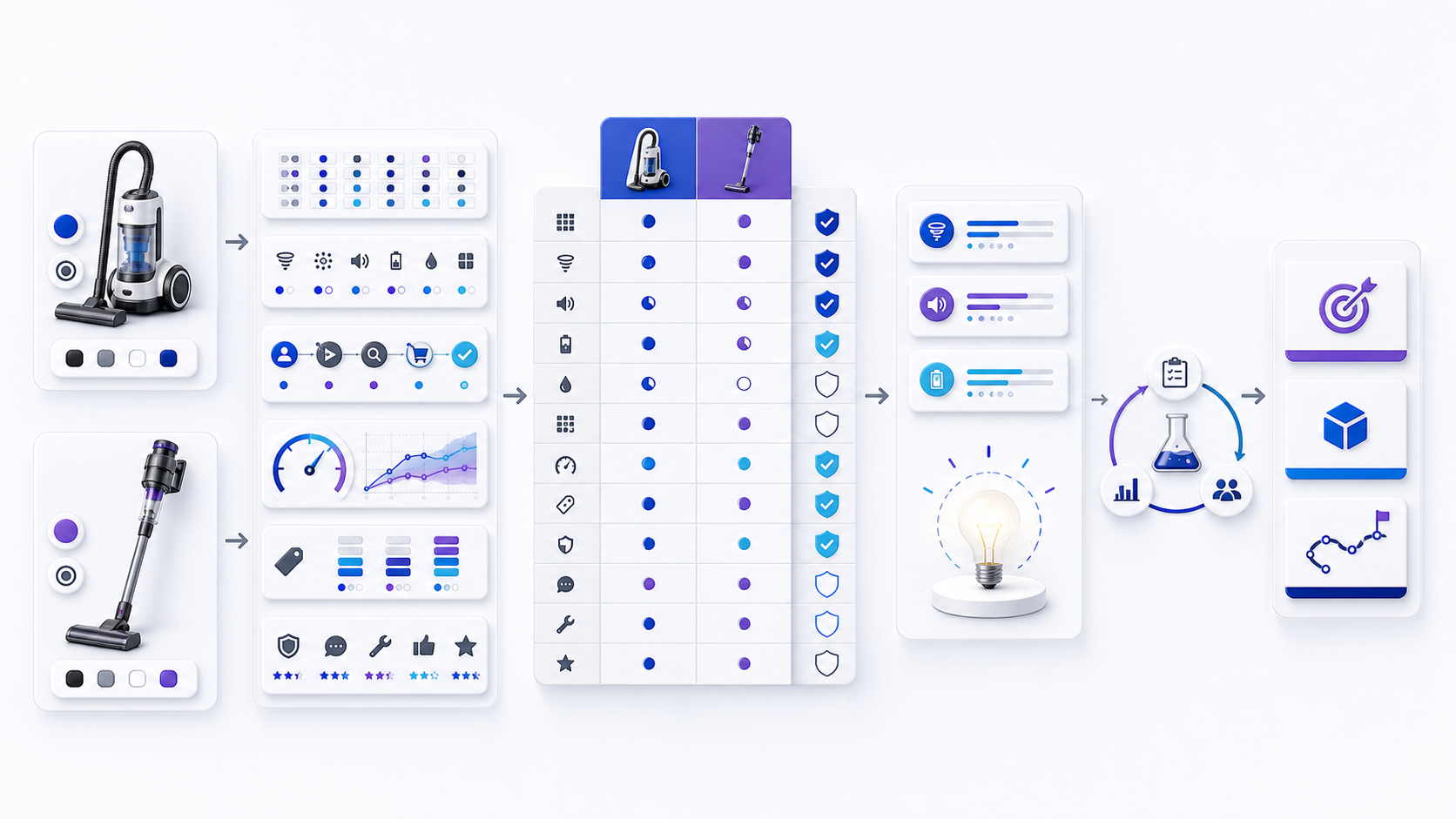
Competitive product analysis is a decision-led comparison of exact product variants across customer tasks, features, parameters, experience, tested performance, price, total cost, service, and customer evidence. Its purpose is to reveal meaningful product gaps, trade-offs, risks, and opportunity hypotheses that can be verified before a roadmap, launch, positioning, or investment decision.
竞争产品分析是一种服务决策的产品比较方法:针对确切产品版本,从客户任务、功能、参数、体验、实测表现、价格、总成本、服务和客户证据等维度进行分析。它用于发现有意义的产品差距、取舍、风险和机会假设,并在路线图、发布、定位或投资决策前进行验证。
This is not a race to count features. A longer checklist can hide weak execution, poor task fit, high buyer effort, or a cost that customers will not accept. Competitive product analysis connects product facts to customer outcomes and evidence quality. Use the broader competitor analysis guide for company and market context, and competitive positioning when choosing which value to own.
这不是功能数量竞赛。更长的清单可能掩盖执行薄弱、任务不匹配、买方投入过高或客户无法接受的成本。竞争产品分析必须把产品事实连接到客户结果与证据质量。如需企业和市场层面的背景,应参考竞品分析指南;如需选择应占据的价值,应参考竞争定位。
Define the Product Decision Before the Matrix建立矩阵前先定义产品决策
Write the decision in one sentence: “Should we prioritize guided connection recovery for the next portable-speaker release?” or “Which cordless-vacuum trade-offs should a new entry model test?” Record the owner, deadline, customer segment, task, geography, channel, product lifecycle stage, options, constraints, and decision rule. “Compare our product with competitors” is too broad to determine useful dimensions or completion.
用一句话写出决策,例如:“下一代便携音箱是否应优先开发引导式连接恢复?”或“新的入门吸尘器应测试哪些取舍?”记录负责人、截止日期、客户细分、任务、地区、渠道、产品生命周期阶段、选项、约束和决策规则。“比较我方与竞品”过于宽泛,无法确定有用维度或完成标准。
Scope rule: include a dimension only if it can change an assumption, option, risk, priority, test, or decision. Record exclusions so a deliberate boundary is not mistaken for missing research.
范围规则:只有可能改变假设、选项、风险、优先级、测试或决策的维度才应纳入。记录排除项,避免有意设定的边界被误认为研究遗漏。
Align Exact Product Identity and Comparison Conditions对齐确切产品身份和比较条件
Create an identity record for every product: brand, product name, model number, generation, hardware revision, software or firmware version, market, release date, package, included accessories, channel, observation date, and source. Do not compare a base model with a premium bundle without labeling the difference. If specifications vary by country, retailer, subscription, configuration, or update, preserve those boundaries.
为每个产品建立身份记录:品牌、产品名、型号、代际、硬件修订、软件或固件版本、市场、发布日期、套餐、随附配件、渠道、观察日期和来源。不能在不标注差异的情况下把基础款与高级套装比较。如果规格随国家、零售商、订阅、配置或更新变化,应保留这些边界。
Use “unknown,” “not disclosed,” “not applicable,” “not tested,” and “not available in this market” as separate states. A blank must never silently become zero or “no.” Exact identity work looks administrative, but many false advantages begin with mismatched variants, dates, packages, or units.
应区分“未知”“未披露”“不适用”“未测试”和“该市场不可用”。空白不能被悄悄解释为零或“不支持”。准确身份记录看似行政工作,但许多虚假优势正源于版本、日期、套餐或单位不一致。
Analyze the Product Through the Customer Task Journey通过客户任务旅程分析产品
Start with the customer job, context, desired outcome, and constraints. Map discovery, evaluation, purchase, setup, first success, routine use, exception handling, maintenance, support, renewal or replacement, and disposal when relevant. Compare the effort, time, error risk, confidence, accessibility, safety, and recovery at each critical step.
从客户任务、情境、期望结果和约束出发。根据产品情况,映射发现、评估、购买、设置、首次成功、日常使用、异常处理、维护、支持、续订或更换以及处置。在每个关键步骤比较投入、时间、错误风险、信心、无障碍、安全和恢复能力。
A feature may exist but fail in the journey. An automatic mode that is hard to discover, difficult to configure, or impossible to recover from should not receive the same score as one that reliably completes the job. Use observed task behavior and defined success criteria rather than relying only on interface screenshots or marketing descriptions.
功能可能存在,却在旅程中失败。难以发现、难以配置或出错后无法恢复的自动模式,不能与可靠完成任务的模式获得相同评分。应使用观察到的任务行为和明确定义的成功标准,而不能只依赖界面截图或营销描述。
Build a Decision-Specific Product Comparison Schema建立服务决策的产品比较结构
| Dimension维度 | Evidence to capture记录证据 | Decision question决策问题 |
|---|---|---|
| Customer task客户任务 | Context, outcome, steps, effort, errors, recovery, accessibility情境、结果、步骤、投入、错误、恢复和无障碍 | Which product completes the important job under realistic conditions?哪款产品能在真实条件下完成重要任务? |
| Features and specifications功能与规格 | Capability, level, limits, dependencies, defaults, units, conditions能力、水平、限制、依赖、默认值、单位和条件 | What is present, usable, and materially different?哪些能力存在、可用且具有实质差异? |
| Performance and quality性能与质量 | Test method, samples, environment, repeatability, uncertainty, failures测试方法、样本、环境、重复性、不确定性和失败 | How reliably does performance hold in the target context?性能在目标情境中能多可靠地保持? |
| Price and total cost价格与总成本 | Acquisition, required accessories, subscription, setup, maintenance, switching购买、必需配件、订阅、设置、维护和切换 | What value and burden does the buyer receive over the decision period?在决策周期内,买方获得什么价值并承担什么负担? |
| Service and lifecycle服务与生命周期 | Availability, onboarding, warranty, repair, updates, support, replacement可得性、上手、保修、维修、更新、支持和更换 | Can the promised experience be sustained after purchase?购买后能否持续兑现承诺体验? |
| Customer evidence客户证据 | Interviews, observed use, reviews, support, returns, win/loss, limitations访谈、观察使用、评价、支持、退货、赢单输单和限制 | Which differences matter, to whom, and with what confidence?哪些差异对谁重要,置信度如何? |
Compare Feature Quality, Not Checkbox Presence比较功能质量,而不只是勾选是否存在
Define every row before collection: customer outcome, capability definition, level or range, unit, direction, prerequisites, test condition, source rule, and missing state. Separate “supported” from “usable without add-on,” “available in the tested version,” and “successful under the target task.” Preserve raw values and the original wording when normalization requires interpretation.
收集前定义每一行:客户结果、能力定义、水平或范围、单位、方向、前提、测试条件、来源规则和缺失状态。区分“支持”“无需附加项即可使用”“在被测版本中可用”和“在目标任务中成功”。标准化需要解释时,应保留原始数值和原始表述。
Do not add scores merely because a feature exists. Evaluate discoverability, setup, effectiveness, consistency, control, feedback, error prevention, recovery, accessibility, integration, security, and trade-offs where relevant. Weight dimensions only after the target customer and decision criteria are defined, and keep raw evidence visible beside any score.
不能仅因功能存在就加分。根据相关性评估可发现性、设置、有效性、一致性、控制、反馈、错误预防、恢复、无障碍、集成、安全和取舍。只有在目标客户与决策标准明确后才设置权重,并在任何分数旁保留原始证据。
Design Fair Product Tests and Report Uncertainty设计公平产品测试并报告不确定性
Use a written test protocol: decision metric, test item identity, preparation, environment, instrumentation, calibration or reference, operator steps, sample size, repetitions, randomization where useful, pass or comparison rule, data exclusions, and known uncertainty. Run all products under equivalent conditions unless the decision intentionally compares different use modes.
使用书面测试方案:决策指标、被测产品身份、准备方式、环境、仪器、校准或参照、操作步骤、样本量、重复次数、必要时的随机化、通过或比较规则、数据排除和已知不确定性。除非决策有意比较不同使用模式,否则所有产品应在等效条件下测试。
A measured difference smaller than test variability may be inconclusive. Report ranges, repeatability, failures, missing runs, and conditions, not only averages. Separate manufacturer claims, independent tests, internal measurements, and customer observations. Avoid combining results produced by incompatible methods into one ranking. Safety, health, regulatory, or specialized engineering claims require qualified review and applicable standards.
如果测得差异小于测试变异,结论可能不确定。应报告范围、重复性、失败、缺失测试和条件,而不仅是平均值。区分厂商主张、独立测试、内部测量和客户观察。不能把不兼容方法产生的结果合并成一个排名。涉及安全、健康、监管或专业工程的主张,需要合格人员和适用标准审查。
Compare Total Cost, Service, and Lifecycle比较总成本、服务和生命周期
List price is one input. Capture required accessories, consumables, subscription, financing, delivery, installation, training, energy, maintenance, repair, downtime, support, switching, resale, and disposal when material. Align currency, tax treatment, market, package, purchase date, discount assumptions, and ownership period. Do not infer realized transaction prices from a displayed price page.
标价只是一个输入。根据重要性记录必需配件、耗材、订阅、融资、配送、安装、培训、能源、维护、维修、停机、支持、切换、转售和处置。对齐货币、税务处理、市场、套餐、购买日期、折扣假设和持有周期。不能根据展示价格页面推断实际成交价。
Service can reverse a product conclusion. Warranty coverage, repair path, parts availability, update policy, data portability, support access, and replacement time influence buyer risk. Mark whether the evidence is a written policy, observed experience, reported experience, or inference, and note regional differences.
服务可能逆转产品结论。保修范围、维修路径、零件可得性、更新政策、数据可迁移性、支持渠道和更换时间都会影响买方风险。应标明证据属于书面政策、观察体验、他方报告还是推断,并记录地区差异。
Use Reviews and Customer Signals Responsibly负责任地使用评价和客户信号
Customer evidence helps determine which differences matter, but review volume is not automatically prevalence or market share. Verify exact product, variant, date, channel, geography, user type, use context, severity, duplication, incentives, selection bias, and whether the statement is first-hand. A repeated phrase is a research signal; it is not proof of frequency across the customer base.
客户证据有助于判断哪些差异重要,但评价数量不自动代表发生率或市场份额。核验确切产品、版本、日期、渠道、地区、用户类型、使用情境、严重程度、重复、激励、选择偏差以及是否为第一手陈述。重复表达是研究信号,不是整个客户群发生频率的证明。
Combine interviews, observed tasks, support themes, returns, repair records, controlled studies, and win/loss evidence where lawful and relevant. Preserve counterevidence and quiet outcomes, not only complaints. Remove or minimize unnecessary personal information and confirm rights, retention, and organizational policy before processing supplied material.
在合法且相关时,结合访谈、观察任务、支持主题、退货、维修记录、受控研究和赢单输单证据。保留反证和无明显问题的结果,而不是只收集投诉。处理材料前,应删除或最小化不必要个人信息,并确认使用权、保留周期和组织政策。
Build an Evidence Register Behind Every Comparison为每项比较建立证据台账
Give each material cell an evidence ID, source, exact location, product identity, observation or publication date, market, method, collector, raw value, normalized value, confidence, and limitation. Label statements as observed, measured, reported, inferred, or unknown. “Not found” must not become “does not exist.”
为每个重要单元格记录证据编号、来源、确切位置、产品身份、观察或发布日期、市场、方法、采集人、原始值、标准化值、置信度和限制。把陈述标为已观察、已测量、他方报告、推断或未知。“未找到”不能变成“不存在”。
Keep evidence confidence separate from product performance. A product may appear strong on weak evidence or average on strong evidence. Use scoring only when scale anchors, direction, weights, missing-data treatment, and source requirements are defined in advance. Test whether conclusions survive reasonable changes to weights and uncertain values.
证据置信度必须与产品表现分开。某产品可能在弱证据下显得很强,也可能在强证据下表现一般。只有在刻度锚点、方向、权重、缺失值处理和来源要求预先定义时才使用评分,并测试结论能否承受合理的权重和不确定值变化。
A Nine-Step Competitive Product Analysis Workflow竞争产品分析九步工作流
- Frame the product decision. Define owner, audience, customer task, market, deadline, options, and rule.界定产品决策。定义负责人、受众、客户任务、市场、截止日期、选项和规则。
- Select products and alternatives. Include exact direct variants and meaningful substitutes; document exclusions.选择产品和替代方案。纳入确切直接版本和重要替代方案,并记录排除项。
- Lock identity and conditions. Align model, version, package, region, channel, date, and use context.锁定身份与条件。对齐型号、版本、套餐、地区、渠道、日期和使用情境。
- Design the schema. Define task, feature, parameter, experience, test, cost, service, and evidence rows.设计比较结构。定义任务、功能、参数、体验、测试、成本、服务和证据字段。
- Collect lawful evidence. Preserve source context, raw values, dates, rights, limitations, and unknowns.合法收集证据。保留来源情境、原始值、日期、权利、限制和未知项。
- Observe tasks and run tests. Use equivalent protocols, record failures, and report uncertainty.观察任务并开展测试。使用等效方案,记录失败并报告不确定性。
- Normalize and compare. Align definitions, units, conditions, periods, missing states, and confidence.标准化与比较。对齐定义、单位、条件、时期、缺失状态和置信度。
- Synthesize product implications. Link observations to trade-offs, gaps, risks, options, and counterevidence.综合产品影响。把观察连接到取舍、差距、风险、选项和反证。
- Validate and decide. Test customer value, feasibility, economics, safety, and thresholds before roadmap action.验证与决策。在路线图行动前测试客户价值、可行性、经济性、安全和阈值。
Turn Product Gaps into Validated Opportunity Hypotheses把产品差距转化为经验证的机会假设
A gap is an observed difference; an opportunity requires more. For each gap, state the affected customer and task, importance, current alternative, evidence, expected outcome, mechanism, required capability, delivery cost, risk, ease of imitation, and test. Add counterevidence and a reason the gap may exist—low demand, technical constraint, regulation, poor economics, or an acceptable trade-off.
差距只是观察到的不同,机会还需要更多条件。针对每项差距,说明受影响客户与任务、重要性、当前替代方案、证据、预期结果、机制、所需能力、交付成本、风险、模仿难度和测试。补充反证以及差距可能存在的原因,例如需求低、技术约束、监管、经济性差或可接受的取舍。
Prioritize hypotheses using customer value, strategic fit, evidence confidence, feasibility, economics, risk, time to learn, and defensibility. Avoid copying a rival’s visible feature without understanding its activity system or customer consequence. The strongest next step is often a small customer, usability, technical, or commercial experiment—not immediate roadmap commitment.
根据客户价值、战略匹配、证据置信度、可行性、经济性、风险、学习时间和防御性排列假设。不要在不了解竞品活动系统或客户结果的情况下复制可见功能。最有力的下一步通常是小规模客户、可用性、技术或商业实验,而不是立即承诺路线图。
Hypothetical Example: Cordless Vacuum Comparison虚拟示例:无线吸尘器比较
Illustrative scenario: a product team compares two invented cordless vacuums for households that move between hard floors and low-pile rugs. It aligns the exact packages, battery and cleaning-head configuration, then observes setup, surface change, blockage recovery, emptying, charging, and storage. Names and findings are hypothetical.
示意情境:某产品团队比较两款虚构无线吸尘器,目标家庭需要在硬地板与短绒地毯之间切换。团队对齐确切套餐、电池和清洁头配置,再观察设置、表面切换、堵塞恢复、清空、充电和存放。名称和发现均为假设。
| Observation观察 | Possible implication可能影响 | Required validation所需验证 |
|---|---|---|
| One test item recovers from a simulated blockage with fewer task steps一款测试产品从模拟堵塞中恢复所需步骤更少 | Recovery guidance may reduce interruption and support burden恢复引导可能降低中断和支持负担 | More units, realistic blockages, target users, safety, time, and error rates更多样机、真实堵塞、目标用户、安全、时间和错误率 |
| Published runtime claims use different modes and conditions公开续航主张使用不同模式和条件 | A direct ranking would be misleading直接排名会产生误导 | Common protocol, repeated runs, battery state, environment, and uncertainty统一方案、重复测试、电池状态、环境和不确定性 |
| The lower purchase price requires an accessory for the target task较低购买价需要额外配件才能完成目标任务 | Entry price understates comparable task cost入门价格低估了可比任务成本 | Package availability, total cost, replacement cycle, and buyer importance套餐可得性、总成本、更换周期和买方重要性 |
None of these observations alone proves a winning product direction. The team should reject an opportunity if the task is unimportant, the effect does not repeat, users do not value it, the design creates new safety or maintenance problems, or economics fail the predefined threshold.
这些观察都不能单独证明某个产品方向一定成功。如果任务不重要、效果无法重复、用户不重视、设计制造新的安全或维护问题,或经济性未达到预定阈值,团队就应否定该机会。
Use AI After Product Scope and Evidence Are Prepared产品范围和证据准备好后再使用 AI
AI can help organize supplied parameters and documents, normalize obvious formats, summarize repeated themes, identify missing fields, and draft comparison or opportunity hypotheses. It cannot confirm that variants are comparable, that a test is valid, that a review sample is representative, or that a recommendation is safe, feasible, valuable, and economical. Keep a responsible reviewer between output and decision.
AI 可以帮助组织已提供参数与文档、标准化明显格式、汇总重复主题、识别缺失字段并起草比较或机会假设。它无法确认版本是否可比、测试是否有效、评价样本是否具有代表性,或建议是否安全、可行、有价值且经济。AI 输出与决策之间必须保留明确审核者。
Before opening the InfiniSynapse tool, prepare exact product names and models, aligned parameter names, values and units, authorized CSV, Excel, PDF, Word, or text reference files, a bounded instruction, and a reviewer. The visible interface displays a 20 MB per-file limit, requires sign-in for submission, and identifies radar, parameter, pain-point, and differentiation result views. Confirm current behavior in the live interface.
打开 InfiniSynapse 工具前,准备确切产品名与型号、对齐的参数名、数值和单位、获授权的 CSV、Excel、PDF、Word 或文本参考文件、有边界的指令和审核者。可见界面显示单文件上限为 20 MB,提交分析需要登录,并标明雷达、参数、痛点和差异化结果视图。实际能力应以当前界面为准。
Use the InfiniSynapse Competitor Benchmarking Analyzer to structure exact product parameters and authorized reference files. Verify every output against original evidence, task tests, uncertainty, customer relevance, feasibility, and decision rules.
使用 InfiniSynapse 竞品对标分析器整理确切产品参数和获授权参考文件。依据原始证据、任务测试、不确定性、客户相关性、可行性和决策规则复核全部输出。
Keep Product Analysis Current and Accountable让产品分析保持更新并明确责任
Assign a decision owner, research owner, test owner, and independent reviewer where risk justifies it. Record evidence rights, confidentiality, personal-data handling, safety escalation, retention, and approved uses. Do not use unlawful access, misrepresentation, restricted material, or testing that creates unacceptable risk.
根据风险指定决策负责人、研究负责人、测试负责人和独立审核者。记录证据使用权、保密、个人数据处理、安全升级、保留周期和批准用途。不得使用非法访问、虚假身份、受限材料或制造不可接受风险的测试。
Refresh after a material product update, new model, firmware change, package or price change, channel change, recall, safety notice, support-policy change, or new evidence that challenges a key conclusion. Archive the previous snapshot so teams can distinguish product change from corrected research.
在重大产品更新、新型号、固件变化、套餐或价格变化、渠道变化、召回、安全通知、支持政策变化,或出现挑战关键结论的新证据后更新分析。保存此前快照,以便团队区分产品变化与研究纠错。
Common Competitive Product Analysis Mistakes竞争产品分析常见错误
Different packages, markets, dates, firmware, or accessories create false differences.
不同套餐、市场、日期、固件或配件会制造虚假差异。
Presence replaces task success, quality, limits, dependencies, and recovery.
是否存在取代了任务成功、质量、限制、依赖和恢复。
Values from different methods and conditions are ranked as though equivalent.
不同方法和条件的数值被当作等效结果排名。
Required accessories, service, maintenance, switching, and lifecycle are ignored.
忽略必需配件、服务、维护、切换和生命周期。
Duplicate or biased signals are treated as prevalence or market proof.
重复或有偏信号被视为发生率或市场证明。
Customer value, feasibility, economics, risk, and the reason for absence are untested.
未测试客户价值、可行性、经济性、风险和缺失原因。
Frequently Asked Questions常见问题
Competitive product analysis is a decision-led comparison of exact product variants across customer tasks, features, parameters, experience, tested performance, price, total cost, service, and customer evidence to identify validated product gaps and options.
竞争产品分析是服务决策的确切产品版本比较,覆盖客户任务、功能、参数、体验、实测表现、价格、总成本、服务和客户证据,用于识别经过验证的产品差距与选项。
Competitive product analysis integrates product structure, customer journeys, commercial context, evidence, and opportunity hypotheses for a specific decision. Product benchmarking focuses more narrowly on performance against defined metrics or reference points.
竞争产品分析针对具体决策整合产品结构、客户旅程、商业情境、证据和机会假设;产品对标更集中于根据定义好的指标或参照点比较表现。
Include exact identity and scope, customer jobs, features and specifications, experience journey, controlled performance, quality and reliability, price and total cost, service and lifecycle, customer evidence, confidence, risks, and validation needs.
应包含准确身份与范围、客户任务、功能与规格、体验旅程、受控性能、质量与可靠性、价格与总成本、服务与生命周期、客户证据、置信度、风险和验证需求。
Align model, generation, market, version, definitions, units, test conditions, package, date, and missing-data states. Compare task outcomes and quality levels rather than treating every feature as a yes-or-no checkbox.
对齐型号、代际、市场、版本、定义、单位、测试条件、套餐、日期和缺失数据状态。比较任务结果和质量水平,而不是把每项功能当成简单的是非勾选。
AI can organize supplied parameters and documents and assist comparison, but people must verify product identity, sources, definitions, test conditions, evidence rights, uncertainty, customer relevance, and every product recommendation.
AI 可以组织已提供参数与文档并辅助比较,但必须由人核验产品身份、来源、定义、测试条件、证据权利、不确定性、客户相关性和每项产品建议。