What Is a Competitor Analysis Framework?什么是竞品分析框架?
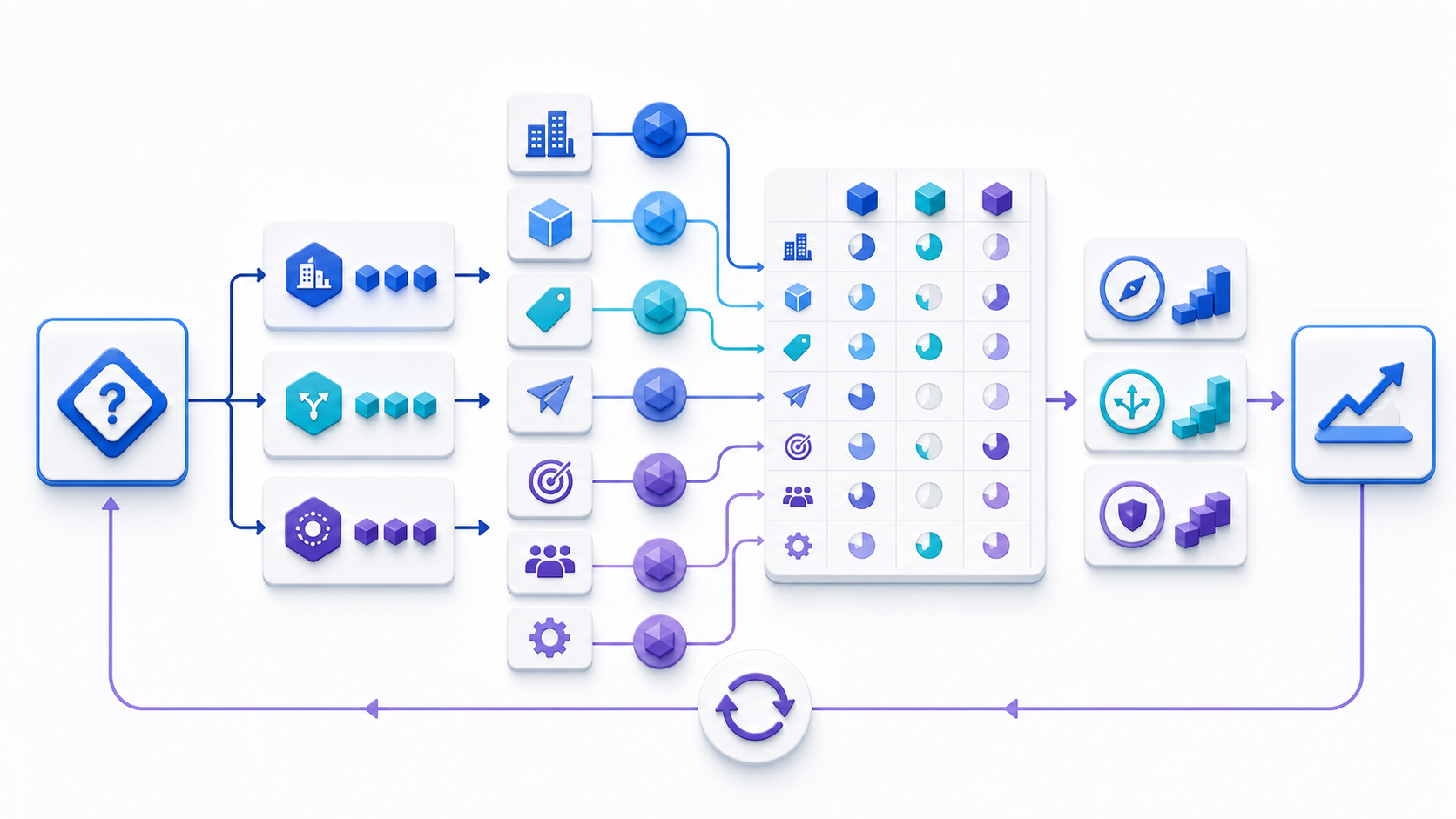
A competitor analysis framework is a repeatable decision system that defines scope, selects relevant competitors, organizes comparable evidence, separates observations from interpretation, and turns validated findings into strategic choices. It prevents a team from collecting attractive facts without knowing which decision they support.
竞品分析框架是一套可重复执行的决策系统:它定义范围、选择相关竞争者、组织可比证据、区分观察与解释,并把经过验证的发现转化为战略选择。它能避免团队收集大量看似有趣、却不知道支持什么决策的事实。
A framework is not a single chart. A feature matrix compares attributes; SWOT summarizes internal strengths and weaknesses plus external opportunities and threats; Five Forces examines industry economics; positioning maps show perceived differences. Each can be useful, but none replaces the end-to-end structure connecting a question, competitor set, evidence, synthesis, decision, owner, and review date.
框架不是一张图。功能矩阵用于比较属性;SWOT 汇总内部优势与劣势以及外部机会与威胁;五力模型研究行业经济力量;定位图呈现感知差异。这些方法各有用途,但都不能代替把问题、竞品集合、证据、综合、决策、负责人和复核日期连成一体的端到端结构。
Begin with the competitor analysis guide if you need a complete introduction. Use market mapping when the competitor universe is unclear, and a competitor analysis template when you need copyable fields. Once those inputs are ready, apply the framework below to connect evidence, interpretation, decisions, and actions.
如果需要完整入门,请先阅读竞品分析指南;当竞争者集合尚不明确时,可先进行市场映射;需要可复制字段时,可使用竞品分析模板。准备好这些输入后,再使用下方框架连接证据、解释、决策和行动。
Start with the Decision, Not the Data从决策开始,而不是从数据开始
Write a one-sentence decision before opening a spreadsheet: “Should we change the entry package for independent design teams in the UK during the next two quarters?” A useful brief identifies the owner, deadline, audience, customer job, geography, time horizon, product level, and options under consideration. “Understand competitors” is too broad because it cannot define relevant evidence or a stopping point.
打开表格前,先写一句决策问题,例如:“未来两个季度,我们是否应为英国独立设计团队调整入门套餐?”有效简报应说明负责人、截止日期、受众、客户任务、地区、时间范围、产品层级以及待评估选项。“了解竞争者”过于宽泛,因为它无法界定哪些证据相关,也无法确定何时停止。
Boundary test: if a finding would not change the decision, an assumption, a risk, or the next experiment, it probably does not belong in this analysis. Record exclusions explicitly so later readers do not mistake an intentional boundary for missing work.
边界测试:如果一项发现不会改变决策、假设、风险或下一项实验,它通常不属于本次分析。应明确记录排除项,避免后续读者把有意设定的边界误认为工作遗漏。
Build a Decision-Relevant Competitor Set建立与决策相关的竞品集合
Do not select competitors only by category label or market fame. Start from the customer job and buying situation. Include direct competitors that solve the same job similarly, indirect alternatives that solve it differently, and adjacent or emerging players that could alter expectations. Add “do nothing,” manual work, an internal process, or a substitute category when buyers genuinely choose those options.
不要只根据品类标签或市场知名度选择竞品。应从客户任务和购买情境出发:纳入以相似方式解决同一任务的直接竞品、以不同方式解决任务的间接替代方案,以及可能改变客户预期的相邻或新兴参与者。当买方确实会选择“不采取行动”、人工流程、内部自建或其他品类时,也应纳入。
Similar customer, job, offer, and buying context; best for close product and price comparison.
客户、任务、产品和购买情境相似,适合开展紧密的产品与价格比较。
Different mechanism for the same job; reveals substitution risk and overlooked expectations.
以不同机制完成同一任务,用于发现替代风险和被忽略的客户预期。
Nearby segment, technology, channel, or business model that may enter or reset the standard.
可能进入市场或重设标准的相邻细分、技术、渠道或商业模式。
A non-rival admired for a specific capability; label it separately to avoid false market conclusions.
因某项能力值得借鉴、但并非竞争者的对象;必须单独标注,避免错误的市场结论。
The Seven-Layer Competitor Analysis Framework七类证据的竞品分析框架
Use consistent layers across every competitor. Adapt fields to the decision, but do not let one company receive rich research while another receives only a homepage summary. Each cell should contain a dated observation, source, confidence level, and any comparability note.
对每个竞争者使用一致的证据层。字段可以根据决策调整,但不能对某家公司进行深入研究、对另一家公司却只记录官网摘要。每个单元格都应包含带日期的观察、来源、置信度和可比性说明。
| Layer证据层 | What to capture记录内容 | Decision use决策用途 |
|---|---|---|
| 1. Company and intent1. 公司与战略意图 | Ownership, stated priorities, target markets, partnerships, investments, launches所有权、公开优先事项、目标市场、合作、投资和发布 | Estimate direction and constraints without pretending to know private plans在不假装掌握内部计划的前提下判断方向与约束 |
| 2. Offer and product2. 产品与方案 | Jobs served, features, specifications, experience, variants, roadmap signals所服务任务、功能、规格、体验、版本和路线信号 | Identify parity, gaps, trade-offs, and testable differentiation识别同质项、差距、取舍和可测试差异化 |
| 3. Pricing and economics3. 定价与经济性 | List price, package, unit basis, discounts, contract terms, switching costs标价、套餐、计价单位、折扣、合同条款和切换成本 | Compare total buyer cost and packaging logic, not isolated prices比较买方总成本和打包逻辑,而非孤立价格 |
| 4. Go-to-market4. 市场进入方式 | Segments, regions, sales motion, channels, partners, onboarding, service细分、地区、销售方式、渠道、伙伴、上手与服务 | Reveal reach, friction, distribution advantage, and channel conflict发现触达、摩擦、分销优势和渠道冲突 |
| 5. Positioning and brand5. 定位与品牌 | Audience, category, promise, proof, message, visual and verbal signals受众、品类、承诺、证明、信息以及视觉和语言信号 | Find claimed territory and whether evidence supports the promise判断其主张的定位领域以及证据是否支持承诺 |
| 6. Customer evidence6. 客户证据 | Reviews, interviews, win/loss notes, support themes, adoption and churn signals评价、访谈、赢单输单记录、支持主题、采用与流失信号 | Test whether product differences matter in actual use and choice检验产品差异是否真正影响使用和选择 |
| 7. Capabilities and constraints7. 能力与约束 | Assets, data, operations, talent, patents, dependencies, regulation, likely trade-offs资产、数据、运营、人才、专利、依赖、监管和可能取舍 | Assess durability and execution feasibility rather than copying visible features评估优势持久性和执行可行性,而不是复制可见功能 |
Create an Evidence Register Before You Score评分前先建立证据台账
Give every material claim an evidence ID, exact source, publication or observation date, market and product version, quoted fact or measured value, collector, and confidence. Prefer first-party product documentation, regulatory filings, company accounts, patents, and directly observed behavior for factual claims. Customer interviews and reviews add experience signals but require sampling, deduplication, identity, date, and context checks.
为每项重要主张分配证据编号,并记录确切来源、发布或观察日期、市场和产品版本、引用事实或测量值、采集人和置信度。事实主张优先使用第一方产品文档、监管申报、公司账目、专利和直接观察。客户访谈与评价可补充体验信号,但必须检查抽样、去重、身份、日期和情境。
Use separate labels for observed, reported, inferred, and unknown. A pricing page is observed evidence of a displayed package on a date; it is not proof of realized average selling price. A repeated complaint is a signal for investigation, not prevalence. “Not found” is not the same as “does not exist.”
应分别标注已观察、他方报告、推断和未知。价格页面只能证明某日期显示的套餐,不能证明实际平均成交价。重复投诉是需要调查的信号,不代表发生率。“未找到”也不等于“不存在”。
Define Metrics and Scoring Rules Before Comparison比较前定义指标和评分规则
Metrics must follow the decision. For a packaging decision, compare included capability, limits, buyer effort, contract term, support, and total cost. For a product concept, compare job completion, performance under stated conditions, experience friction, reliability, accessibility, and serviceability. Align names, definitions, units, test conditions, market, version, and date before placing values in one row.
指标必须服务决策。针对套餐决策,可比较包含能力、限制、买方投入、合同周期、支持和总成本;针对产品概念,可比较任务完成、特定条件下的性能、体验摩擦、可靠性、无障碍和可维护性。将数值放入同一行前,必须对齐名称、定义、单位、测试条件、市场、版本和日期。
If scoring helps, define the scale anchors in plain language. A five-point score without anchors invites opinion. Keep a performance score separate from evidence confidence, disclose weights, preserve raw values, and state treatment for unknown, not applicable, and not disclosed. Run a sensitivity check: if a small weight change reverses the recommendation, the result is fragile and should be presented as a scenario rather than a winner.
如需评分,应使用清晰语言定义刻度锚点。没有锚点的五分制会放大主观判断。必须把表现分与证据置信度分开,公开权重,保留原始数值,并说明未知、不适用和未披露的处理方法。还应开展敏感性检查:如果小幅调整权重就会逆转建议,结果很脆弱,应作为情景而不是“胜者”呈现。
An Eight-Step Competitor Analysis Framework Workflow竞品分析框架八步工作流
- Frame the decision. Record owner, deadline, options, audience, job, geography, time horizon, and decision rule.界定决策。记录负责人、截止日期、选项、受众、任务、地区、时间范围和决策规则。
- Select the competitor set. Include direct rivals, meaningful substitutes, and relevant adjacent players; document exclusions.选择竞品集合。纳入直接竞品、重要替代方案和相关相邻参与者,并记录排除项。
- Design the schema. Choose the seven-layer fields, metrics, definitions, sources, dates, and missing-data states.设计结构。选择七类证据字段、指标、定义、来源、日期和缺失数据状态。
- Collect lawful evidence. Capture the exact fact and context; minimize restricted or personal information.合法收集证据。记录确切事实和情境,并尽量减少受限或个人信息。
- Normalize comparisons. Align identity, version, market, unit, period, test condition, and package before scoring.标准化比较。评分前对齐身份、版本、市场、单位、时期、测试条件和套餐。
- Analyze patterns. Separate observations from inferences; identify parity, gaps, trade-offs, clusters, and contradictions.分析模式。区分观察与推断,识别同质项、差距、取舍、聚类和矛盾。
- Synthesize choices. Link evidence to implications, options, risks, counterevidence, owners, and validation tests.综合选择。把证据连接到影响、选项、风险、反证、负责人和验证测试。
- Decide and refresh. Record the decision and rejected options, then set scheduled and event-based update triggers.决策与更新。记录最终决策和被否定选项,并设置定期与事件触发的更新条件。
Choose Supporting Methods by Question根据问题选择辅助方法
| Method方法 | Best question最适合的问题 | Common misuse常见误用 |
|---|---|---|
| Feature or parameter matrix功能或参数矩阵 | How do aligned product attributes differ?对齐后的产品属性有何差异? | Counting features without customer importance, quality, or trade-offs忽略客户重要性、质量与取舍,只统计功能数量 |
| Positioning map定位图 | How do buyers perceive alternatives on meaningful dimensions?买方如何在重要维度上感知不同方案? | Using convenient axes with no buyer evidence使用方便但没有买方证据的坐标轴 |
| Competitive benchmarking竞争对标 | Where do performance gaps exist against a reference?相对于参照,哪些表现存在差距? | Mixing definitions, units, periods, or test conditions混合定义、单位、时期或测试条件 |
| Five Forces五力模型 | What industry forces affect profit and bargaining power?哪些行业力量影响利润和议价能力? | Treating it as a product feature comparison把它当作产品功能比较 |
| SWOTSWOT | How do internal capabilities meet external conditions?内部能力如何应对外部条件? | Writing unsupported adjectives or mixing internal and external factors填写无证据形容词,或混淆内部与外部因素 |
Turn Comparisons into Testable Strategic Choices把比较转化为可验证的战略选择
A useful conclusion shows a chain: observation → interpretation → implication → option → test. For example, “three observed competitors place assisted onboarding only in higher packages” is an observation. “The segment may accept self-service at entry level” is an interpretation. “A guided self-service path could reduce onboarding cost” is an implication and option. A usability and support-load experiment is the test.
有效结论应呈现一条链:观察 → 解释 → 影响 → 选项 → 测试。例如,“观察到三家竞品仅在高阶套餐提供人工上手支持”是观察;“该细分市场可能接受入门层自助服务”是解释;“引导式自助流程可能降低上手成本”是影响和选项;可用性与支持负荷实验则是测试。
Always add counterevidence and failure conditions. The same packaging pattern could reflect poor adoption, hidden enterprise discounts, or a support model that does not transfer to your product. Rank options by expected customer value, strategic fit, feasibility, economics, risk, defensibility, and confidence—not by which competitor looks strongest.
必须补充反证和失败条件。同一种套餐模式也可能源于采用率低、隐藏的企业折扣,或无法迁移到自家产品的支持模式。应按照预期客户价值、战略匹配、可行性、经济性、风险、防御性和置信度排列选项,而不是判断哪家竞品“最强”。
Hypothetical Example: Portable Speaker Launch Decision虚拟示例:便携音箱发布决策
Illustrative scenario: a product team must decide whether to test a weather-resistant portable speaker for small outdoor gatherings. It compares two invented direct products, one phone-plus-speaker substitute, and one adjacent rugged-audio product. Names and values are hypothetical; the method, not the outcome, is the example.
示意情境:某产品团队需要决定是否测试一款适合小型户外聚会的耐候便携音箱。团队比较两款虚构直接竞品、一种手机加音箱替代方案,以及一款相邻的耐用音频产品。名称和数值均为假设,本例展示的是方法,而不是结论。
| Framework stage框架阶段 | Illustrative finding示意发现 | Responsible response负责任的应对 |
|---|---|---|
| Offer evidence产品证据 | Published specifications show different protection ratings and test wording公开规格显示不同防护等级和测试表述 | Do not convert unlike claims into one score; verify standards and conditions不要把不同主张换算为同一分数;应核验标准和条件 |
| Customer evidence客户证据 | A supplied review sample mentions connection recovery after network changes已提供评价样本提到网络变化后的连接恢复 | Deduplicate, confirm product identity, and test severity with target users去重、确认产品身份,并与目标用户测试严重程度 |
| Strategic option战略选项 | Test guided recovery plus clearer status feedback测试引导式恢复和更清晰的状态反馈 | Set usability, security, support-load, cost, and concept-test thresholds设置可用性、安全、支持负荷、成本和概念测试阈值 |
The framework does not prove that the complaint is widespread or that the option will win. It exposes what is known, what is inferred, and what must be tested. If the issue cannot be reproduced, the sample is biased, or the recovery flow creates security or cost problems, the team should revise or reject the option.
该框架不能证明投诉普遍,也不能证明选项一定成功。它的作用是呈现已知事实、推断内容和待验证事项。如果问题无法复现、样本存在偏差,或恢复流程引发安全与成本问题,团队应修改或否定该选项。
Use AI After the Framework Is Defined定义框架后再使用 AI
AI can help normalize supplied text, arrange evidence into the seven layers, highlight missing fields, compare prepared parameters, and propose questions for review. It should not choose the competitor universe, invent unknown values, treat marketing claims as measured facts, or make an accountable business decision. Keep the source register and require a reviewer to trace every material conclusion.
AI 可以帮助标准化已提供文本、把证据整理到七类结构、标记缺失字段、比较准备好的参数,并提出复核问题。它不应代替团队选择竞品集合、编造未知数值、把营销主张当成测量事实,或作出需要承担责任的商业决策。必须保留来源台账,并要求审核者追溯每项重要结论。
Before opening the InfiniSynapse tool, prepare exact product names and models, aligned parameter names, values and units, authorized reference files, a bounded analysis instruction, and a reviewer. The verified interface supports user-entered product comparison, reference-file upload, and structured radar, parameter, pain-point, and differentiation views; submission requires sign-in. It is not represented here as automatic competitor discovery or continuous monitoring.
打开 InfiniSynapse 工具前,应准备确切产品名称与型号、对齐的参数名、数值和单位、获授权参考文件、有边界的分析指令以及审核者。经核验界面支持用户录入产品比较、上传参考文件,并呈现雷达、参数、痛点和差异化结构化视图;提交分析需要登录。本页不把它描述为自动发现竞争者或持续监测工具。
Use the InfiniSynapse Competitor Benchmarking Analyzer after you have fixed the scope, product identities, comparable parameters, evidence rights, and review rules. Validate every output against the original materials before acting.
在确定范围、产品身份、可比参数、证据使用权和复核规则后,使用 InfiniSynapse 竞品对标分析器。采取行动前,应依据原始材料验证全部输出。
Make the Framework Maintainable让框架可以持续维护
Assign a decision owner, research owner, and independent reviewer. Record access rights, source restrictions, personal-data handling, retention, and approved uses. Competitor research should rely on lawful, proportionate methods; public availability does not remove copyright, contractual, privacy, or organizational obligations.
指定决策负责人、研究负责人和独立审核者。记录访问权、来源限制、个人数据处理、保留周期和批准用途。竞品研究应使用合法且适度的方法;信息公开并不消除版权、合同、隐私和组织政策义务。
Set both scheduled and event-based refresh triggers. Review quarterly or at the cadence required by the decision, and refresh earlier after a major launch, price or package change, acquisition, channel shift, regulatory event, or new evidence that challenges a key assumption. Archive snapshots so readers can distinguish market change from research correction.
同时设置定期和事件触发的更新条件。可按季度或决策所需频率复核;遇到重大产品发布、价格或套餐变化、收购、渠道转移、监管事件,或出现挑战关键假设的新证据时,应提前更新。保存历史快照,以便区分市场变化与研究纠错。
Common Competitor Analysis Framework Mistakes竞品分析框架常见错误
Research expands indefinitely because relevance and completion are undefined.
由于相关性和完成标准未定义,研究会无限扩张。
Selecting only leaders misses substitutes and emerging expectation setters.
只选择头部企业会遗漏替代方案和新兴标准制定者。
Rich data for one competitor and weak summaries for another create false precision.
一家证据丰富、另一家只有简略摘要,会制造虚假精确性。
Numbers conceal opinion when scales, direction, weights, and unknowns are undefined.
如果刻度、方向、权重和未知值未定义,数字只会掩盖主观意见。
A public signal does not prove private intent, adoption, economics, or future action.
公开信号不能证明内部意图、采用情况、经济性或未来行动。
A polished report replaces customer tests, feasibility work, ownership, and review dates.
精美报告取代了客户测试、可行性研究、明确责任和复核日期。
Frequently Asked Questions常见问题
A competitor analysis framework is a repeatable decision system that defines scope, selects relevant competitors, organizes comparable evidence, separates observations from inference, and converts validated findings into strategic choices.
竞品分析框架是一套可重复的决策系统,用于定义范围、选择相关竞争者、组织可比证据、区分观察与推断,并把经过验证的发现转化为战略选择。
The seven layers are company and strategic intent; offer and product; pricing and economics; go-to-market and distribution; positioning and brand; customer evidence; and capabilities and constraints.
七类证据层包括:公司与战略意图、产品与方案、定价与经济性、市场进入与分销、定位与品牌、客户证据,以及能力与约束。
Use the smallest set that represents the decision: usually a few direct competitors, at least one indirect alternative, and an adjacent or emerging player when relevant. Coverage matters more than a fixed count.
使用能够代表决策的最小集合:通常包括若干直接竞品、至少一个间接替代方案,并在相关时加入相邻或新兴参与者。覆盖关键选择比固定数量更重要。
Define each metric, scale, direction, weight, source rule, missing-data treatment, and confidence threshold before scoring. Keep performance and evidence confidence separate, and test whether conclusions survive reasonable weight changes.
评分前定义每项指标、刻度、方向、权重、来源规则、缺失数据处理和置信度阈值。表现分与证据置信度应分开,并测试结论能否承受合理的权重变化。
AI can organize supplied evidence and assist comparison, but people must verify competitors, product identity, definitions, sources, dates, missing data, legal use, interpretations, and strategic recommendations.
AI 可以组织已提供证据并辅助比较,但仍需由人核验竞争者、产品身份、定义、来源、日期、缺失数据、合法使用、解释和战略建议。