Article Schema SEO: Type, Dates, and a Named Author
Article schema SEO means JSON-LD with a headline, image, dates, and a named author. Match the visible byline, then test rich-result eligibility on its own.
Author credentials: William Zhu is cofounder of InfiniSynapse (GitHub @allwefantasy · auto-coder). Desk: shipping SEO Health and the /en/tool/ visibility pages. No personal LinkedIn published. About: team / editorial standards.
Publisher credentials: InfiniSynapse has public profiles on GitHub, YouTube, and X. A 2026 WAIC Future Tech OPC excellence award covers the Agentic Data Infra entry (WAIC; third-party recap: Xinhua / Caohejing). That award does not review this page or SEO Health. Method CLI: infinitegrowth on npm. Archive: recognition and scope notes.
On this page
By William Zhu · Cofounder, InfiniSynapse · Last updated: 2026-09-27 · Last verified: 2026-09-11 · Methods: Fetched six publisher URLs; compared page role with raw headline, author, datePublished, dateModified, and image fields. JSON-LD parsing is completed locally; missing types or unresolvable entities can become an InfiniSynapse punch list. Evidence observed 2026-09-11; not an official Google score.
Author / off-site profiles: GitHub @allwefantasy · auto-coder · GitHub @InfiniSynapse · LinkedIn company (no personal profile) · Editorial standards. No personal LinkedIn or vendor badge.
Reviewed by: InfiniSynapse Data Team · method review 2026-09-11. First-party method review.
Trust / COI: About · Corrections · Publishing principles · Privacy · Terms. SEO Health is commercial. The dated public probe below reports raw fields and limits. The InfiniSynapse Data Team publishes this method.
TL;DR
Article schema SEO checks whether the Article block you shipped has dates that match the page and a named author a reviewer can open. A publisher Organization is not a Person. A green parse is not rich-result eligibility. Traffic lights are not a Google 100.
Direct answer: Run Article schema SEO to pick Article, NewsArticle, or BlogPosting, then confirm headline, image, dates, and a named author. Do not treat a valid Article as a Top Stories ticket or an official score.
What you'll learn:
- Which Article-family type to ship, and which fields Google’s documentation asks for
- A minimal JSON-LD template and where the script has to live
- Why Article schema SEO is still a dates-and-author check, not a news-carousel contract
- A dated public probe with raw fields, status handling, and explicit limitations
The social card at ./images/og-cover.png matches the hero. Paste a public URL at infinitegrowth.agency/seo-tools#check. Do not paste secrets.
We evaluate Article schema SEO hands-on as the InfiniSynapse Data Team. Our article review compares dates and the named author directly; no generated narrative can repair contradictory source fields.
Article, NewsArticle, or BlogPosting
Google’s Article structured data documentation, cited below, lists Article and the more specific types NewsArticle and BlogPosting. Use the most specific type that matches the page. The subtype is not a ranking switch, and it does not admit the URL to Top Stories.
| Type | Ship it when | It does not grant |
|---|---|---|
| Article | A guide, explainer, or other editorial page | A Top Stories place |
| NewsArticle | Reporting written for the news cycle | Automatic Google News inclusion |
| BlogPosting | A blog post; Google still lists the type | A different ranking factor |
A news publisher’s publisher is an Organization, not a Person. The byline is a separate author. Evergreen guides on this site stay Article. Do not retitle a product page as Article so a plugin checkbox turns green.
Fields Google recommends
The same documentation treats these as the properties to supply. Image sizes and aspect ratios, including the 1:1, 4:3, and 16:9 set, live on that page. This check does not restate pixel minimums that Google can change.
| Field | What to put | What fails the read |
|---|---|---|
headline | The visible title | A headline that is not the H1 |
image | Images a reader can open | A missing image, or one ratio only when the docs ask for several |
datePublished | The visible publish date, ISO 8601 | A stamp that disagrees with the byline |
dateModified | The visible update, if you show one | A modified date earlier than datePublished |
author | A Person with name and a URL you can open | A plain string, “Admin”, or the publisher Organization alone |
description, mainEntityOfPage, and a publisher Organization with a logo are useful. They do not replace the named Person. Site branding often follows the hostname; the Organization inside the Article node is not a substitute for the organization schema check later on this page. When another system will quote headline, author, and dates, that extraction is structured data for AI search. This page still only checks the Article node.
A minimal JSON-LD template
This block is a template. Replace every example.com value with the live page. Do not copy it onto a URL whose byline says something else.
<script type="application/ld+json">
{
  "@context": "https://schema.org",
  "@type": "Article",
  "headline": "Visible H1",
  "image": [
    "https://example.com/1x1.jpg",
    "https://example.com/4x3.jpg",
    "https://example.com/16x9.jpg"
  ],
  "datePublished": "2026-09-09T10:00:00+08:00",
  "dateModified": "2026-09-27T10:00:00+08:00",
  "author": {
    "@type": "Person",
    "name": "Named author",
    "url": "https://example.com/authors/named-author"
  }
}
</script>
Where the Article script has to live
Put the script in the HTML the server returns.
- A CMS or plugin that writes the block into the template is the normal path.
- Raw HTML in the document is required when the first index pass does not run JavaScript. News pages and crawlers that do not execute scripts never see a tag injected later.
- Tag Manager is the last place to put it. It can be invisible to those non-JavaScript fetches.
After the script is in the HTML, syntax belongs to the JSON-LD checker linked below. Dates and the named author are this page.
Headline, image, and author failures
These are field mismatches. They are not a Discover penalty, and a missing image is not a sentence this page will invent.
- Headline text that is not the H1.
authoras a plain string, or only the publisher Organization.- No
image, or a single aspect ratio when the documentation asks for several. dateModifiedearlier thandatePublished, or a preview host that stamps today on every render.author.nameset to Admin.
The dated probe and the scorecard below show how those fields look on live pages. The later failure section covers the Top Stories claim and the Admin stamp as operating mistakes.
What Article schema SEO is
Key Definition: Article schema SEO is the choice of Article, NewsArticle, or BlogPosting plus a local read of the JSON-LD: headline, image, dates, and a named Person that match the visible page. It is not a Top Stories admission ticket, not an official Google health score, and not a ranking boost.
Observed page CLI (2026-09-11, infinitegrowth@0.1.1): seo-health check https://schema.org/NewsArticle --format json --lang en exited 0. issues[].status listed Title Length (warning), Image Alt Text (warning), Meta Description (warning), Page Structure (warning). Process exit 0 is not a clean page.
issues[].name | issues[].status |
|---|---|
| Title Length | warning |
| Image Alt Text | warning |
| Meta Description | warning |
| Page Structure | warning |
| H1 Tag | good |
| URL | good |
| Robots.txt | good |
| Sitemap.xml | good |
The dated public-page probe below reports raw observations.
Independent citation: According to [Article](https://schema.org/Article), Article is the Schema.org type for a news or blog article. Schema.org's Article page is the third-party rule this write-up holds to. The dated probe below is evidence, not that rule.
Article is the type this check looks for. Article schema SEO starts there because that is the block blog and docs templates actually ship. It does not start with a wish for a news logo.
Google’s Article structured data documentation is the official appearance book. Article schema SEO is not that book. Official testers stay official. This page stays on dates and a named author.
News style puts the who and when in the lead. A block that ships datePublished in 2019 while the visible byline says 2026 should say “dates disagree,” not “has Article.”
The W3C PROV overview is the provenance reminder: who created the thing, and when. This check should treat author and dates as provenance, not as optional decoration.
The Article schema SEO review stays on Article. The hub audit schema markup is the wider type list. Article schema SEO is the narrower job: dates plus a named author.
Dates must match what people see
MDN’s time element is how HTML already exposes a machine date. A block that invents a different ISO stamp in JSON-LD creates a second clock. Prefer one clock. If the visible date updates, update dateModified.
A byline names a person. A block that sets author to the publisher Organization fails the named-author test even when the script parses. A service-case traffic story is not product proof; it is not product proof that an Article block is consistent.
What this check will not do
An Article schema SEO review will not rewrite robots. Use the robots txt check when the question is allow or disallow. It will not score experience. An EEAT checker reads author evidence on the page. Cannot score EEAT is the honest sibling when the body is empty.
A dates-and-author framework
Keep parse local. Keep dates and the Person inspectable. Keep eligibility official. Article schema SEO that skips any layer will sell a BlogPosting tag as a news result. A parse that mixes those three layers will sell a BlogPosting tag as a news result.
Parse Article on the machine
Chrome extracts structured data on the machine unless you start AI EEAT. Extract the Article node on the reviewer’s machine before any narrative step so author and date fields remain unchanged.
Pair the byline audit with page-health diagnostics so clean Article fields do not conceal title, image, link, or rendering failures. Those lights still apply after a clean Article schema SEO pass. An SEO health checker pass is the cheap companion, not a substitute for the byline test.
Name the Person, then check the clocks
The extract does not invent a journalist. It lists what Article claimed. A report that says “has Article” with no author.name is a slide, not a check.
If the publisher entity is the question, open Organization schema. One defendable Organization is that sibling. This page still answers dates and a named author.
If the encoding itself is the question, open the JSON-LD checker. Syntax versus entity is that sibling.
Eight lights still apply after Article
A page can ship valid Article fields and still fail title, canonical, or speed. Ignoring the eight modules will celebrate a script tag on a soft 404. Traffic lights are not a Google 100. Article schema SEO still lists dates after the lights.
Article schema SEO versus a publisher-only block
A publisher logo is not a byline. The Article block requires a Person a reviewer can resolve.
Official testers stay in another book
Official testers answer “does this URL currently look eligible for a named rich result.” Article schema SEO answers “did we ship dates and a named author.” Keep both. When you want the official book as its own Target, open rich result eligibility. Do not paste a green Article parse into a ticket titled “we should be in Top Stories.”
FAQPage is a different type
Help templates that answer questions belong on FAQ schema SEO. Use that page as the FAQ checker. Do not hang FAQPage on every Article because a plugin offered a checkbox. This page stays on the Article node.
Landscape of bylines and provenance
The landscape is local extractors, official testers, and CMS defaults that stamp “Admin.” Article schema SEO belongs with the first. Only the first is this page’s job. Official testers stay official. CMS defaults stay a risk.
The extract is closer to a batch job than to a chat. It should fail loud when datePublished is missing, when dateModified is older than datePublished, or when author is an Organization with no Person. Prefer one Article @id per URL.
How you validate after the first parse is a sibling. Move to how to validate schema after the visible byline and both timestamps match the extracted node. This page stays on dates and a named author.
Query movement after you ship Article still uses Search Console. That overlay is a sister job. It does not prove the byline was named on the day you shipped it.
NewsArticle and BlogPosting are still Article-family types for Article schema SEO. The same two columns apply: dates and a named Person. Timezones belong in the ISO stamp. A datePublished of 2026-09-09 with no time is acceptable if the visible byline is the same day. A dateModified earlier than datePublished is a clock bug.
Author sameAs should be a profile you can defend, the same rule as Organization. “Admin” and empty author fail the Person column. Preview hosts often stamp today’s date on every render. Re-extract the live URL after merge. The seo-health CLI (npm i -g infinitegrowth) can fail a pull request when the post template drops Article. That gate is a fail/pass on parse, not a Top Stories ticket.
How to run the local check
Run Article schema SEO as four inspectable steps. JSON-LD parse is local. A missing Article type, unresolved author URL, or conflicting timestamp belongs in the article template defect list.
Step 1 — Extract Article in Chrome
Open the page in Chrome with the SEO Health extension. Confirm the extract happened on the machine. Preserve the delivered Article script before transformation so timestamp and author defects remain reproducible. After changing the byline or dates, recheck the live article so the rendered page and extracted node are compared together.
Step 2 — Confirm dates, then the named author
List @type values. Confirm Article or BlogPosting. Compare datePublished and dateModified to the visible timestamps. Confirm author is a Person with a name you can open. A stop at “JSON parsed” will miss “Admin” and a 2018 stamp on a 2026 rewrite. That miss is the whole reason Article schema SEO has two columns.
Step 3 — Send fetch-policy issues to their owner
If the question is whether GPTBot may fetch the URL, leave this page. The robots.txt checker is the live tool for allow and disallow. llms.txt is a hint file with its own cluster note. Article schema SEO does not rewrite those files.
Step 4 — Turn gaps into an assignable list
Name the missing date, the Organization-only author, or the missing Article type as a ticket. Do not name a Top Stories deadline. The check ends at an assignable gap. Optional narrative of that list is a credited InfiniSynapse task. Chrome stays local unless you start AI EEAT.
Do not present the punch list as an official Google score. Do not present a service-case traffic story as Article proof.
Independent citation 2: According to [Article structured data](https://developers.google.com/search/docs/appearance/structured-data/article), Article structured data can mark news and blog pages; eligibility is not a ranking guarantee. A second independent source, from Google, keeps this page claim from resting only on first-party lights.
Public Article schema SEO probe: six publisher pages
Observed sample (2026-09-11, InfiniSynapse Data Team): We fetched six publisher URLs, parsed raw-HTML JSON-LD, and counted headline, author, datePublished, dateModified, and image across nested nodes. A homepage may legitimately have no Article node; the table reports what was returned, not what every page should contain.
| Public URL | HTTP | Article-like observation | headline / author / published / modified / image |
|---|---|---|---|
| BBC News index | 200 | WebPage + NewsMediaOrganization | 0 / 0 / 0 / 0 / 0 |
| New York Times homepage | 200 | WebSite/ItemList graph | 0 / 0 / 0 / 0 / 1 |
| Ahrefs schema-markup article | 200 | Article + Person | 1 / 1 / 2 / 2 / 4 |
| Moz schema guide | 200 | WebPage with article fields | 1 / 1 / 1 / 1 / 3 |
| Search Engine Land homepage | 200 | date fields in broad graph | 0 / 0 / 1 / 1 / 19 |
| Guardian international | 200 | no raw JSON-LD block | 0 / 0 / 0 / 0 / 0 |
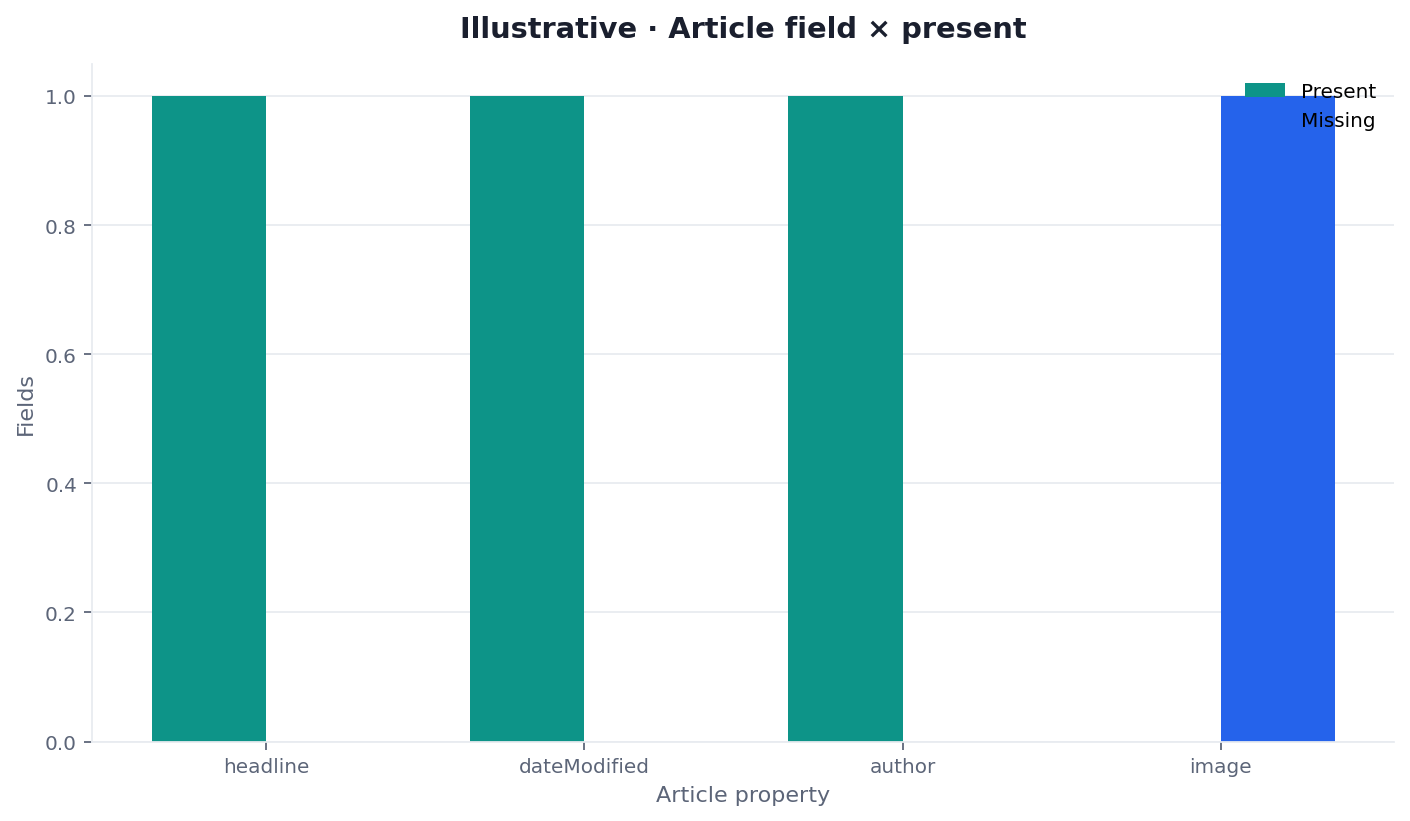
Page role changes the expected field set
The Ahrefs article is the cleanest Article-family row in this sample: one headline and author with published and modified values present in nested nodes. The BBC and New York Times URLs are indexes, so their lack of an Article headline is not automatically a defect. Article schema SEO must first classify page role, then compare raw fields with the visible byline and dates. A broad recursive count is a discovery aid, not the final node-level verdict.
Reproduction and limits.
The probe uses one raw GET and recursive key counts. It does not render JavaScript, resolve every author URL, compare timezone normalization, or run a Google eligibility test. The Guardian row means “no block in the returned HTML,” not “the publisher never uses structured data.” Repeat on a specific article URL before filing a template issue.
Article schema SEO should preserve the raw author node with the ticket. Repeat Article schema SEO after any byline or publication-date migration.
Selection scorecard
Use this scorecard to keep Article schema SEO inside its job. Each row is inspectable. None of the rows is an official Google health score.
| Test | Pass | Fail |
|---|---|---|
| Extract is local | Chrome or deterministic parse | Remote rewrite of the JSON |
| Dates are explicit | Published and modified match the page | Missing or disagreeing clocks |
| Author is a Person | Named, resolvable | Organization only or “Admin” |
| Check scope | Dates + named author | Top Stories promise |
| Sibling files left aside | robots / GPTBot / llms.txt elsewhere | Article schema SEO edits robots |
A row that fails the last test is a crawler ticket. A row that fails the carousel test is a sales slide.
Failure modes that hide the byline
Most disappointment after Article schema SEO is a category error. The parse was never a ticket into Top Stories.
Inventing a news result from a valid Article
A valid Article block can still be ineligible, unused, or later restricted. The extract should say “dates present, author named.” It should not say “we will get Top Stories.” Do not attach an invented traffic percent.
Stamping Admin because the CMS defaulted it
A CMS that writes author: Admin on every post fails the named-author column even when every script parses. Article schema SEO should fail that pattern. Map the real Person. Then re-run the extract on the live URL, not on a preview host that injects a different date.
The editorial handoff uses InfiniSynapse and the Server API as a queueing foundation only. SEO Health reads syntax, robots rules, and llms.txt observations deterministically before this editorial handoff. Parsed defects can be uploaded server-side into an InfiniSynapse Server API long-task workspace, where the API layer organizes date conflicts, missing authors, and visible-subject mismatches into a human-ready fix queue. This handoff does not revalidate Google eligibility or prove crawler behavior.
Check dates and the named author
Extract Article locally on a public URL, then match the visible byline and clocks.
Run SEO Health CheckerFrequently Asked Questions
Is article schema SEO a ranking factor?
Bottom line: No. Google’s Article documentation describes appearance and eligibility, not a ranking boost. A valid block still needs its own eligibility test.
Which Article type should a blog use?
Bottom line: Use the most specific type that matches the page. BlogPosting fits a blog post. Article fits a guide. NewsArticle fits reporting. The subtype is not a ranking switch.
What fields should the JSON-LD include?
Bottom line: Headline, image, datePublished, dateModified, and an author Person with a name and a URL you can open. Match those values to the visible byline.
Does a valid Article mean Top Stories?
Bottom line: No. Article schema SEO confirms dates and a named author. Eligibility is a separate official test. Markup is not eligibility.
Can the author be the publisher Organization?
Bottom line: No. The publisher is an Organization. The byline is a Person with a name you can open. Organization-only author fails this check.
Is the parse an official Google score?
Bottom line: No. Traffic lights are eight modules on a pasted URL. Article schema SEO is a local dates-and-author read. Neither object is an official Google health or EEAT score.
Conclusion
Article schema SEO earns trust when it names the type, reports dates and a named author, and stops before news-carousel theater. Parse locally. Match the byline. Leave crawler files to their own tools. Use the InfiniSynapse web app only to organize the dated author-field defects attached to the article ticket. Then paste the live URL again and keep the eight lights honest.
William Zhu · Cofounder, InfiniSynapse · GitHub @allwefantasy
Desk-validated SEO Health methods. Corrections: zhuhl@infinisynapse.com · corrections policy.