Structured Data Tool for AI Agents: Choose
A structured data tool for AI agents should return typed, replayable JSON. See query tools, page-extract APIs, and when JSON-LD is not that tool.
Author credentials: William Zhu is cofounder of InfiniSynapse (GitHub @allwefantasy · auto-coder). Desk: shipping SEO Health and the /en/tool/ visibility pages. No personal LinkedIn published. About: team / editorial standards.
Publisher credentials: InfiniSynapse has public profiles on GitHub, YouTube, and X. A 2026 WAIC Future Tech OPC excellence award covers the Agentic Data Infra entry (WAIC; third-party recap: Xinhua / Caohejing). That award does not review this page or SEO Health. Method CLI: infinitegrowth on npm. Archive: recognition and scope notes.
On this page
By William Zhu · Cofounder, InfiniSynapse · Last updated: 2026-09-23 · Last verified: 2026-09-23 · Methods: Public product docs for query and extract calls, reviewed 2026-09-23, plus a 2026-09-11 fetch of six public pages that counted JSON-LD blocks separately from visible text. We did not execute a vendor query or extract API for this update. JSON-LD parsing is local. Evidence is not an official Google score.
Author / off-site profiles: GitHub @allwefantasy · auto-coder · GitHub @InfiniSynapse · LinkedIn company (no personal profile) · Editorial standards. No personal LinkedIn or vendor badge.
Reviewed by: InfiniSynapse Data Team · method review 2026-09-23. First-party method review.
Trust / COI: About · Corrections · Publishing principles · Privacy · Terms. SEO Health is commercial. The dated public probe below reports raw fields and limits. The InfiniSynapse Data Team publishes this method.
TL;DR
Direct answer: A structured data tool for AI agents is a function the agent calls to get JSON that matches a schema you fixed in advance. The same input should be replayable. Page markup is a different job: an answer engine can quote a page that shipped no JSON-LD, and a valid Article block can sit on a page nobody quotes.
What you will learn: how to choose a structured data tool for AI agents by the call it exposes; what typed JSON and a replay hash look like; where a URL-extract API fits; and when on-page schema stays on the schema markup audit.
We did not run a vendor runtime for this page. Call shapes below come from public docs checked on 2026-09-23. The six-URL markup probe later in the page is the InfiniSynapse observation from 2026-09-11.
What a structured data tool for AI agents returns
Key definition: A structured data tool for AI agents returns a record the next step can parse: named fields, declared types, and a way to show which source and which plan produced the row. A paragraph, a rich result, and a chatbot quote are other objects.
The return is typed JSON
JSON Schema is the usual contract. You name price as a number and sku as a string before the call. The tool fills those fields or reports that a field is missing. A prose summary that happens to mention the price is a different output. A structured data tool for AI agents that changes field names between two identical calls has not finished the job.
Independent citation: According to [schema.org documents](https://schema.org/docs/documents.html), Schema.org is a shared vocabulary for entities on a web page. That vocabulary is how a crawler reads Organization or Product in HTML. It is the book for on-page types. It is not, by itself, the function an agent invokes at runtime.
Keep the two books apart. The JSON-LD checker parses a script block. A structured data tool for AI agents answers a question against a source or a URL and hands back a record.
Three calls: query, extract, and on-page JSON-LD
A structured data tool for AI agents shows up as one of three calls. Pick the row that matches the input you already have.
| Call | Input you pass | What comes back | Who runs it |
|---|---|---|---|
| Read-only query | A question or a typed plan against a pinned file or database | Rows or a computed value, plus a plan you can replay | The tool runtime, after a policy check |
| Page extract | One URL plus a JSON Schema | JSON for that page, or a missing-field error | The extract API, after it fetches the URL |
| On-page JSON-LD | Nothing. The HTML already contains the block | Types a crawler may read | The site template, in the server response |
Query a pinned source
Use the query call when the numbers already live in CSV, SQLite, a warehouse, or an object store. The agent should describe the question. The tool should compile that description into a read-only plan. SQAI’s public description is one example of this shape: a typed plan, no raw SQL from the model, and hashes on the answer. Treat that page as a category example, not as a score we measured.
Extract one URL
Use the extract call when the fact is on a public page and you do not already store it. Firecrawl’s JSON mode documents a scrape that accepts a URL and a schema and returns JSON for that page. Tabstack’s public extract endpoint describes the same input pair. A structured data tool for AI agents in this row still owes you stable field names. A markdown dump of the page is context, not the structured result.
Leave JSON-LD on the page
Google’s intro to structured data describes JSON-LD, Microdata, and RDFa in the HTML response. That markup helps a crawler label an entity. It does not give your agent a function to call. Ship it from the server-rendered response when the page is yours. Validate it with how to validate schema. Do not file it as the structured data tool for AI agents.
How an AI agent calls the tool
The agent needs a short function list, not a password to the database.
Three functions, then one call
A practical query surface is three tools: list the sources the policy allows, preview the plan without running it, and execute the read-only plan. The Model Context Protocol specification is the wire format many clients use to expose those tools to an agent. Names vary. The sequence does not: discover, preview, then run.
Put the schema on the request when the job is extraction. Prompt-only JSON lets the model invent keys. A structured data tool for AI agents that accepts a schema should reject a response that adds a sibling object the schema did not name.
W3C RDF 1.1 concepts describe a typed graph. Use that reference when you are talking about on-page entities. Use the function list when you are talking about a runtime call. Mixing the two sentences is how a JSON-LD block gets described as an agent tool.
What to require before the agent runs it
Write the acceptance checks before you connect the client.
Refuse a write path
The grammar the model authors should have no insert, update, or delete form. A system prompt that says “only SELECT” still leaves a language that can write. A structured data tool for AI agents earns the read-only label when a write cannot be expressed, not when a filter hopes the model will behave.
Require a replay handle. A plan hash known before execution, and a result hash known after, let a reviewer run the same input again. Float results should name the runtime. “The model said 12.4” is not a replay.
Same input, same field names. If currency arrives as curr on the second call, stop. Missing data should be a null or an explicit error, not a guessed number. A structured data tool for AI agents that fills gaps with a plausible value has left the tool and entered a draft.
Read-only query tools and page-extract APIs
Public pages cluster into two products. Neither cluster is a ranking.
Query tools versus extract APIs
| Read-only query tool | Page-extract API | |
|---|---|---|
| Best input | Files and databases you already govern | A URL whose facts are not in your store |
| Model output | A typed plan, not SQL text | A schema plus an optional prompt |
| Typical failure | Policy denies the source | Page is script-rendered and the fetch sees an empty shell |
| Replay | Plan hash and result hash | Repeat the URL and diff the JSON |
SQAI’s docs describe the left column, including in-process files and a private deployment for warehouses. Firecrawl’s docs describe the right column, including JSON mode on one URL and an MCP server that exposes scrape and extract to a client. A structured data tool for AI agents can be either column. Say which column you bought before you write the agent prompt.
On-page JSON-LD is a third column with no runtime. The schema markup audit owns that column. Headline, author, and dates on an Article node are article schema SEO. This page only points at those checks.
When on-page schema is not the tool
People still search structured data for AI search when a cited paragraph is offered as proof that schema worked. That screenshot is extraction of prose. It is not a function return. A structured data tool for AI agents did not run.
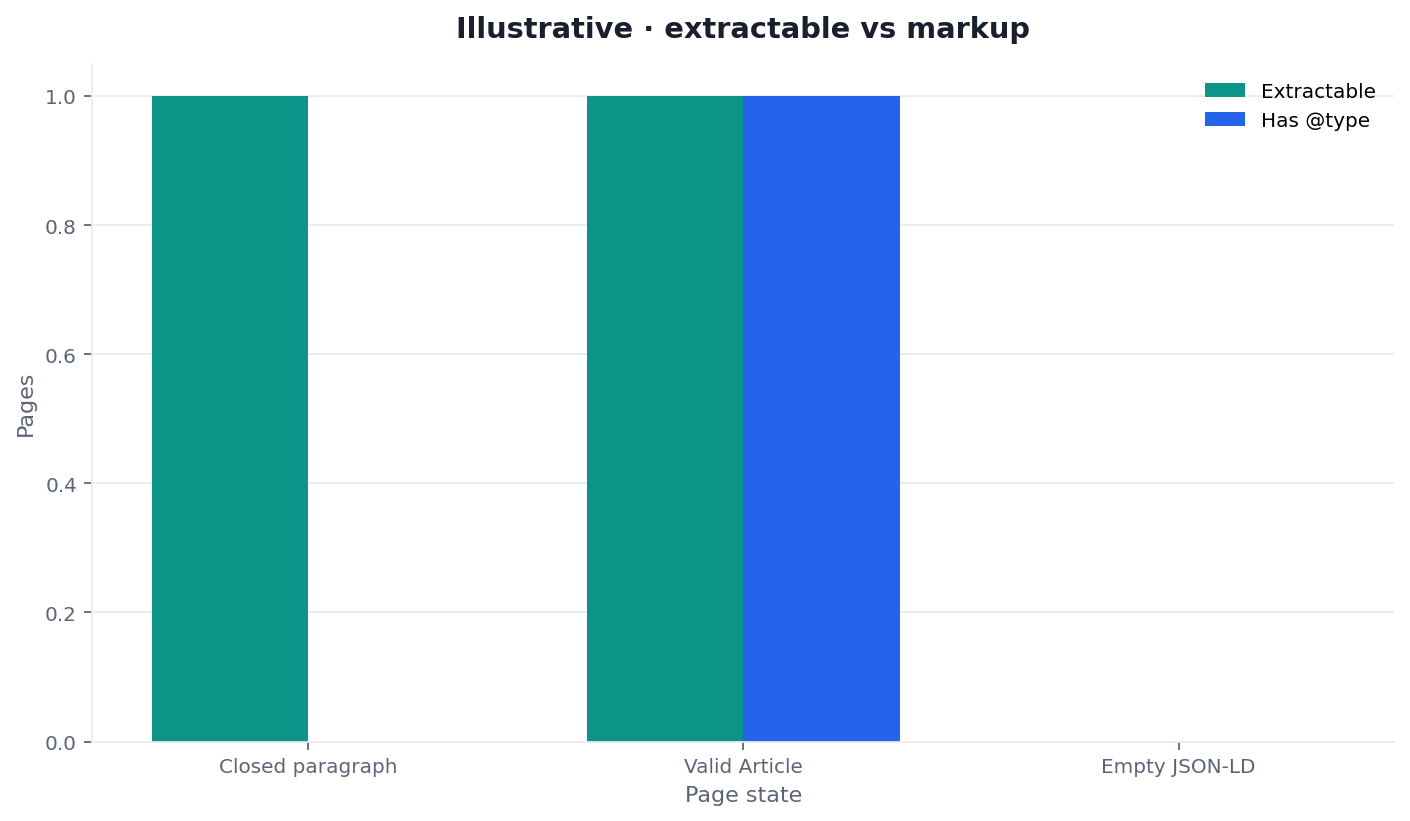
Observed sample (2026-09-11, InfiniSynapse Data Team): We fetched six public URLs, parsed raw-HTML JSON-LD, removed scripts, styles, and tags, and checked whether the response exposed a substantial visible-text body. We report markup blocks and body extractability as separate dimensions. We did not query an answer engine or claim a citation effect.
| Public URL | HTTP | Parsed blocks | Raw type signal | Extractable body signal |
|---|---|---|---|---|
| Wikipedia JSON | 200 | 1 | Article/Organization | substantial reference text |
| NHS conditions index | 200 | 1 | MedicalWebPage/WebPage | substantial index text |
| Guardian international | 200 | 0 | none in raw HTML | substantial news-index text |
| Apple iPhone | 200 | 2 | Organization/Brand | substantial product text |
| Search Engine Land | 200 | 1 | WebSite/Organization and nested entities | substantial publisher text |
| Shopify blog index | 200 | 0 | none in raw HTML | substantial index text |
Six public pages, markup and visible text
The Shopify blog index returned substantial visible text and no JSON-LD block in raw HTML. That row is enough to separate “a page can be quoted” from “a page shipped a type.” A parsed block also cannot prove that an agent called a tool. Knowledge extraction is the act of pulling a fact from text. A structured data tool for AI agents is the interface that returns the fact already typed.
Record status first, parse JSON-LD separately, then build a visible-text extract after removing scripts. Publish the text-length rule before you run the sample. Raw HTML can differ from a rendered DOM. Six pages are not a citation study.
If the ticket is “add Organization markup,” stay on the schema hub. If the ticket is “the agent must read our orders table,” you are choosing a structured data tool for AI agents, and markup will not answer it.
How to test a structured data tool for AI agents
Run five checks on a copy of the source. Keep the schema file in the same change as the prompt.
Five checks
- Freeze one schema and one input. A structured data tool for AI agents should return the same keys on run one and run two.
- Delete one required column from a copy of the file. The call should name the missing field. It should not invent the value.
- Ask for a write. The plan should be inexpressible, or the policy should refuse it before execution.
- Change nothing and compare hashes. A replay handle that changes when the input did not is a new plan, and you should see why.
- Open the page in a browser only if the product claims to read client-rendered HTML. If the server response is empty, say so in the test note.
Independent citation 2: According to [RDF 1.1 concepts](https://www.w3.org/TR/rdf11-concepts), a typed graph is a standards object. Passing the five checks above does not mean your HTML graph is valid. Parse the page on its own ticket.
Failure modes
A citation is not a tool result
Three misses show up after a team wires the first agent.
The model emits SQL. The tool accepted a string and hoped the prompt would stay read-only. Replace the string with a typed plan.
The extract JSON drifts. Monday’s key is price; Tuesday’s key is amount. Pin the schema in the request and fail the call when the keys move. A structured data tool for AI agents that “usually” matches the schema will break the next step that destructures the object.
A chatbot quote gets filed as a tool result. The quote is someone else’s sentence. Parse the URL if you care about types. Call the tool if you care about a row from your table. Those are different logs.
JSON-LD that appears only after JavaScript runs is a fourth miss for crawlers that read the raw response. It is still not the agent’s function. Fix rendering on the schema ticket. Choose the structured data tool for AI agents on the data ticket.
Parse the page when the ticket is markup.
Paste the public URL, read the lights, then decide whether the gap is prose, a type, or a fetch. That check does not query your warehouse.
Frequently Asked Questions
What is a structured data tool for AI agents?
Bottom line: It is a callable function that returns JSON matching a schema you set, with a source and a replay handle. A structured data tool for AI agents is not a citation and not a rich-result test.
Is JSON-LD a structured data tool for AI agents?
Bottom line: No. JSON-LD is markup in the HTML. A structured data tool for AI agents is the runtime call. Use the schema hub for the markup and this page for the call.
If an answer cited us, do we have schema?
Bottom line: Not necessarily. Structured data for AI search treats a cite as extraction of prose. Parse the URL before you celebrate a type. The cite also does not show that a structured data tool for AI agents ran.
If we ship Article JSON-LD, will an agent get typed rows?
Bottom line: No. The block can describe the article. Rows from your files still need a query or extract call. Shipping Article markup does not create a structured data tool for AI agents.
Conclusion
Choose a structured data tool for AI agents by the call: a read-only plan against data you store, or a schema-bound extract of a URL. Require typed fields, no write path, and a replay handle. Leave JSON-LD, rich results, and crawler access on their own pages.
The six-page probe still shows that visible text and a parsed block travel separately. Use that when someone waves a quote as proof of schema. Use the five checks when someone waves a demo as proof of a tool.
William Zhu · Cofounder, InfiniSynapse · GitHub @allwefantasy
Desk-validated SEO Health methods. Corrections: zhuhl@infinisynapse.com · corrections policy.