Schema Check: Parse, Then Official Test
A schema check is local JSON-LD parse first, then Schema.org or Rich Results. Green parse is not eligibility. Not a JSON Schema draft tester.
Author credentials: William Zhu is cofounder of InfiniSynapse (GitHub @allwefantasy · auto-coder). Desk: shipping SEO Health and the /en/tool/ visibility pages. No personal LinkedIn published. About: team / editorial standards.
Publisher credentials: InfiniSynapse has public profiles on GitHub, YouTube, and X. A 2026 WAIC Future Tech OPC excellence award covers the Agentic Data Infra entry (WAIC; third-party recap: Xinhua / Caohejing). That award does not review this page or SEO Health. Method CLI: infinitegrowth on npm. Archive: recognition and scope notes.
On this page
By William Zhu · Cofounder, InfiniSynapse · Last updated: 2026-09-24 · Last verified: 2026-09-11 · Methods: Fetched five public pages; parsed raw JSON-LD and compared actual script fields with page role before any official tester step. URL reachability, visible-subject match,
sameAsconsistency, and ownership evidence remain separate validation findings. Evidence observed 2026-09-11; not an official Google score.
Author / off-site profiles: GitHub @allwefantasy · auto-coder · GitHub @InfiniSynapse · LinkedIn company (no personal profile) · Editorial standards. No personal LinkedIn or vendor badge.
Reviewed by: InfiniSynapse Data Team · method review 2026-09-11. First-party method review.
Trust / COI: About · Corrections · Publishing principles · Privacy · Terms. SEO Health is commercial. The dated public probe below reports raw fields and limits. The InfiniSynapse Data Team publishes this method.
TL;DR
Direct answer: A **schema check** is two books in order. First parse JSON-LD, record identifier reachability, compare the node with the visible subject, check sameAs, and retain ownership evidence separately. Then run the official tester for eligibility. A green local parse is not a rich result. **How to validate schema** is that same order. It is not a paste-URL widget and not a JSON Schema draft tester.
What you will learn: why a schema check starts on the machine; when to open the official tester; why JSON Schema drafts are a different product; a dated public parse-and-field probe; four steps that refuse to sell a parse as eligibility. How to validate schema remains the step list.
Paste a public URL at infinitegrowth.agency/seo-tools#check for the eight lights around the markup. Those lights are not a Google 100. A lesson on how to validate schema does not replace them.
We evaluate how to validate schema hands-on as the InfiniSynapse Data Team. We build InfiniSynapse when a missing type needs a punch list, not when an official tester needs a second opinion.
What how to validate schema actually means
Key Definition: A schema check is a two-stage method: a local, deterministic parse of the JSON-LD (or RDFa / Microdata) you shipped, then a separate official eligibility test. How to validate schema names the same order. It is not one green badge, not a JSON Schema draft tester, not a crawler-access audit, and not an official Google health score.
Observed page CLI (2026-09-11, infinitegrowth@0.1.1): seo-health check https://schema.org/docs/datamodel.html --format json --lang en exited 0. issues[].status listed Meta Description (error), Sitemap.xml (error), Title Length (warning). Process exit 0 is not a clean page.
issues[].name | issues[].status |
|---|---|
| Meta Description | error |
| Sitemap.xml | error |
| Title Length | warning |
| H1 Tag | good |
| URL | good |
| Robots.txt | good |
| Image Alt Text | good |
| Page Structure | good |
The dated public-page probe below reports raw observations.
Independent citation: According to [schema.org data model](https://schema.org/docs/datamodel.html), Schema.org's data model defines types, properties, and enumerated values. Schema.org's schema.org data model page is the third-party rule this write-up holds to. The dated probe below is evidence, not that rule.
People search schema check when a pull request added an Article block and the meeting asked “is it valid.” How to validate schema is the same meeting. Valid is a parse word. Eligible is a tester word. Mixing them is how a truncated script becomes a carousel ticket.
Wikipedia’s data validation page is the right metaphor: check the object you have before you ask a downstream system to accept it. The schema.org data model is the vocabulary you are checking against. The JSON-LD 1.1 API is how a processor expands and compacts that object. The ECMA-404 JSON standard is the boring first gate: if the script is not JSON, stop. MDN’s DOMParser is how a browser reads the document you will parse. Schema.org’s validator is one official-adjacent surface after the local parse. A note on how to validate schema that opens the official tester first will debug eligibility on broken JSON.
The hub for the type list is the schema markup audit. This page is the step order. JSON-LD parse is local. Parser failures, unreachable identifiers, visible-subject mismatches, inconsistent sameAs links, and unsupported ownership claims remain separate findings before any feature-specific test begins.
Local parse is the first book
Chrome extracts structured data on the machine unless you start AI EEAT. how to validate schema either succeeds or it fails. A guide that reports “mostly valid” as a Google 100 is inventing a score.
The syntax sibling is the JSON-LD checker. Use it when the question is braces and @type, not the official fold.
Official tester is the second book
Eligibility lives in the official tester and in Google’s systems. A page that pastes a green parse into a ticket titled “we should be in the carousel” has skipped the second book. Read rich result eligibility when the tester is the job.
A local-then-official framework
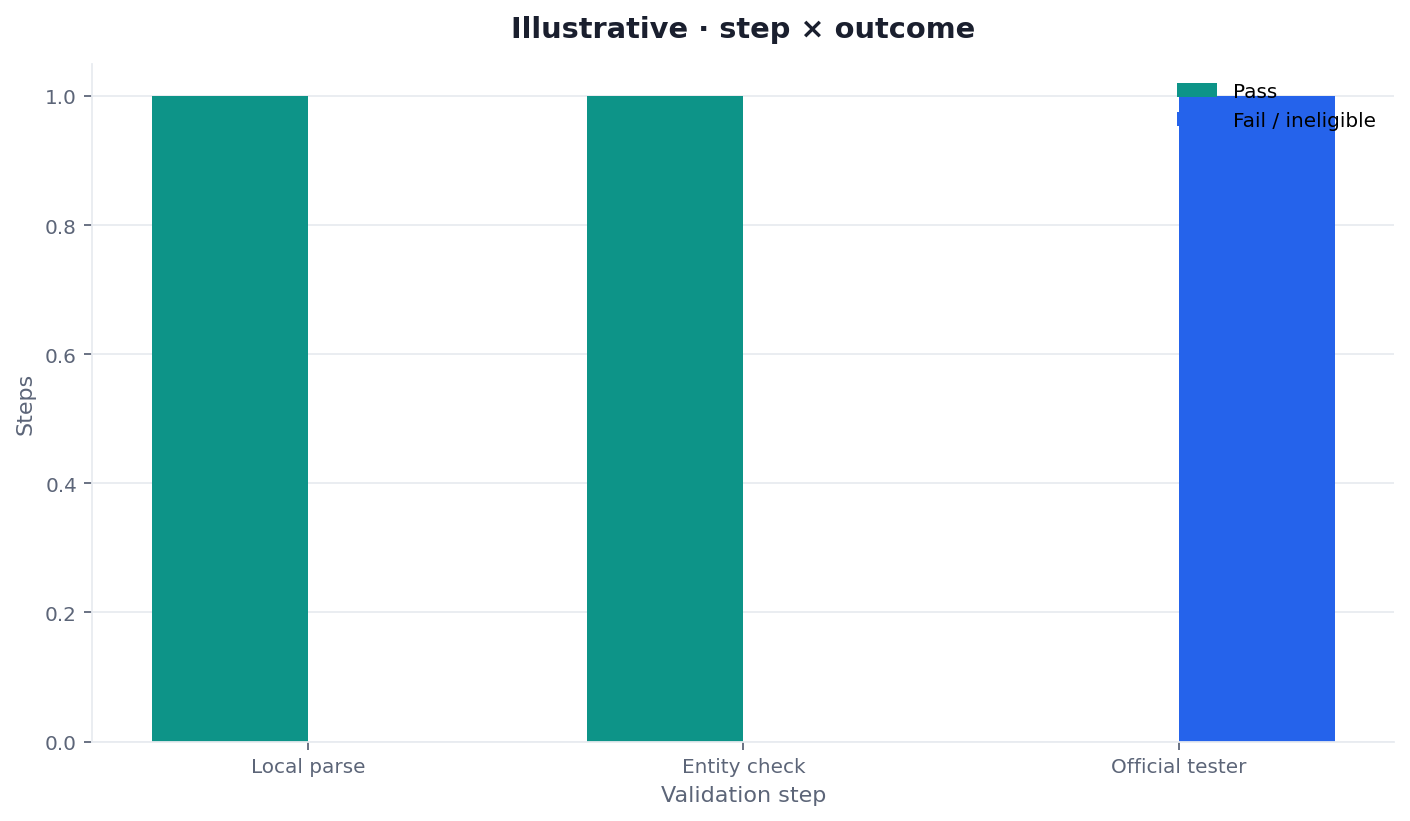
Keep parse, entity, and eligibility on three rows. A method that shares one pass/fail cell will hide a dead SKU behind valid JSON.
| Stage | Question | Pass | Fail |
|---|---|---|---|
| Syntax | Does the script parse? | JSON / RDFa / Microdata reads | Truncated script |
| Entity evidence | Do URL status, visible subject, sameAs, and ownership evidence agree? | Separate recorded checks | One “resolved” label |
| Official | Does the tester call this eligible? | Named rich result | Ineligible or unused |
A walkthrough that stops after syntax will ship Product markup for a 404 SKU.
Entity evidence stays separate
“JSON parsed” is not “this is our article.” Confirm @id, author, datePublished, and the URL the block claims. A lesson that skips the entity will celebrate a copied example.com block.
Structured data for AI search is the sibling that separates extractable prose from markup. Do not use that page as a validator. Parsing JSON-LD does not give the agent a query function. That call is a structured data tool for AI agents.
Eight lights still apply
A valid Article block on a soft 404 is still a failed page. Run the SEO health checker on the same URL. How to validate schema does not retire title, canonical, or speed.
Parse versus eligibility
Parse is your object. Eligibility is theirs. A method that treats those as synonyms will file the wrong bug.
Keep the two testers on two shelves
Local parse answers “did we ship a consistent type.” The official tester answers “does this URL currently look eligible for a named rich result.” Both are useful. A guide on how to validate schema that runs only the official tester will miss a second encoding that contradicts the first.
Prefer one encoding per template. Mixed JSON-LD plus leftover Microdata is a common desk miss. Say which encoding won.
Landscape of parsers and testers
The landscape is local extractors, Schema.org’s validator, and Google’s rich-result tester. A landscape that adds robots or GPTBot as a fourth validator is on the wrong pillar job.
A schema check on Schema.org markup is not a JSON Schema Draft validator. Those drafts test whether a JSON instance matches a JSON Schema document. This page checks the @type you shipped, then Schema.org’s validator or Google’s Rich Results Test. JSON Schema drafts stay on a different product.
Crawler files stay on llms.txt vs robots vs sitemap and the access siblings. They do not validate @type.
Preview and production often ship different script tags. A CMS preview may inject Article JSON-LD that the live template drops, or the reverse. Run both stages on the hostname you will defend. A tag manager can append a second encoding after paint. If Chrome’s local extract and “view source” disagree, say so in the ticket. Credits and login apply when you ask InfiniSynapse to write the missing-type punch list. They do not apply to how to validate schema itself. The seo-health CLI (npm i -g infinitegrowth) can fail a pull request when the template drops @type. That gate is parse, not eligibility. Eight modules still sit on the URL after a clean type list: title, meta, headings, density, images, links, tech, and speed. A valid Organization block on a 5xx homepage is still a failed page. Re-paste production after merge. Do not paste secrets into a tester field that will be logged.
Query movement after you ship a type is Search Console. Analyze Search Console with AI overlays an export. It does not replace either validation book.
JSON-LD.org’s playground provides an independent processor surface for inspecting expansion and compaction, while Search Engine Land’s schema guide adds a publisher-oriented implementation view. Neither source replaces the official feature test. They help isolate whether a defect belongs to syntax, vocabulary, or deployment before the validation record reaches Google’s tool.
Where a fail is allowed
A local fail can be a ship-blocking parse, unreachable identifier, visible-subject mismatch, inconsistent sameAs, or unsupported ownership claim. An official fail on a valid parse is often “not eligible,” not “your JSON is trash.” A note on how to validate schema that treats every official fail as a syntax bug will churn the template.
Run the check in four steps
Walk how to validate schema as four inspectable steps. Do not open the official tester in step 1.
Step 1 — Extract the script on the machine
Open the page in Chrome with the SEO Health extension. Confirm the extract happened locally. A remote rewrite of the JSON is not this method. When the repaired block reaches production, repeat the page check before saving the official-test evidence. How to validate schema starts with the bytes you shipped.
Step 2 — Confirm syntax, type, and entity
List @type values. Record each identifier’s exact network result; compare names, canonical URLs, authors, dates, or product details with the visible subject; check every sameAs target for identity consistency; and attach ownership or account-control evidence where ownership is claimed. If JSON fails, fix JSON. If the type is missing, write the punch list. How to validate schema does not invent Organization because a homepage “should have it.”
Step 3 — Only then open the official tester
Run the official tester on the production URL. Read eligibility for the named rich result you actually wanted. A sound process for how to validate schema stops short of calling a local parse “eligible.” If the tester is ineligible, keep the how to validate schema notes and open the eligibility sibling.
Step 4 — Assign the gap to one book
A broken script is an engineering ticket. A dead identifier, subject mismatch, sameAs conflict, or unsupported ownership claim is an evidence ticket. An ineligible but valid block is an eligibility ticket. How to validate schema that assigns “fix schema” to one inbox will mix the three again.
Preview hosts lie. Re-run production after merge.
Independent citation 2: According to [Schema.org’s validator](https://validator.schema.org), the Schema Markup Validator checks whether markup parses against the Schema.org vocabulary. A second independent source, from Schema.org, keeps this page claim from resting only on first-party lights.
Reproducible validation sample: five pages and raw fields
Observed sample (2026-09-11, InfiniSynapse Data Team): We fetched five public pages, extracted JSON-LD from raw HTML, ran json.loads, and counted selected fields. Three are official Google documentation pages; two are public content pages. The sample demonstrates local validation order and does not report invented official-tester outcomes.
| URL | HTTP | Blocks parsed / broken | Raw types and selected fields |
|---|---|---|---|
| Google Article documentation | 200 | 1 / 0 | BreadcrumbList; name ×3 |
| Google Product snippet documentation | 200 | 1 / 0 | BreadcrumbList; name ×3 |
| Google Breadcrumb documentation | 200 | 1 / 0 | BreadcrumbList/ListItem; name ×3 |
| Ahrefs schema article | 200 | 1 / 0 | Article/Person; headline ×1, author ×1, dates ×2 each |
| Wikipedia JSON-LD article | 200 | 1 / 0 | Article/Organization; headline ×1, author ×1, dates ×1 each |
Documentation examples are not the page’s own entity
Each Google guide’s own page markup was BreadcrumbList even though its visible code samples describe Article, Product, or Breadcrumb. A validator must parse script tags, not arbitrary code snippets. The Ahrefs and Wikipedia pages supplied Article-family fields that can then be compared with visible headline, byline, and dates. Only after those local checks should a reviewer open the official Rich Results Test.
Evidence limitation and reproduction
Fetch raw HTML, save status, extract only JSON-LD script bodies, and recursively list types and fields. For each named node, preserve URL status, visible-subject comparison, sameAs consistency, and ownership evidence in separate columns. Then run the official tester manually on the current production URL and save its dated result separately. The main limitation is that this five-URL sample does not render JavaScript, claim eligibility, or generalize its findings to the web.
Anyone learning how to validate schema should archive the raw block before editing it.
Selection scorecard
Use this scorecard when someone asks how to validate schema today. Each row is inspectable. None of the rows is an official Google health score.
| Test | Pass | Fail |
|---|---|---|
| Parse is local first | Chrome or deterministic JSON | Official tester on broken JSON |
| Type list is explicit | Named @type values | “Has schema” |
| Entity evidence is explicit | URL status + visible subject + sameAs + ownership | Copied example or one reachability result |
| Official tester is second | Eligibility after parse | Parse sold as eligible |
| how to validate schema scope | Two books in order | Crawler files or a Google 100 |
A row that fails the last test is a different page. Send crawler jobs to the access siblings.
Failure modes that skip the local parse
Most disappointment after a lesson on how to validate schema is an official screenshot of a page whose script never parsed in Chrome.
Opening the official tester on truncated JSON
The tester will complain. You will “fix eligibility.” The bug was a missing brace. How to validate schema that skips step 1 wastes a day.
The second failure is adding a third copy of the same type to please the tester. Prefer one encoding.
The third failure is treating a GPTBot 403 as invalid markup. Access is a sibling.
The fourth failure is a punch list that names a rich-result deadline. A guide on how to validate schema ends at an assignable gap.
The fifth failure is celebrating extractable prose as validated schema. That confusion is the AI-search sibling.
Validation keeps a hard boundary before task generation. Before task generation, SEO Health records syntax, robots, and llms.txt observations as deterministic reads. Parsed defects may be uploaded server-side into an InfiniSynapse Server API long-task workspace, where the InfiniSynapse API foundation translates malformed nodes, entity conflicts, and official-tool follow-ups into a human-ready fix queue. That layer does not revalidate Google eligibility or prove crawler behavior.
Parse the page before you open the official tester
Paste a public URL, extract structured data locally, then decide whether eligibility is even the next ticket.
Run SEO Health CheckerCluster guides for validation
Use the next guide according to the validation stage that failed; each row keeps its own evidence boundary.
| Job you actually have | Guide to open next | What how to validate schema will not do |
|---|---|---|
| Type list and punch list | Schema markup audit (hub) | Retarget the hub as this Target |
| Syntax versus the named entity | JSON-LD checker | Finish eligibility there |
| Article dates and a named author | article schema SEO | Treat a green Article parse as Top Stories |
| Official tester as its own book | Rich results eligibility | Call a green parse a carousel |
| Extractable prose versus markup | Structured data for AI search | Treat a citation as validation |
| Eight lights on one paste | SEO health checker | Finish both books in thirty seconds |
Keep a schema check as local parse, then official test. How to validate schema is the same step list.
Frequently Asked Questions
What is a schema check?
Bottom line: A schema check is local JSON-LD parse first, then Schema.org or Rich Results. How to validate schema is the same two-book order. It is not a paste-URL widget and not a JSON Schema draft tester.
Is a JSON Schema validator a schema check?
Bottom line: No. JSON Schema drafts test a document against a schema spec. A schema check here is Schema.org markup: parse locally, then official eligibility.
Does a valid local parse mean we are eligible?
Bottom line: No. How to validate schema keeps eligibility in the official tester. Markup is not eligibility.
Should I start in the official tester?
Bottom line: No. Parse locally first. How to validate schema that starts official will debug the wrong book.
Is the parse an official Google score?
Bottom line: No. Traffic lights are eight modules. How to validate schema is a type list plus a later tester. Neither object is an official Google health score.
Do robots or GPTBot belong in this validation?
Bottom line: No. They are crawler siblings. How to validate schema stays on structured data.
Conclusion
A schema check earns trust when the local parse is first and the official tester is second. How to validate schema is that same order. Fix JSON, record URL status, match the visible subject, check sameAs, and retain ownership evidence. Then ask eligibility. Do not sell a green parse as a rich result. Do not open crawler files to validate @type.
Keep the eight lights honest on the live URL. Open the InfiniSynapse web app only when a missing type or a documented entity-evidence gap needs that punch list written as a task. Until then, the useful order is local, then official.
William Zhu · Cofounder, InfiniSynapse · GitHub @allwefantasy
Desk-validated SEO Health methods. Corrections: zhuhl@infinisynapse.com · corrections policy.