SKU Margin Analysis across Price and Cost (2026)
By William Zhu & the InfiniSynapse Data Team · Published: 2026-08-22 · Last updated: 2026-08-31 · Last verified: 2026-08-31 · Next review: 2026-11-30 · About · Privacy policy · Editorial standards · Corrections
Table of Contents
- TL;DR
- What SKU Margin Analysis Means in 2026
- A Price-and-Cost Framework You Can Lock
- How Teams Compare Margin Approaches
- Tool Landscape without a Metric Warehouse
- Implementation Steps You Can Replay
- Accuracy and Experience Record: Illustrative Contribution Flip Pack
- Evidence Boundaries and Independent Validation
- How to Cite This Page
- Selection Scorecard for SKU Margin Analysis
- Failure Modes That Invent Profit
- Frequently Asked Questions
- Conclusion
TL;DR
We evaluate these patterns at the InfiniSynapse desk on sanitized composites; sample figures on this page are illustrative, not customer uplifts.
Direct answer: SKU margin analysis is the practice of binding price, cost, fees, and return lag to one catalog key so a merchandiser can defend contribution on sources already in the building—without standing up a pre-built retail metric warehouse first.
What you'll learn: a definition-first margin sentence; a price-and-cost framework; how list price differs from net realized; a three-step implementation path; an illustrative desk pack; a scorecard; and the failure modes that keep a losing SKU “green.”
Download evidence: desk log · contribution CSV · verification script · source check · reproduction protocol. This package is first-party and illustrative—not customer, accounting, pricing, benchmark, or third-party evidence.
SKU margin analysis fails when revenue lives in one system, cost lives in another, and returns arrive a week late under a different key. The fix is not a prettier waterfall. It is a locked grain, a signed contribution sentence, and a question you can replay. Pair the method with the hub on ecommerce analytics before you rank SKUs.
What SKU Margin Analysis Means in 2026
Key Definition: SKU margin analysis is the audit of price, cost, fees, and optional ad spend on one catalog key so contribution and returns stay reconcilable across authorized sources. The unit of work is a signed sentence plus inspectable joins, not a chart that hides whether tax or shipping sat inside “net.”
U.S. Census Bureau data (retrieved 2026-09-04) provide public statistical context, not this pack's COGS. Use the specific Monthly Retail Trade methodology and releases for official aggregate context.
HHS HIPAA materials (retrieved 2026-09-04) apply to covered entities, business associates, and protected health information—not automatically to every health SKU. Exclude patient-linked attributes where applicable.
Use U.S. GAO Assessing Data Reliability (retrieved 2026-09-04) for accuracy, completeness, and fitness-for-purpose checks. Consult the FASB Accounting Standards Codification (retrieved 2026-09-04) and qualified professionals for applicable U.S. GAAP. Neither organization reviewed this method.
List price is not realized price. A coupon in a second table is not the same as a line discount. A landed cost from last quarter is not this week’s COGS. SKU margin analysis begins at those identities. If two teams cannot recite the same contribution sentence, they do not have one pack.
Treat SKU margin analysis as a definition problem with joins attached. If “margin” sometimes means gross after COGS and sometimes means contribution after fees, bind the rule before you sort the catalog.
Margin is a sentence before it is a chart
Write contribution as one sentence: net sales minus COGS minus fees minus allocated ads—or whatever finance will sign. SKU margin analysis without that sentence will pick a convenient column.
Lock three keys before any rank: order_id, line_id, and the catalog key you will call SKU. A rank of “top margin SKUs” on mixed grains will double-count kits, bundles, and replacements. Write the exception list—gifts, samples, internal transfers—into the same note.
Returns need their own timestamp. A refund posted on Tuesday does not rewrite Monday’s contribution unless your policy says it does. SKU margin analysis that folds late refunds into the original order week without a lag rule will restock the wrong SKUs.
Why cost vintage matters as much as price
Price changes daily. Cost often changes on a receipt. SKU margin analysis that joins today’s selling price to last year’s average cost will look precise and be stale.
If you lack a dated cost, say so. Report “price minus last known cost” as a labeled estimate, not as signed contribution. SKU margin analysis should refuse a blended cost that cannot name its vintage.
When the missing object is store versus digital grain, continue in retail analytics. When the missing object is delay and refund quality, use order analysis.
A Price-and-Cost Framework You Can Lock
Use one table as the contract for SKU margin analysis. Every weekly question should name the grain, the window, and the money definition that must not drift.
| Layer | What you lock | Typical source | Failure if skipped |
|---|---|---|---|
| Identity | order_id, line_id, SKU key | Orders + catalog | Bundle double count |
| Price | list, discount, tax treatment | Checkout or invoice extract | Net that finance rejects |
| Cost | COGS vintage, landed vs standard | Finance or receiving export | Stale “profit” |
| Fees | payment, marketplace, fulfillment | Payout or fee file | Contribution that ignores take-rate |
| Quality | return reason, refund lag | After-sales table or CSV | Fake green SKUs |
| Attention | campaign spend, if it can join | Ads export | Silent allocation |
SKU margin analysis does not need a pre-built metric warehouse. It needs those rows to be explicit. If ad spend cannot join on SKU, report it at campaign grain.
How Teams Compare Margin Approaches
Teams usually pick one of three shapes. SKU margin analysis quality depends on whether the shape matches the money they can actually join.
| Approach | Works when | Breaks when |
|---|---|---|
| Warehouse-first margin model | Many consumers, hourly freshness, dedicated modeling | Cost vintage lags the store by a week |
| Direct database questions | Orders and cost already share keys | Fees live only in a marketplace CSV |
| File-first weekly pack | Finance emails a cost file and orders are a dated export | Nobody versions the cost file |
Gross after COGS versus contribution after fees
Gross after COGS is a finance grain. Contribution after fees is a trading grain. SKU margin analysis should name which one the pack uses. Mixing them in one rank will make a high-fee SKU look like a hero.
A useful first pass is exploratory data analysis on one week of price, cost, and fee files before you scale the join. If 10 percent of SKUs have no cost, ranking “margin leaders” is fiction.
Allocated ads versus unallocated spend
Paid spend that cannot join on SKU is not a SKU fact. SKU margin analysis should keep it at campaign grain or publish an allocation rule that finance will sign. Hidden last-click allocation is how a hero SKU funds the catalog.
If the next question is unit contribution across billing and usage, use unit economics analytics. That page owns a different unit. Do not import it into a merchandising pack without a new sentence.
Tool Landscape without a Metric Warehouse
A data agent is a fit when the question is a goal (“which SKUs flip after 14-day returns”) and you need the SQL trail. It is a poor fit when someone wants the tool to reprice the store. SKU margin analysis still needs the sentence first.
Query engines that already hold price and cost
If orders already sit in Postgres or MySQL and cost is a second table, ask the join in place. SKU margin analysis on a live replica is still “no new warehouse” if you refuse a second copy. Use a read-only role.
web.dev security-header guidance (retrieved 2026-09-04) concerns browser security, not COGS or contribution definitions.
If someone wants a picture, generate data visualization from the same query that produced the table. A waterfall that cannot name its cost vintage is decoration.
Files when cost still lives in a weekly workbook
Smaller catalogs live in Excel and morning CSVs. SKU margin analysis can start there if you freeze the file date and the mapping. Upload a sanitized extract, bind the contribution note, and ask one trading question. Do not paste live credentials into a prompt.
NIST Cybersecurity Framework and CISA Secure by Design materials (retrieved 2026-09-04) provide risk-management and product-security context. They do not certify this workflow or define margin.
Plain-language questions over those files are closer to chat with your data than to a new ETL project.
Implementation Steps You Can Replay
Begin with the sentence. SKU margin analysis that starts from “insight” will invent a definition to match the story.
Lock grain, price, and cost vintage
- Name the order grain and the SKU grain in one paragraph.
- List excluded lines: samples, replacements, internal transfers.
- Write the cost vintage: standard, last receipt, or unknown.
- Choose a currency and a tax rule.
SKU margin analysis at this step is boring on purpose. If two analysts disagree on whether shipping sits inside net, stop.
Bind contribution and return lag
Write the contribution sentence and the lag window (illustrative default: 14 days). Bind those notes to the order source so the next run uses the same words. This is definition work, not a semantic layer product. A short Markdown note is enough if everyone can find it.
SKU margin analysis should also name fee columns: payment, marketplace, fulfillment. If a fee cannot join, leave it out and say the pack is incomplete on take-rate.
Ask the flip question and inspect SQL
Ask one goal: which SKUs show positive contribution before returns and flip after a stated lag. SKU margin analysis quality is the inspectable plan, not the paragraph. Open the joins. Check that refunds did not land on a different key.
If the source is a database, use a read-only role. If the source is a file, record the filename and date in the pack.
Accuracy and Experience Record: Illustrative Contribution Flip Pack
The following numbers are an illustrative desk composite, not a customer result or uplift claim. Run ID: SMA-FLIP-20260823. Run date: 2026-08-23. Operator: InfiniSynapse Data Team. Objects inspected: order/SKU grain, cost vintage, return lag, six aggregates, two held actions, and discarded draft.
| Item | Desk composite (illustrative) |
|---|---|
| Window | 14 days, 2026-07-27 to 2026-08-09 |
| Order lines | 16,800 across owned store and one marketplace |
| Catalog | 1,240 SKUs; 88 lines with no dated cost |
| Question | Which SKUs stay positive only if refunds and marketplace fees are ignored? |
| Finding | 5 SKUs flip after 14-day returns; 3 more flip after fees; return rate 9.1% on the flip set |
| Action | Hold paid spend; do not auto-reorder the five flip SKUs |
SKU margin analysis on this pack is useful because the missing-cost lines are visible. A rank that hid the 88 orphans would have looked cleaner and been wrong.
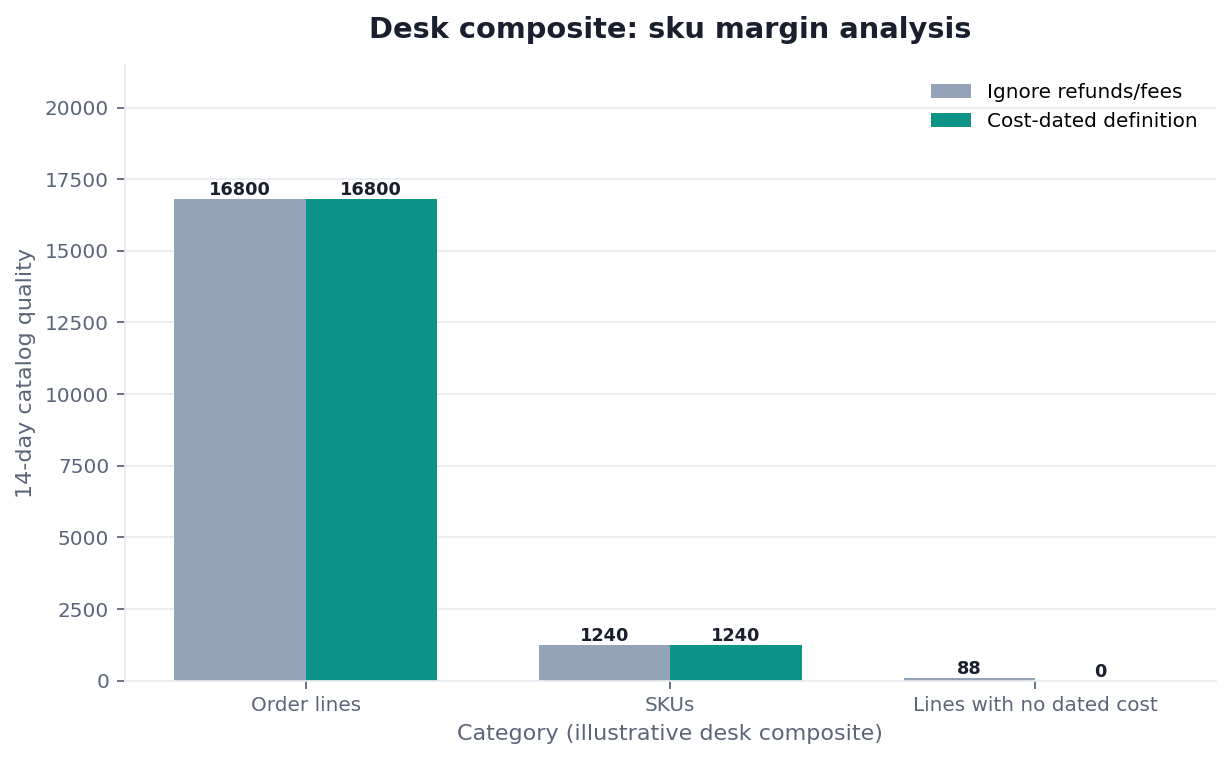
Figure. Desk composite from this page: 16,800 lines / 1,240 SKUs / 88 lines with no dated cost. Published context: web.dev; nist.gov; cisa.gov. Not a customer experiment, SLA, or official benchmark.
| Evidence class | What you can cite | What you cannot claim |
|---|---|---|
| Desk composite on this page | Grain, collision, inspectable artifacts | Customer uplift %, vendor bake-off win |
| Published authority (linked above) | Frameworks and definitions from the cited sources | That those sources ran this desk sample |
The operator discarded a draft that subtracted promotion three times. Paid spend and auto-reorder remained held. The desk log records those decisions. The CSV exposes six illustrative aggregates and two held actions.
Evidence Boundaries and Independent Validation
The scenario is not customer, order, pricing, cost-accounting, financial-statement, benchmark, or representative research. Source rows, prices, cost vintages, fee records, identifiers, SQL, denominators, reconciliations, and accounting review are unavailable.
The 16,800 lines and 1,240 SKUs do not form disclosed sampling frames. The 88 missing-cost lines, five return flips, three fee flips, and 9.1% return rate cannot be independently recomputed or generalized.
The source check separates direct guidance from security context. The open protocol specifies an external test. As of 2026-08-31, no qualifying independent report, customer validation, accounting opinion, or media investigation exists.
The output checker confirms displayed labels and values only. It does not establish source accuracy, COGS, contribution, causation, legal compliance, accounting treatment, or commercial impact.
SKU margin analysis fixes order-line grain. SKU margin analysis versions the cost date. SKU margin analysis preserves missing-cost lines. SKU margin analysis separates discounts from promotions. SKU margin analysis reconciles refunds to lines. SKU margin analysis reports fee coverage. SKU margin analysis keeps currencies and taxes explicit. SKU margin analysis tests the return-lag sensitivity. SKU margin analysis holds unsupported spend and reorder actions. SKU margin analysis remains open to independent review.
How to Cite This Page
Page: Zhu, W., & InfiniSynapse Data Team. (2026). SKU margin analysis across price and cost. InfiniSynapse. https://infinisynapse.com/en/blog/sku-margin-analysis
Run: InfiniSynapse Data Team. (2026). Desk log SMA-FLIP-20260823 (illustrative contribution composite). https://infinisynapse.com/blog-media/sku-margin-analysis/downloads/desk-log-SMA-FLIP-20260823.md
Neither is an independent audit, customer study, accounting opinion, benchmark, valuation, pricing recommendation, or evidence of profit. Cite unavailable source rows, incomplete cost, held actions, and first-party limitations.
Selection Scorecard for SKU Margin Analysis
Score a stack from 1 (weak) to 5 (strong).
| Criterion | What “5” looks like | Disqualifier |
|---|---|---|
| Grain control | Order line and SKU keys named | Session metrics sold as SKU profit |
| Definition binding | Contribution sentence and cost vintage in a note | “Margin” changes by teammate |
| Source honesty | Missing cost and unmapped IDs listed | Silent inner joins |
| Audit trail | Plan and SQL downloadable | Chat-only answers |
| Write path | Read-only; no price or listing updates | Agent can reprice the store |
| Replay | Same goal next week, same sentence | One-off screenshots |
SKU margin analysis scores well when merchandisers can ask the question and finance can open the join.
Failure Modes That Invent Profit
Name the failure before you ship the pack.
Promotion subtracted three times
A discount in the order line plus a coupon in a second table plus an ad-funded markdown will subtract three times. SKU margin analysis should pick one promotion source or show the overlap.
Return lag treated as same-week profit
Same-week contribution looks strong on fashion and electronics until refunds arrive. SKU margin analysis that books profit on ship date without a lag window will restock the wrong SKUs. State the lag.
Cost vintage that nobody can name
An average cost from a closed year will make a newly negotiated SKU look worse than it is, or better. SKU margin analysis should print the cost date next to the rank.
A fourth pattern is currency mix without a dated rate.
| Live guide | Open it when |
|---|---|
| ecommerce analytics | the missing object is orders, SKUs, and margin across sources |
| retail analytics | store and digital must share a grain |
| order analysis | quality flags and delay are the decision |
| data governance | the contribution sentence must be owned |
| Marketplace Data Analysis across Event Feeds | Multi-platform events need a shared SKU key |
| Inventory and Sales Join without a Planning Suite | A sales-inventory join is an ops question, not MRP |
| Ecommerce Weekly Trading Pack You Can Rerun | The trading pack is last week’s goal, rerun |
Ask high-return SKUs and their margin
Connect a read-only order source or upload a sanitized order-and-cost extract, bind the contribution note, and ask which SKUs flip after returns and fees. This check uses only sources you authorize.
Commercial association: You do not need the workspace to complete the educational diagnosis on this page.
Open InfiniSynapseHow this page is sourced. William Zhu is cofounder of InfiniSynapse (GitHub @allwefantasy); no personal LinkedIn, CPA/CMA credential, retailer affiliation, or independent auditor role is claimed. His profile establishes authorship, not accounting qualification. Desk decisions are recorded in run SMA-FLIP-20260823. Reviewed internally by analytics engineering · data platform · LLM security · editor. Editorial standards · corrections · publishing principles. COI: InfiniSynapse sells an AI-native Data Agent. GAO, FASB, Census, HHS, NIST, CISA, and web.dev did not validate this run. This is not accounting, financial, tax, legal, retail, pricing, or investment advice.
Frequently Asked Questions
Is list price enough for a first rank?
Bottom line: No. SKU margin analysis that ranks on list price will ignore discounts, fees, and returns. Bind net sales and a cost vintage before you sort the catalog.
Do I need a metric warehouse before the practice is real?
Bottom line: No. SKU margin analysis is real when order lines, a catalog key, and a signed contribution sentence can be joined and replayed. A warehouse is optional for the first honest weekly pack.
What is a safe first margin question?
Bottom line: Ask which SKUs look profitable before returns and unprofitable after a stated lag. That question forces grain, money, and quality into one table.
Can this replace pricing, ERP, or the store admin?
Bottom line: No. SKU margin analysis explains contribution on authorized reads. It does not write prices or listings. Keep the agent read-only.
Can readers recompute the 5, 3, and 9.1% figures?
Bottom line: No. Source rows and denominators are unavailable. The CSV makes six aggregates and two held actions inspectable, not independently reproducible.
Has an independent retailer or accountant reproduced this run?
Bottom line: No qualifying external report is published as of 2026-08-31. The protocol defines the data, calculations, and review required.
Conclusion
SKU margin analysis is a sentence you can defend: price, cost, fees, and returns on sources you already operate. Lock the grain, bind the contribution words, publish missing-cost lines, and refuse ranks that hide orphans. The weekly pack is the product; the chat paragraph is not.
When the keys and the lag rule are written, you can ask the same flip question on a read-only source at https://app.infinisynapse.com/. Download the pack, keep the SQL, and rerun next week with the same definitions.