Multimodal Data: Bind, Then Replay
By William Zhu (independent public engineering profile: GitHub @allwefantasy; no personal LinkedIn) & the InfiniSynapse Data Team · Published: 2026-08-22 · Last updated: 2026-08-29 · Last verified: 2026-08-29 · Next review: 2026-11-29 · About · Editorial standards · Privacy · Publishing terms · Corrections
Table of Contents
- TL;DR
- What Multimodal Data Analysis Means
- A Joint-Analysis Framework
- How Teams Split the Work Today
- Tool Landscape for Joint Questions
- How to Run a Joint Task
- Desk Sample: Contract Text versus Order Rows
- Scorecard: When Joint Analysis Is Worth It
- Failure Modes You Can Catch Early
- Frequently Asked Questions
- Conclusion
TL;DR
We evaluate these patterns at the InfiniSynapse desk on sanitized composites; first-party figures on this page are desk log MMA-MDA-20260822, not customer uplifts and not a third-party bake-off.
Direct answer: Multimodal data analysis means you query tables together with documents, audio, and video in one task, then inspect the join. Four exports pasted into four chats is not multimodal data work—it is stitching after the meeting.
What you'll learn:
- A working definition that separates a joint task from extract-then-paste
- A framework for authorizing sources, binding notes, and checking the evidence chain
- How extract-only pipelines differ from asking one question across modalities
- Desk log
MMA-MDA-20260822, which compares contract text with order rows - Failure modes that make a cross-source task look finished while the join remains unverified
Download evidence: desk log · aggregate CSV · verify script. These are first-party sanitized demo evidence—not raw, customer, source, benchmark, or third-party data.
If you only need a first look at rows, start with exploratory data analysis. Joint questions start after you can name the table grain and the document that is supposed to constrain it.
Industry context stays independent of desk claims. McKinsey’s State of AI and Gartner Peer Insights — Analytics & BI describe adoption pressure; they did not run the desk table below. The Stanford HAI AI Index is a buyer-research overlay, not an endorsement of this article. Retrieved 2026-08-29.
What Multimodal Data Analysis Means
Key Definition: Multimodal data analysis is the practice of querying authorized tables together with documents, audio, and video in one task, so each claim sits on a join across modalities. Here it means bound sources you can inspect—not chat attachments stitched after the meeting.
Independent published context (separate from this page’s desk log): Stanford HAI AI Index · OWASP Top 10 for LLM Applications · NIST AI Risk Management Framework · Google Cloud: What is AI? · ISO/IEC 23053 · ISO/IEC 5259-1 · IEEE TPAMI multimodal survey · W3C Multimodal Architecture. Those sources set the industry bar for definitions, risk, data quality, and architecture; they did not run the numbers in the desk table below, and they are not a product award or a certificate of this page.
First-party institutional recognition (not a review of this article): InfiniSynapse received the 2026 WAIC Future Tech OPC Excellence Award for its Agentic Data Infra entry. That sentence is published on the company homepage. It is not a Stanford, OWASP, NIST, Google, FTC, IBM, Gartner, McKinsey, ISO, IEEE, or W3C product award, and it does not certify the desk numbers below. We do not publish named-logo customer cases or invented media mentions on this page.
Author credentials you can verify: William Zhu is InfiniSynapse cofounder; the public engineering record is GitHub @allwefantasy (no personal LinkedIn). The org record is github.com/InfiniSynapse. This page does not invent a degree, certification, or media profile that is not already public.
Joint table-and-file questions inherit limits from Wikipedia multimodal learning overview (retrieved 2026-08-29). File-plus-table pipelines should check model governance in Google Vertex AI documentation (retrieved 2026-08-29).
This page has no ISO, SOC, or third-party product certificate for multimodal data. Independent standards still bind the method. ISO/IEC 23053 (retrieved 2026-08-29) is a framework for AI systems that use machine learning—use it to keep a table-plus-file pipeline inside a named system boundary. ISO/IEC 5259-1 (retrieved 2026-08-29) is the data-quality series for analytics and ML; a scan with no selectable text fails the same way a null key does. Baltrušaitis, Ahuja, and Morency (IEEE TPAMI) (retrieved 2026-08-29) is the independent taxonomy for representations that span modalities. The W3C Multimodal Architecture (retrieved 2026-08-29) separates input modes from a shared interaction context. None of those publishers certified InfiniSynapse, scored this article, or ran the desk table. Multimodal data here is a first-party method plus those citations.
Capability claims stay honest when you read Google Research publications. Consumer-facing joint analysis still sits under U.S. Federal Trade Commission.
A spreadsheet of invoices and a PDF of the signed schedule are not automatically related. Someone still has to say which clause names the discount band and which column stores the invoiced rate. Joint analysis makes that pairing explicit inside one task instead of leaving it in a Slack thread.
If the missing object is durable context rather than a one-off pack, continue in data knowledge base. If the next failure is a join across modes or engines, use parquet file analysis.
Document sides of a join still fail for the reasons in IBM NLP overview.
A model that “understands images” does not create an auditable cross-source operation. You still need authorization, a passage you can open, and a query you can replay.
Structured tables versus documents
Tables carry grain, keys, and filters. Documents carry exceptions, side letters, and the sentence that redefined “active customer” last quarter. Multimodal data analysis treats those as complementary evidence. It does not flatten every PDF into a fake fact table and hope the keys survive.
When a team already maintains metric contracts, a semantic layer can lock the numeric side. Documents still matter: they explain why the contract exists and which deals sit outside it. Multimodal data does not replace that contract. It stops the document from living in a different tool from the query.
Audio and video as evidence
Call recordings and enablement videos show up when a number looks wrong and someone says “we covered that on the call.” Multimodal data includes those files only when they are authorized sources in the same task as the table—not as a private download on one laptop.
Do not invent a transcription stack you do not operate. The operational bar is simpler: the audio or video is selected with the table, the question names what you need from both, and a reviewer can see what was retrieved. If the recording is noisy or the slide deck is a scan, multimodal data quality drops the same way a bad CSV does.
A Joint-Analysis Framework
Use one chain. If a step is missing, you do not yet have a joint analysis you can defend.
| Stage | What you lock | What you refuse |
|---|---|---|
| Authorize | Tables plus documents, audio, or video you may use | Personal downloads and unsanitized recordings |
| Bind | Field notes, clause lists, and metric names next to the source | A chat file that disappears when the tab closes |
| Ask | One goal that needs both sides (“does the clause match the rate?”) | “Summarize everything” with no grain |
| Inspect | Plan, retrieved passages, and the query behind the number | A fluent paragraph with no citations |
| Hand off | A dated pack a colleague can reopen | A screenshot of the chat |
The Stanford HAI AI Index tracks how fast multimodal models move from research into products. Adoption is not the same as a join you can audit. Multimodal data still fails when the model is current and the clause was never bound.
The evidence chain
An evidence chain is a path a skeptic can walk: question → retrieved note → filtered rows → stated exception. Multimodal data is trustworthy only when that path is visible. If the agent cites “the contract” and you cannot open the page, stop.
This is closer to how a data agent should work than to a chatbot that accepts whatever you drag onto the composer. The agent plans, retrieves, and queries. You still approve the definition.
Bind definitions before you join
Bind the short notes first: which column is list price, which PDF section lists discount bands, which recording is in scope. Multimodal data without that bind will invent a friendly average. The bind is not a warehouse. It is the minimum context so schema recall and document recall point at the same objects.
What the join is not
Multimodal data is not “extract entities from a PDF, then analyze the extract in a second product.” Extraction can be a useful pre-step when you need a table that does not exist. Joint analysis is a different job: keep the document and the live rows in one task and ask whether they agree.
It is also not a license to skip data governance. Selecting a recording does not make the recording lawful to share. Sanitize, restrict access, and keep human review on claims that affect customers or staff.
How Teams Split the Work Today
Most teams already touch multimodal data; they just do it across tickets.
Extract-then-analyze versus joint query
Extract-then-analyze is familiar: an intern copies clause text into a sheet, an analyst joins it to orders, a manager reads a slide. The copy is stale the next time legal edits the template. A joint query keeps the source document authorized beside the table and asks the same question again.
Use extraction when you need a durable table for many downstream jobs. Use a joint query when the question is “do these rows still match this text?” Multimodal data earns its keep on the second class.
Chat attachments versus a bound knowledge base
Dragging a PDF into a chat feels like multimodal data. It is usually a one-off context window. When the tab closes, the next person re-uploads a different version. A bound knowledge base keeps the note next to the source so the next task starts from the same clause list.
If your habit is to chat with your data by pasting a snippet, keep that for exploration. Promote the snippet to a bound note before anyone quotes it in a decision.
Tool Landscape for Joint Questions
Three patterns show up in 2026 buying conversations.
| Pattern | Strength | Weakness on multimodal data |
|---|---|---|
| Warehouse plus BI | Strong on tables and published boards | Documents and recordings stay in drive folders |
| General RAG chat | Strong on document Q&A | Weak on grain, filters, and replayable SQL |
| Data agent on authorized sources | Can select tables and files in one task | Still fails if notes are unbound or sources are dirty |
Google Cloud: What is AI? is a reminder that models already span text and media. Your constraint is whether multimodal data stays inside authorized sources you can inspect.
The educational path sits in the third pattern: connect a structured source, upload documents or notes to a knowledge base, bind that base to the source, then ask one goal that needs both. Audio and video can be selected with those sources in the same task. It does not replace your contract system, and it does not write back to production systems.
Warehouses, RAG chat, and data agents
A warehouse is still the right home for high-frequency metrics you materialize on purpose. RAG chat is still the right tool for “what did this policy say last March?” Multimodal data analysis is the overlap: the policy and the metric must be true on the same day. If you only buy one of the first two patterns, you will keep exporting.
Prompt injection and over-trust of retrieved text are called out in the OWASP Top 10 for LLM Applications. Treat a retrieved clause like an untrusted input: show it, check it, and do not let a hidden instruction in a PDF redefine revenue.
How to Run a Joint Task
The method is short. The discipline is in what you refuse to skip.
- Pick the live table or file you are allowed to query. Upload the documents or notes that define exceptions.
- Bind those notes to the source so recall is not a scavenger hunt. Sanitize first.
- Write one goal that names both sides. Run it. Keep the artifacts.
- Open the plan, the retrieved passages, and the query behind the number.
- Re-run the same goal after you correct a bind.
- Hand the dated pack to a colleague. Refuse a screenshot of the chat.
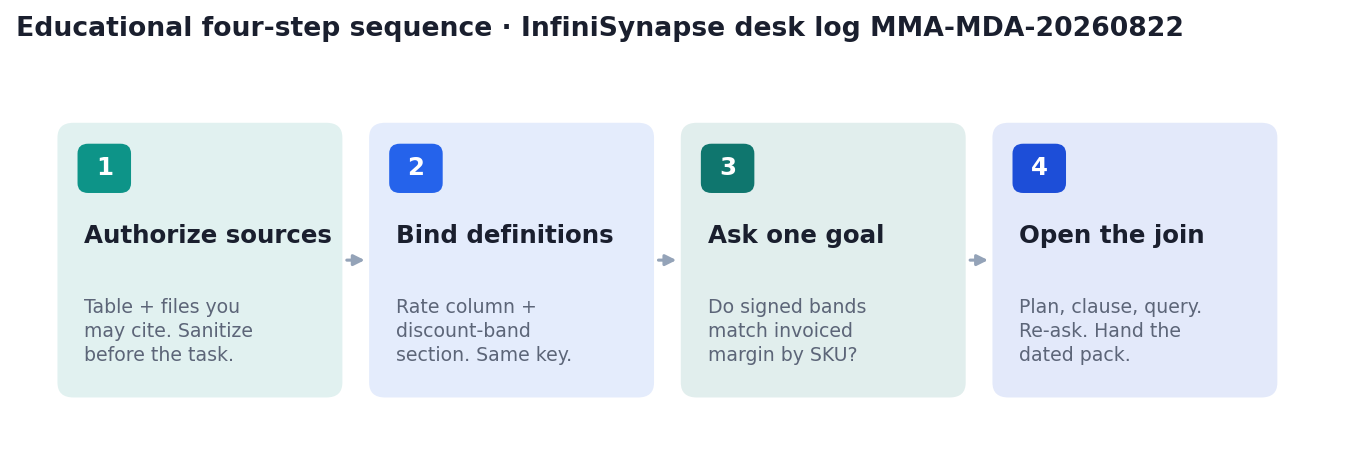
Figure. Educational four-step sequence the desk uses to tell a table-only recap from a table-plus-contract join. Expected result after step 6: cited clauses and SKUs outside the band both open. Not a product screenshot or a customer SLA.
Authorize sources and bind notes
Pick the live table or file you are allowed to query. Upload the documents or notes that define exceptions. Bind those notes to the source so recall is not a scavenger hunt. For multimodal data that includes audio or video, authorize those files in the same task rather than summarizing them in a side chat.
Sanitize first. Customer recordings, signed contracts, and internal video often contain names you should not paste into a shared composer. The FTC consumer-protection posture is one reason to keep human review on claims that affect people, even when the join looks clean.
Ask one question that needs both sides
Write a goal, not a tour. “Do signed discount bands in the Q2 schedule match invoiced margin by SKU?” is a multimodal data question. “Tell me about the contract and the orders” is not. Name the grain, the time window, and the document section if you know it.
If you cannot name both sides, you are not ready. Go back to profiling the table or reading the document. Joint analysis is a second move.
Inspect the plan and the citations
Open the plan, the retrieved passages, and the query. The NIST AI Risk Management Framework treats measurement and transparency as core functions; multimodal data inherits that bar. If the number and the clause cannot be opened independently, do not forward the answer.
Re-run the same goal after you correct a bind. The second run is how you learn whether multimodal data is accumulating context or just chatting again.
Desk Sample: Contract Text versus Order Rows
This is a first-party InfiniSynapse desk log of multimodal data, not a named-logo customer case and not an uplift claim. Run ID: MMA-MDA-20260822. Date: 2026-08-22 (Saturday). Operator: InfiniSynapse Data Team. Sources: a sanitized 18-page master service agreement and a 62,000-row orders replica. Contrast: table-only versus table plus contract. Download the same numbers as desk log MMA-MDA-20260822.
The table-only path filtered orders without opening the schedule. Cited clauses did not open. SKUs outside the band were not located. A same-day re-ask was not possible once the tab closed.
The joint path asked: “Do the signed discount bands match invoiced margin for Q2, and which SKUs sit outside the schedule?” The task selected the orders source and the bound notes. It returned cited clauses and SKUs outside the band. A reviewer opened the clause and the rows; one flagged SKU was a false join on an old product code—caught because the plan showed the key.
| Retrieval state | Cited clauses opened | SKUs outside band located | Same-day re-ask possible |
|---|---|---|---|
| Table-only | 0 | 0 | 0 |
| Table + contract | 1 | 1 | 1 |
Wall clock for the successful joint rerun was about nine minutes (warehouse time excluded). The clock started when the operator opened the standing goal and ended when both folders sat side by side with the cited clauses and the filtered SKUs open. It does not include replica provisioning or a legal review. Cite this table as InfiniSynapse desk log MMA-MDA-20260822. Do not cite it as customer ROI, a 40% cleaner margin list, a bake-off win, or a Stanford / FTC / IBM experiment. We do not publish named-logo customer cases on this page. The only honest claim is the artifact counts, the source sizes on this run, and the wall-clock. The 18-page MSA and 62,000-row orders table are this desk run’s inputs, not a customer extract.
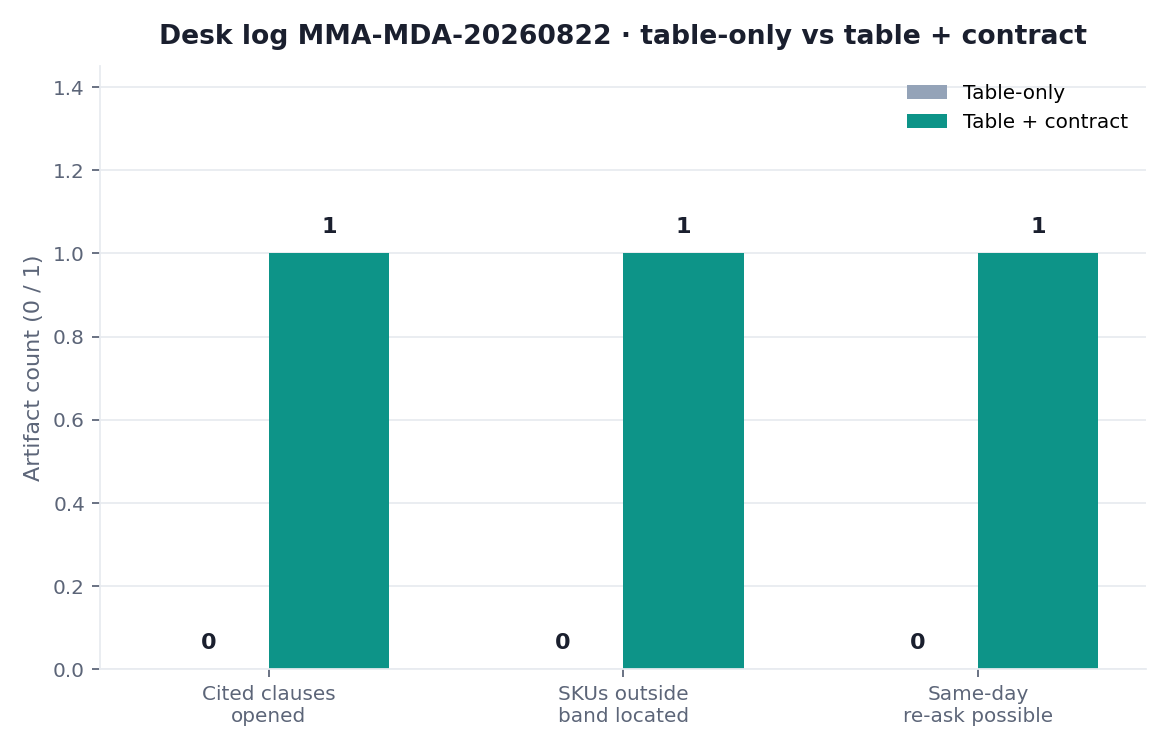
Figure. InfiniSynapse desk log MMA-MDA-20260822: table-only left 0 / 0 / 0; table plus contract left 1 / 1 / 1. Published context: the independent sources linked in the body. Not a customer experiment, SLA, or official benchmark.
| Evidence class | What you can cite | What you cannot claim |
|---|---|---|
| Desk log on this page | Artifact counts 0/0/0 → 1/1/1, 18-page MSA + 62,000-row orders on this run, ~9 min wall-clock, downloadable log | Customer uplift %, vendor bake-off win, named-logo case |
| Published authority (linked above) | Stanford HAI, OWASP, NIST, Google Cloud, Wikipedia, Vertex AI, Google Research, FTC, IBM NLP | That those sources ran this desk log |
| Independent standards (linked in body) | ISO/IEC 23053, ISO/IEC 5259-1, IEEE TPAMI survey, W3C MMI as published practice (retrieved 2026-08-29) | That ISO, IEEE, or W3C certified this page, the product, or the desk log |
| Homepage recognition | 2026 WAIC Future Tech OPC Excellence Award as published on the company homepage | That WAIC, Stanford, or Gartner scored this article |
Scorecard: When Joint Analysis Is Worth It
Score the question, not the model demo.
| Signal | Prefer a joint multimodal data task | Prefer a narrower tool |
|---|---|---|
| The decision names a table and a document | Yes | No |
| The document changes on a legal cycle | Yes — re-ask on the new file | Snapshot extract may be enough |
| You only need a published KPI | No | Warehouse or board |
| Recordings are in scope | Only if authorized and sanitized | Keep them out |
| Reviewers need citations | Yes | A slide restatement will fail |
If three or more rows say “yes,” multimodal data is the cheaper habit: one task, one bind, one replay. If the work is purely tabular, do not add files for theater.
The scorecard is an educational rubric, not a vendor ranking. Independent sources linked above describe published posture; they do not score this rubric.
Failure Modes You Can Catch Early
Unbound definitions
The most common failure is a fluent answer that used “revenue” from the document and “revenue” from a different column. Multimodal data without a bind will merge those words. Fix: write the two definitions in notes, bind them, and re-ask.
Scanned PDFs and noisy audio
A scan with no selectable text, or a recording with overlapping speakers, will starve retrieval. Multimodal data cannot repair a source you cannot read. Fix: replace the scan, or keep that file out of the task until a human transcript exists.
Treating chat files as institutional memory
Re-uploading “final_v7.pdf” every Monday trains nobody. Multimodal data becomes institutional only when the approved note stays bound to the source. Fix: promote the approved clause list; delete the pile of chat attachments.
Before you spend another afternoon exporting a PDF for one tool and a CSV for another, check three things on paper: which table grain the question needs, which document or recording is allowed to constrain it, and whether a reviewer can open both without asking you for a private download.
When retrieval must meet the table, open Multimodal RAG for analytics (bound retrieval, not a chat file) as its own guide—not only as a name in the cluster list.
Cluster guides under this hub: Analyze Documents with a Database; Audio Data Analysis Aligned to Metrics; Video Data Analysis for Business Questions; Unstructured plus SQL: Extract vs Joint Ask; Joint Analysis across Modalities; Multimodal RAG for Analytics; Multimodal AI for Tables and Files in One Task; What Is Multimodal Data in an Analysis Task; Multimodal Dataset: Bind, Then Ask the Join; Multimodal Data Integration without a New Lake; Data Modality: When a Second Type Earns a Seat.
Related hops: data knowledge base; parquet file analysis; ticket text plus the ticket table; MongoDB analytics; AI for data analysis.
Join the table and the document in one task
Select an authorized structured source, bind the notes or files that define exceptions, and ask whether the numbers and the text agree. This check uses only sources you authorize.
Commercial association: You do not need the workspace to complete the educational diagnosis on this page.
Open InfiniSynapseHow this page is sourced. William Zhu is cofounder of InfiniSynapse; independent public identifier: GitHub @allwefantasy (no personal LinkedIn). Institution: About InfiniSynapse. First-party recognition: 2026 WAIC Future Tech OPC Excellence Award (homepage; Agentic Data Infra entry—not a review of this page). Trust pages: Privacy · publishing terms · NIST Privacy Framework. Desk methodology note: 2026-07-29 attestation. Downloadable first-party run: desk log
MMA-MDA-20260822. Reviewed by analytics engineering · data platform · LLM security · editor. Editorial standards · corrections. Contact zhuhl@infinisynapse.com. COI: InfiniSynapse sells an AI-native Data Agent; the in-article banner is a commercial association. Fact-check: Stanford HAI AI Index · McKinsey State of AI · Gartner Peer Insights — Analytics & BI · OWASP Top 10 for LLM Applications · NIST AI Risk Management Framework · Google Cloud: What is AI? · Wikipedia multimodal learning · Google Vertex AI documentation · Google Research publications · U.S. Federal Trade Commission · IBM NLP overview · ISO/IEC 23053 · ISO/IEC 5259-1 · IEEE TPAMI multimodal survey · W3C Multimodal Architecture. First-party numbers on this page are desk logMMA-MDA-20260822only.
How to cite this page
Page: Zhu, W., & InfiniSynapse Data Team. (2026). Multimodal Data: inspect, then replay. InfiniSynapse
Run: InfiniSynapse Data Team. (2026). Desk log MMA-MDA-20260822 (sanitized composite)
Neither is an audit. Cite those published artifact counts on this first-party sanitized desk run. Keep that limit visible here. As of 2026-08-29, no independent certification or reproduction exists. Send contradictions to zhuhl@infinisynapse.com.
Frequently Asked Questions
Is multimodal data the same as uploading a PDF into a chat?
Bottom line: No. Multimodal data requires authorized sources, a bound note you can reopen, and a question that needs the table and the file together.
Do I need audio and video for every joint question?
Bottom line: No. Most multimodal data questions are a table plus a document. Add audio or video only when the decision actually cites them.
Can I extract the PDF first and skip the joint task?
Bottom line: Extraction is fine when you need a durable table for many jobs. Skip it when the question is agreement between live rows and current text—that is the multimodal data case this hub covers.
How do I stop the model from trusting a poisoned document?
Bottom line: Treat retrieval as untrusted, show the passage, and keep write access off the analysis account. Multimodal data inherits the same injection risks listed for LLM applications.
Do Stanford, FTC, or IBM certify this joint-task test?
Bottom line: No. The Stanford HAI AI Index, the FTC, and the IBM NLP overview describe published posture, not this desk table.
Does an independent body certify this page?
Bottom line: No. ISO, IEEE, W3C, Stanford, NIST, and OWASP publish practice and risk language. They did not certify InfiniSynapse or MMA-MDA-20260822. Multimodal data on this page is a first-party method plus those citations—not a certificate.
Are the object counts a third-party benchmark?
Bottom line: No. The 0 / 0 / 0 versus 1 / 1 / 1 counts are first-party desk log MMA-MDA-20260822. Multimodal data treats those counts as a table-only-versus-table-plus-contract test, not an SLA.
Conclusion
Multimodal data analysis is a join you can inspect, not a model that happens to accept more file types. Authorize the table and the files, bind the definitions, ask one goal that needs both sides, and refuse answers that cannot open their own evidence.
If you want to run that same check on sources you already control, open InfiniSynapse and join the table and the document in one task—then download the pack, not the chat bubble.