Multimodal RAG for Analytics (2026) Guide
By William Zhu (independent public engineering profile: GitHub @allwefantasy; no personal LinkedIn) & the InfiniSynapse Data Team · Published: 2026-08-22 · Last updated: 2026-09-14 · Last verified: 2026-09-14 · Next review: 2026-12-14 · About · Editorial standards · Privacy · Terms of Service · Corrections
Table of Contents
- TL;DR
- What multimodal RAG is in 2026
- Multimodal RAG vs traditional RAG vs document chat
- A retrieval architecture that can meet SQL
- PDFs, images, and notes next to a live table
- How to bind the pack, then ask
- Worked example: exception memo plus holds table
- How to evaluate multimodal RAG
- When you should not use multimodal RAG
- Failure modes you can catch early
- How to cite this page
- Frequently Asked Questions
- Conclusion
TL;DR
First-party figures on this page are desk log MMA-RAG-20260822 on sanitized composites, not customer uplifts and not a third-party bake-off.
Direct answer: Multimodal RAG for analytics retrieves bound notes, PDFs, or other files so a live table and a definition can be asked in one task. A chat attachment is not multimodal RAG—it is a file that vanishes when the tab closes.
What you'll learn: what multimodal RAG is in 2026; how it differs from traditional RAG and document chat; a retrieval architecture that still emits SQL; desk log MMA-RAG-20260822; and when not to use it.
Download evidence: desk log · aggregate CSV · verify script. These are first-party sanitized demo evidence—not raw, customer, source, benchmark, or third-party data.
If you only need rows, start with exploratory data analysis. The parent method lives in multimodal data analysis.
McKinsey’s State of AI and the Stanford HAI AI Index describe adoption pressure; they did not run the desk table. Retrieved 2026-09-14.
What multimodal RAG is in 2026
Key Definition: Multimodal RAG is retrieval-augmented generation over more than text—notes, PDFs, images, audio, or video—so a model answers from retrieved evidence instead of memory. For analytics, multimodal RAG also binds that pack to an authorized table, so the agent reads your definitions with the query plan. Here it means a pack you can reopen.
Independent method notes (not this desk log): Lewis et al. (arXiv 2005.11401) defines retrieve-then-generate; ISO/IEC 23053 names a system boundary. CDC data, OECD data, and BIS statistics show a count traveling with its annex. None evaluated InfiniSynapse or MMA-RAG-20260822. Retrieved 2026-09-14. Author record: GitHub @allwefantasy (no personal LinkedIn).
Classical retrieval answers “what did this memo say?” Analytics still has to answer “does that definition match these rows?” Multimodal RAG for analytics is that overlap. Four tools glued together do not create it.
If the missing object is a signed contract beside orders, continue in analyze documents with a database. If the missing object is a recording that must meet a KPI, use audio data analysis.
Retrieval is not a chat attachment
Tables carry grain, keys, and filters. Retrieved notes carry exceptions, side letters, and the sentence that redefined “active customer” last quarter. These sources become complementary evidence only when bound. A file dragged onto the composer is not institutional memory.
When a team already maintains metric contracts, a semantic layer can lock the numeric side. Multimodal RAG does not replace that contract. It stops the definition from living in a different tool from the query.
Multimodal RAG vs traditional RAG vs document chat
Most teams already attempt multimodal RAG; they just do it across tickets.
| Pattern | What it retrieves | Where it fails on an analytics question |
|---|---|---|
| Traditional RAG | Text chunks from a corpus | Grain, filters, and replayable SQL stay out of scope |
| Document chat / chat upload | Whatever you dropped in this thread | The file is gone when the tab closes; Monday re-upload cites a retired draft |
| Multimodal RAG for analytics | Bound notes, PDFs, or clips next to a live table | Still fails if the pack is unbound, dirty, or never queried |
Traditional RAG is strong on “what did this policy say last March?” Document chat is the same habit with a worse memory. Multimodal RAG vs traditional RAG is not “more file types.” It is whether retrieval and the query plan share a room.
Use a chat upload for exploration. Promote the approved note before anyone quotes it in a decision. Multimodal RAG earns its keep on the second move.
If your habit is to chat with your data by pasting a snippet, keep that for exploration. The durable object is the bound pack described in data knowledge base. For board metrics that must compile, read SQL RAG vs semantic layer—multimodal RAG retrieves the memo; the layer locks the number.
A retrieval architecture that can meet SQL
A 2026 multimodal RAG architecture still follows retrieve-then-generate. The analytics cut adds one bind and one query.
| Stage | What you lock | What you refuse |
|---|---|---|
| Ingest / authorize | The live table plus the pack you may retrieve | Personal downloads and unsanitized recordings |
| Encode / bind | The pack to one source at a time | A chat file that disappears when the tab closes |
| Retrieve | Passages that name the exception or clause | A silent merge of two “revenue” definitions |
| Ask / generate | One goal that needs the note and the rows | “Summarize the pack” with no grain |
| Inspect | Plan, retrieved passages, and the query | A fluent paragraph with no citations |
| Hand off | A dated pack a colleague can reopen | A screenshot of the chat |
Shared embedding spaces and page-level retrievers matter when the answer lives in a figure. They do not replace the bind. If the agent cites “the memo” and you cannot open the page, you do not yet have multimodal RAG you can defend.
This is closer to how a data agent should work than to a chatbot that accepts whatever you drag onto the composer. The agent plans, retrieves, and queries. You still approve the definition.
Data.gov (retrieved 2026-09-14) is a reminder that a table without the dictionary is not a finding. Multimodal RAG inherits that habit.
The OWASP Top 10 for LLM Applications flags prompt injection. Treat a retrieved clause as untrusted: show it, and do not let a hidden instruction redefine revenue. If the next object is an inspectable plan, continue in explainable AI data analysis.
PDFs, images, and notes next to a live table
Pick the live table you are allowed to query. Upload the field notes, signed reports, and clause lists that define exceptions. Bind that pack to the source so recall is not a scavenger hunt.
Prefer searchable text—Markdown, Word, and text-based PDF. Images earn a seat when the decision cites a figure the text does not carry. Whiteboard photos and private recaps do not. If you cannot copy a sentence out of the file, do not put that file in retrieval.
Sanitize first. Packs often contain names you should not paste into a shared composer. Selecting a memo does not make the memo lawful to share. Multimodal RAG still sits under data governance.
If the next fight is extract versus joint ask, continue in unstructured plus SQL. Extraction is the right move when you need a durable table for many jobs. Skip it when the question is agreement between live rows and current notes.
How to bind the pack, then ask
The method is short. The discipline is in what you refuse to skip.
- Pick the live table you are allowed to query. Upload the field notes, signed reports, and clause lists that define exceptions.
- Bind that pack to the source so recall is not a scavenger hunt. Sanitize first.
- Write one goal that names the note and the rows. Run it. Keep the artifacts.
- Open the plan, the retrieved passages, and the query behind the number.
- Re-run the same goal after you correct a bind.
- Hand the dated pack to a colleague. Refuse a screenshot of the chat.
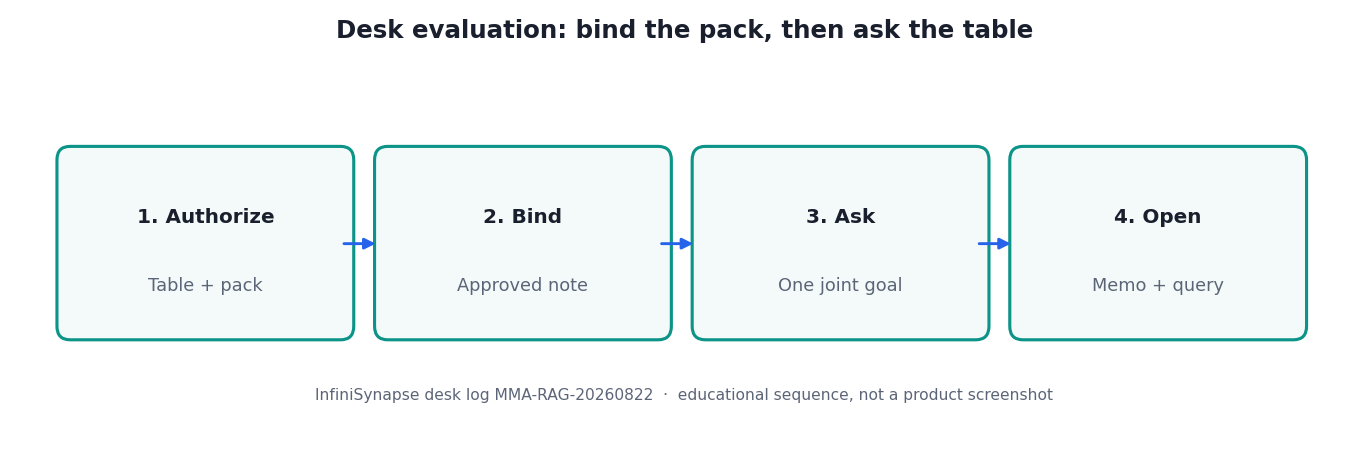
Figure. Four-step desk sequence: authorize, bind, ask one joint goal, open memo and query. Not a product screenshot or SLA.
Ask the table and the memo together
Write a goal, not a tour. “Do bound exception notes match SKU holds in the live table for Q2?” is multimodal RAG for analytics. “Summarize the pack” is not. Name the grain, the time window, and the memo section if you know it.
If you cannot name both sides, you are not ready. Retrieval that never meets a query is still document chat.
Inspect the plan and the citations
Open the plan, the retrieved passages, and the query. The NIST AI Risk Management Framework (retrieved 2026-09-14) treats measurement and transparency as core functions; multimodal RAG inherits that bar. If the number and the passage cannot be opened independently, do not forward the answer.
Re-run the same goal after you correct a bind. The second run is how you learn whether multimodal RAG is accumulating context or just chatting again. Download the task pack, not the chat bubble.
Worked example: exception memo plus holds table
This is a first-party InfiniSynapse desk log of multimodal RAG, not a named-logo customer case. Run ID: MMA-RAG-20260822. Sources: a sanitized 16-page exception memo and a 22,000-row holds replica. Contrast: Monday chat re-upload versus a bound pack. Downloads sit in the TL;DR.
The chat path re-uploaded “memo_final_v6.pdf” each Monday. The current memo did not open. SKUs outside the list were not located. A same-day re-ask was not possible once the tab closed. The composer cited a paragraph from v4 that legal had already retired.
The bound path asked: “Which SKUs sit outside the current exception list?” The task selected the holds source and the bound note. It returned the current passage and SKUs outside the list. A reviewer opened the passage and the rows; one extra flag was a false join on a retired code—caught because the plan showed the key.
| Retrieval state | Current memo opened | SKUs outside list located | Same-day re-ask possible |
|---|---|---|---|
| Chat re-upload | 0 | 0 | 0 |
| Bound pack | 1 | 1 | 1 |
Wall clock for the successful bound rerun was about seven minutes (warehouse time excluded). Cite InfiniSynapse desk log MMA-RAG-20260822, not customer ROI or a third-party experiment.
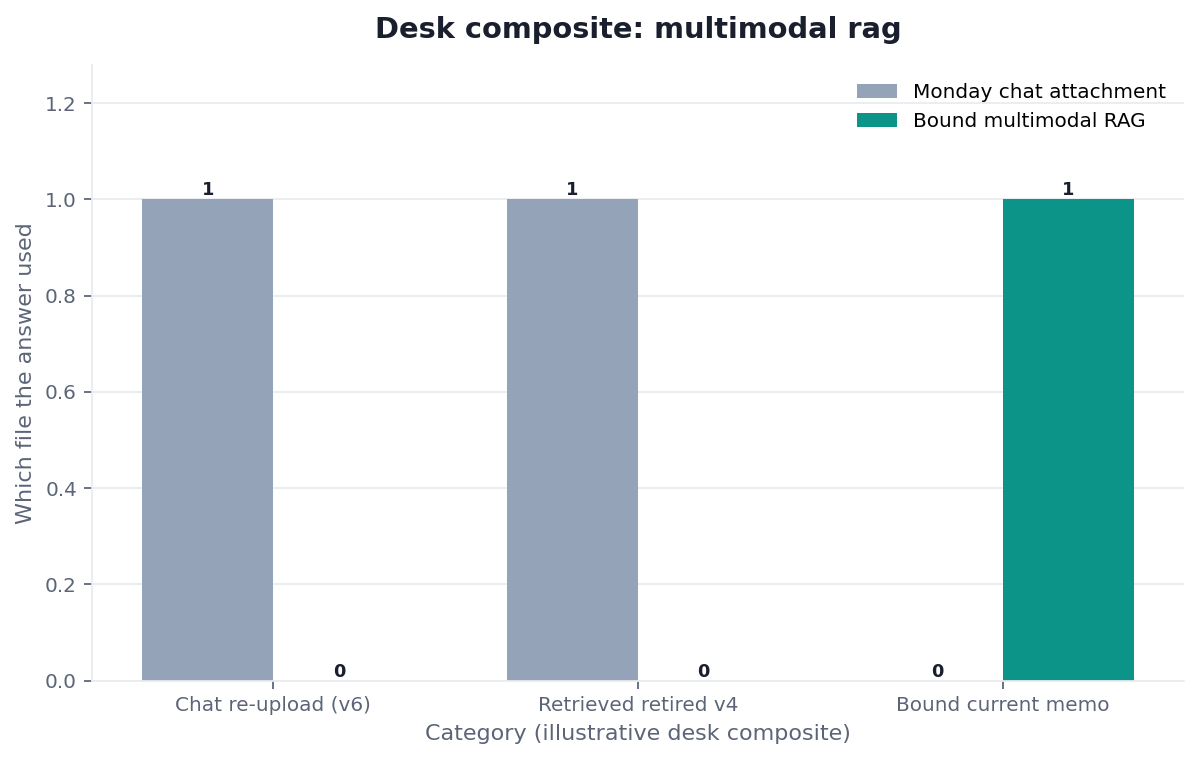
Figure. InfiniSynapse desk log MMA-RAG-20260822: chat re-upload left 0 / 0 / 0; the bound pack left 1 / 1 / 1. Not a customer experiment, SLA, or official benchmark.
How to evaluate multimodal RAG
Score the question, not the retrieval demo. For an analytics task, multimodal RAG is working only when a reviewer can reopen three objects: the current passage, the filtered rows, and the query that produced them.
| Signal | Prefer multimodal RAG bound to a source | Prefer a narrower tool |
|---|---|---|
| The decision names a table and a memo | Yes | No |
| The pack changes on a legal or clinical cycle | Yes — re-ask on the new file | Snapshot extract may be enough |
| You only need document Q&A | No | General RAG chat |
| Reviewers need citations plus a query | Yes | A slide restatement will fail |
| Definitions collide across memos | Yes — bind the approved note | A silent merge will invent agreement |
If three or more rows say “yes,” multimodal RAG is the cheaper habit: one pack, one bind, one replay. The scorecard is an educational rubric, not a vendor ranking.
When you should not use multimodal RAG
Skip multimodal RAG when the work is purely tabular and no memo constrains the filter. Do not add retrieval for theater.
Skip it when a semantic layer already compiles the measure you are being asked to quote. Retrieval of a slide that restates that measure is duplicate context.
Skip it when you only need document Q&A and nobody will open a query. That is traditional RAG or document chat. Buy that tool; do not relabel it.
If you still need four kinds of evidence in one trail, continue in joint analysis across modalities. For the parent method, open AI for data analysis.
Failure modes you can catch early
Unbound packs
The most common failure is a fluent answer that retrieved “revenue” from a memo and “revenue” from a different column. Multimodal RAG without a bind will merge those words. Fix: write the two definitions in notes, bind them, and re-ask.
Chat attachments treated as the index
Re-uploading “pack_final_v7.pdf” every Monday trains nobody. Multimodal RAG becomes institutional only when the approved note stays bound to the source. Fix: promote the approved pack; delete the pile of chat attachments.
Retrieval that never touches the table
A beautiful citation with no query is still document chat. Multimodal RAG for analytics must meet a replayable filter. Fix: name the grain in the goal and open the query before you forward the answer.
When the next missing object is not this page, open Video Data Analysis for Business Questions when a walkthrough video is a source, or Joint Analysis across Modalities when one task must carry four kinds of evidence.
Bind the pack, then ask the table and the memo
Select an authorized structured source, bind the notes that define exceptions, and ask whether live rows still match the retrieved passage. This check uses only sources you authorize.
Commercial association: You do not need the workspace to complete the educational diagnosis on this page.
Open InfiniSynapseHow this page is sourced. William Zhu is InfiniSynapse cofounder (GitHub @allwefantasy; no personal LinkedIn). First-party recognition: 2026 WAIC Future Tech OPC Excellence Award (homepage; self-described). Desk run: MMA-RAG-20260822. Reviewed by analytics engineering · data platform · LLM security · editor. COI: InfiniSynapse sells an AI-native Data Agent. Fact-check sources are linked in the body. Contact zhuhl@infinisynapse.com.
How to cite this page
Page: Zhu, W., & InfiniSynapse Data Team. (2026). Multimodal RAG: Bind, Then Replay. InfiniSynapse
Run: InfiniSynapse Data Team. (2026). Desk log MMA-RAG-20260822 (sanitized composite)
Neither is an audit. As of 2026-09-14, no independent reproduction of the contrast exists. Send contradictions to zhuhl@infinisynapse.com.
Frequently Asked Questions
Is multimodal RAG the same as uploading a file into a chat?
Bottom line: No. Multimodal RAG requires a bound pack you can reopen, authorized sources, and a question that needs the table and the note together.
How is multimodal RAG different from traditional RAG?
Bottom line: Traditional RAG retrieves text. Multimodal RAG can retrieve notes, PDFs, images, or clips. For analytics, the extra requirement is that retrieval meets a replayable query—not that you uploaded more file types.
Do I need audio and video in the pack?
Bottom line: No. Most analytics packs are notes plus a document. Add audio or video only when the decision cites them. Multimodal RAG is the bind, not a quota of file types.
Can I extract the memo first and skip retrieval?
Bottom line: Extraction is fine when you need a durable table for many jobs. Skip it when the question is agreement between live rows and current notes—that is multimodal RAG for analytics.
How do I stop the model from trusting a poisoned memo?
Bottom line: Treat retrieval as untrusted, show the passage, and keep write access off the analysis account. Multimodal RAG inherits the same injection risks listed for LLM applications.
Are the object counts a third-party benchmark?
Bottom line: No. The 0 / 0 / 0 versus 1 / 1 / 1 counts are first-party desk log MMA-RAG-20260822. CDC, OECD, and BIS files are citable as their practice, not as a score of this run.
Conclusion
Multimodal RAG for analytics is retrieval you can inspect next to a query you can replay, not a chat attachment that happens to accept more file types. Bind the pack to the source, ask one goal that needs the note and the rows, and refuse answers that cannot open their own evidence.
If you want to run that same check on sources you already control, open InfiniSynapse and bind the pack, then ask the table and the memo—then download the pack, not the chat bubble.