Financial Planning and Analysis without a New Mart
By William Zhu & the InfiniSynapse Data Team · Published: 2026-08-22 · Last updated: 2026-08-31 · Last verified: 2026-08-31 · Next review: 2026-11-30 · Editorial standards · Corrections
Table of Contents
- TL;DR
- What Financial Planning and Analysis Means on the Ledger You Close
- A Planning Framework: Ledger, Version, Driver, Memo
- How Financial Planning and Analysis Differs from a Mart Program
- Tool Landscape for Financial Planning and Analysis
- How to Run Financial Planning and Analysis This Month
- Accuracy and Experience Record: An Illustrative Plan-to-Actual Split
- Evidence Boundaries and Independent Validation
- How to Cite This Page
- Scorecard: Ledger-First Planning
- Failure Modes Finance Teams Already Know
- Frequently Asked Questions
- Conclusion
TL;DR
We evaluate these patterns at the InfiniSynapse desk on sanitized composites; sample figures on this page are illustrative, not customer uplifts.
Direct answer: Financial planning and analysis still starts on the ledger you already close. Lock the version, ask one variance, keep a memo a controller can reopen—without standing up a new mart first.
What you'll learn:
- Why financial planning and analysis is a cycle on existing books, not a greenfield warehouse
- A four-object frame: ledger, version, driver, memo
- Why a mart program is delay dressed as architecture
- How to connect the finance source and ask one variance this month
- Three failure modes that move planning off the books you already close
Download evidence: desk log · aggregate CSV · verification script · external-source check · independent-reproduction protocol. This financial planning and analysis package is first-party and illustrative—not customer, audited, statistical, or third-party evidence.
Controllers do not buy a planning suite. They buy a cycle they can defend. Financial planning and analysis fails the moment the plan lives in a model nobody can join to the books. If your team is waiting on a finance mart before anyone may ask “why did opex miss the plan,” you are delaying the close, not de-risking it. The wider cycle still lives on the FP&A analytics hub; this page is only the ledger-first cycle.
What Financial Planning and Analysis Means on the Ledger You Close
Key Definition: Financial planning and analysis is the operating cycle that joins a named plan version to the ledger you already close, then explains the gap with a driver table and a memo a controller can reopen—on sources you already authorize, without a new mart first.
Public catalogs already work this way. NOAA education and NASA Earthdata (retrieved 2026-09-04) expose existing materials and observations. They are data-access analogies, not finance evidence or validation. Financial planning and analysis should be that honest: start on the books you already close.
The AFP FP&A Handbook and AFP’s What is FP&A? page (both retrieved 2026-09-04) describe integrated planning and forecasting, performance management, and financial analysis. The ledger-first workflow here is narrower InfiniSynapse operating guidance; AFP did not publish or endorse it. For the abbreviation itself, see what is FP&A.
That is the job. A planning calendar on a slide does not create the cycle. A forecast file that cannot join the ledger is not financial planning and analysis either. Name the ledger, lock the version, open the drivers, write the memo.
If the next object is the comparable pair rather than the planning cycle, continue in budget vs actual analysis. If the next object is the checklist with files, use month-end close analytics.
A mart is useful when you must materialize the same grain every night. It is not a veto on this month’s financial planning and analysis. A read-only ledger replica, a plan workbook with a version ID, and a bound note that says how the plan rolls is enough to start. Data governance still applies: least privilege, read-only, no payroll register in a prompt. Prove one variance on one entity before you unify the group.
The ledger that already closed
The first object in financial planning and analysis is the ledger you already close. Not a shadow workbook. Not a “management view” that cannot be reconciled. Write the source in the question: “read-only finance replica, Plan v2, books-closed-plus-two.” If the question omits the ledger, you will explain a movement that is actually a file the books never booked.
EPA data (retrieved 2026-09-04) is a published catalog, not a source for this finance method. Analysts query named tables. They do not wait to rebuild the agency. Financial planning and analysis has the same patience limit: this close still has a date. A semantic layer can lock ledger names at scale later. A bound note is enough for one entity this month.
The plan version that keeps the join honest
The expensive failures in financial planning and analysis are vocabulary, not calculus. “Opex” that includes capitalized labor in the plan and excludes it in actuals is not a miss. It is two sentences. Bind the rollup, the exclusion list, and whether intercompany is eliminated. Then ask. If you need durable context rather than a one-off cycle, keep what is data management next to the note.
Currency is a join too. Write the rate source: “month-end rate from the treasury file, not the daily spot.”
A Planning Framework: Ledger, Version, Driver, Memo
Score the month with one table. Financial planning and analysis quality is visible in the columns.
| Object | What it is | Pass signal |
|---|---|---|
| Ledger | The books you already close | Authorized, read-only, named |
| Version | The plan file you are measuring against | Version ID in the question |
| Calendar | Period, close cutoff, restatement rule | Everyone uses the same cutoff sentence |
| Account map | How P&L lines roll up | A bound note, not a hallway rule |
| Driver | The operating table that explains the line | Join keys you can name |
| Memo | The file the task leaves | A colleague can download it |
The cycle fails when the plan exists and the ledger join does not. A paragraph that says “we missed hiring” with no table is a story. Bind the account map before you ask the model to narrate.
NREL research (retrieved 2026-09-04) catalogs work that already exists. This is an archive analogy, not finance authority. You query it. You do not rebuild the lab to read one paper. Financial planning and analysis should be equally dull: open the authorized ledger, do not invent a second books of record.
Minimize payroll-adjacent fields. Compensation lines can stay at cost-center totals. The NIST Privacy Framework (retrieved 2026-09-04) supplies privacy-risk context; it does not validate this run.
The U.S. GAO data-reliability guide and UK Government AQuA Book (both retrieved 2026-09-04) support checks of accuracy, completeness, applicability, verification, and fitness for purpose. Applied here, financial planning and analysis should disclose source versions, cutoff, mappings, formulas, and failed claims. Neither publisher reviewed this page.
How Financial Planning and Analysis Differs from a Mart Program
Finance teams already produce plans. Financial planning and analysis is a narrower claim: the plan joins the books, and the movement is explained on the same grain.
A forecast that never meets the ledger
Someone builds a bottoms-up model in a spreadsheet and presents it as the plan. That can be a forecast. It is not financial planning and analysis until the file joins the ledger at entity, period, and account. Next month the model will not replay, and nobody can say which version sat on the other side of the minus sign.
A mart veto on this period
The program says “we will run financial planning and analysis after the finance mart lands.” Eighteen months later the cycle still lives in weekend files. Build the mart if nightly grain requires it. Do not use it as a veto on this period. Analyze a database without ETL is the same honesty on the engineering side: connect the authorized source, then ask.
A reopenable cycle on the books you have
You connect the ledger and the plan file, bind the rollup note, and ask for the top drivers versus the named version. That is financial planning and analysis you can audit. Self-service analytics still applies: the controller types a business question. The ledger is the source.
arXiv computer science (retrieved 2026-09-04) is an archive you query, but not a source for the FP&A definition. You do not rebuild the archive to read one paper. The same patience limit applies to financial planning and analysis: this close still meets.
Tool Landscape for Financial Planning and Analysis
You do not need a new aisle of planning logos. You need objects that survive a controller review. Spreadsheet plans break on join keys. Dedicated planning systems own the version. BI tools are strong when the grain is already certified. A data agent that can ask across the ledger, the plan file, and an operating extract—without a new mart first—is the missing piece.
InfiniSynapse matches that piece: authorize a finance source, bind the definition note, ask one variance, download the memo from the task workspace. It is a professional AI data analyst, not ChatBI or NLP2SQL. It will not invent a chart of accounts, and it will not post to the ERP. Refuse a tool that hides the statement, wants write access, or “explains” opex without naming the join. Accept a read-only replica, a versioned plan file, and a one-page note.
If you cannot name period, entity, and account, stop. Chat with your data only counts when the chat leaves a trail. Financial planning and analysis still needs the file.
How to Run Financial Planning and Analysis This Month
Keep the sequence boring. Boring is how financial planning and analysis survives a controller.
Lock the ledger and the plan version
Write both in the question: “August 2026 versus Plan v2 on the read-only finance replica, cutoff books-closed-plus-two.” If the question omits the version, you will explain a movement that is actually a file swap. If two entities close on different days, write both cutoffs. Do not let the model average them.
Bind the rollup and the exclusion list
One short note: how opex rolls, which reclasses are excluded, whether capitalized labor sits in opex. Hallucinations are usually vocabulary, not calculus. Add the FX sentence if more than one currency is in the pack. Add the restatement sentence if last year was recast. Bind the note to the source so retrieval and the query plan share a room.
Ask one variance, then open the statement
Ask: “Top five drivers of opex versus Plan v2, with the join to the operating extract.” Open the plan, the statement, and the driver table before you write the committee sentence. Then download the memo. If the plan skipped the join, reject the paragraph even when the dollars look familiar. When those three are written, financial planning and analysis has started on the books you already close.
If the output must be a file the committee already expects, open the management reporting pack guide. If the first control is the role on the replica, use connect a finance database.
Accuracy and Experience Record: An Illustrative Plan-to-Actual Split
Desk composite, not a customer case. Run ID: FPA-PLANV2-20260823. Run date: 2026-08-23. Operator: InfiniSynapse Data Team. Objects inspected: ledger, Plan v2, close cutoff, account map, exclusion note, vendor extract, driver table, and retained memo. A controller-role prompt asked: “What are the top five drivers of August opex versus Plan v2 on the read-only finance replica, excluding one-time reclass per the bound note?” That is financial planning and analysis as a single variance, not a mart ticket.
The plan named the ledger, the plan file, and a vendor extract at cost-center grain. The driver table (illustrative) showed +$280k in contracted services, +$120k in cloud, −$40k in travel, and a +$35k mapping miss where one cost center had been rolled to the wrong parent. The first paragraph blamed “hiring.” The opened table showed contractors, not FTE. The controller rejected the adjective, kept the table, and sent a two-page memo.
A second pass joined the vendor invoice extract. The true-up was $90k of the $120k (illustrative). The sentence changed from “cloud is out of control” to “Plan v2 missed the true-up.” That is financial planning and analysis on the ledger you already close.
The dollar figures are illustrative. Published context: NOAA education, NASA Earthdata, EPA data, NREL research, arXiv computer science.
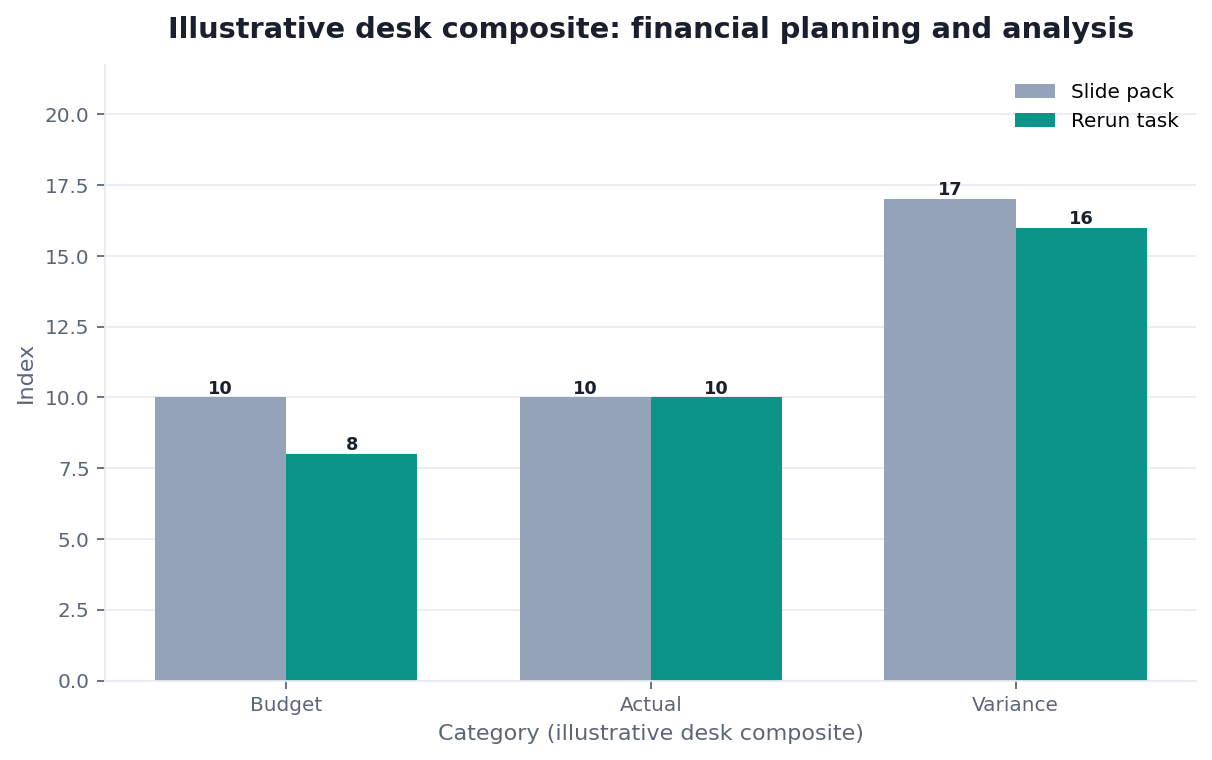
Figure. Illustrative desk composite (category × method). Not a customer experiment, SLA, or official benchmark.
The operator typed the financial planning and analysis goal, opened Plan v2, the rollup note, and driver table, then rejected an unsupported hiring explanation. A vendor join isolated the illustrative cloud true-up. The desk log records the review; the aggregate CSV exposes five rows. This is first-party experience, not a close-time promise.
Evidence Boundaries and Independent Validation
The scenario is not audited financial data, a customer case, statistical sample, benchmark, or independent study. Source records remain private, so outsiders cannot reconstruct its values from the public package. The script checks CSV transcription only.
The public package is intentionally small. It supports checking the article's transcription, source labels, stated arithmetic, and review sequence. It does not expose private ledger rows, establish population-level performance, prove savings, compare vendors, or show that another finance team would reach the same conclusion. Those questions require authorized source access and an independent report.
The source check separates direct finance authority from archive analogies. The open protocol defines an external test on separate authorized data. As of 2026-08-31, no qualifying independent report exists.
Use these controls when financial planning and analysis claims are disputed: define scope, lock source versions, publish formulas, disclose exclusions, and preserve failed claims. Reliable financial planning and analysis separates a repeatable procedure from one result. Reviewers can challenge financial planning and analysis without endorsing the product; conflicting evidence should update financial planning and analysis guidance.
How to Cite This Page
Page: Zhu, W., & InfiniSynapse Data Team. (2026). Financial planning and analysis without a new mart. InfiniSynapse. https://infinisynapse.com/en/blog/financial-planning-and-analysis
Run: InfiniSynapse Data Team. (2026). Desk log FPA-PLANV2-20260823 (illustrative sanitized composite). https://infinisynapse.com/blog-media/financial-planning-and-analysis/downloads/desk-log-FPA-PLANV2-20260823.md
Neither citation is an independent audit. Cite Plan v2, run ID, five illustrative rows, review decisions, and first-party limitation.
Scorecard: Ledger-First Planning
| Check | Yes | No |
|---|---|---|
| Ledger and plan version are in the question | Run | Rewrite |
| Rollup note is bound to the source | Run | Bind first |
| Source is read-only and authorized | Run | Stop |
| Driver table is visible, not only a paragraph | Brief | Reject |
| Payroll-adjacent fields are minimized | Run | Cut columns |
| Memo is a file, not a chat bubble | Repeatable | Folklore |
Financial planning and analysis is close-ready when the first five rows pass. A pretty forecast with a “No” on the ledger join is still a story.
Failure Modes Finance Teams Already Know
A plan that cannot name the ledger
If the file cannot join entity, period, and account, financial planning and analysis has not started. Put the ledger in the question every time.
A missing join sold as a story
“Mix” and “timing” are adjectives until the driver table names the key. Financial planning and analysis that ships the adjective and hides the join will be rewritten by the first skeptical VP. Open the statement. If the join is missing, the paragraph is worthless.
A model that writes like a CFO
Fluent language over a wrong account map is the expensive failure. Open the rollup. If the map is wrong, the paragraph is worthless. Write the restatement sentence or accept a fake miss. A financial variance analysis page is the sibling that owns the driver table when the cycle is already settled.
Before you send the pack, confirm the version, the cutoff, and the driver table. Multi-year restatements belong on multi-year financial analysis. A dashboard is optional after the join is right.
Each row is a single hop.
| Live guide | Open it when |
|---|---|
| FP&A analytics | the cycle is the close, not only the plan join |
| budget vs actual analysis | the missing object is the comparable pair |
| month-end close analytics | the missing object is the checklist with files |
| financial variance analysis | the missing object is the driver table |
| connect a finance database | the first control is the read-only role |
Confirm the ledger, the version, and the driver join. That is the desk check for financial planning and analysis on this period.
Connect the finance source and ask one variance
Connect the ledger you already authorize, bind the plan-version note, and ask one variance. This check uses only sources you authorize.
Commercial association: You do not need the workspace to complete the educational diagnosis on this page.
Open InfiniSynapseHow this page is sourced. William Zhu is cofounder of InfiniSynapse (GitHub @allwefantasy); no personal LinkedIn or finance certification is published. His profile establishes authorship, not independent qualification. Desk decisions are recorded in run FPA-PLANV2-20260823. Reviewed by analytics engineering · data platform · LLM security · editor. Editorial standards · corrections · publishing principles. COI: InfiniSynapse sells an AI-native Data Agent. AFP, GAO, UK Government, NIST, NOAA, NASA, EPA, NREL, and arXiv did not validate the run. This is not accounting, tax, employment, or legal advice.
Frequently Asked Questions
Can financial planning and analysis start without a finance mart?
Bottom line: Yes. Financial planning and analysis can start on a read-only ledger, a plan file with a version ID, and a bound rollup note. Build a mart when nightly grain or extract cost requires it—not as a veto on this close.
Should the agent post journals or update the ERP?
Bottom line: No. Financial planning and analysis is read-only. Posting is a different control plane. If a tool offers write-back, treat it as out of scope for this page.
What belongs in the bound note?
Bottom line: The cutoff sentence, the account rollup, the plan version rule, and the exclusion list. Quality is usually the note, not the model.
How do I handle a mid-quarter plan version change?
Bottom line: Put the new version ID in the question and say so in the memo. Financial planning and analysis that silently swaps files will invent a miss.
Is this ledger-first workflow the complete definition of FP&A?
Bottom line: No. AFP describes a broader function spanning planning, forecasting, performance management, and financial analysis. This page presents one narrower operating workflow.
Has an independent practitioner reproduced this run?
Bottom line: No qualifying report exists as of 2026-08-31. The protocol defines an external financial planning and analysis test; the script verifies illustrative CSV transcription only.
Conclusion
Financial planning and analysis is a monthly habit: lock the ledger, bind the version, ask one variance, keep the memo. You do not need a new mart to start. You do need a trail a controller will sign.
Run the scorecard on the last cycle you sent upstairs. If the ledger join was missing, the pack was a forecast story. When you want to ask this month’s variance on a read-only finance source, open InfiniSynapse and ask the drivers before you write the adjective.