AI Prompts for Data Analysis: 36 Copy-Paste Templates
By William Zhu & the InfiniSynapse Data Team · Published: 2026-06-09 · Last updated: 2026-09-16 · Last verified: 2026-09-16 · About: Editorial standards / policy · About / team
Author credentials: William Zhu — InfiniSynapse cofounder; public engineering profile GitHub @allwefantasy. Desk contact: zhuhl@infinisynapse.com. First-hand: maintaining recurring reporting prompts, debugging failed analyses, and training analysts to reuse high-trust prompt cards. Reviewers: analytics engineering · data platform.
Disclosure: We build an AI-native analytics platform. Educational templates below stand alone. Product links appear only in a short commercial note. Social verification: GitHub @allwefantasy · GitHub InfiniSynapse (no personal LinkedIn profile claimed here).
Third-party anchors: OWASP LLM Top 10, NIST AI RMF, ISO/IEC 27001, AWS ML Lens, PostgreSQL docs. Peer-review archive: editorial standards.
Table of Contents
- TL;DR
- Key Definition
- AI Prompts for Analyzing Data
- End-to-End Prompting for Data Visualization
- AI Prompt Analyst Workflows
- AI Search Prompt Analytics
- Datenanalyse-Prompts
- Evaluate a prompt-expansion vendor
- AI Prompts for Data Management
- When Prompt Libraries Actually Work
- Design Rules Before You Write Prompts
- 36 Prompt Templates by Use Case
- How to Operationalize the Library in 30 Days
- Real Rollout Example
- Operating the prompt library in production
- Communicating Results to Stakeholders
- Frequently Asked Questions
- Downloadable checklist
- Who wrote this
- References
- Conclusion
TL;DR
Direct answer: AI search prompt analytics measures a frozen prompt set the way you measure a pipeline: reuse rate, correction loops, rerun variance, and—when the prompt is used in AI search—mention versus citation on the same locked file. AI prompts for analyzing data are the 36 copy-paste cards on this page. Start with the six starters, instrument the library in AI search prompt analytics, then expand the 36-template library.
This guide gives you 36 production-ready AI prompts for data analysis, grouped by high-frequency analyst workflows. Use it with What Is a Data Agent? so prompts become governed assets—not ad-hoc snippets. Read governance questions before you paste a prompt before the library goes to production. For skills alongside the library, see AI Data Analyst Skills.
Evaluation basis: Patterns below come from desk reviews of analyst prompt libraries on production warehouses. Governance citations (OWASP, NIST, ISO) are inline; product fit is optional and fenced at the end.
Key Definition
Key Definition: AI prompts for data analysis (and AI prompts for analyzing data) are structured instructions that define decision objective, data boundaries, metric logic, validation checks, and output format so an AI assistant can produce repeatable analysis instead of one-off narrative.
When prompts touch live warehouses, pair them with role design and explainable validation queries from the PostgreSQL documentation (or your warehouse’s equivalent grants model).
AI Prompts for Analyzing Data
Searchers asking for ai prompts for analyzing data or ai prompt for data analysis usually want copy-paste cards—not theory. These six starters cover the most common “analyze this dataset” requests; each assumes you fill [METRIC], [TABLE], and [TIME WINDOW] from your metric contract.
| # | Prompt (copy-paste) | Use when |
|---|---|---|
| 1 | "Act as a senior analyst. For [METRIC] over [TIME WINDOW] on approved table [TABLE], state the decision owner, list assumptions, compute the metric with SQL, run a null-rate check, and return a one-paragraph finding plus confidence level." | First pass on a recurring KPI |
| 2 | "Compare [METRIC] to trailing 7-day and 28-day baselines. Flag only statistically meaningful deviations. Show segment breakdown by region and channel." | Weekly “what changed?” |
| 3 | "Decompose the change in [METRIC] into volume, mix, price, and conversion effects. Quantify each and report residual." | Post-drop diagnosis |
| 4 | "Produce two independent SQL paths for [METRIC] and reconcile results. If variance exceeds 2%, list likely causes." | Trust-building before exec readout |
| 5 | "Given this question: [BUSINESS QUESTION], list three testable hypotheses, required fields per hypothesis, and the fastest validation query for each." | Exploratory analyzing-data sessions |
| 6 | "Summarize findings in five bullets: decision, evidence, risk, recommended action, next checkpoint—with explicit data boundaries used." | Stakeholder handoff |
These map to full templates 1–6, 8, 11, 13–14, 19, 31 in the 36-template library below.
End-to-End Prompting for Automated Data Visualization
End-to-end prompting for automated data visualization means chaining prompts so analysis does not stop at SQL—you specify chart intent, encoding, and validation in the same governed workflow.
| Step | Prompt pattern | Output |
|---|---|---|
| 1 — Frame | "Define the decision, metric contract, and grain for [CHART QUESTION] before any SQL." | Scoped analysis brief (template 1–2) |
| 2 — Query | "Write SQL for [METRIC] at [GRAIN]. Comment filters and join assumptions." | Validated query (template 8) |
| 3 — Chart spec | "Given this result schema, propose a chart type (bar, line, or small multiple). Justify with comparison type—not decoration. Include axis labels and units." | Chart specification |
| 4 — Automate | "Convert the SQL + chart spec into a repeatable prompt card with validation: row count, null check, and 2% reconciliation vs prior week." | Production prompt card |
Rule: visualization prompts inherit the same data boundaries and metric contract as analysis prompts—never generate a chart from unapproved tables. For dashboard design discipline after charts ship, see dashboards: design best practices.
AI Prompt Analyst Workflows
An AI prompt analyst (or ai prompt analyst) maintains prompt libraries, metric contracts, and rerun benchmarks—not only ad-hoc ChatGPT sessions.
| Responsibility | Prompt-library action |
|---|---|
| Curate templates | Map recurring business questions to template IDs (see Quick Selection Table) |
| Enforce boundaries | Fill owner + approved sources on every card (Design Rules) |
| Run reruns | Monthly reconciliation on templates 11, 17, 13 |
| Train stakeholders | Publish “start here” set: templates 1, 8, 13, 19, 31 |
Daily stack for a prompt analyst: morning KPI snapshot (13) → segment drill (14) → root-cause matrix if alert (19, 24) → exec summary (31). Log corrections in the CSV checklist.
AI Search Prompt Analytics
AI search prompt analytics is not a vanity “prompt score.” It is two ledgers on the same frozen file: (1) warehouse-library health—reuse, correction, rerun variance—and (2) AI-search behavior when that file is the weekly prompt set (mention vs citation, locale lock, no silent verb edits).
The library-ops table below is unchanged from the 2026-09-07 desk. Keep it. The search ledger is what was missing when queries like ai search prompt analytics ranked this URL without a first-screen method.
| Metric | How to track | Target (desk heuristic) |
|---|---|---|
| Prompt reuse rate | Share of recurring reports using library IDs vs free-form chat | ≥70% by week 4 |
| Correction loop rate | Outputs sent back for SQL/metric fix | <15% |
| Rerun consistency | Same prompt, two analysts, same KPI | ≤2% variance |
| Time-to-first-insight | Kickoff → validated table | Track vs pre-library baseline |
| AI-search row | How to track | Do not claim |
|---|---|---|
| Locked-file hash | SHA-256 of the UTF-8 prompt-set file before the week starts | That the hash “ranks” |
| Mention vs citation | For each prompt: named / cited / neither, plus date and surface | A blended citation rate across engines |
| Locale lock | Same language tag on the file and the session | That a translated log is a second test |
| Verb-edit break | Re-hash after any wording change | That prompt count proves comparability |
On 2026-09-14 this host’s locked-set desk wrote two eight-prompt files: v1 818 bytes vs v2 830 bytes after one verb change. Prompt count stayed 8; the digest did not. That is why AI search prompt analytics versions the file first. Method: locked prompt set AI visibility. Surface rows: Perplexity search rank tracking.
Instrument warehouse prompts the way you instrument pipelines—pair with How to Evaluate an AI Data Analyst when tools enter the stack.
Datenanalyse-Prompts
Datenanalyse-Prompts are the same 36 English cards with German question labels. This URL stays English (hreflang="en"). Do not treat a later translation of the log as a second test.
| Deutscher Einstieg | Start here | Why |
|---|---|---|
| „Analysiere diesen KPI“ | Starters 1–6, templates 8, 13 | Decision owner + metric contract first |
| „Was hat sich diese Woche geändert?“ | Templates 13, 14, 18 | Baselines before story |
| „Warum ist die KPI gefallen?“ | Templates 19, 21, 24 | Residual after volume/mix/price |
| „Kann ich dem SQL trauen?“ | Templates 8, 9, 11 | Two independent paths, 2% variance |
| Bibliotheksgesundheit | AI search prompt analytics | Reuse and rerun, not a style score |
Copy the English prompt body. Fill [METRIC], [TABLE], and [TIME WINDOW] from the German metric contract you already signed. If you need a native-language prompt file for AI-search weeks, version it as its own hash—see the locked-set guide above.
Evaluate a prompt-expansion vendor
Queries such as “evaluate the prompt expansion company Sana Labs on statistical analysis” are a vendor-method job, not a reason to turn this library into a branded review. This page does not score Sana Labs, and it does not invent a customer study. Use the checklist when any prompt-expansion vendor claims statistical analysis.
| Test | Pass rule | Fail if |
|---|---|---|
| Locked prompt set | Vendor runs your dated file; hash stored | They rewrite prompts mid-trial |
| Sample size | n and time window written on the readout | One demo chat treated as a test |
| Independence | Two analysts or two days, same file | One operator, one session |
| Metric contract | Named KPI, grain, exclusions | “Insight quality” with no formula |
| Significance | Test named (e.g. paired comparison) + residual | A single percentage without a comparator |
| SQL reconciliation | Two paths, ≤2% variance (templates 11, 19, 22) | Narrative only |
If the vendor cannot store the hash, the n, and the residual, stop. That is a demo, not statistical analysis. Tool scoring lives on How to Evaluate an AI Data Analyst. Prompt text lives in the 36-template library.
AI Prompts for Data Management
AI prompts for data management support catalog, freshness, and access—not headline KPIs. Use alongside analysis templates when the blocker is “can we trust the source?”
- Freshness audit — "List last-updated timestamps for tables in
[DOMAIN]. Flag any source older than[SLA]for[METRIC]." - Schema drift scan — "Compare current schema to last month's snapshot for
[TABLE]. Report new, dropped, or type-changed columns affecting[METRIC]." (extends template 17) - Access boundary check — "Confirm role
[ROLE]can read only approved objects for this analysis. List any over-privileged paths." - Lineage question — "Trace
[METRIC]to upstream columns and transformations. Note single points of failure." (pair with data lineage tracking)
When Prompt Libraries Actually Work
Prompt libraries deliver value only when paired with metric contracts, source boundaries, and a review workflow. The most common failure patterns—and their fixes—look like this:
| Anti-pattern | What It Looks Like | Practical Fix |
|---|---|---|
| Prompt-only thinking | Team saves text snippets but ignores metric contracts | Pair every prompt with a metric definition card |
| No source boundaries | AI pulls stale or unapproved data | Add allowed sources and freshness windows in prompt header |
| No reviewer workflow | Answers ship without challenge or rerun checks | Require analyst + stakeholder sign-off for high-impact reports |
| No drift detection | Prompt quality decays after schema changes | Add monthly rerun benchmark and correction log |
Design Rules Before You Write Prompts
Before you expand a library, lock six fields on every prompt card. Metric and access hygiene should align with the OWASP Top 10 for LLM Applications when prompts can trigger tool calls or export data, and with the NIST AI Risk Management Framework for production review gates.
- Decision owner: who acts on the output.
- Question class: diagnosis, forecast, monitoring, or recommendation.
- Metric contract: exact formulas and exclusions.
- Data boundaries: approved tables, connectors, and freshness limits.
- Validation requirements: null checks, outlier flags, and reconciliation.
- Output contract: table structure, narrative length, confidence statement.
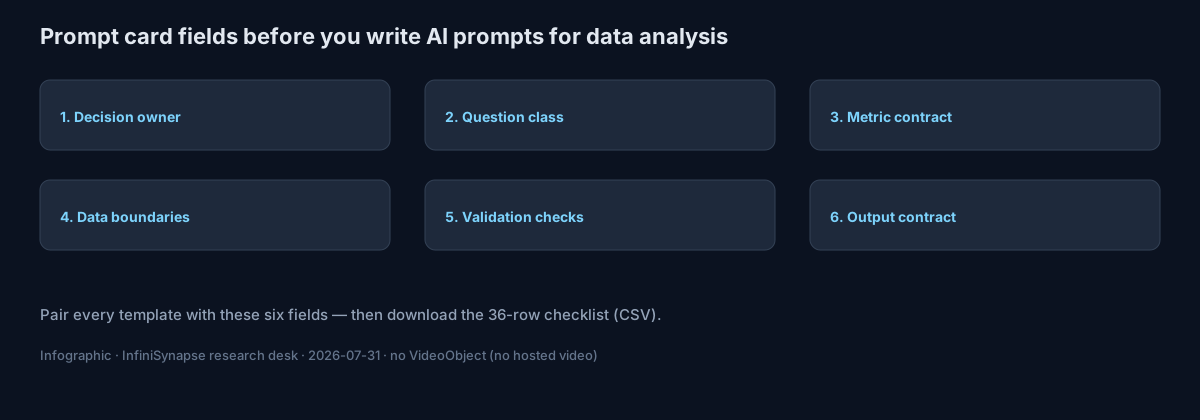
Download (CC BY 4.0): ai-prompts-for-data-analysis-checklist.csv — 36 template rows with blank owner / metric-contract / boundary columns so you can operationalize the library without our product.
36 Prompt Templates by Use Case
A) Business Framing Templates (1-6)
-
Decision framing
Prompt: "Act as a senior analyst. Clarify the decision in one sentence, list the decision owner, define success metric, and request missing context before analysis begins."
Use when: stakeholder request is broad or ambiguous. -
Scope boundary setup
Prompt: "Define what is in scope and out of scope for this request. Include geographies, product lines, time window, and data assets allowed for computation."
Use when: teams debate scope after output is generated. -
Hypothesis draft
Prompt: "Generate three testable hypotheses for the question, rank by business impact, and map required data fields to each hypothesis."
Use when: early exploratory analysis. -
Decision risk pre-check
Prompt: "List top five risks if we act on this result. For each risk, propose a validation step and fallback decision."
Use when: high-stakes planning. -
Constraint translation
Prompt: "Translate leadership constraints into measurable parameters: budget, latency, service level, compliance, and staffing."
Use when: requests include policy constraints. -
Stakeholder alignment brief
Prompt: "Draft a one-page analysis brief with objective, constraints, source list, metric definitions, timeline, and review checkpoints."
Use when: kickoff for recurring reporting.
B) SQL and Data Retrieval Templates (7-12)
-
Schema discovery
Prompt: "Inspect available schema and identify candidate tables for this KPI. Return join keys, grain, and likely duplication risks."
Use when: new domain onboarding. -
Query draft with assumptions
Prompt: "Write SQL to compute the metric. Comment all assumptions, filters, and default values inline."
Use when: fast prototyping with review. Ground joins, grain, and null handling in classical SQL semantics before you trust the draft. -
Join explosion guardrail
Prompt: "Before running SQL, identify joins that may multiply rows. Propose dedup strategy and expected row count checks."
Use when: many-to-many joins. -
Null and missingness audit
Prompt: "Quantify null rates per critical field and explain how null handling affects final metric confidence."
Use when: data quality uncertainty. -
Reconciliation query pair
Prompt: "Produce two independent SQL approaches for the same KPI and compare results; flag variance greater than 2%."
Use when: trust-building for executive metrics. -
Performance-aware SQL rewrite
Prompt: "Optimize this query for warehouse cost and runtime while preserving metric equivalence. Explain each optimization in plain English."
Use when: production hardening.
C) KPI Monitoring Templates (13-18)
-
Daily KPI snapshot
Prompt: "Generate today's KPI table vs trailing 7-day and 28-day baselines. Highlight statistically meaningful deviations only."
Use when: daily operations meeting. -
Segment breakdown
Prompt: "Break KPI by region, channel, and customer tier. Rank segments by contribution to total variance."
Use when: decomposition after KPI shift. -
Threshold alert interpretation
Prompt: "Given threshold alerts, classify each as likely signal, likely noise, or requires manual review. Explain why."
Use when: noisy monitoring systems. -
Leading indicator scan
Prompt: "Find upstream indicators that changed before the headline KPI moved. Show lag assumptions and confidence level."
Use when: early warning analysis. -
Metric definition drift check
Prompt: "Compare current KPI logic to historical logic and report any formula drift, filter changes, or source substitutions."
Use when: dashboard migration. -
Weekly KPI narrative
Prompt: "Write a concise weekly KPI narrative with what changed, why it changed, and what action should be tested next week."
Use when: stakeholder updates.
D) Diagnostic and Root Cause Templates (19-24)
-
Anomaly decomposition
Prompt: "Decompose anomaly into volume, mix, pricing, and conversion effects; quantify each effect and residual."
Use when: sudden P&L shifts. -
Cohort comparison
Prompt: "Compare new vs existing cohorts on retention and monetization. Control for acquisition channel and seasonality."
Use when: growth investigations. -
Funnel leak isolation
Prompt: "Identify stage-level funnel drops, estimate impact in absolute counts, and prioritize top two repair opportunities."
Use when: product conversion issues. -
Experiment interference check
Prompt: "Assess whether concurrent experiments or campaigns confound the observed effect. Provide a confidence downgrade if needed."
Use when: overlapping tests. -
Counterfactual baseline
Prompt: "Construct a baseline from matched periods and peer segments. Estimate expected value without intervention."
Use when: causal storytelling. -
Root cause evidence matrix
Prompt: "Build a table listing hypotheses, supporting evidence, contradicting evidence, and decision readiness status."
Use when: synthesis for leadership.
E) Forecast and Planning Templates (25-30)
-
Short-horizon demand forecast
Prompt: "Forecast next four weeks with confidence interval, key drivers, and assumptions sensitivity."
Use when: weekly capacity planning. -
Scenario planning trio
Prompt: "Model conservative, expected, and aggressive scenarios. State trigger conditions for switching between scenarios."
Use when: quarterly planning. -
Driver elasticity estimate
Prompt: "Estimate effect size of major levers on target KPI. Include assumptions and confidence caveats."
Use when: investment allocation. -
Capacity risk warning
Prompt: "Project load vs capacity by week and flag dates where service thresholds are likely to break."
Use when: operations coordination. -
Budget sensitivity review
Prompt: "Show how forecast output changes under +/-10% budget and +/-15% conversion assumptions."
Use when: CFO review prep. -
Plan vs actual bridge
Prompt: "Build variance bridge from plan to actual, attributing deltas to volume, mix, price, and execution factors."
Use when: monthly business review.
F) Communication and Handoff Templates (31-36)
-
Executive summary generator
Prompt: "Convert detailed findings into a five-bullet executive summary: decision, evidence, risk, recommendation, next checkpoint."
Use when: leadership brief. -
Analyst handoff note
Prompt: "Write a handoff note for another analyst including open questions, assumptions, and unresolved data quality issues."
Use when: shift handover. -
Confidence statement writer
Prompt: "Generate confidence statement with confidence level, major uncertainty sources, and evidence quality rating."
Use when: high-visibility reports. -
Action register builder
Prompt: "Translate findings into an action register with owner, deadline, success metric, and dependency risk."
Use when: cross-functional planning. -
Slide-ready table formatter
Prompt: "Format output into board-friendly table with readable labels, units, and one-line interpretation per row."
Use when: presentation prep. -
Postmortem capture
Prompt: "After decision outcome, capture which assumptions held, which failed, and how prompt should change for next cycle."
Use when: continuous improvement.
Quick Selection Table {#quick-selection-table}
| If your question is... | Start with template IDs | Add this check |
|---|---|---|
| "Analyze this dataset / KPI" | Starters 1–6, 8, 13 | 11 reconciliation |
| "What changed this week?" | 13, 14, 18 | 17 for definition drift |
| "Why did KPI drop?" | 19, 21, 24 | 22 for experiment interference |
| "Chart this for the board" | Visualization chain, 35 | 33 confidence statement |
| "Can we trust this SQL?" | 8, 9, 11 | 10 for null handling |
| "Prompt library health" | Prompt analytics, 36 | Monthly rerun log |
| "Source / catalog issues" | Data management prompts, 17 | Freshness SLA |
How to Operationalize the Library in 30 Days
Analysts scaling this workflow should skim Data Analysis Template (2026): Reusable Frameworks for Teams before rollout. When you later judge tool fit—not just prompt text—use How to Evaluate an AI Data Analyst.
| Week | Deliverable | Owner | Success metric |
|---|---|---|---|
| Week 1 | Draft top 12 prompts for recurring workflows | Analytics lead | 80% of recurring requests mapped |
| Week 2 | Add metric contracts + source boundaries | Data governance owner | 100% prompts reference approved sources |
| Week 3 | Run rerun tests and error logging | Senior analyst | <15% correction loop rate |
| Week 4 | Roll out shared library + review board | Data team manager | 70% prompt reuse in monthly cycle |
Real Rollout Example
A B2B operations team we supported used a governed prompt library to rebuild its weekly executive review flow. Before rollout, two analysts spent half a day preparing one deck and still faced metric-definition disputes in every review. They introduced three prompt families first: KPI snapshot, segment decomposition, and root-cause matrix.
In week one, the team mapped every recurring chart to one reusable prompt and one metric contract. In week two, they added reconciliation checks and confidence statements to every output. By week three, the same prompts were executed by two different analysts with near-identical outputs, which reduced handoff friction. By week four, leadership trusted the process enough to shift meeting time from data argument to action planning.
The lesson is simple: prompts deliver value only when paired with governance and ownership. Teams that publish prompt text without process controls usually get faster drafts but not better decisions.
Operating the prompt library in production
Treat the library as an operating capability, not a one-off task: confirm owners, metric definitions, and review gates for the first workflow before widening scope. Capture the first reliable run as a reusable template—assumptions, checks, and reviewer sign-off in one playbook—so quality holds when schemas change.
Ground production controls in ISO/IEC 27001 for access and retention, and in the AWS Well-Architected Machine Learning Lens when prompts sit inside automated agent loops.
What to review on a regular cadence
Audit monthly: compare rerun consistency, validation pass rate, and time-to-first-insight against baseline, retire stale definitions, and re-confirm access scopes so silent drift is caught before it reaches a stakeholder report.
Communicating Results to Stakeholders
When prompts generate warehouse-facing SQL for executives, Snowflake Cortex Analyst documentation is a useful reference for how semantic layers change NL grounding expectations. Access scoping for production agents should also map to NIST SP 800-53 control families your security team already uses.
Keep stakeholder decks short: decision, evidence, risk, recommendation, next checkpoint—template 31 is the default handoff.
Frequently Asked Questions
What are AI prompts for analyzing data?
They are reusable instruction templates—objective, metric contract, data boundaries, validation, output format—for repeating warehouse-backed analysis. Start with the six starters, then the 36-template library.
What is AI search prompt analytics?
AI search prompt analytics versions a locked prompt file, then logs reuse, correction loops, rerun variance, and—if you run the file in AI search—mention versus citation. It is not a style score. See AI search prompt analytics.
What is the difference between ai prompts for data analysis and ai prompt analytics?
AI prompts for data analysis are the template text analysts copy. AI prompt analytics (and AI search prompt analytics) is how you measure library and search-set health: reuse rate, correction loops, rerun consistency—see AI search prompt analytics.
What are Datenanalyse-Prompts?
German label for the same 36 cards. Keep this URL in English; fill German metric names into the English prompt body. See Datenanalyse-Prompts.
How do I evaluate a prompt-expansion company on statistical analysis?
Do not treat a demo chat as a test. Require a locked hash, written n, independent reruns, a named metric contract, and ≤2% SQL reconciliation. This page does not score Sana Labs. See Evaluate a prompt-expansion vendor.
What does an AI prompt analyst do?
An AI prompt analyst curates prompt cards, enforces metric contracts and data boundaries, runs monthly reruns, and trains stakeholders on template IDs—see AI Prompt Analyst Workflows.
How do I use end-to-end prompting for automated data visualization?
Chain four prompts: frame → SQL → chart spec → validation. Details in End-to-End Prompting for Data Visualization.
What are AI prompts for data management?
Prompts for freshness, schema drift, access boundaries, and lineage—before you analyze KPIs. See AI Prompts for Data Management.
How many analysis prompts should a team launch with?
Start with 12–15 prompts tied to your most frequent decisions. Expand only after you can measure reuse, correction loops, and cycle-time impact.
What makes analysis prompts trustworthy?
Trust comes from explicit metric definitions, source boundaries, independent reconciliation, and confidence statements. Prompt style alone is never enough.
Should we assign an owner for each prompt family?
Yes. Each prompt family needs a named owner responsible for revisions after schema changes, policy updates, and postmortem findings.
How do I connect prompts to data agent workflows?
Map each prompt to a named data source, KPI, reviewer, and handoff. See What Is a Data Agent? for the execution layer.
Can I copy these templates into ChatGPT or Claude?
Yes. Fill metric contracts and source boundaries for your warehouse before you trust outputs in a board pack.
How often should we refresh the library?
Monthly at minimum for high-traffic prompts; immediately after schema migrations, KPI definition changes, or a failed executive review.
Do prompts replace SQL skills?
No. Templates accelerate drafting and review. Analysts still need to read SQL, challenge joins, and own the metric contract.
Downloadable checklist
Use the CSV above as the working register for all 36 templates. Fill owner, metric contract, and data boundaries before you treat any prompt as production-ready.
Who wrote this
Named author. William Zhu — InfiniSynapse cofounder (GitHub @allwefantasy), accountable for the desk review notes and template framing on this page. Team: InfiniSynapse Data Team. About / editorial policy: editorial standards · About · corrections.
References
- [Security] OWASP — Top 10 for LLM Applications. owasp.org.
- [Standard] NIST — AI Risk Management Framework. nist.gov.
- [Standard] ISO/IEC 27001 — Information security. iso.org.
- [Vendor] AWS — Well-Architected Machine Learning Lens. docs.aws.amazon.com.
- [Vendor] PostgreSQL — Documentation. postgresql.org/docs.
- [Vendor] Snowflake — Cortex Analyst. docs.snowflake.com.
- [Standard] NIST — SP 800-53 Rev. 5. csrc.nist.gov.
- [Independent] Wikipedia — SQL. en.wikipedia.org/wiki/SQL.
- [Policy / About] InfiniSynapse — Editorial standards. editorial standards.
- [Dataset] InfiniSynapse — 36-template checklist (CC BY 4.0). CSV.
Conclusion
AI prompts for analyzing data become valuable when they are governed assets—not inspirational snippets. Use the six starters, AI search prompt analytics on a locked file, the visualization chain, and the full 36-template library to cut rework, speed decisions, and preserve trust under schema drift.
Optional product note (commercial): To try a warehouse-connected analyst with a bound knowledge base of metric definitions from your library, use the InfiniSynapse web app. Skip if you only need the templates and checklist above.