AI Data Analyst Skills: Practical 2026 Guide
By William Zhu & the InfiniSynapse Data Team · Published: 2026-06-09 · Last updated: 2026-08-07 · Last verified: 2026-08-07 · About: Editorial standards · About / team
Author credentials: William Zhu is cofounder of InfiniSynapse (GitHub @allwefantasy). Desk experience: hiring loops, enablement programs, and delivery reviews for analyst teams adopting AI-assisted workflows. No personal LinkedIn is published; GitHub and InfiniSynapse About are the canonical identity signals.
COI / interest disclosure: InfiniSynapse sells an AI-native analytics platform. This competency map is editorial. Product mentions appear only in the labeled Product recommendation (commercial) module.
Fact-check / verification: Desk n=16 composite below is InfiniSynapse first-party desk review—not a paid industry survey. Primaries: UK NCSC Guidelines for Secure AI System Development · OWASP Top 10 for LLM Applications · FTC · Google Cloud Architecture Framework · BigQuery docs · Wikipedia SQL · Spider NL2SQL. Corrections: zhuhl@infinisynapse.com · editorial corrections.
Version history: 2026-06-09 initial · 2026-08-07 EEAT / desk n=16 / 8-domain infographic / dens destuff / SEO-insertion cleanup. Marker:
DESK-ADAS-20260807B.
 Hire and coach for decision quality—not tool demos.
Table of Contents
- TL;DR
- Key Definition
- InfiniSynapse First-party Data (desk n=16)
- Why Teams Need a New Skills Map
- 8-Domain Competency Model
- Hiring Signals and Interview Rubric
- HowTo: 90-Day Upskilling Roadmap
- Calibration Playbook for Managers
- Example Development Paths by Persona
- Training Design
- Promotion Criteria
- Operational Metrics
- Operating a Skills Program in Production
- Frequently Asked Questions
- Reference List
- Conclusion
TL;DR
Analysts scaling this workflow should skim the Data Analysis Prompt Template before rollout.
Modern teams need a clearer definition of ai data analyst skills than “can use AI tools.” Top performers combine business framing, technical rigor, statistical judgment, governance awareness, and communication discipline. Hire for decision quality—not tool familiarity. When procurement is scoring vendors rather than people, score the tool, not the job posting. The four-class stack for weekly KPI loops is on AI tools for data analysts.
This guide maps eight domains with beginner / intermediate / advanced signals. It also covers hiring rubrics, a 90-day enablement plan, and desk n=16 outcomes from enablement reviews.
Evaluation basis: We evaluate InfiniSynapse on production customer workflows. Governance and security context is cited with deep links below—not SEO filler.
Key Definition
Leaderboard scores on the Wikipedia SQL overview are a useful sanity check. They rarely predict enterprise schema drift on their own.
Key Definition: ai data analyst skills are the observable capabilities an analyst needs to frame decisions, validate AI-assisted analysis, communicate uncertainty, and operate within governance boundaries—not merely prompt-writing fluency.
Spreadsheet connectors should follow Google Sheets documentation for sharing rules, ranges, and API quotas when analysts prototype outside the warehouse.
InfiniSynapse First-party Data (desk n=16)
Label: InfiniSynapse first-party data — Source: InfiniSynapse 2025–2026 Analyst Skills Enablement Desk Composite (n=16) from hiring-loop and 90-day enablement reviews. Methodology tags: domain rubric present/absent; correction-loop rate at day 90; confidence-statement coverage. Not a paid market survey. Principles: editorial standards.
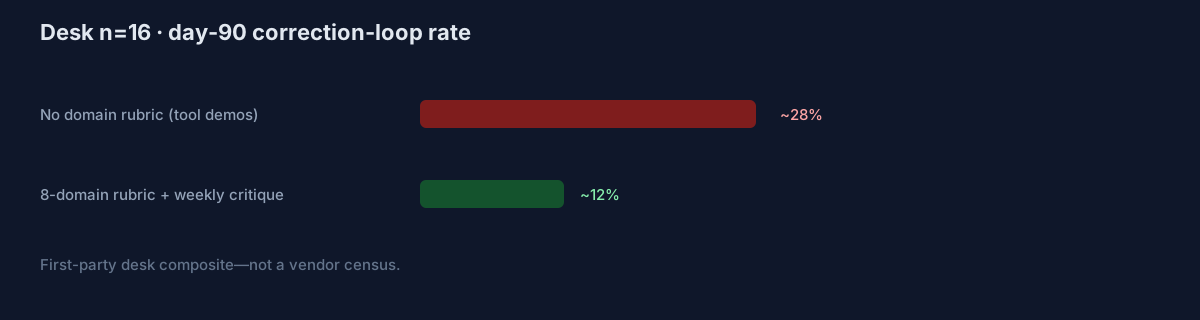 Desk composite: programs with an eight-domain rubric cut major rework and raised confidence reporting.
| Desk finding | Result (n=16) | Implication |
|---|---|---|
| No written domain rubric (tool demos only) | 6 / 16 (38%) | Hire for enthusiasm; coach in the dark |
| Day-90 correction-loop rate (no rubric) | median ~28% major rework | Validation never became habit |
| Day-90 correction-loop rate (8-domain rubric + weekly critique) | median ~12% | Target band ≤15% is achievable |
| Confidence-statement coverage (with rubric) | median ~88% | Close to the ≥90% scorecard target |
Quotable desk assertion: in this n=16 set, an eight-domain rubric plus weekly artifact critiques cut median major-rework rate from ~28% to ~12% by day 90. Re-measure on your tickets before citing internally.
Why Teams Need a New Skills Map
AI copilots changed the execution layer. Hiring rubrics often still reward SQL speed and dashboard counts. Teams that update ai data analyst skills definitions see faster onboarding, clearer promotion paths, and fewer governance incidents when agents touch production schemas. The map is not a certification checklist—it is a shared language for coaching and promotion evidence.
- Prompt and workflow orchestration—not only query writing.
- Validation discipline and uncertainty communication.
- Governance literacy across source boundaries.
- Reuse: turning one-off analysis into maintainable assets.
| Mistake | What happens | Better approach |
|---|---|---|
| Hiring for “AI enthusiasm” | Fast demos, weak reliability | Score concrete case evidence per domain |
| Ignoring validation behavior | Incorrect outputs reach stakeholders | Require a QA walkthrough in interviews |
| No communication test | Good analysis, poor decision impact | Add an executive translation exercise |
| No growth ladder | Managers cannot coach | Define domain-level progression |
8-Domain Competency Model
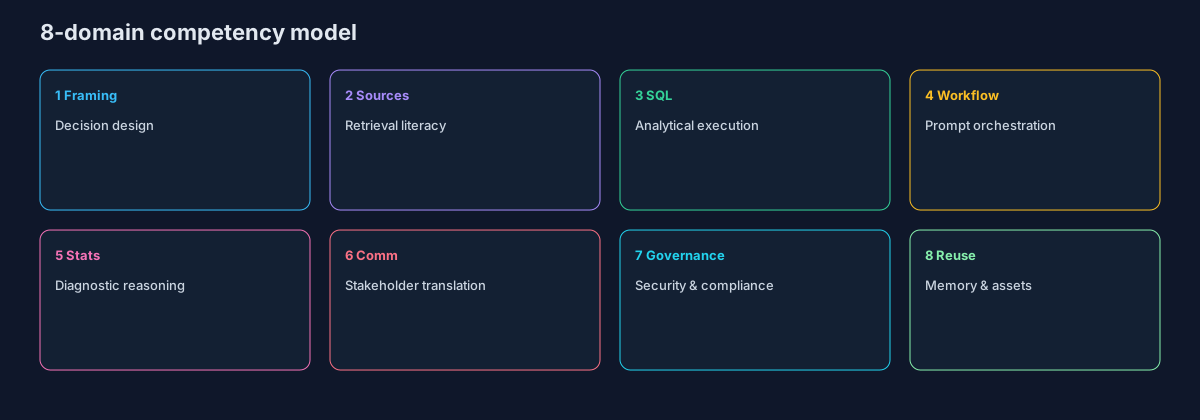 Eight domains—from business framing to reusable asset ownership.
Governance literacy threads through every domain. Competency should track production risk, not tool fluency alone. For LLM connector risk (prompt injection, exfiltration), use OWASP Top 10 for LLM Applications as the deep reference—not a generic “AI safety” slogan.
- Business Framing and Decision Design. Restate questions → define metrics/constraints → design decision trees that survive executive scrutiny.
- Source Literacy and Data Retrieval. Curated views → documented cross-system joins → retrieval patterns agents can reuse safely.
- SQL and Analytical Execution. Supervised SQL → optimized joins/edge cases → validation SQL that catches drift early. Ground grains and nulls with Wikipedia SQL semantics; stress-test NL2SQL expectations against Spider.
- Workflow Orchestration and Prompt Design. Single-turn prompts → chained checkpoints → memory-backed workflows with rollback.
- Statistical and Diagnostic Reasoning. Describe trends → hypothesis tests with confidence notes → separate correlation from causation.
- Communication and Stakeholder Translation. Summarize charts → tailor narratives → drive decisions with risks and actions.
- Governance, Security, and Compliance. Follow access policies → flag retention/exfiltration risks → design review gates. Align secure AI rollouts with UK NCSC secure AI development guidelines. When outputs inform external consumer decisions, also check FTC consumer protection guidance.
- Reuse, Memory, and Asset Ownership. Ad-hoc files → templates → owned scorecards, glossary terms, and workflow assets.
Domain weighting by role profile
| Role profile | Primary domains | Suggested weight mix |
|---|---|---|
| Product analytics | 1, 3, 5, 6 | 35% / 25% / 20% / 20% |
| Revenue operations | 1, 2, 3, 8 | 30% / 25% / 25% / 20% |
| Data governance-focused | 2, 4, 7, 8 | 25% / 25% / 30% / 20% |
| Leadership-track analyst | 1, 4, 6, 8 | 30% / 25% / 25% / 20% |
Hiring Signals and Interview Rubric
Use a structured loop mapped to the eight domains. Each stage should produce a scorable artifact.
| Stage | Domains | Deliverable |
|---|---|---|
| Case framing (30 min) | 1, 6 | Decision brief + assumptions |
| Data retrieval (45 min) | 2, 3 | SQL draft + validation notes |
| Workflow design (30 min) | 4, 8 | Prompt/agent workflow sketch |
| Risk challenge (20 min) | 5, 7 | Uncertainty + governance response |
Scoring: 4 independent with trade-offs · 3 solid with minor prompting · 2 developing · 1 weak/generic.
HowTo: 90-Day Upskilling Roadmap
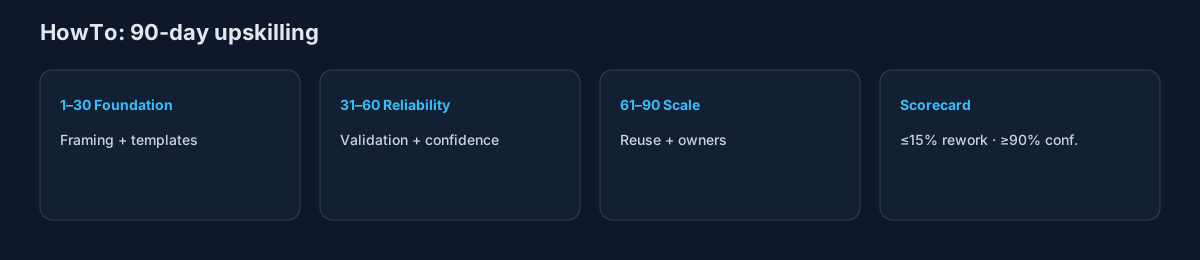
- Days 1–30 — Foundation. Decision framing, metric contracts, 8–12 prompt templates, weekly output reviews.
- Days 31–60 — Reliability. Reconciliation-first SQL, confidence statements, source-boundary checklist. Warehouse IAM patterns: BigQuery documentation.
- Days 61–90 — Scale. Convert wins into reusable assets; assign owners; track cycle time, rerun consistency, and trust.
- Publish the scorecard. Correction-loop ≤15% · reuse ≥70% · time-to-first-draft ≤12 min · confidence coverage ≥90%.
Service boundaries for production agents should follow the Google Cloud Architecture Framework.
| Metric | Baseline question | Target by day 90 |
|---|---|---|
| Correction loop rate | How often do outputs need major rework? | ≤15% |
| Reuse rate | How often are approved assets reused? | ≥70% |
| Time to first draft | How long to first reviewable output? | ≤12 minutes |
| Confidence reporting coverage | Share with explicit confidence statements | ≥90% |
Calibration Playbook for Managers
| Input artifact | Why it matters | Review owner |
|---|---|---|
| Decision briefs | Framing quality | Analytics manager |
| SQL + validation notes | Technical rigor | Senior analyst |
| Stakeholder summaries | Communication precision | Business partner |
| Postmortem edits | Learning over time | Enablement lead |
- Select 3–5 recent cases.
- Blind-score before discussion.
- Discuss gaps; anchor to behaviors.
- Update rubric examples.
- Record notes in a shared registry.
Example Development Paths by Persona
Related cluster guide: AI Data Analysis Prompts. Map each persona to two primary domains and a weekly ritual.
- Persona A — Early-career reporting analyst: framing, source literacy, communication. Weekly case teardown.
- Persona B — Mid-level product analyst: experimental reasoning, orchestration, executive translation. One full cycle each sprint.
- Persona C — Senior analytics lead: governance design, asset ownership, coaching. Monthly quality board.
- Persona D — Platform-facing partner: modeling strategy, integration trade-offs, reliability. Joint reviews with engineering.
Semantic alignment before agents encode metrics: Wikipedia conceptual data model.
Training Design
Skills grow faster through active feedback on real delivery—not passive demos.
High-yield: artifact critiques · rerun drills · failure postmortems · peer teaching · decision simulation.
Lower-yield: tool demos without workflow context · certification-only · one-time workshops with no coaching.
Schedule critiques on the same calendar as delivery deadlines. When learning and shipping share a cadence, managers stop treating enablement as optional side work. Keep sessions under forty-five minutes and always end with one assigned practice task for the next sprint.
Promotion Criteria
| Level transition | Required evidence |
|---|---|
| Beginner → intermediate | Independent execution on recurring workflows with reliable checks |
| Intermediate → advanced | Reusable system design + coaching impact |
| Advanced → leadership | Cross-functional influence + sustained quality outcomes |
Require evidence over at least two review cycles.
Operational Metrics
Track: confidence-statement share · rerun consistency · correction rate by workflow · time to first reviewable output · stakeholder clarity scores. These show whether skill growth improves decisions—not only artifacts. In desk reviews, teams that instrument these five signals usually spot hidden coaching needs within two sprints: strong SQL with weak stakeholder translation, or clear narratives with weak validation discipline. Publish the dashboard next to the rubric so managers coach from the same evidence set.
Operating a Skills Program in Production
Treat capability development as an operating system. Confirm owners, rubrics, and review cadences before scaling. When a program stalls, the cause is usually vague rubrics, too few real-workflow reps, or no feedback loop—not “bad people.” Write the first-cohort charter in one page: who scores, how often calibration runs, and which three workflows count as the practice set. Expand only after that charter survives two review cycles without special exceptions.
For workflow context, see the Data Agent FAQ. Ground NL2SQL expectations with Spider. Keep a short debug checklist: schema drift, ambiguous metric names, stale statistics, missing join keys. Compare agent output to a human-reviewed baseline each sprint. Disagreements become regression tests—aligned with Wikipedia SQL guidance on trust through verification.
Frequently Asked Questions
What are the most important ai data analyst skills for entry-level hiring?
Framing, SQL fundamentals, and communication clarity. Prefer case evidence over tool-brand claims.
How should managers assess these skills in performance reviews?
Domain scores plus delivery outcomes. Use rerun consistency, correction rate, and decision impact—not tenure alone.
Do strong skills replace statistical depth?
No. AI accelerates execution; statistical reasoning still prevents false certainty.
How long does it take to build these skills?
One to two quarters with a structured 90-day plan. Pace depends on reviewed reps, not feature memorization.
Are the desk percentages a market survey?
No. They are InfiniSynapse first-party desk composites (n=16). See First-party Data.
Reference List
Structured sources (title · URL · accessed 2026-08-07):
- UK NCSC — Guidelines for Secure AI System Development — https://www.ncsc.gov.uk/collection/guidelines-secure-ai-system-development
- OWASP — Top 10 for LLM Applications — https://owasp.org/www-project-top-10-for-large-language-model-applications/
- FTC — Consumer protection — https://www.ftc.gov/
- Google — Cloud Architecture Framework — https://cloud.google.com/architecture/framework
- Google — BigQuery documentation — https://cloud.google.com/bigquery/docs
- Google — Sheets documentation — https://support.google.com/docs/topic/9054603
- Wikipedia — SQL — https://en.wikipedia.org/wiki/SQL
- Wikipedia — Conceptual data model — https://en.wikipedia.org/wiki/Conceptual_data_model
- Yale LILY — Spider NL2SQL benchmark — https://yale-lily.github.io/spider
- InfiniSynapse — Editorial standards — https://infinisynapse.com/en/editorial-standards
Conclusion
Clear definitions of ai data analyst skills create better hiring, stronger coaching, and higher trust in AI-assisted analytics. Score current capability against the eight domains. Close the gaps that most hurt decision reliability.
Product recommendation (commercial)
Label: The following is a commercial product recommendation, separate from the editorial guidance above.
To practice governed, reviewed workflows on real warehouses, optionally try the InfiniSynapse web app (free on registration). Desk n=16 findings are not product endorsements.