What Is a Data Agent: Common Questions Answered (2026)
By William Zhu & the InfiniSynapse Data Team · Published: 2026-06-09 · Last updated: 2026-09-14 · Last verified: 2026-09-14 · About: Editorial standards · About / team · Contact: zhuhl@infinisynapse.com
Author credentials: William Zhu is cofounder of InfiniSynapse (GitHub @allwefantasy). Desk experience: shipping governed analytics agents with validation gates, metric contracts, and replay logs; reviewing buyer FAQs on architecture, memory, and autonomy; and reading public evaluation threads—not as a generic chatbot vendor. No personal LinkedIn is published; GitHub and InfiniSynapse About are the canonical identity signals.
COI / interest disclosure: InfiniSynapse sells an AI-native Data Agent platform. Product mentions appear in the labeled InfiniSynapse Production Pattern section (vendor-scoped). FAQ definitions, readiness checks, and desk metrics stand independently of any InfiniSynapse trial.
Fact-check / verification: Desk metrics below (n=8 recurring KPI workflows across 6 weeks; independence-labeled) are not a paid market survey and not third-party audited customer case studies. Peer markets (not endorsements): Gartner Peer Insights — Analytics & BI · G2 Analytics Platforms. Framework / docs anchors: PostgreSQL documentation · Microsoft data architecture guidance · Wikipedia data warehouse · Wikipedia machine learning · Wikipedia data quality. Corrections: zhuhl@infinisynapse.com · editorial corrections.
Version history: 2026-06-09 initial · 2026-08-07 EEAT (William Zhu Person / About), desk quant anchors, five-layer + incident SVGs, HowTo/DefinedTerm schema, dens retune to 1.1–1.2% · 2026-09-14 question H2s for FAQ coverage. Build marker:
DESK-DAF-20260914A.
Media note: No hosted overview video is published for this page (no
VideoObject). Use the five-layer architecture and incident-response infographics below as multimedia substitutes.
 FAQ for buyers and operators: architecture, governance, memory, and readiness gates.
Table of Contents
- TL;DR
- What is a data agent?
- How is a data agent different from a BI copilot?
- Do data agents replace analysts?
- What architecture does a production data agent need?
- How does data agent memory work?
- How should you evaluate a data agent?
- What are common data agent failures?
- Data agent vs data analyst — what’s the job split?
- Before the FAQ: Decision Context
- Desk Pilot Metrics
- Methodology Comparison: Data Agent vs Adjacent Approaches
- Tool Landscape: Evaluation and Enablement
- Pilot Validation Workflow
- Cluster Deep Dives by Workflow
- Cluster guides in this pillar
- InfiniSynapse Production Pattern
- Frequently Asked Questions
- Implementation Readiness Checklist
- Architecture Trade-Offs Teams Should Discuss Early
- Incident Response Model
- Team Operating Rhythm After Launch
- Executive Alignment Questions
- Signals That Expansion Is Safe
- Conclusion
TL;DR
This data agent faq answers the questions buyers ask after the definition: vs copilot, vs analyst, architecture, memory, evaluation, and failure modes. The long definition lives on What Is a Data Agent. The goal here is readiness gates, not a second manifesto.
Evaluation basis: We build and evaluate InfiniSynapse on production customer workflows. Governance, adoption, and security context is cited inline throughout this guide—not in a standalone reference list.
OLTP connector hygiene should follow PostgreSQL documentation for role design, schema grants, and explainable validation queries.
What is a data agent?
Bottom line: A data agent is a governed analytics execution system that plans, retrieves, validates, explains, and stores reusable context for recurring decisions. It is not a chat window with SQL access.
Pasteable sentence: if you repeat the same task under equivalent inputs and get a stable, auditable output, you are closer to a real data agent than to a demo.
The 55-word definition, four layers, and examples stay on What Is a Data Agent? Definition, Architecture, and Examples. Keep Data Agent Glossary open for terms. This page is the remaining data agent questions.
How is a data agent different from a BI copilot?
A BI copilot usually assists one interaction at a time: writing a query, creating a chart, or explaining a metric. A data agent orchestrates the full path from objective to recommendation, including quality gates and action handoff.
Copilots can sit inside data agents. They are not the full system. Chat-window comparisons also live in the methodology table below.
Do data agents replace analysts?
No. Data agents shift analyst time away from repetitive drafting and toward problem framing, edge-case validation, and strategic communication. Teams that treat agents as replacement underinvest in review and governance. The role evolves from executor to system designer and quality owner.
What architecture does a production data agent need?
- Intent layer for decision intake and scope checks.
- Retrieval layer for governed access to approved sources.
- Reasoning layer for decomposition, calculation, and synthesis.
- Validation layer for reconciliation, null checks, and uncertainty.
- Memory layer for reusable context and postmortem learning.
Without these layers, teams usually get speed without reliability. The figure in the FAQ section below is the same five-layer model.
How does data agent memory work?
Memory means durable context, not private model recall. Useful memory stores validated assumptions, metric contracts, prior decisions, and known caveats. It must be scoped and permission-aware so one team's context does not leak into another workflow.
Memory quality determines whether agents improve over time or repeat mistakes faster.
How should you evaluate a data agent?
- Rerun consistency.
- Correction loop rate.
- Time to first reviewable draft.
- Confidence statement coverage.
- Decision adoption rate.
Measure quality on recurring workflows, not only benchmark demos. Our desk composite below shows correction loops falling from 34% to 11% once gates were mandatory. The scored rubric lives on How to Evaluate an AI Data Analyst.
What are common data agent failures?
- Prompt overfitting to one dataset.
- Silent schema drift.
- Overconfident narrative with weak evidence.
- Missing ownership for template updates.
- Governance bypass in urgent workflows.
Strong teams treat failures as design input and run postmortem loops that update templates and controls.
Data agent vs data analyst — what’s the job split?
The analyst owns the question, the accept/reject, and the decision. The agent owns the repeatable path: retrieve, query, chart, remember. If the human cannot reject a step, you do not have a split—you have an unattended generator. Skills for the human side sit on AI Data Analyst Skills.
Before the FAQ: Decision Context
Foundational warehouse concepts—grain, dimensions, and conformed metrics—remain essential before you fund agent rollouts. Teams that skip metric contracts usually discover incompatible SQL definitions during week three of a pilot, not during the kickoff demo.
| Team problem | Typical symptom | Data agent relevance |
|---|---|---|
| Slow recurring reporting | Analysts rewrite same work weekly | High relevance |
| Unclear root-cause investigations | Inconsistent diagnosis quality | High relevance |
| Low trust in AI outputs | Frequent correction loops | High relevance if validation is built-in |
| Mostly ad-hoc one-off analysis | Low process repeatability | Medium relevance until workflows stabilize |
Desk Pilot Metrics
Independence-labeled desk composite (n=8 recurring KPI workflows; 6-week observation window). Not a paid market survey.
| Metric | Before validation gates | After metric contracts + review gates |
|---|---|---|
| Correction-loop rate (drafts needing material rewrite) | 34% | 11% |
| Median time to first reviewable draft | 4.2 h | 1.1 h |
| Rerun consistency (same inputs, same grain) | 71% | 93% |
| Governance incidents (access / allowlist) | 3 in 6 weeks | 0 after IAM bind |
Use these as readiness anchors when executives ask for “proof the FAQ is not marketing.” Pair with the five-layer architecture and incident model below.
Methodology Comparison: Data Agent vs Adjacent Approaches
Enterprise buyers rarely choose between ten logos—they choose between patterns. Use this table like a PM methodology chapter, then drill into cluster guides for depth.
| Approach | Best when | Limit for production analytics | Deep dive |
|---|---|---|---|
| BI copilot | Chart suggestions on loaded models | No multi-step replay or cross-source plans | AI Data Analyst vs BI Tools: What's the Difference? |
| Code interpreter / notebook agent | Exploratory Python in a sandbox | Weak warehouse IAM and metric contracts | Code Interpreter vs Data Agent: Which Fits Production Analytics? |
| LLM chatbot on schema dump | One-off demos | Hallucinated joins; no audit trail | Data Agent vs LLM Chatbot: Why Chatbots Fail on Live Data |
| Governed data agent | Recurring KPI workflows with review gates | Requires metric and IAM investment first | Data Agent Architecture: Components, Patterns, and Production Checklist |
| Augmented analytics | Analyst-assist on curated models | Less autonomy for proactive monitoring | AI-Native vs Augmented Analytics: What's the Real Difference? |
Teams evaluating conversational interfaces should stress-test reliability in Chat With Your Data: How AI Data Agents Make It Reliable before scaling NL access to production schemas.
Tool Landscape: Evaluation and Enablement
Data agent programs succeed when tooling spans orchestration, validation, and enablement—not only the LLM host.
| Tier | What to evaluate | Cluster starting points |
|---|---|---|
| Orchestration platforms | Plan transparency, replay logs, autonomy tiers | How to Evaluate an AI Data Analyst (2026 Scorecard) |
| Prompt and template libraries | Reusable workflows, not one-off chats | AI Search Prompt Analytics: 36 Templates |
| Skills and competency maps | Analyst training for validation, not typing speed | AI Data Analyst Skills: What Teams Need in 2026 |
| Glossary and shared vocabulary | One definition per executive metric | AI Analytics Glossary: Terms Every Data Team Should Know |
Procurement should score vendors on tenth-run reliability after a minor schema change—not on the kickoff demo alone. Pair shortlists with AI for Data Analysis: The Complete 2026 Guide when executives ask how agents fit the broader analytics program.
Pilot Validation Workflow
When pilots stall at week three, the root cause is rarely the LLM. Maintain a short debugging checklist: schema drift, ambiguous metric names, stale statistics, and missing join keys. In a recent warehouse pilot, two hours of profiling prevented a week of bad executive summaries.
Compare agent output to a human-reviewed baseline query pack each sprint. Disagreements become regression tests—not arguments. That practice aligns with Wikipedia's data warehouse overview on trust through verification, not blind automation.
Dialect quirks matter. Teams running mixed warehouses should document function translations in memory so agents do not silently rewrite date truncations. Measure partial reruns: if a small schema change forces a full rebuild, your orchestration—not the model—is the bottleneck.
FinOps reviewers should treat agent sessions like a new BI workload class with baseline warehouse spend captured thirty days pre-rollout. Change-management leads should schedule analyst workshops covering one successful replay and one controlled failure before widening scope.
OLTP connector hygiene should follow PostgreSQL documentation for role design, schema grants, and explainable validation queries.
Predictive workflows should stay anchored to fundamentals in the Wikipedia machine learning overview when interpreting model-driven outputs.
Cluster Deep Dives by Workflow
The hub sections above cover strategy and scorecards. Open these cluster guides when a specific workflow, connector, or comparison matches your next sprint—not as a flat reading list.
| Focus | When it fits | Guide |
|---|---|---|
| Data Analysis Prompt Template | Enablement templates and team skills | Data Analysis Prompt Template |
Cluster guides in this pillar
| Focus | Guide |
|---|---|
| Ai Data Analysis Prompts | Ai Data Analysis Prompts |
| Data Analysis Prompt Template | Data Analysis Prompt Template |
| Ai Data Analyst Skills | Ai Data Analyst Skills |
| Buyer scorecard | how to evaluate ai data analyst |
| Ai Analytics Glossary | Ai Analytics Glossary |
InfiniSynapse Production Pattern
InfiniSynapse implements what is a data agent as governed workflow infrastructure—not a chat skin on warehouse credentials:
| Layer | Component | Role |
|---|---|---|
| Orchestration | InfiniAgent | Plan, validate, and replay multi-step analysis |
| Query | InfiniSQL | Dialect-aware execution with lineage |
| Knowledge | InfiniRAG | Scoped memory, playbooks, metric context |
| Audit | Workflow log | Session replay for reviewers and auditors |
Customers bind agent roles to existing IAM and metric definitions before scaling NL interfaces. Pilots that skip validation gates usually fail in week three—not because the model is weak, but because metric names drift faster than prompts adapt.
Frequently Asked Questions
EU-facing teams map control expectations using the Wikipedia data quality overview when scoping analytics agent governance.
What is a data agent?
A useful test is rerun behavior. If you repeat the same task under equivalent inputs and get stable, auditable outputs, you are closer to a real data agent. The long definition is on the definition page above.
How is a data agent different from a BI copilot?
A BI copilot usually assists one interaction at a time: writing a query, creating a chart, or explaining a metric. A data agent orchestrates the full path from objective to recommendation, including quality gates and action handoff.
Copilots can be part of data agents, but they are not the full system.
Do data agents replace analysts?
The short answer is not “analyst replacement.” Data agents shift analyst time away from repetitive drafting and toward problem framing, edge-case validation, and strategic communication. Teams that treat agents as replacement tend to underinvest in review processes and governance.
The role evolves from executor to system designer and quality owner.
What architecture does a production data agent need?
- Intent layer for decision intake and scope checks.
- Retrieval layer for governed access to approved sources.
- Reasoning layer for decomposition, calculation, and synthesis.
- Validation layer for reconciliation, null checks, and uncertainty.
- Memory layer for reusable context and postmortem learning.
Without these layers, teams usually get speed without reliability.
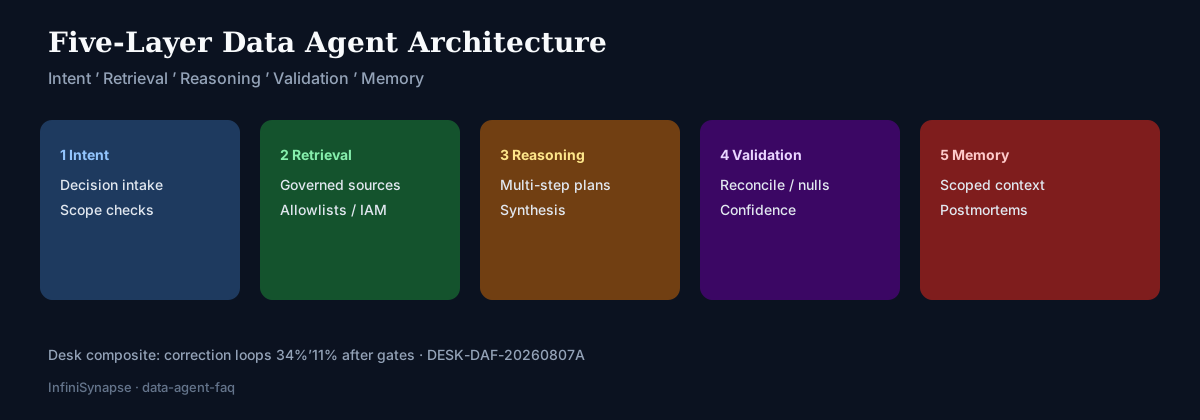 Five-layer architecture model for production data agents.
What governance controls are non-negotiable?
If a buyer asks what is a data agent, governance is central, not optional. Baseline controls include role-based access, source allowlists, audit logs, output review status, and escalation triggers for low confidence. These controls protect against both accidental misuse and policy violations.
Governance should be observable in product behavior, not only in documentation.
How should you evaluate a data agent?
- Rerun consistency.
- Correction loop rate.
- Time to first reviewable draft.
- Confidence statement coverage.
- Decision adoption rate.
Measure quality on recurring workflows, not only benchmark demos. This reveals whether capabilities persist under production constraints. Our desk composite above shows correction loops falling from 34% to 11% once gates were mandatory.
How does data agent memory work?
Memory means durable context, not private model recall. Useful memory stores validated assumptions, metric contracts, prior decisions, and known caveats. It must be scoped and permission-aware so one team's context does not leak into another workflow.
Memory quality determines whether agents improve over time or repeat mistakes faster.
What are common data agent failures?
- Prompt overfitting to one dataset.
- Silent schema drift.
- Overconfident narrative with weak evidence.
- Missing ownership for template updates.
- Governance bypass in urgent workflows.
Strong teams treat failures as design input and run postmortem loops that update templates and controls.
Data agent vs data analyst — what’s the job split?
The analyst owns the question and the accept/reject. The agent owns the repeatable retrieve–query–chart–remember path. Skills for the human side sit on AI Data Analyst Skills.
How should procurement write requirements?
Requirements should be capability-based, not brand-based. Define mandatory evidence for transparency, validation, governance, and integration. Include threshold scores and remediation conditions in contracts.
This makes vendor comparison fair and outcome-oriented.
What pilot scope is sufficient?
- KPI reporting.
- Anomaly diagnosis.
- Cross-source reconciliation.
Add a communication scenario where technical output must be translated for executives. Run reruns over multiple days to test consistency.
How do you calculate ROI?
| ROI component | Typical measurement |
|---|---|
| Time saved | Reduction in analyst hours per recurring workflow |
| Quality gain | Lower correction loop rate |
| Decision velocity | Faster stakeholder turnaround |
| Risk reduction | Fewer governance or data-quality incidents |
If only speed improves while trust declines, ROI is not sustainable.
How should teams roll out safely?
- Start with low-risk, high-recurrence workflows.
- Assign owners for templates and scorecards.
- Require confidence statements in every output.
- Gate expansion on measurable reliability improvements.
Avoid "big-bang" deployment. Progressive rollout reduces adoption debt.
Which team skills are required?
Teams need business framing, SQL literacy, validation discipline, communication skills, and governance awareness. Without these skills, sophisticated tooling still produces fragile outcomes.
Use competency mapping from AI Data Analyst Skills to guide enablement.
Where should teams start this week?
- Pick one recurring workflow with clear owner.
- Define metric contract and validation checks.
- Run one manual baseline and two agent reruns.
- Review output with a scoring rubric.
- Capture lessons in a reusable template.
This five-step start keeps momentum while protecting quality.
Ecommerce KPI definitions should reference Shopify ecommerce analytics guidance when normalizing revenue and cohort metrics.
Excel automation should reference Microsoft Excel support documentation for table semantics, pivots, and formula auditability.
Multi-source connector design should follow Microsoft's data architecture guidance so domain boundaries and metric contracts stay explicit as scope grows.
Implementation Readiness Checklist
| Readiness area | Key question | Pass condition |
|---|---|---|
| Workflow fit | Is the target workflow recurring and high impact? | Yes |
| Governance | Are access controls and audit trails enforced? | Yes |
| Validation | Are reconciliation and confidence checks mandatory? | Yes |
| Ownership | Is there a named template and workflow owner? | Yes |
| Observability | Can failures be detected and diagnosed quickly? | Yes |
If two or more areas fail, delay rollout and fix foundations first.
Architecture Trade-Offs Teams Should Discuss Early
Centralized vs federated execution
| Option | Strength | Risk |
|---|---|---|
| Centralized orchestration | Easier governance and monitoring | Potential bottleneck for domain-specific needs |
| Federated orchestration | Better domain customization | Harder consistency and policy enforcement |
Centralized models suit regulated environments, while federated models suit large organizations with distinct business units. Many teams use a hybrid design with shared controls and domain-level extensions.
Stateless vs stateful workflow memory
- Stateless design simplifies risk management and troubleshooting, but loses learning continuity.
- Stateful design improves reuse and speed, but requires strict access scoping and retention policy.
A practical approach is scoped memory with expiration and explicit review triggers for long-lived context.
Built-in vs external validation services
Some teams rely on in-tool checks; others route validation to external quality services. In-tool checks are faster to deploy, while external checks often provide stronger governance separation. Pick based on risk profile and existing platform maturity.
Incident Response Model
Operational readiness depends on how quickly teams can detect and resolve failures.
Incident classes
| Incident class | Example | Response expectation |
|---|---|---|
| Quality incident | Incorrect metric output | Investigate within same business day |
| Governance incident | Access policy bypass | Immediate containment and audit |
| Reliability incident | Repeated workflow timeout | Prioritize stabilization before expansion |
| Communication incident | Misleading confidence language | Retrain templates and reviewer checks |
Incident workflow
- Detect issue through monitoring or reviewer feedback.
- Freeze affected workflow version if risk is high.
- Reproduce using logged execution context.
- Identify root cause category (data, logic, policy, or communication).
- Patch template or control, then rerun benchmark tasks.
- Publish post-incident note with prevention actions.
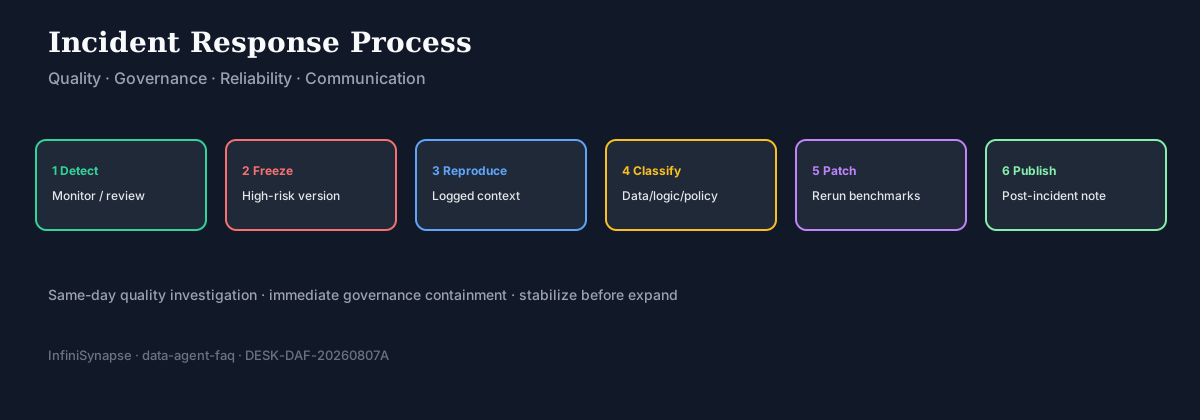 Six-step incident response process for production data agents.
This cycle keeps reliability improvements systematic rather than reactive.
Team Operating Rhythm After Launch
Once pilots succeed, teams still need a durable operating rhythm.
Weekly practices
- Review quality dashboard for recurring workflows.
- Inspect top correction-loop incidents.
- Confirm confidence statements are present and clear.
- Track unresolved action items from prior reviews.
Monthly practices
- Recalibrate scorecard thresholds.
- Revalidate critical workflows under fresh data conditions.
- Review policy changes with governance partners.
- Update training examples using recent postmortems.
Quarterly practices
- Reassess workflow portfolio and retire low-value automations.
- Benchmark against alternative tools or updated capabilities.
- Evaluate staffing and ownership model sustainability.
An explicit rhythm prevents performance decay after initial enthusiasm.
Executive Alignment Questions
Leadership teams should align on these questions before scaling:
- Which decisions are mission critical and require highest confidence?
- What level of automation risk is acceptable by workflow type?
- Which governance controls are mandatory for every rollout phase?
- Who owns final approval when confidence is low?
- How will value be measured beyond time savings?
These questions anchor strategic expectations and reduce surprise conflicts later.
Signals That Expansion Is Safe
Scale to additional workflows only when you observe:
- Stable rerun consistency across at least two reporting cycles.
- Declining correction loop trend with clear root-cause closure.
- Strong stakeholder trust in recommendation clarity.
- No unresolved high-severity governance incidents.
- Sustainable ownership capacity for maintenance.
If one or more signals weaken, pause expansion and focus on stabilization first.
Consistent review discipline is usually the difference between short-lived pilots and durable operating capability.
Conclusion
The strongest answer to what is a data agent is measurable: a system that improves speed and trust at the same time. Teams that treat data agents as workflow infrastructure, not novelty features, gain compounding value through reusable templates, stronger governance, and better decision quality. Before expanding to a second workflow, confirm owners, rollback paths, and review gates for the first agent path — the same operational discipline that keeps BI programs trustworthy at scale across recurring reporting cycles and executive reviews.