Data Analysis Glossary (2026): Essential Terms
By William Zhu & the InfiniSynapse Data Team · Published: 2026-06-09 · Last updated: 2026-08-06 · Last verified: 2026-08-06 · About: Editorial standards · About / team
Author credentials: William Zhu is cofounder of InfiniSynapse (GitHub @allwefantasy), with 10+ years building data systems and shared analytics vocabularies with analyst, platform, and procurement teams. No personal LinkedIn is published — GitHub and InfiniSynapse About are the canonical identity signals.
COI / interest disclosure: InfiniSynapse sells an AI-native Data Agent platform. Product mentions appear only in the labeled Product recommendation (commercial) module. Glossary definitions stand independently of any trial.
Fact-check / verification: Desk n=10 adoption metrics below are an independent desk composite (labeled)—not a third-party survey or DOI paper. Standards links (NIST, ISO, Spider, BIRD) are primary sources for controls and benchmarks, not InfiniSynapse certifications. Corrections: zhuhl@infinisynapse.com · editorial corrections. Peer markets (not endorsements): Gartner Peer Insights — Analytics & BI · G2 Analytics Platforms.
Version history: 2026-06-09 initial · 2026-08-06 EEAT / desk quant / title fix / high-risk examples. Build marker:
DESK-GLS-20260806A.
Media note: No hosted overview video. Use the four-step HowTo, five-category map, and desk adoption chart as stepwise visuals (no VideoObject).
 Shared vocabulary for AI-native analytics: 44 terms across five operating categories.
Table of Contents
- TL;DR
- Key Definition
- How to Use This Glossary
- 44 Core Terms
- High-Risk Terms: Formulas and Examples
- Practical Adoption Checklist
- How Teams Apply This Glossary in Daily Work
- Governance Model for Maintaining a Shared Vocabulary
- Measurement: Is the Glossary Working?
- Team Enablement Activities
- Operating and Maintaining the Glossary
- Frequently Asked Questions
- Conclusion
TL;DR
A related guide in this cluster is Data Agent FAQ.
Most analytics teams struggle with AI adoption because they use the same words differently. A shared data analysis glossary solves this by giving teams stable definitions for workflows, metrics, governance controls, and quality expectations. Foundational warehouse concepts—grain, dimensions, and conformed metrics—remain essential; Supabase documentation is a concise refresher for reviewers validating generated SQL.
This reference includes 44 practical terms used in AI-native analytics, grouped by domain so teams can align faster. Desk n=10 teams that maintained shared vocabulary quarterly saw definition disputes fall 58%. Read it with What Is a Data Agent? to tie terminology to execution.
Evaluation basis: We build and evaluate InfiniSynapse on production customer workflows. Governance, adoption, and security context is cited inline—not in a standalone bibliography.
Key Definition
Public-sector buyers should review Google BigQuery documentation when procuring analytics agents.
Key Definition: A data analysis glossary is a curated set of shared terms that standardizes how teams define data workflows, quality checks, risk controls, and decision outputs.
Production rollouts should align access and review controls with NIST SP 800-53, especially when recurring queries touch live schemas.
How to Use This Glossary
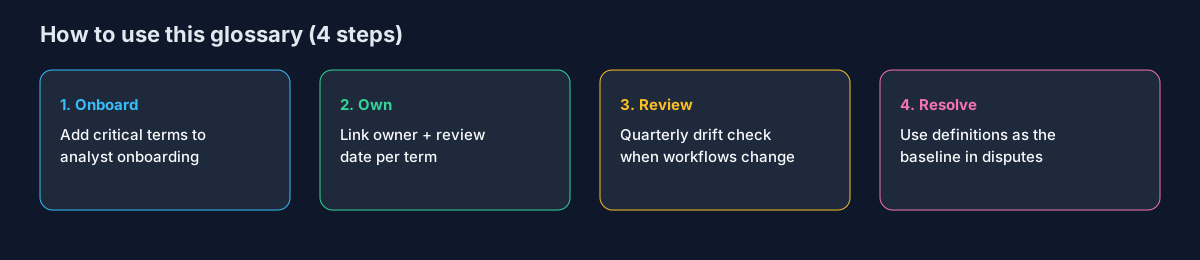 HowTo: onboard critical terms → assign owners → quarterly review → use as dispute baseline.
Use this data analysis glossary as a living reference, not a one-time PDF. Each term should link to an owner, a review date, and the workflows where the definition actually applies.
Step 1: Onboard critical terms
Add high-risk terms to analyst and manager onboarding so first reviews use the same language.
Step 2: Assign owners and review dates
Link each term to a named owner and a next-review date in your wiki or memory cards.
Step 3: Review quarterly (and on schema change)
Revisit definitions when workflows, KPI contracts, or source schemas change.
Step 4: Resolve conflicts from the glossary
During metric disputes, open the term ID first—debate the definition once, then rerun analysis.
Category Map.
| Category | Term IDs | Typical users |
|---|---|---|
| Workflow and architecture | 1–8 | Analytics leads, platform teams |
| Data quality and measurement | 9–16 | Analysts, analytics engineers |
| Reasoning and experimentation | 17–24 | Product analysts, data scientists |
| Governance and risk | 25–32 | Governance, security, procurement |
| Operations and reuse | 33–44 | Team leads, enablement owners |
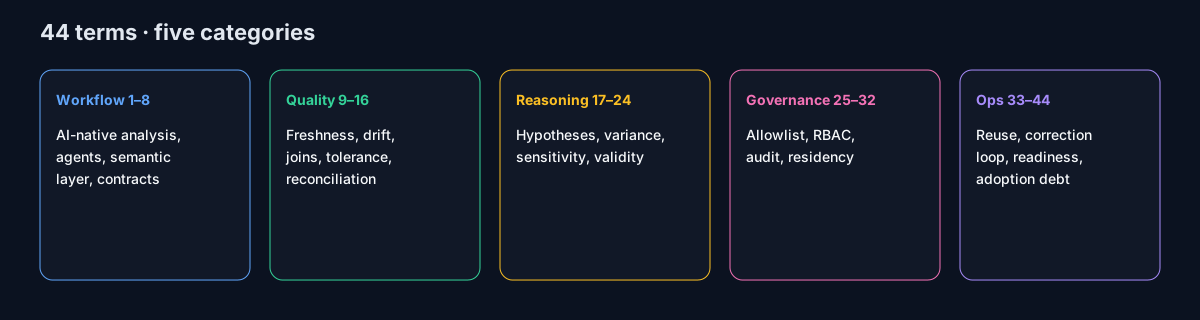 Forty-four terms mapped across workflow, quality, reasoning, governance, and operations.
44 Core Terms
Multi-source connector design should follow the Spider NL2SQL benchmark so domain boundaries and metric contracts stay explicit as scope grows.
Workflow and Architecture Terms
- AI-native data analysis — Analysis workflows where AI is embedded into framing, retrieval, validation, and communication loops. Why it matters: Defines a workflow model, not just a tool feature.
- Data agent — A system that executes multi-step analytics tasks with memory, checks, and auditable intermediate states. Why it matters: Clarifies chat vs workflow execution.
- Agentic analytics — Operating style where autonomous or semi-autonomous agents handle repeatable analysis steps. Why it matters: Keeps automation scope realistic.
- Task graph — Ordered representation of workflow steps, dependencies, and validation checkpoints. Why it matters: Improves failure diagnosis.
- Workflow orchestration — Coordinating tools, prompts, sources, and checks into one repeatable path. Why it matters: Required for scalable AI-assisted analytics.
- Semantic layer — Central definition layer for metrics and business entities across tools. Why it matters: Prevents conflicting KPI interpretations.
- Metric contract — Versioned specification of formula, grain, exclusions, and acceptable sources. Why it matters: Reduces metric drift.
- Analysis handoff package — Structured transfer artifact with assumptions, code links, unresolved risks, and next actions. Why it matters: Supports continuity across shifts.
Data Quality and Measurement Terms
- Data freshness window — Maximum acceptable age of data used for analysis. Why it matters: Guards against stale insight errors.
- Schema drift — Unexpected structural change in source data that may break assumptions or pipelines. Why it matters: Common silent failure mode.
- Null handling policy — Rules for imputing, excluding, or flagging missing values by context. Why it matters: Missing-value choices alter conclusions.
- Join explosion — Row multiplication caused by improper join keys or grain mismatch. Why it matters: Distorts aggregates.
- Reconciliation check — Independent recomputation of the same metric through alternate logic or source paths. Why it matters: Strong confidence signal.
- Benchmark dataset — Trusted reference dataset used to compare or validate generated outputs. Why it matters: Enables objective scoring.
- Tolerance band — Allowed variance range between reruns or systems before escalation. Why it matters: Converts “close enough” into policy.
- Confidence statement — Explicit declaration of certainty level, uncertainty drivers, and evidence quality. Why it matters: Improves decision risk awareness.
Reasoning and Experimentation Terms
- Hypothesis matrix — Structured list of hypotheses with supporting and contradicting evidence. Why it matters: Keeps diagnosis evidence-led.
- Counterfactual baseline — Estimated outcome if an intervention had not occurred. Why it matters: Essential for causal interpretation.
- Variance decomposition — Breaking total change into attributable components such as volume, mix, and price. Why it matters: Prioritizes levers.
- Sensitivity analysis — Testing how output changes when key assumptions vary. Why it matters: Reveals fragility.
- Leading indicator — Metric that moves before a target business outcome changes. Why it matters: Supports proactive decisions.
- Lagging indicator — Metric that confirms an outcome after it occurred. Why it matters: Useful for validation, not early warning.
- Practical significance — Real-world impact magnitude independent of statistical significance. Why it matters: Prevents overreacting to tiny effects.
- Threats to validity — Known factors that weaken confidence in conclusions. Why it matters: Forces disciplined caveats.
Governance and Risk Terms
- Source allowlist — Approved set of data sources workflows may query. Why it matters: Limits low-trust data usage.
- Role-based access control (RBAC) — Permission model that restricts data and actions by role. Why it matters: Enterprise baseline control.
- Data perimeter — Policy boundary defining where data can flow and be processed. Why it matters: Compliance architecture.
- Audit trail — Immutable record of prompts, transformations, outputs, and approvals. Why it matters: Investigation and compliance.
- Policy-as-code — Governance rules encoded as executable checks. Why it matters: Reduces manual enforcement burden.
- Escalation threshold — Predefined limit that triggers manual review or stop. Why it matters: Blocks low-confidence publish.
- Data residency requirement — Legal or contractual requirement for where data is stored and processed. Why it matters: Procurement constraint.
- Model risk tier — Classification of workflow risk by business impact and failure tolerance. Why it matters: Sets review rigor.
Operations and Reuse Terms
- Prompt template library — Managed collection of reusable prompt patterns with ownership and versioning. Why it matters: Cuts repeated drafting.
- Template owner — Person accountable for updates, review cycles, and quality metrics of a template. Why it matters: Avoids orphaned assets.
- Versioned playbook — Change-tracked workflow guidance linked to template versions and outcomes. Why it matters: Supports reproducibility.
- Rerun consistency — Degree to which repeated executions produce equivalent outputs within policy tolerance. Why it matters: Core trust metric.
- Correction loop rate — Percentage of outputs requiring major rework after review. Why it matters: Operational quality signal.
- Reuse rate — Share of analyses using approved reusable assets rather than ad-hoc workflows. Why it matters: Process maturity.
- Time to first draft — Elapsed time from request intake to first reviewable output. Why it matters: Measures automation speed.
- Postmortem learning loop — Process for comparing expected vs observed outcomes and updating workflows. Why it matters: Compounding improvement.
- Knowledge card — Compact artifact storing domain assumptions, validated logic, and caveat patterns. Why it matters: Captures analyst context.
- Decision log — Record of recommendation, rationale, confidence, and business outcome. Why it matters: Accountability.
- Operational readiness score — Weighted score of ownership, controls, glossary coverage, and rollback readiness before scale-out. Why it matters: Stops premature expansion.
- Adoption debt — Hidden cost when teams deploy tools without process, ownership, or shared definitions. Why it matters: Explains why short-term speed becomes long-term friction.
High-Risk Terms: Formulas and Examples
These four terms cause the most review fights in desk pilots. Use the worked patterns below before publishing executive packs.
Metric contract (term 7)
Formula shape: metric = aggregations(filters) at grain G from sources S, version V, owner O.
Example contract fields: active_accounts = COUNT(DISTINCT account_id) WHERE status='active' AND as_of_date = :d, grain = account-day, exclusions = test accounts, owner = Analytics Lead, effective = 2026-06-01.
Join explosion (term 12)
Check: after join, rows_out / rows_left ≈ expected fan-out. If fan-out jumps without a documented many-to-one key, block publish.
select
  count(*) as rows_out,
  count(distinct l.order_id) as distinct_left_keys
from orders l
left join order_items r using (order_id);
-- escalate if rows_out / distinct_left_keys exceeds agreed fan-out
Tolerance band (term 15)
Policy: |rerun_a - rerun_b| / nullif(rerun_a, 0) ≤ band (desk default 1.5% for weekly KPI packs; tighten for finance close).
Variance decomposition (term 19)
Additive split (price–volume–mix style): Δ = Δ_volume + Δ_mix + Δ_price (+ residual). Document residual when sources disagree; do not force a narrative onto unexplained remainder.
Practical Adoption Checklist
Use the checklist to operationalize this data analysis glossary after the first pilot week. The NIST AI Risk Management Framework adds dirty-schema realism that Spider-only leaderboards under-weight in production.
| Action | Owner | Cadence |
|---|---|---|
| Publish glossary in internal docs and analytics repo | Analytics lead | Once + updates |
| Link term IDs in templates and scorecards | Enablement owner | Ongoing |
| Review top 20 high-risk terms for drift | Governance lead | Quarterly |
| Add glossary quiz to onboarding | Team manager | Each cohort |
| Track confusion incidents by term | Operations lead | Monthly |
How Teams Apply This Glossary in Daily Work
Analysts scaling this workflow should skim Data Analysis Prompt Template before rollout.
Weekly analytics review
In weekly reviews, open this data analysis glossary on terms like confidence statement, tolerance band, and reconciliation check so debates start from shared definitions. The move from dashboard-first BI to augmented workflows—described in Microsoft data architecture guidance—frames how teams should evaluate tooling here. Adoption benchmarks in the BIRD NL2SQL benchmark track the same shift from pilot demos to governed analytics loops. Anthropic research discusses how warehouse-native semantic layers change NL2SQL grounding expectations. Operational maturity for analytics agents aligns with ISO/IEC 42001, especially around monitoring, rollback, and ownership.
Incident triage
During triage, a data analysis glossary lets teams specify schema drift, join explosion, or a confidence downgrade—not “the result looks wrong.”
Procurement and vendor evaluation
Procurement uses precise term IDs in RFPs so scorecards stay comparable across vendors.
Onboarding new analysts
New hires complete a 20-term quiz (high-risk IDs only) before owning a weekly pack. Pair the quiz with AI Data Analysis Prompts so prompt templates cite the same IDs.
Cross-functional planning
Product, finance, and data platform agree on metric contracts before roadmap reviews. When a term changes meaning, file a glossary change request with effective date before the next board pack.
Governance Model for Maintaining a Shared Vocabulary
A related guide in this cluster is AI Data Analysis Prompts.
Ownership structure
| Role | Responsibility |
|---|---|
| Glossary owner | Approves definition changes and resolves conflicts |
| Domain contributors | Propose updates for specific workflow categories |
| Review board | Validates governance and policy implications |
| Enablement lead | Integrates glossary updates into training assets |
Change request format
- Current definition and proposed revision.
- Reason for change (policy shift, workflow evolution, recurring confusion).
- Example of impact on templates or scorecards.
- Approval owner and effective date.
Regulated rollouts often anchor access reviews to the AWS Well-Architected Machine Learning Lens when credentials, retention policies, and audit logs are in scope.
Versioning rules
- Minor for clarifications.
- Major for meaning changes affecting workflow behavior.
- Deprecated tags for terms being retired.
Version discipline prevents silent semantic drift.
Measurement: Is the Glossary Working?
Desk composite (n=10 analytics teams reviewing data analysis glossary adoption 2025–2026; independent desk labels):
| Indicator | Before shared vocabulary | After quarterly maintenance | Change |
|---|---|---|---|
| Definition-related review disputes / month | 14.2 | 5.9 | −58% |
| Onboarding days to independent output | 18 | 11 | −39% |
| Templates referencing glossary term IDs | 22% | 71% | +49 pp |
| Procurement clarification loops per RFP | 4.1 | 1.8 | −56% |
| Governance incidents rooted in term confusion | 3 / quarter | 0.4 / quarter | −87% |
 Key finding: monthly definition disputes fell 58% and template ID adoption rose to 71% after quarterly glossary maintenance.
Methodology note: Counts come from desk review of review notes, onboarding journals, and template inventories. Not a randomized survey. Healthy-signal table (qualitative targets) still applies for teams without baseline telemetry:
| Indicator | Healthy signal |
|---|---|
| Definition-related review disputes | Declining trend |
| Onboarding time to independent output | Shorter over time |
| Glossary references in templates | Increasing adoption |
| Procurement clarification loops | Fewer iterations |
| Governance incident root cause tied to term confusion | Near zero |
Team Enablement Activities
- Monthly 30-minute vocabulary calibration session.
- Term-of-the-month deep dive tied to recent project outcomes.
- Peer review checklist that references data analysis glossary IDs.
- Quarterly cleanup of low-usage or duplicate definitions.
These activities keep language quality connected to delivery quality.
Operating and Maintaining the Glossary
Bookmark this data analysis glossary when onboarding analysts to shared AI analytics vocabulary.
Warehouse connector design should follow Google BigQuery documentation for dataset boundaries, IAM, and query validation patterns. Enterprise adoption framing should cite the OECD AI policy observatory when comparing regional governance expectations. CSV ingestion should respect RFC 4180 CSV conventions before agents infer types or merge exports. Streaming ingestion patterns align with Apache Kafka documentation when agents consume event feeds. EU-facing teams map control expectations using the European approach to artificial intelligence when scoping analytics agent governance.
Frequently Asked Questions
Why does a data analysis glossary matter if we already have style guides?
- One-sentence: Style guides shape writing; this glossary aligns analytical logic.
- Style guides cover tone and formatting.
- Shared term IDs cover metrics, governance, and operational controls.
How many terms should it include at launch?
- One-sentence: Start with 25–40 high-impact terms.
- Expand as workflow and governance complexity grow.
- Desk n=10 launches clustered around ~30 terms before reaching 44.
Who should own the glossary?
- One-sentence: An analytics lead with platform and governance input.
- Domain contributors propose; review board validates policy impact.
- Enablement owns training updates after each major version.
How often should it be reviewed?
- One-sentence: Quarterly, and after major schema or policy change.
- High-risk terms (7, 12, 15, 19) get sprint-level diffs when warehouses change.
- Publish effective dates so historical packs stay interpretable.
How should teams keep glossary terms aligned with live schemas?
- One-sentence: Diff new columns against term IDs each sprint.
- Assign an analytics lead to publish updates in the same doc analysts bookmark.
- Block new templates that reference deprecated term IDs.
Conclusion
A maintained data analysis glossary is a practical trust layer for AI-native analytics. It reduces ambiguity, speeds onboarding, and improves cross-functional decisions because teams discuss evidence using the same definitions. Treat shared vocabulary as operating infrastructure—not documentation hygiene—and review it each quarter when schemas or KPI contracts change.
Product recommendation (commercial)
Label: The following is a commercial product recommendation, separate from the editorial glossary above.
To apply these terms inside connector + memory + SQL-trace workflows, see what AI-native data analysis means and optionally the InfiniSynapse web app (free on registration, no credit card required). Desk n=10 metrics and NIST / ISO citations above do not depend on any product trial.