200GB Data Analysis without a Spark Program (2026)
By William Zhu & the InfiniSynapse Data Team · Published: 2026-08-22 · Last updated: 2026-08-24 · Last verified: 2026-08-24 · Next review: 2026-11-24 · Editorial standards · Corrections
Table of Contents
- TL;DR
- What 200gb data analysis actually means
- A framework for size without an overnight myth
- Methods: engine-first, file-first, and cluster-first
- Tool landscape for a 200 GB class source
- Implementation steps you can audit
- Desk sample: a 200 GB fact table (illustrative)
- Scorecard: long task versus overnight myth
- Failure modes that look like “the file is too big”
- Frequently Asked Questions
- Conclusion
TL;DR
Direct answer: Treat 200gb data analysis as a long task on the warehouse, lake table, or sanctioned file directory you already operate. Authorize a read-only role, write a dated goal, let the engine scan, and download artifacts. A published 200 GB desk size is social proof that a large source can be connected. It is not an overnight myth, not a duration SLA, and not a reason to hire a Spark program first.
What you'll learn:
- A precise definition of 200gb data analysis that separates size from Spark
- A framework that splits volume, question shape, and compute location
- Engine-first, file-first, and cluster-first methods for the same 200 GB sentence
- Implementation steps: authorize, date the goal, watch the long task, download
- An illustrative 200 GB desk sample, a scorecard, and copy-or-scan failure modes
What 200gb data analysis actually means
Key Definition: In this guide, 200gb data analysis means a long task against a source that already stores a 200 GB class object, with the warehouse or file engine doing the scan. The agent plans steps, exposes SQL, and returns artifacts. The size is published desk proof, not a duration SLA.
A 200 GB fact table is a storage fact. 200gb data analysis is an operating fact: someone authorized the source, wrote a goal, and can open the scan. If those three objects are missing, you have a file that is large.
Hive remains a common home for that class of table. The Apache Hive project is the catalog for that engine—the agent asks it; the agent does not replace it. If the same 200 GB lives as indexed logs, OpenSearch documentation is the contract for query and index behavior. Neither site is an InfiniSynapse SLA.
The parent method sits in analyze large datasets with AI: authorize the large source, run a long task, refuse a Spark-replacement claim. 200gb data analysis is the size-specific cut of that method. Row-count acceptance lives in analyze millions of rows. Console behavior lives in a long-running analysis job.
Industry weather stays independent of any vendor minute count. The Stanford HAI AI Index tracks adoption rising faster than evaluation discipline—the same gap buyers feel when a 50,000-row demo is treated as a 200gb data analysis contract.
A framework for size without an overnight myth
Use three axes before you turn 200gb data analysis into an overnight story. Most failed 200 GB tickets fail on one axis.
| Axis | Question to ask | Long-task signal | Overnight-or-Spark signal |
|---|---|---|---|
| Volume | Is the 200 GB object already in an engine? | Warehouse, lake table, or columnar directory exists | Raw landings with no engine and a promised “run it overnight” |
| Question shape | Is the ask a dated goal or a new pipeline? | Aggregates, ranked drivers, a memo | New nightly marts, CDC, streaming joins |
| Compute location | Who executes the scan? | The source engine, with SQL you can open | A new cluster or a laptop copy |
Volume versus a duration story
Volume is a noun. Duration is a measurement. 200gb data analysis fails in budget review when someone swaps the two. A 200 GB table that already loads every night is a source, not a new batch program. Overnight language belongs to jobs that must finish before another system reads a new table. If no other system is waiting, you have a 200gb data analysis task that can take tens of minutes without becoming a platform hire.
Ask where the bytes sit today. If they sit in Snowflake, BigQuery, Redshift, Hive, or a columnar directory, 200gb data analysis can proceed as a read. If they sit in a zip on a laptop, you have a copy problem first. If they sit in a landing zone that must be reshaped every night, you have a pipeline ticket first. The location decides the method. Size alone does not.
Methods: engine-first, file-first, and cluster-first
Three methods compete for the sentence “we have 200 GB, analyze it.” They are not interchangeable. Only one of them implies a Spark program.
Engine-first 200gb data analysis
Engine-first 200gb data analysis means the table of record already lives in a warehouse or lake engine. You authorize a read-only role, bind a short knowledge-base note for the metric, and ask the goal. The agent writes SQL the engine will execute. This is the default for finance and operations grains that already land at 200 GB. It pairs with data governance because the role, the grain, and the definition are the control surface—not a new cluster.
File-directory 200gb data analysis
File-first 200gb data analysis is valid when the large object is Parquet, a directory, or a sanctioned export. Columnar files can be 200 GB without a warehouse login. The boundary is the same: the reader must filter. A desktop path can reduce latency for local files; the primary check is still a web task on an authorized source. If the source is a directory rather than a table, continue in parquet file analysis. Do not treat a giant CSV email as 200gb data analysis just because the filename contains “full_extract.”
Why a Spark program is a different ticket
A Spark program exists to build and operate distributed jobs: shuffles, checkpoints, streaming, and fragile joins across dirty landings. That work remains real. 200gb data analysis on a table you already load is not a Spark-replacement claim. If your next ticket is a new nightly shuffle, hire the platform skill. If it is “explain this quarter on the 200 GB table we already load,” you do not need a Spark program first.
Tool landscape for a 200 GB class source
The landscape splits into engines that store 200 GB and layers that ask them. Mixing the two produces false Spark mandates.
Engines that already store the object
Warehouses, Hive, and OLAP engines are the system of record for most company 200 GB facts. They already have slots, warehouse sizes, and scan billing. 200gb data analysis inherits those contracts. It does not invent a second compute estate “because AI.” If operators already watch jobs, Grafana documentation is the independent reference for duration and error panels—use it as the model for a visible task, not as a vendor duration promise.
Agent layers that wait on a long task
Agent layers plan, wait, retry, and write artifacts. They belong next to what is a data agent: a system that takes a goal, runs SQL or file reads, and leaves a trail. A copilot that pastes SQL into a console is not 200gb data analysis. A long task that you can cancel, rerun, and download as Markdown or PDF is. Treat the pack like a reviewable change; GitHub documentation is the model for diffs you can open, not a hidden transcript.
InfiniSynapse sits in the agent layer: authorize the 200 GB class source, run a long task, inspect InfiniSQL and intermediate tables, download the workspace. It does not advertise a Spark-replacement SLA. Quota, when used, is visible in the task console.
Implementation steps you can audit
The method is the same whether 200gb data analysis lives in a warehouse or a sanctioned file store.
Authorize the large source, not the laptop
Create a read-only role on the warehouse or a least-privilege file grant. Do not paste credentials into a prompt. Do not grant write. Confirm the role can see the 200 GB grain and cannot see secrets or raw identity dumps. 200gb data analysis without a role review is just a larger blast radius. If you need a mental model for “ask the table you have,” start from exploratory data analysis habits: profile the grain, then ask the decision question.
State a dated goal before the scan
Write the business goal with time bounds and the metric definition. “Contribution by channel, last 90 days, excluding internal orders, using the finance definition of contribution.” That sentence is the task. If you paste a 200-line query, you have skipped the agent and you still own the 200gb data analysis scan plan. Bind a short knowledge-base note for the definition so the second run does not invent a new grain. Billing systems already publish request and idempotency rules in Stripe documentation—use that as the model for how a paid scan should be observable, not as a claim that InfiniSynapse ships a native Stripe connector.
Watch the task and download the pack
Open the task timeline. Confirm a date predicate exists before a full-table scan. Confirm the SQL is readable. When the task finishes, download the memo, the chart, and the data file from the workspace—not from the chat bubble. Long tasks can be cancelled and rerun. Duration is an observation, not a contract. For 200gb data analysis, the artifact is the product; the paragraph is the cover letter.
Desk sample: a 200 GB fact table (illustrative)
We evaluate this as a desk composite, illustrative, not a customer SLA and not a Spark benchmark. Source: a 200 GB orders fact already loaded in a cloud warehouse, plus a one-page contribution definition. Goal: last-90-day contribution by channel, top five drivers of the week-on-week drop.
The agent planned four dated SQL steps and wrote a memo plus a chart. Wall clock was tens of minutes. Opening the SQL showed the 90-day filter. A second run reused the same definition. The warehouse already had the 200 GB object; the missing piece was a long task, not a Spark program. This is 200gb data analysis as desk social proof, not a minute contract.
Figure note. Illustrative 200 GB desk composite. Not a Spark SLA. Cite Hive, OpenSearch, Grafana, GitHub, and Stripe docs linked above—not this sample as their experiment.
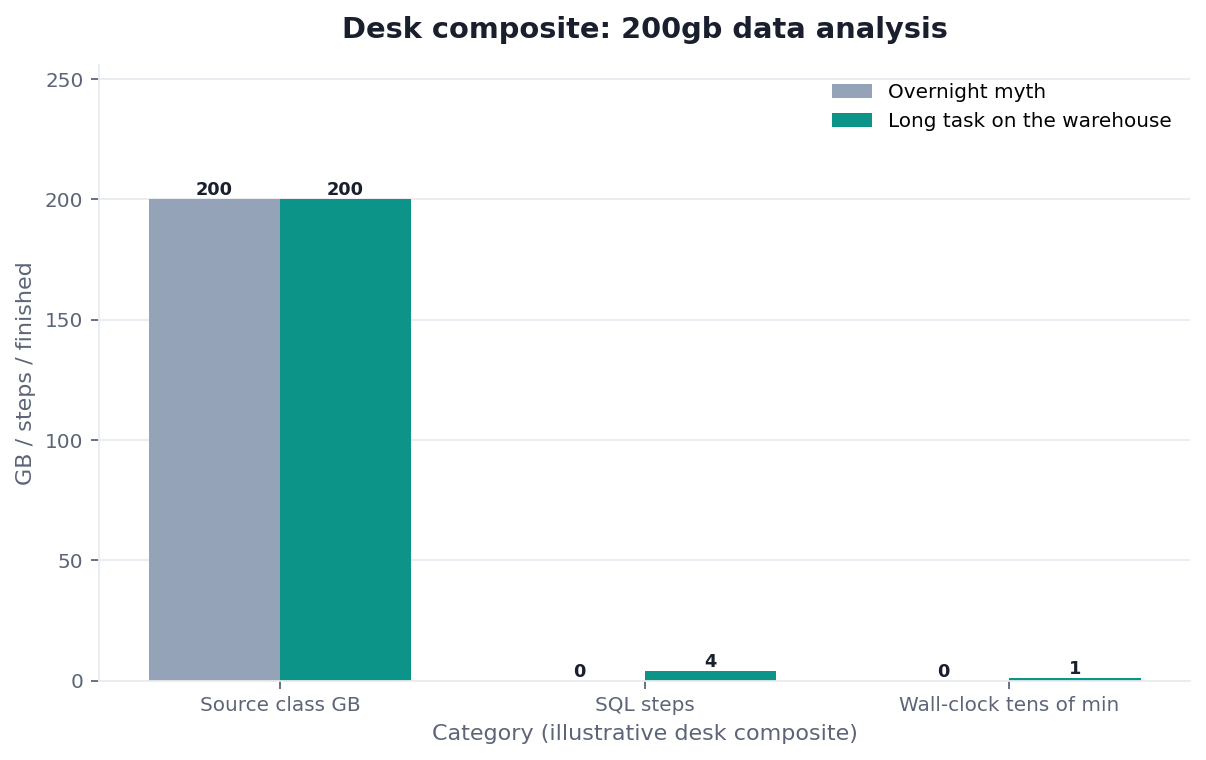
Figure. Desk composite from this page: 200 GB orders fact already in warehouse; four dated SQL steps; tens of minutes. Published context: hive.apache.org; opensearch.org; grafana.com. Not a customer experiment, SLA, or official benchmark.
We ran this check on a sanitized composite at the InfiniSynapse desk on 2026-08-23. We typed the 200gb data analysis goal from this page and opened the dated predicate, the read-only role, and the opened SQL. The first draft still had copying 200 GB into a chat sandbox. We discarded that draft and kept the table. Figures stay illustrative. What you can copy is the dated predicate and the SQL, not a duration SLA.
Scorecard: long task versus overnight myth
Score the next ticket, not the adjective 200 GB.
| Signal | Stay on engine + long task | Overnight myth / Spark program |
|---|---|---|
| Source of record | Already in a warehouse, Hive, or columnar files | Raw landings that must be reshaped nightly |
| Output | Memo, board, ranked drivers, downloadable files | A new table other systems will read every hour |
| Predicate quality | Time and entity filters are known | Every job is a full shuffle by design |
| Staffing pain | Analysts wait on ad hoc SQL | Pipelines page the on-call |
| Success metric | Auditable **200gb data analysis** this week | Guaranteed materialization SLO |
Stay put when 200gb data analysis already has an engine and the buyer wants a memo. Hire Spark when other services will consume a new table on a clock. Sequential jobs, not rivals.
Failure modes that look like “the file is too big”
Most complaints about 200gb data analysis are copy or scan complaints.
Copying 200 GB into a chat sandbox
The agent, or a person, downloads the 200 GB object into a notebook or a chat upload. Memory dies. The model looks weak; the plan was a copy. Honest 200gb data analysis pushes predicates to the engine that already holds the bytes. If the file has no engine, give it a reader that can filter, or land it once. Do not treat a sandbox crash as an AI quality event.
Missing predicates on a 200 GB scan
The agent asks for “all history” and the warehouse bills a full scan. The model looks slow; the plan was unbounded. Fix the goal with dates and grain. If the table has no usable partition column, that is a modeling ticket, not an AI ticket. 200gb data analysis without a predicate is a cost event.
Treating desk size as a batch SLA
A published 200 GB desk proof is used as a contract for every 200 GB scan. There is no honest Spark-replacement SLA in that leap. Measure the job you actually run. Publish predicates and bytes scanned. Refuse vanity duration claims. 200gb data analysis programs that survive budget review show the SQL, not the adjective.
Before you start, check three things: the source holds the 200 GB grain, the role is read-only, and the goal has dates plus a definition. If any box is empty, you are not ready to spend a 200gb data analysis scan.
Related hops: analyze large datasets with AI; analyze millions of rows; long-running analysis job; parquet file analysis; Desktop vs Browser for Large Data Analysis; When Large Data Still Needs a Warehouse; Cost of Large Analysis: Quotas You Can See.
Start the long task on the large authorized source
Authorize the 200 GB class warehouse or sanctioned file, paste the same dated goal, and open the task SQL before you brief anyone. This check uses only sources you authorize.
Commercial association: You do not need the workspace to complete the educational diagnosis on this page.
Open InfiniSynapseHow this page is sourced. William Zhu is cofounder of InfiniSynapse (GitHub @allwefantasy); no personal LinkedIn is published. Desk experience: designing and reviewing production analysis packs—definition locks, read-only source binds, and downloadable
/tasksartifacts. Reviewed by analytics engineering · data platform · LLM security · editor. Editorial standards · corrections · publishing principles · Contact zhuhl@infinisynapse.com. Company Vision. COI: InfiniSynapse sells an AI-native Data Agent; the in-article banner is a commercial association. Fact-check: hive.apache.org · opensearch.org · grafana.com · stripe.com.
Frequently Asked Questions
Is 200gb data analysis a Spark replacement?
Bottom line: No. 200gb data analysis on an existing engine answers a dated goal. A Spark program builds and operates distributed pipelines. Size that already sits in Hive or a warehouse rarely needs a new cluster for the first decision memo.
Is 200 GB a promised finish time?
Bottom line: No. Two hundred gigabytes is published desk proof that a large source can be connected. Duration, bytes scanned, and cost depend on predicates, warehouse slots, and the question shape. 200gb data analysis inherits those contracts.
Can I upload a 200 GB CSV and call it done?
Bottom line: Usually no. A giant CSV in email is not 200gb data analysis. Prefer the engine that already stores the grain, or a columnar directory a reader can filter. Upload is a last resort, not a plan.
How do I accept a 200gb data analysis pack?
Bottom line: Open the plan, the SQL, and the downloaded artifacts. Confirm the 200 GB source was not copied. Confirm predicates. Rerun with the same definition. If you cannot open the scan, you do not have 200gb data analysis.
Conclusion
200gb data analysis is a permission and predicate problem before it is a model problem. If the warehouse or sanctioned directory already holds the 200 GB grain, authorize a read-only role, write the goal with dates and definitions, and run a long task you can cancel and download. If you need a new nightly shuffle, that is still a Spark or warehouse-engineering ticket—do not dress it up as an agent failure. Keep the two jobs on separate calendars. Use the agent for the memo on the 200 GB table you have. Use the platform team for the table that does not exist yet.