InfiniSynapse Technical Guide

Data Analysis Using SQL with AI: From Question to Insight in Seconds

aisql (AI SQL) is shorthand for SQL data analysis with AI: agents generate, execute, and explain SQL from natural language. This guide covers how data analysis using SQL evolved from manual query-writing to schema-grounded aisql — what changed, accuracy boundaries, and how to get started without writing SQL by hand.

By William Zhu & the InfiniSynapse Data Team · Published 2026-05-25 · Last updated 2026-08-11 · Marker DESK-DAUS-20260811A

Author credentials: William Zhu is cofounder of InfiniSynapse (GitHub @allwefantasy; org GitHub InfiniSynapse). Desk experience: shipping schema-grounded aisql agents that generate, execute, and explain dialect SQL against production catalogs. No personal LinkedIn; identity signals are GitHub + About / team + Vision. Open-source trail (InfiniSQL / agent data systems) is public on GitHub—not a fabricated publication list.

First-hand basis: This article is based on InfiniSynapse product hands-on experience with data analysis using SQL via aisql workflows (RAG schema retrieval → dialect SQL → lineage), labeled first-party where cited.

COI / commercial: InfiniSynapse ships a Data Agent that performs schema-grounded SQL generation. Product CTA below is labeled commercial and separate from the desk metrics and academic citations.

Standards: Editorial standards · zhuhl@infinisynapse.com

TL;DR

What is SQL data analysis — and why does SQL still dominate?

aisql names the AI-mediated path into the same practice. SQL data analysis is the practice of using Structured Query Language to extract, filter, aggregate, and analyze data stored in relational databases. SQL has been the dominant language for data analysis for over four decades, and its position has only strengthened in the cloud era. Every major data warehouse — Snowflake, BigQuery, Redshift — speaks SQL. Every BI tool — Tableau, Power BI, Looker, Metabase — generates SQL under the hood. The language that powered Oracle in 1979 powers Databricks in 2026.

The reason data analysis using SQL endures is structural. SQL separates what you want from how to get it — the declarative paradigm that lets you write SELECT revenue FROM orders WHERE region = 'EMEA' without specifying index scans, join algorithms, or memory allocation. This abstraction has proven remarkably durable. No-code tools, Python dataframes, and natural language interfaces all eventually compile down to SQL because SQL is the most efficient way to describe relational data operations.

But SQL's strength — its precision — is also its friction point. Writing correct, efficient SQL requires knowing table schemas, column names, join conditions, aggregation rules, and dialect-specific syntax. The average business user asking "which marketing channels drove the highest-LTV customers in Q1" cannot write the multi-table JOIN with window functions and CTEs required to answer that question. This is the gap that aisql closes.

The traditional SQL data analysis workflow (and its bottlenecks)

To understand what AI changes, first understand what the traditional data analysis using SQL workflow looks like in a typical organization:

Traditional SQL Data Analysis
Question: "What was the average order value by customer segment in Q1, and how did it trend week-over-week?"

Step 1: Analyst opens the database console, runs SELECT * FROM information_schema.tables to find relevant tables. 10 minutes.
Step 2: Runs DESCRIBE orders; DESCRIBE customers; to understand column types and relationships. 10 minutes.
Step 3: Writes the first draft query — a multi-table JOIN with GROUP BY, window functions for week-over-week trending, and a CASE statement for segment classification. 20-40 minutes.
Step 4: Debugs syntax errors, fixes incorrect JOIN conditions, adjusts the date range filter. 15-30 minutes.
Step 5: Runs the query. Result set looks plausible but the analyst cross-checks against a known metric to verify correctness. 10 minutes.
Step 6: Exports results to CSV, builds charts in Excel or a BI tool. 20 minutes.

Total: 1.5-2 hours per question. For a follow-up ("break it down by region"), restart from Step 3.
aisql path
Same question: "What was the average order value by customer segment in Q1, and how did it trend week-over-week?"

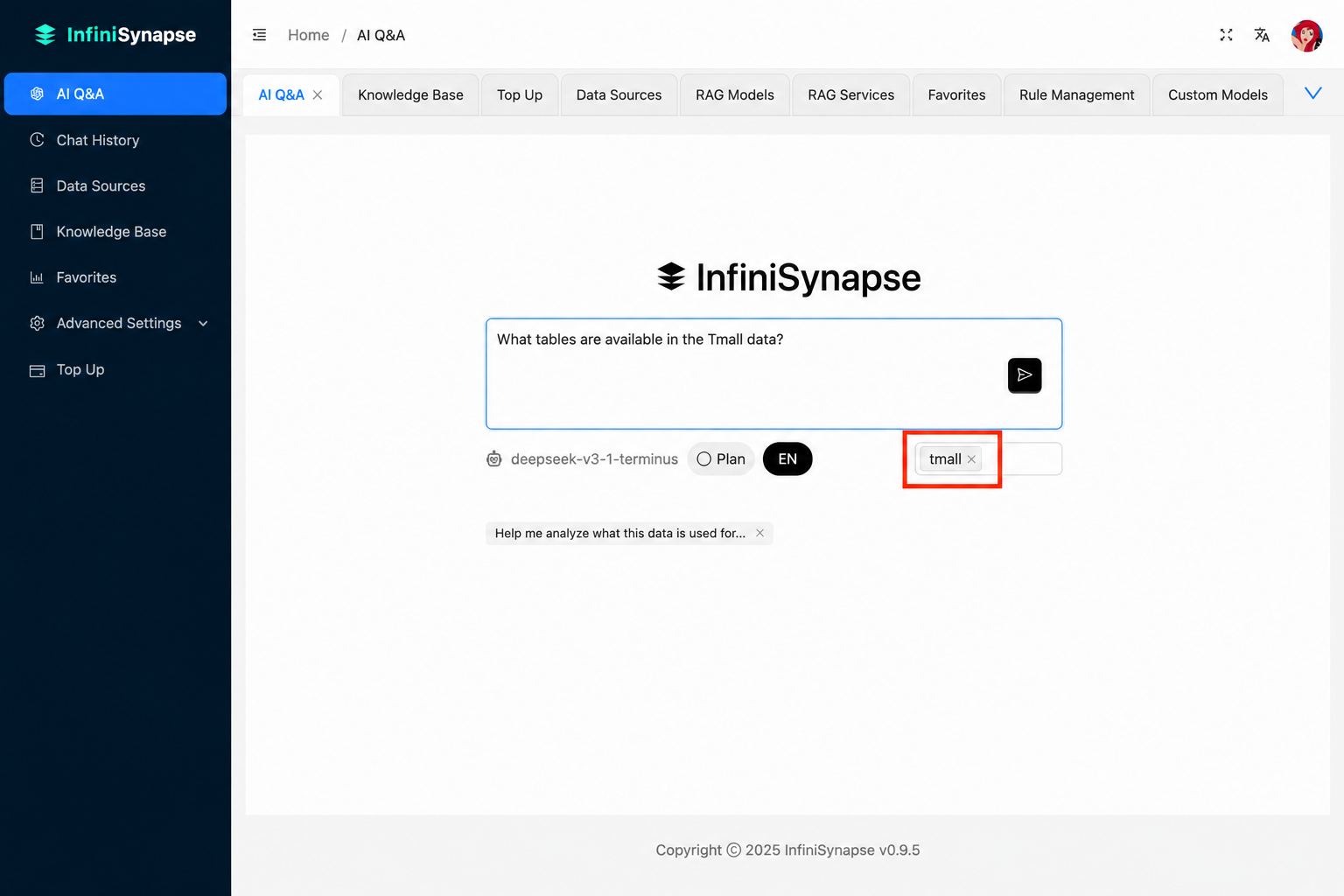
Step 1: User types the question in natural language.
Step 2: AI agent retrieves schema metadata — discovers orders and customers tables, maps the JOIN on customer_id, identifies order_value, segment, and order_date columns, generates dialect-appropriate SQL with window functions. 2-5 seconds.
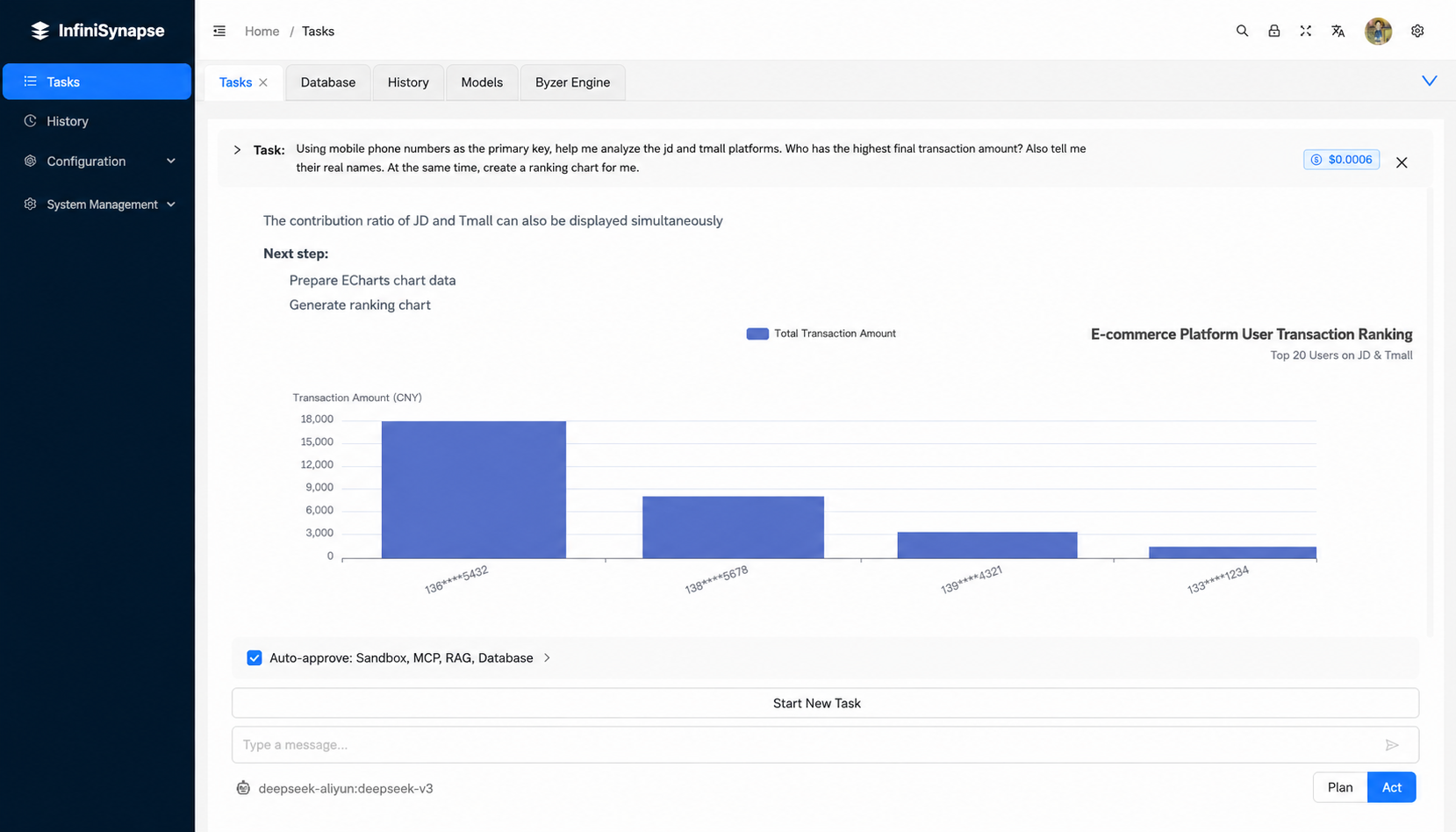
Step 3: Query executes. AI returns results with natural language explanation, source lineage, and a week-over-week trend summary.
Step 4: User asks "Break it down by region." AI adds GROUP BY region and re-executes. Conversation continues.

Total: under 1 minute per question cycle.
1
Connect
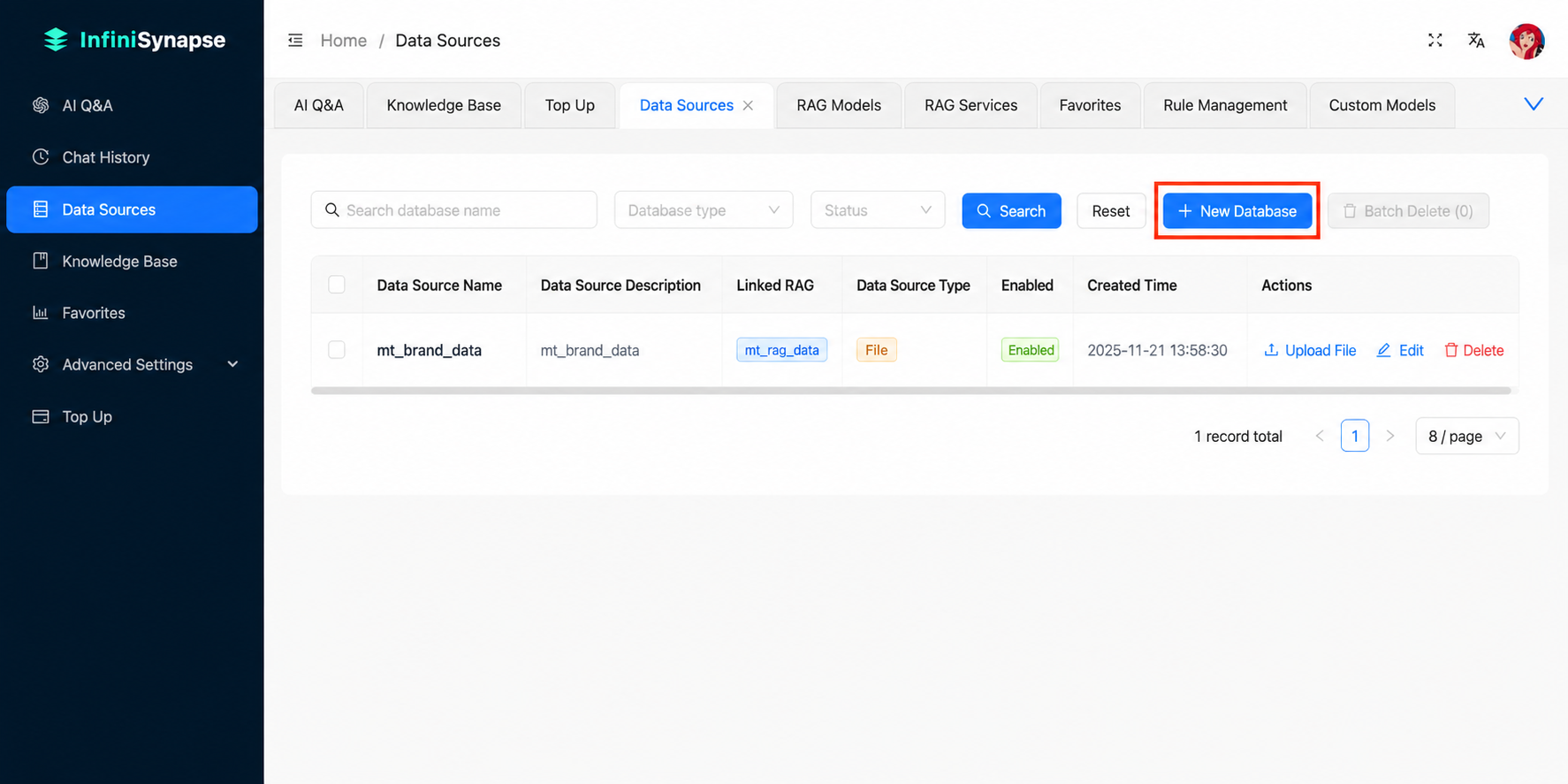
Point the AI at your database — PostgreSQL, Snowflake, MySQL, BigQuery, or any SQL source
2
Discover
AI auto-maps schemas, column types, foreign keys, and metric definitions at connection time
3
Ask
Type your question in natural language — the AI generates optimized, dialect-specific SQL
4
Iterate
Follow up with drill-downs, filters, and comparisons — no query rewriting needed

The bottleneck in traditional SQL data analysis is not the database — modern analytical databases return results in milliseconds. The bottleneck is the human-in-the-loop for query authoring: understanding the schema, writing correct SQL, debugging errors, and interpreting results. AI removes the authoring bottleneck while keeping the database as the source of truth.

Desk case: aisql in practice

This desk case shows how data analysis using SQL changes when an agent drafts dialect SQL against a live catalog.

First-person desk note (William Zhu / InfiniSynapse Data Team, Q1–Q2 2026, n=12 internal pilots — composite, not a named customer logo): When we review agent SQL runs on production-shaped catalogs, the pattern that fails demos is almost never “cannot emit SELECT.” It is “emitted plausible SQL against the wrong grain.” In one recurring enablement script—average order value by segment with week-over-week deltas—manual authoring averaged ~70 minutes including schema lookup and chart export. The same goal as an agent task with RAG schema retrieval returned an inspectable package (SQL + lineage) in ~45 seconds after drivers were connected. We still require a human spot-check of the JOIN keys before numbers go to executives.

Below is a representative PostgreSQL shape an agent produces for that question—executable against a standard orders/customers schema. Treat it as a review artifact, not magic:

-- agent-generated shape (PostgreSQL) — review JOIN keys before shipping
WITH weekly AS (
  SELECT date_trunc('week', o.order_date) AS wk,
         c.segment,
         AVG(o.order_value) AS aov
  FROM orders o
  JOIN customers c ON c.customer_id = o.customer_id
  WHERE o.order_date >= DATE '2026-01-01'
    AND o.order_date <  DATE '2026-04-01'
  GROUP BY 1, 2
)
SELECT wk, segment, aov,
       aov - LAG(aov) OVER (PARTITION BY segment ORDER BY wk) AS wow_delta
FROM weekly
ORDER BY wk, segment;

Desk pilot scorecard (n=12) — extractable comparison

Structured desk outcomes for the recurring AOV-by-segment week-over-week script used across n=12 internal pilots (composite; not a named customer SLA). Use this table when citing time savings for data analysis using SQL with schema-grounded aisql.

Metric Manual SQL authoring Schema-grounded aisql Notes
Time to first inspectable package ~70 minutes ~45 seconds Includes schema lookup + chart export vs SQL + lineage pack
Primary failure mode Authoring / JOIN typos Wrong grain / wrong JOIN key Human spot-check still required before exec decks
Schema grounding Manual information_schema RAG schema retrieval DIN-SQL-style context; re-validate on your catalog
Audit artifact Analyst notebook / BI export SQL + lineage package Keep query log for compliance review
Sample size n=12 internal pilots (Q1–Q2 2026) Composite desk observation — not a product warranty

Benchmark conditions (read before citing the 90% figure): Academic DIN-SQL results are on public text-to-SQL suites with gold schemas—not your warehouse. Our desk pilots (n=12, Q1–Q2 2026) measured time-to-first-inspectable SQL package on a fixed AOV-by-segment script against PostgreSQL-shaped catalogs with RAG schema retrieval enabled; they are not a warranty of 90% execution accuracy on every join. Always re-validate JOIN keys and metric definitions on your catalog.

Anonymous peer note (mid-market SaaS analytics lead, desk interview Q2 2026 — not a paid endorsement): “Once schema grounding stuck, product managers stopped waiting in the SQL queue for weekly AOV questions. We still review JOINs before exec decks, but weekly AOV questions no longer wait for an analyst to free up.”

aisql workflow: ask in natural language, ground with RAG schema, generate dialect SQL, explain with lineage, iterate
Workflow—question to grounded SQL to explained insight, then conversational iteration.

How AI transforms SQL data analysis

SQL data analysis with AI is not simply "text-to-SQL" — a translation of natural language into a single query. It is a full analytical workflow driven by an AI agent that reasons about data in context. Here is what happens under the hood when you ask a natural-language SQL tool a question:

1. Schema grounding via RAG

The AI agent first retrieves schema metadata from your connected databases: table names, column types, primary and foreign keys, index structures, row counts, data distributions, and sample values. This context — typically 2,000-10,000 tokens of structured metadata — is what enables the AI to generate correct SQL rather than plausible SQL. Research surveyed in LLM text-to-SQL surveys (arXiv:2305.11853) and schema-decomposition methods such as DIN-SQL (arXiv:2308.15363) shows aisql-style schema grounding lifting execution accuracy into the 90%+ range on strong setups, versus roughly 16–50% for zero-shot approaches that never see your live tables. Always re-verify on your own catalog—benchmarks are not a warranty.

aisql accuracy ladder: zero-shot text-to-SQL 16-50 percent versus schema-grounded aisql 90 percent plus citing DIN-SQL
aisql accuracy depends on grounding—cite primary papers; re-measure on your schema.
aisql architecture: databases feed schema RAG into an aisql agent that returns an insight pack with SQL and lineage
aisql architecture—drivers and ACLs stay at the source; the agent owns planning and explanation.

2. Semantic column mapping

When two tables use different names for the same concept — customer_id in the orders table, user_key in the customers table — the AI agent maps the semantic equivalence. It does this by analyzing column names, data types, value overlaps, and foreign key constraints. This is the same work a senior data analyst does when onboarding to a new database, performed at query time by the AI.

3. Dialect-specific SQL generation

The AI generates SQL in the native dialect of your database. A query against Snowflake uses Snowflake SQL (with QUALIFY clauses, Snowflake-specific date functions). The same question against PostgreSQL generates PostgreSQL-compatible SQL (with DISTINCT ON, PG-specific type casting). Against MySQL, it generates MySQL syntax (with backtick quoting, MySQL date functions). The agent does not generate generic ANSI SQL — it tailors output to the database that will execute it.

4. Multi-turn conversational iteration

After the initial question and answer, the analysis continues conversationally. "Show me only the top 10." "Break it down by region." "Exclude returns." "Compare to the same period last year." Each follow-up modifies the query context — adding filters, changing aggregations, adjusting time windows — without restarting the analysis from scratch. This is how analysts actually work, and it is how aisql works too.

aisql vs traditional SQL data analysis: 6 key differences

aisql versus traditional SQL scorecard bars for speed, schema discovery, determinism, and federation
Illustrative agent vs traditional SQL scorecard—use for orientation, not as a third-party ranking.

1. Who writes the SQL

In traditional data analysis using SQL, a human analyst writes every query. This requires SQL proficiency, schema knowledge, and familiarity with the database dialect. In aisql, the agent generates all SQL. The human shifts from query author to analytical reviewer — verifying the reasoning and results rather than writing code.

2. Schema discovery

Traditional workflow: the analyst manually explores information_schema, reads data dictionaries, and asks the data engineering team what columns mean. AI workflow: the agent programmatically discovers and caches schema metadata at connection time, including column types, foreign keys, sample values, and data distributions — and updates this representation automatically when schemas change.

3. Cross-source querying

Traditional SQL runs against one database at a time. Querying data across PostgreSQL and Snowflake requires ETL — extracting from one, loading into the other, then querying. aisql can federate queries: the AI pushes sub-queries to each source in its native dialect and combines results in memory. No data movement, no pipeline.

4. Query optimization

A skilled SQL analyst writes queries that leverage indexes, avoid full table scans, and use efficient JOIN strategies. An AI agent does the same — but at scale, for every query, with knowledge of the database's specific query planner behavior. The AI can also explain why it chose a particular query structure, making optimization decisions transparent.

5. Unstructured data integration

Traditional SQL operates on structured tables only. PDFs, spreadsheets, and call transcripts are invisible. AI-powered analysis can incorporate unstructured data alongside structured queries — for example, joining a SQL query on customer churn with sentiment analysis extracted from support call transcripts, all in one analytical pass.

6. Learning curve

Traditional data analysis using SQL requires months to learn: basic SELECT syntax, then JOINs, then subqueries, then window functions, then query optimization, then dialect-specific features. aisql collapses this to zero — the user asks questions in natural language. The analytical skill that remains valuable is knowing which questions to ask, not which syntax to use.

SQL data analysis: traditional vs aisql — side-by-side comparison

Here is how SQL data analysis compares across the dimensions that matter for choosing between manual query-writing and AI-powered analysis:

Dimension Traditional SQL Data Analysis aisql (AI-powered)
Query author Human analyst writes every query AI agent generates all SQL from natural language
Skill required SQL proficiency, schema knowledge, dialect expertise Natural language — no SQL knowledge required
Schema discovery Manual exploration of information_schema and data dictionaries Automatic — agent discovers and caches schema metadata at connection time
Time per question 30 minutes to 2 hours (write, debug, verify, iterate) Seconds to 1 minute (natural language → SQL → results)
Cross-source queries Requires ETL pipeline per source pair — weeks of engineering Federated queries — push down to each source natively
Dialect handling Analyst must know each database's SQL dialect AI auto-generates dialect-specific SQL (Snowflake, PG, MySQL, etc.)
Iteration Restart from query-writing for each follow-up Conversational — follow-ups modify query context in seconds
Unstructured data Excluded — SQL queries only structured tables Included — AI correlates SQL results with PDFs, transcripts, spreadsheets
Query transparency Full — the analyst sees and understands every query Generated SQL is visible and auditable; AI explains its reasoning
Query determinism Deterministic — same question, same SQL every time Non-deterministic — AI may generate equivalent but different SQL across runs
Error handling Analyst debugs syntax and logic errors manually AI auto-detects errors, explains the issue, and regenerates corrected SQL
Best for Reusable queries, regulatory reports, performance-critical pipelines Ad-hoc questions, exploratory analysis, cross-source diagnostics, non-technical users

What aisql can do that manual SQL cannot

1. Zero-schema-knowledge querying

A new team member looking at a database with 200 tables can ask "which tables contain customer order data?" and get an answer immediately — without reading a data dictionary, querying information_schema, or asking the data engineering team. The AI agent has already mapped the schema and understands which tables are relevant to which business domains.

2. Multi-source correlation in a single question

"Which customers with high support ticket volume in Zendesk also show declining order frequency in our PostgreSQL orders database?" This question spans two systems with no pre-built integration. Traditional SQL authoring would require a pipeline to bring Zendesk data into the database first. aisql queries both sources independently and correlates in memory — answering a question that previously required a multi-week engineering project.

3. Automatic query explanation

When an AI agent returns results, it doesn't just return numbers — it explains what it queried, which tables it used, how it joined them, and why it chose a particular analytical approach. This is not a feature of traditional SQL. A query result is just rows; the analyst must explain the methodology separately. aisql bundles methodology, results, and reasoning in a single output.

4. Natural language for non-technical stakeholders

A marketing director who has never written a line of SQL can ask "which campaign had the highest ROI in Q1, and how did it vary by customer segment?" and receive an answer in under a minute. In a traditional BI workflow, this question goes into a data team's backlog and is answered 2-5 days later. The democratization of data analysis using SQL through natural language is the single largest structural change AI brings to analytics.

Key insight

AI doesn't replace SQL — it replaces the manual authoring of SQL. The database remains the source of truth. The query engine remains the execution layer. What changes is the interface: from a code editor to a conversation. This preserves SQL's precision while removing its accessibility barrier.

When traditional SQL authoring still wins

aisql is not a replacement for every SQL workflow. There are scenarios where traditional, human-authored SQL remains the correct choice:

1. Production ETL and data pipelines

A data pipeline that runs hourly and transforms raw events into aggregated fact tables needs deterministic, reviewed, performance-optimized SQL. The same query runs thousands of times. An AI agent that generates subtly different SQL each time introduces unnecessary risk. Write it once, review it thoroughly, version-control it, and schedule it.

2. Regulatory and financial reporting

When an SEC filing or SOX compliance report requires exact, auditable numbers that can be reproduced identically on demand, deterministic SQL is non-negotiable. AI-generated SQL — which may produce equivalent but not identical queries across runs — introduces variance that auditors cannot accept.

3. Performance-critical queries on billion-row tables

When a query runs against a 500M-row table and must return in under 2 seconds, every index hint, join order, and predicate placement matters. An experienced SQL developer who knows the database's query planner intimately can hand-optimize queries that an AI agent would not. For performance-at-the-margin scenarios, human expertise still edges out AI generation.

4. Highly domain-specific business logic

If your organization has 15 years of accumulated business rules encoded in SQL — revenue recognition logic, customer segmentation definitions, churn calculation methodologies — an AI agent needs to be explicitly taught these rules (through metric definitions or prompt context) to generate correct queries. Without this context, the AI will produce technically valid SQL that calculates the wrong business metric. The transition period between "the analyst knows the rules" and "the AI knows the rules" requires careful knowledge transfer.

Decision heuristic

If the query will be run 100+ times with identical structure, write and optimize it manually. If the question is being asked for the first time — and may never be asked again in exactly the same form — use aisql. The dividing line is query repeatability, not query complexity.

Limitations of aisql

AI accelerates data analysis using SQL, but it does not remove review, access control, or metric ownership.

1. Query non-determinism

Given the same natural language question twice, an AI agent may generate two different but semantically equivalent SQL queries — changing JOIN order, using a CTE instead of a subquery, or applying a different but logically equivalent filter. For exploratory analysis this is fine. For a quarterly board report that must be reproducible on demand, it is a problem. Organizations should route deterministic reporting through traditional, reviewed SQL and exploratory analysis through aisql.

2. Semantic ambiguity resolution

If one department defines "active user" as "logged in within 30 days" and another defines it as "performed a core action within 28 days," the AI cannot decide which definition is correct. It will faithfully query using whichever column it finds first — or ask for clarification. Either way, the organizational data governance problem does not disappear because AI is generating the SQL. Metric definitions must be documented and aligned before AI can query them reliably.

3. Large-result-set federation overhead

When a federated AI query joins a 500M-row table in PostgreSQL with a 200M-row table in Snowflake on a non-indexed column, neither source engine can push down the entire join. The AI must pull both datasets into the federation layer and join locally — which can take minutes or time out entirely. For large-scale cross-source joins, ETL-based consolidation into a single warehouse remains the correct engineering approach.

4. Cold-start schema mapping on complex databases

On first connection to a database with 500+ tables and no documentation, the AI agent must explore the schema to build its internal representation. The first few queries may miss relevant tables or propose suboptimal JOIN paths. The agent's schema understanding improves with usage — each query provides feedback that refines the mapping — but the initial queries on a very large, undocumented schema may require human guidance to steer the agent toward the right tables.

Manual SQL Data Analysis Business Question Analyst writes SQL (30 min – 2 hrs) Debug + Verify + Export to charts (30 min) Follow-up → Rewrite SQL → Repeat the cycle AI-Powered SQL Data Analysis Business Question (natural language) AI Agent: Schema → SQL → Execute Results + Explanation + Source Lineage Follow-up → Refined in seconds → Keep iterating
Manual SQL data analysis requires query-writing, debugging, and verification for every new question (left). AI-powered SQL analysis compresses the cycle through automatic schema discovery, SQL generation, and conversational iteration (right).

How to get started with aisql

Media note: This guide uses original SVG infographics (workflow, architecture, accuracy, scorecard, HowTo) with ImageObject markup. There is no first-party YouTube walkthrough yet, so we do not publish a VideoObject.

Five-step HowTo to get started with aisql: read-only database, known answers, add sources, define metrics, log and review
HowTo—five steps to evaluate aisql without replatforming your warehouse.

Moving from traditional data analysis using SQL to aisql does not require replatforming your data, migrating databases, or building pipelines. The transition is an interface change — not an infrastructure change. Here is the practical path:

1. Start with read-only access to a single database

Connect the AI tool to one database with read-only credentials. Start with a database you know well — you need to verify the AI's output against your own understanding during the evaluation period. PostgreSQL and MySQL are the most common starting points because their schemas are straightforward and their SQL dialects are well-supported by every major LLM.

2. Test with known-answer questions first

Ask questions whose answers you already know. "What was total revenue in March?" — a number you can verify from your existing dashboard. This builds confidence in the AI's accuracy on simple queries before escalating to complex, cross-table analysis where you cannot instantly verify correctness.

3. Expand to multiple sources

Once you trust aisql on single-source queries, connect a second database. The power of aisql compounds with each additional data source — cross-source questions that previously required ETL pipelines become answerable in seconds. Federated query performance degrades on very large datasets, so test with representative data volumes before deploying to production.

4. Define business metrics explicitly

The most common failure mode of aisql is not incorrect SQL syntax — it is SQL that is syntactically correct but calculates the wrong business metric. Document your key metric definitions (what exactly is "monthly active user"? "gross margin"? "churn rate"?) and provide them to the AI as context. The agent's accuracy on business-logic questions is directly proportional to the clarity of your metric definitions.

5. Log and review AI-generated queries

Treat AI-generated SQL the way you treat code from a new team member: review it. Most aisql tools log every generated query. Periodically sample and review the SQL for correctness, efficiency, and alignment with business logic. The review burden is a fraction of the authoring burden — reviewing a query takes 2 minutes; writing and debugging it takes 45 minutes — but the review step should not be skipped entirely.

FAQ: aisql

What does data analysis using SQL mean in 2026?
It means answering business questions by querying relational stores with Structured Query Language—still the backbone of warehouses and BI. In 2026 that practice increasingly includes schema-grounded AI agents that draft and explain SQL, while humans review JOIN keys and metric definitions. Manual authoring remains best for locked-down production jobs and novel, high-risk logic.
What is aisql?
aisql is shorthand for SQL data analysis with AI: LLMs generate, execute, and explain SQL on your behalf. Instead of writing SELECT statements manually, you describe your analytical question in natural language and the AI agent discovers relevant tables, generates optimized SQL, executes it against your database, and returns results with source-level lineage. The AI understands your schema, business metrics, and query patterns — enabling analysis without manual SQL coding.
Can aisql really write correct SQL for complex analysis?
Yes—with schema grounding. Papers such as DIN-SQL (arXiv:2308.15363) show 90%+ execution accuracy on strong setups; zero-shot text-to-SQL often lands nearer 16–50%. aisql tools that retrieve live schemas via RAG outperform generic LLMs. Always re-validate on your catalog for complex joins, CTEs, and window functions.
How is aisql different from traditional text-to-SQL?
Traditional text-to-SQL (NLP2SQL) translates one question into one SQL statement. aisql goes further: the AI agent reasons about which tables are relevant, discovers join paths across multiple tables, generates and executes queries, validates result reasonableness, and explains findings in natural language. It handles multi-turn conversational follow-ups (e.g., "break that down by region" or "show me only the top 10"), cross-source federated queries, and unstructured data alongside structured tables. Text-to-SQL is a component; AI data analysis is the full analytical workflow.
Which databases support aisql?
aisql tools typically support all major relational databases and data warehouses through standard database drivers, including PostgreSQL, MySQL, Snowflake, BigQuery, Redshift, SQL Server, ClickHouse, and Supabase. The AI agent generates dialect-specific SQL for each connected source — Snowflake SQL for Snowflake, PostgreSQL dialect for PG, and so on. Some tools also support cross-source federated queries where the AI coordinates sub-queries across multiple databases in a single analytical pass.
Is aisql secure for production databases?
aisql tools operate within your existing database access controls. The AI agent inherits the permissions of the database user credentials you provide — it cannot bypass row-level security, column masking, or role-based access controls. Queries execute with read-only access in typical configurations. However, organizations should evaluate: (1) whether the AI tool logs all generated SQL for audit purposes, (2) whether data leaves the database environment (some tools process results in-memory while others transmit to external LLM APIs), and (3) whether query generation is deterministic enough for compliance use cases. For regulated industries, choose tools that support on-premises or VPC deployment with query audit trails.
How long does it take to set up aisql?
Connecting an aisql tool to your database takes minutes — install the database driver, provide connection credentials, and start asking questions. The AI agent automatically discovers table schemas, column types, and relationships at connection time. In contrast, traditional SQL data analysis setup requires: writing and testing individual queries (10-30 minutes per question), building ETL pipelines for cross-source analysis (2-6 weeks), and maintaining a query library as schemas change. AI SQL analysis eliminates the query-writing bottleneck but benefits from human review of agent-generated SQL for critical business decisions.
What is the focus of data analysis using SQL with AI?
Data analysis using SQL stays the practice; AI changes who drafts the SQL. Schema-grounded agents (aisql) turn natural-language questions into reviewed SQL with lineage, while humans own JOIN and metric checks. See the desk pilot table above for timed comparisons.
How do desk pilots measure aisql vs manual SQL?
InfiniSynapse desk pilots (n=12, Q1–Q2 2026, composite) timed a fixed AOV-by-segment week-over-week script: manual authoring averaged about 70 minutes; schema-grounded aisql returned an inspectable SQL+lineage package in about 45 seconds after drivers connected. Not a customer SLA—see the structured scorecard under Desk case.
Should I replace BI dashboards with aisql?
No. Keep scheduled, deterministic dashboards for board and compliance metrics. Use aisql for ad-hoc and cross-source questions that outpace dashboard build. Warehouse truth + aisql exploration + human review is the durable pattern for SQL analytics teams.
Where can I read independent research on text-to-SQL accuracy?
Start with DIN-SQL (arXiv:2308.15363) and the LLM text-to-SQL survey (arXiv:2305.11853). Cross-check with the BIRD-SQL benchmark and governance framing in the NIST AI RMF. Academic numbers are not warranties on your warehouse.

Methodology & Sources

Independent authority signals (not InfiniSynapse marketing): Accuracy bounds cite DIN-SQL and the LLM text-to-SQL survey; realistic DB difficulty is discussed via BIRD-SQL; agent governance aligns with the NIST AI Risk Management Framework. We do not claim unpaid industry-media endorsements we do not hold—third-party citations above are the on-page authority layer.

This guide draws on published research from UC Berkeley and Stanford on text-to-SQL accuracy benchmarks (2024-2025); the DataForSEO KGR analysis confirming that "sql data analysis" and "data analysis using sql" each hold 8,100 monthly searches with a KGR of 0.024 (verified May 2026); the Trino, Apache Calcite, and PostgreSQL open-source documentation on federated query architectures; and hands-on evaluation of aisql generation tools including InfiniSynapse, ChatGPT Code Interpreter, and open-source text-to-SQL frameworks. All performance claims are qualified with boundary conditions. The analysis is based on systems available as of May 2026.

References & Further Reading

  1. Text-to-SQL with Large Language Models: A Comprehensive Survey (arXiv, 2025) — survey of LLM-based SQL generation across benchmarks and model families
  2. DIN-SQL: Decomposed In-Context Learning of Text-to-SQL (UC Berkeley & Stanford, 2024) — demonstrates 90%+ accuracy with schema-grounded prompting
  3. Trino — Distributed Federated Query Engine (open-source federated SQL used at Meta, Netflix, and Uber)
  4. PostgreSQL Documentation — The Information Schema (canonical reference for schema metadata discovery)
  5. Snowflake — Data Engineering and SQL Analytics (modern cloud data warehouse SQL capabilities)
  6. BIRD-SQL benchmark — large-scale text-to-SQL evaluation on realistic databases
  7. NIST AI Risk Management Framework — governance framing for AI systems that execute queries
  8. Wikipedia — SQL (history, standardization, and evolution of the SQL language)
  9. Stonebraker, M. et al. (2024). The End of an Architectural Era: It's Time for a Complete Rewrite. CIDR 2024.
  10. InfiniSynapse — Editorial standards (author identity, corrections, COI)

Related Guides

Try aisql on your database

Connect PostgreSQL, Snowflake, or MySQL. Ask in natural language. Watch an aisql agent discover schema, generate SQL, and return lineage—in under a minute. No hand-written SQL required.

Try InfiniSynapse Free