Evaluate Text to SQL Accuracy: Buyer Scorecard
By the InfiniSynapse Data Team · Last updated: 2026-09-24 · We build InfiniSynapse, an AI-native Data Agent platform. This guide reflects how we evaluate text to sql accuracy in production customer workflows.
Table of Contents
- TL;DR
- Why This Matters in 2026
- Definition
- Execution accuracy versus exact match
- Benchmark Eval vs Production Scorecard
- Core Capabilities
- Buyer Scorecard
- Vendor Landscape
- Implementation Patterns
- Governance and Trust
- InfiniSynapse Production Pattern
- Common Failure Modes
- FAQ
- Conclusion
TL;DR
Freeze analyst gold SQL on your warehouse, then evaluate text to sql accuracy with execution match and exact match. Public Spider and BIRD ranks are a ceiling check. How to evaluate text to sql accuracy on a private set is the buy gate.
Who this is for: analytics leaders, data engineers, and procurement teams who need to evaluate text to sql accuracy in 2026. The object under test is still a text to sql llm, and the job being scored is text to SQL, not only the product name on the invoice.
What you'll learn:
- A citable definition for evaluate text to sql accuracy on mixed workloads
- When execution match and exact match disagree
- A six-dimension buyer scorecard with pass/fail signals
- Vendor patterns and when each archetype wins
- Rollout patterns that survive compliance and executive review
Why leaderboard scores mislead procurement—described in the Spider NL2SQL benchmark—frames how teams evaluate text to sql accuracy once natural-language access touches recurring executive metrics.
Start with the cluster hub Natural Language to SQL: Production Playbook when scoping platform-wide analytics strategy.
Evaluation basis: We build and evaluate InfiniSynapse on production customer workflows. Governance, adoption, and security context is cited inline throughout this guide—not in a standalone reference list.
Why This Matters in 2026
Three forces pushed teams to evaluate text to sql accuracy as a procurement item, not a demo slide:
- Benchmark skew — Spider tables do not match enterprise drift
- Single-number traps — 85% accuracy hides catastrophic revenue errors
- No reviewer agreement — Automated metrics miss executive-ready nuance. Run the reliability test for an AI SQL analyst on a question you can already count.
Adoption benchmarks in BIRD track the same shift from demo workflows to governed analytics loops we see in customer rollouts.
| Symptom without governance | What breaks |
|---|---|
| Same question, different SQL | Trust collapses after one wrong number |
| No audit trail on AI outputs | Compliance blocks production access |
| Analysts re-explain definitions | Pilots stall in review |
| Ungoverned self-serve | Metric sprawl amplifies across teams |
For adjacent depth on the same cluster, see Why Text-to-SQL Fails in Production.
Compare complementary patterns in nl2sql benchmark before scaling access to production schemas.
Definition
Citable definition: A production scorecard to evaluate text to sql accuracy measures executable correctness, metric alignment, reviewer agreement, and stability across schema changes—not single-number benchmark accuracy alone.
The definition has four non-negotiable properties:
| Property | Meaning |
|---|---|
| Grounding | Answers compile against approved metrics or schema context |
| Explainability | Reviewers see SQL, steps, and assumptions |
| Governance | Access rules apply at compile time |
| Repeatability | Tenth-run quality matches week-one baselines |
To evaluate text to sql accuracy is a recurring scorecard, not a one-shot prompt demo. Production systems optimize for correct, reviewable outputs. NIST AI Risk Management Framework is a concise refresher on grain and conformed metrics for reviewers validating generated logic.
Execution accuracy versus exact match
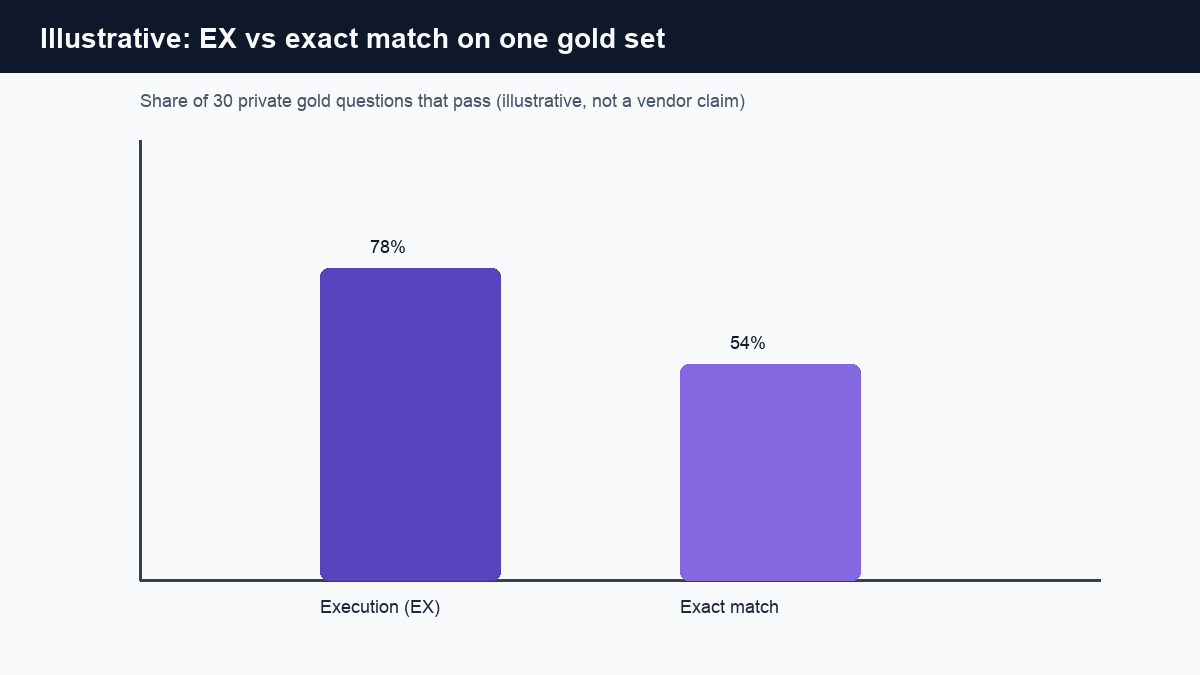
Exact match asks whether the generated SQL string equals the gold query after light normalization. Execution accuracy (EX) asks whether running that SQL returns the same result set as the gold query. Teams that evaluate text to sql accuracy need both: EX is the number you take to review; exact match is the regression check after a prompt, model, or schema change.
Two queries can differ in aliases, column order, or CTE shape and still pass EX. Two queries can also match on a thin fixture and fail on production grain. When you evaluate text to sql accuracy, record EX, exact match, and a reviewer note for semantic equivalence. A string-only scorecard will fail valid rewrites. An EX-only scorecard will pass an inefficient join that happens to return the same ten rows.
Retrieval failure and reasoning failure look the same on a single pass rate. If the model never sees account_flags, EX drops even when SQL generation is fine. If the tables are provided and the join is still wrong, the defect is reasoning. Split those modes before you buy another model.
Benchmark Eval vs Production Scorecard
| Dimension | Traditional approach | Production scorecard |
|---|---|---|
| Dataset | Public benchmark | Internal mixed workload |
| Success metric | Exact match accuracy | Reviewer-approved EX plus exact match |
| Schema | Static | Drifting weekly |
| Cadence | Once at purchase | Weekly regression tracking |
Choose a public-suite snapshot when metrics are fixed and audiences consume the same views weekly. Evaluate text to sql accuracy on a private gold set when stakeholders ask unpredictable questions, definitions span domains, or analysts spend hours rewriting the same logic.
Core Capabilities
Production work to evaluate text to sql accuracy should verify four capability areas:
Question stratification
Bucket questions into simple, join-heavy, and recurring report types.
Baseline SQL library
Analyst-approved gold queries for comparison.
Reviewer rubric
Score explainability, not just result match.
Drift tracking
Re-run the scorecard after schema migrations.
Production rollouts should align with Wikipedia's data warehouse overview when recurring queries touch live schemas.
LLM-backed analytics should account for prompt-injection and data-exfiltration risks in the OWASP Top 10 for LLM Applications, especially when connectors expose production schemas.
Warehouse vendors describe governed NL2SQL agents in Databricks' Genie architecture post—compare memory depth and audit trails against your internal requirements.
Consumer and data-use policies should align with FTC consumer protection guidance when outputs inform external decisions.
Buyer Scorecard
Score each dimension 0–2 when you evaluate text to sql accuracy options:
| Dimension | Pass signal | Fail signal |
|---|---|---|
| Metric grounding | Compiles against governed definitions | Raw schema dump only |
| Explainability | Shows SQL + reasoning | Black-box paragraph |
| Human workflow | Draft → review → publish | Auto-send to executives |
| Access control | Role rules at query time | Post-hoc filtering |
| Integration | Works with existing stack | Rip-and-replace required |
| Audit trail | Replay any generated query | No logs after session |
Platforms scoring below 8/12 usually require heavy custom modeling before evaluate text to sql accuracy work reaches production trust.
Multi-source design should follow Microsoft data architecture guidance so domain boundaries stay explicit as scope grows.
Vendor Landscape
The market around evaluate text to sql accuracy spans multiple archetypes in 2026. To apply the rubric to nl2sql tools, use the 2026 shortlist after you lock the scorecard.
Vendor benchmark decks
Pretty Spider numbers—ask for your schema replay. After tickets replay on your warehouse, return to production Vanna alternatives for the buy shortlist.
Auto-eval tooling
SQL diff frameworks help; you still need business metric alignment when you evaluate text to sql accuracy.
Human-in-the-loop review
Analyst sign-off remains the gold standard.
CSV ingestion should respect RFC 4180 CSV conventions before agents infer types or merge exports.
Implementation Patterns
Pattern A — 30-question pilot set
Draw from last quarter's analyst tickets and freeze gold SQL a person already ran.
Pattern B — Weekly regression
Re-score after every schema change so evaluate text to sql accuracy does not rot with the catalog.
Pattern C — Dual reviewers
Finance and analytics must agree on gold SQL.
Week-one checkpoint
Confirm executive sponsors named a metric council chair, reviewers know the approval UI, and the pilot question set matches last quarter's analyst tickets—not vendor demo prompts.
LLM-backed analytics should account for risks in the OWASP Top 10 for LLM Applications, especially when connectors expose production schemas.
Governance and Trust
Work to evaluate text to sql accuracy fails in production when governance is an afterthought:
| Risk | Mitigation |
|---|---|
| Wrong metric compiled | Bind NL to semantic layer |
| Prompt injection | Sandboxed execution, allow-listed tables |
| Data exfiltration | Row-level security at compile time |
| Unreviewed AI narratives | Mandatory analyst approval gate |
| Model drift | Version prompts and track accuracy weekly |
Regulated rollouts often anchor access reviews to ISO/IEC 27001 when credentials and audit logs are in scope.
Enterprise AI guidance in Google Cloud's AI overview mirrors the shift from ad-hoc copilots to repeatable decision workflows.
Metric definitions should stay grounded in Wikipedia's statistics overview before agents encode KPIs.
InfiniSynapse Production Pattern
InfiniSynapse ships with workflow logs that double as eval artifacts: replay any historical question, diff SQL against current baselines, and track accuracy trends across schema versions.
Customers often start with analyst-reviewed workflows, then graduate to agentic mode once metric councils stabilize. Teams still evaluate text to sql accuracy as the entry gate; autonomy compounds value on recurring operational questions.
Production rollouts should align access and review controls with the NIST AI Risk Management Framework, especially when recurring queries touch live schemas.
Common Failure Modes
Failure 1 — One demo question set: Vendors overfit to your pilot.
Failure 2 — Ignoring grain: Right tables, wrong monthly vs daily aggregation. Score accuracy across Postgres, Snowflake, and BigQuery on the same prompt, not on one demo engine.
Failure 3 — No executive questions: Eval sets miss the queries leadership actually asks.
Failure 4 — Static gold SQL: Baselines rot when metrics evolve.
Capture reviewer disagreements when published outputs differ from finance baselines. Log schema drift next to accuracy reviews so engineers know whether to fix prompts or semantic models. Measure return usage by persona after week four. Record which metric council member signed each published answer so audit can replay responsibility chains.
Analytics uptime improves when teams borrow Google SRE practices—error budgets and blameless postmortems for failed query chains.
Frequently Asked Questions
How do I evaluate text to SQL accuracy on my own warehouse?
Freeze about thirty questions from last quarter's real tickets, with gold SQL a person already ran. Evaluate text to sql accuracy by scoring execution match and exact match on that set, then re-run after every schema change. How to evaluate text to sql accuracy on Spider or BIRD is a ceiling check; the private gold set is the buy gate.
What does a warehouse scorecard measure in simple terms?
When teams evaluate text to sql accuracy, the scorecard is gold SQL, execution match, reviewer agreement, and weekly drift—not a single leaderboard percentage.
How is it different from a generic AI chatbot?
Generic chatbots optimize for fluent text without guaranteed correctness. Governed analytics systems compile against your metrics with lineage and access controls.
Do I need a semantic layer?
For demos, no. For production access touching recurring executive metrics, yes—otherwise logic compiles against raw schema names and joins drift.
Can it replace my existing BI stack?
Usually no—it complements BI and notebooks by handling ad-hoc and recurring questions outside pre-built dashboards.
How long does rollout take?
A focused pilot with five governed metrics and one review workflow often takes 4–6 weeks. Enterprise-wide adoption takes quarters.
Conclusion
Teams that evaluate text to sql accuracy in 2026 score grounding, explainability, and review workflow before model benchmarks. Systems that survive the first executive review share governed metrics and replayable audit trails.
Next steps:
- Build a stratified question set from real tickets.
- Read nl2sql benchmark for public-suite limits.
- Require weekly scorecard reviews during the pilot.
When recurring questions outgrow pilot scope, evaluate AI-native Data Agents that compile, execute, and audit in one loop—with the same governed metrics your evaluation established.