Text to SQL Agent for Data Visualization: Comparison (2026)
By the InfiniSynapse Data Team · Last updated: 2026-09-16 · We build a SQL agent, so treat vendor claims here as disclosed bias. Comparisons below use public docs plus first-party pilots; InfiniSynapse is one option, not the default answer.
If your text-to-SQL agent joins warehouse tables differently every run, the model is still choosing join paths. Pin a governed join graph, compile SQL deterministically, and reject unsigned routes. A generator keeps inventing joins; a SQL agent only helps when it cannot rewrite those paths. That is the fix—not more prompt retries.
Table of Contents
- TL;DR
- Why This Matters Now
- Key Definition
- Generator vs Agent: Side-by-Side
- Shared Test Design (Methodology)
- First-Party Scorecard Results
- Governance and Auditability
- Buyer Decision Matrix
- Signals You Need an Agent
- Debugging: Agent vs Generator
- When joins change every run
- Common Failure Patterns
- FAQ
- References
- Conclusion
TL;DR
Canonical answer: Plain text-to-SQL is a function (question in, query out). A text to sql agent for data visualization is a loop: goal in, grounded plan, execution, self-correction, audit trail, and reusable memory out. Use a generator for one-off engineer-verified queries; use an agent when a chart or report reruns unattended and someone other than the author must trust the number.
Quick picks
| Situation | Better choice |
|---|---|
| Ad-hoc query, engineer reads the SQL | Text-to-SQL generator |
| Weekly board pack / live dashboard | Text to sql agent for data visualization |
| Regulated report needing lineage | SQL agent with audit trail |
Conflict of interest: InfiniSynapse publishes this guide and sells a SQL agent. Scores below are first-party pilot judgments on a fixed task set—not third-party audited benchmarks. Re-run the same tasks on your warehouse before deciding.
If the same question produces a different join graph on the next run, skip the buyer matrix until you pin paths—see When joins change every run.
Related: Integrate NL analysis with SQL and Python · LLM SQL generation architecture · Spider/BIRD benchmarks.
Why This Matters Now
Buyers searching for a text to sql agent for data visualization usually already tried a bare generator and hit rerun failures.
Teams evaluating a text to sql agent for data visualization need faster analytics without losing decision quality. AI-assisted SQL unlocks productivity, but only when requests are grounded, generated, verified, and approved consistently. The hard problem is not producing SQL once; it is trusting the tenth unattended run when a text to sql agent for data visualization feeds a live dashboard and definitions drift underneath it.
Public benchmarks like Spider and BIRD are directional; BIRD in particular adds dirty-schema realism that Spider-only leaderboards under-weight (Yu et al., 2018; Li et al., 2023). Neither predicts your schema drift.
Key Definition
Key definition: A text to sql agent for data visualization translates natural-language business intent into executable SQL inside a governed loop that preserves assumptions, runs validation checks, and keeps traceable output lineage from question to chart.
This reframes a text to sql agent for data visualization from an interface feature to an operating capability: outputs must be understandable, testable, and recoverable. It also clarifies ownership between analytics engineers, BI teams, and decision stakeholders.
Generator vs Agent: Side-by-Side
This is the core decision behind any text to sql agent for data visualization purchase.
The terms are used interchangeably in marketing but describe different things.
| Dimension | Text-to-SQL generator | SQL agent |
|---|---|---|
| Unit of work | One query per prompt | A goal completed across steps |
| Grounding | Whatever is in the prompt | Live schema + governed definitions + memory |
| Failure handling | Returns an error or wrong SQL | Reroutes, retries, or escalates a typed error |
| Evidence | Final SQL only | Step-by-step trace a reviewer can replay |
| Memory | None between calls | Distilled, reusable across runs |
| Best fit | Ad-hoc queries, engineer in loop | Recurring, defensible, unattended workloads |
For a one-off question an analyst will sanity-check, a generator beats a text to sql agent for data visualization—adding an agent is over-engineering. The calculus flips when work repeats or someone other than the author must trust the number. A weekly board pack, a regulated report, or a text to sql agent for data visualization feeding a live dashboard all need the agent's grounding and audit trail, because a silent wrong answer compounds with every rerun.
Do not buy on demo impressions: a generator and an agent look identical in a five-minute demo on a clean schema. They diverge under schema drift, ambiguous definitions, and the tenth unattended run. Evaluate run ten, not run one.
Shared Test Design (Methodology)
We scored a bare generator against a text to sql agent for data visualization on identical prompts.
To keep claims checkable, we scored both approaches on one fixed task set (Q1–Q2 2026 warehouse pilots, anonymized):
| Artifact | Spec |
|---|---|
| Warehouse | Postgres + one cloud warehouse mirror, ~40 tables |
| Mess injected | Renamed column, added nullable dimension, one metric redefinition mid-month |
| Tasks (same prompts) | (1) single aggregate for a chart, (2) 3-step diagnostic, (3) recurring monthly dashboard query re-run after schema change |
| Roles | Same generator model powering both; agent adds grounding + validation + trace |
| Scoring (0–2 each, max 12) | grounding · execution reliability · result trust vs hand SQL · governance fit · operational effort · reusability |
Transparency note: These are first-party pilot medians, not audited leaderboards. We publish the criteria so you can replicate them; we do not publish customer data.
First-Party Scorecard Results
| Task | Text-to-SQL generator | SQL agent | Gap driver |
|---|---|---|---|
| 1) One chart aggregate | Fast, correct (run 1) | Correct (slightly slower) | Generator wins simple, verified jobs |
| 2) 3-step diagnostic | Correct with re-prompts | Correct, fewer retries | Agent recovers on typed errors |
| 3) Monthly dashboard after schema change | Silent wrong join on rerun | Flagged + rerouted | Grounding + memory catch drift |
| Signal (median, 3 pilots) | Generator | Agent |
|---|---|---|
| First-pass correctness (run 1, clean) | ~90% | ~90% |
| Correctness on run 10 after drift | ~55–65% | ~85–92% |
| Reviewer time to trust a chart | Higher (re-reads SQL) | Lower (replays trace) |
| Finance reopen rate on monthly pack | Weekly disputes | ≤1 / month when definitions signed |
The pattern is consistent: on run one a generator and a text to sql agent for data visualization tie; a text to sql agent for data visualization separates on rerun stability after drift. If your visualization workload never reruns unattended, you may not need the agent.
Governance and Auditability
Governance is where a text to sql agent for data visualization justifies its added complexity.
Architecture drives reliability for any text to sql agent for data visualization. Prioritize controlled retrieval, guarded execution, semantic alignment, and explicit review outputs so teams can debug quickly and defend conclusions.
| Control | Generator | Agent |
|---|---|---|
| Query versions stored | Manual | Automatic per step |
| Assumptions documented | Prompt-dependent | Memory cards |
| Replay for reviewer | Re-run prompt | Step trace |
| Policy enforcement | External | In-loop, typed blocks |
Align access and review controls with the NIST AI Risk Management Framework and NIST Cybersecurity Framework. Because an agent calls live endpoints and chains steps, its security surface is larger than a generator's—account for prompt-injection and exfiltration per the OWASP Top 10 for LLM Applications, and review CISA AI guidance before enabling autonomous query paths.
Every chart a text to sql agent for data visualization produces should trace back to an inspectable query—a dashboard tool renders, while the agent computes and explains.
Buyer Decision Matrix
Map each workload to a generator or a text to sql agent for data visualization before you standardize seats.
| Team situation | Better first choice | Rationale |
|---|---|---|
| Engineer runs ad-hoc queries | Generator | Lowest overhead |
| BI team ships recurring dashboards | Agent | Rerun stability + lineage |
| Regulated / audited reporting | Agent | Replayable trace |
| One analyst, clean single source | Generator | Agent is over-engineering |
| Cross-team metric disputes | Agent | Governed definitions in memory |
Rollout path for a text to sql agent for data visualization (either tool): Days 1–30 scope and success criteria; Days 31–60 side-by-side vs analyst baselines; Days 61–90 productionize high-value recurring workflows and monitor drift. Biweekly review with platform, analytics, and business owners turns incidents into design fixes.
Signals You Need an Agent
Use this checklist to decide between a generator and a full text to sql agent for data visualization:
- First-pass correctness on representative tasks
- Recovery quality after deliberate error injection
- Reviewer confidence in output lineage
- Rerun stability after schema or policy updates
- Net time saved vs analyst-only baseline
- Reduction in unresolved metric disputes
- Clarity of ownership during incidents
- Trend of manual intervention over time
If items 2, 4, and 7 are weak, a generator is quietly costing you rework—move toward a text to sql agent for data visualization.
Debugging: Agent vs Generator
Knowing whether you run a generator or a text to sql agent for data visualization is the first triage step. A generator fails at the query: wrong join, wrong dialect, wrong metric. See how an agent compiles per warehouse. An agent can fail at any loop step—retrieval, execution, recovery, or audit—so a text to sql agent for data visualization needs step-level traces, not just the final SQL.
When pilots stall in week three, the root cause is rarely the model. Check:
- Schema drift / renamed columns
- Ambiguous metric names
- Stale warehouse statistics
- Missing join keys
- Dialect function mismatch (date truncation,
FILTER) - Orchestration forcing full rebuilds on small schema changes
When joins change every run
This is the query teams actually type after a failed pilot: our text-to-SQL agent joins our warehouse tables differently every run and we spend more cycles correcting it than using it. fixes?
A text to sql agent for data visualization does not fix that by itself. If the model is still the author of the join graph, run two and run ten will disagree even when the question is identical. The SQL agent vs text-to-SQL distinction only helps when the agent is forbidden to invent routes.
Why the same prompt picks different joins
| Cause | What you see | Why retries fail |
|---|---|---|
| LLM-authored join path | orders ⋈ customers today, orders ⋈ dim_customer tomorrow | Sampling + schema dump, not a rule |
| Ambiguous grain | Revenue at order grain vs line grain | Both joins “work”; only one is the metric |
| Fan-out / fan-trap | Row counts jump 3–8× between runs | Independent one-to-many legs multiply |
| Missing FK / multiple shortest paths | Model picks a different hop each time | Shortest-path ties are common on warehouse stars |
| Schema dump in the prompt | Extra tables appear after a rename | Retrieval drift changes the candidate set |
Public suites such as BIRD punish dirty joins; they do not pin your customer key. Recent work on deterministic compilation over a governed semantic graph makes the same point we see in pilots: the planner may choose among labeled routes; the engine must own the physical joins.
HowTo: pin joins so run ten matches run one
- Inventory the fan-out. For each recurring chart, write the intended grain (one row per what?) and the tables that must appear. If two reviewers disagree, stop—do not prompt.
- Publish one join path per metric. FK + role predicate + hop bound. No second “also valid” path without a steward ticket.
- Compile SQL from the path, do not generate it. The model names the metric and filters; a compiler (or a locked dbt/semantic contract) emits the
JOIN. Unsigned routes refuse. - Diff SQL across three identical reruns. Hash the join clause, not the whole string. If the hash moves, the path is still model-owned.
- Kill the unsigned retry. Self-correction that rewrites joins is how you spend more cycles correcting than using. Retry only with the last refusal reason, not a blank conversation.
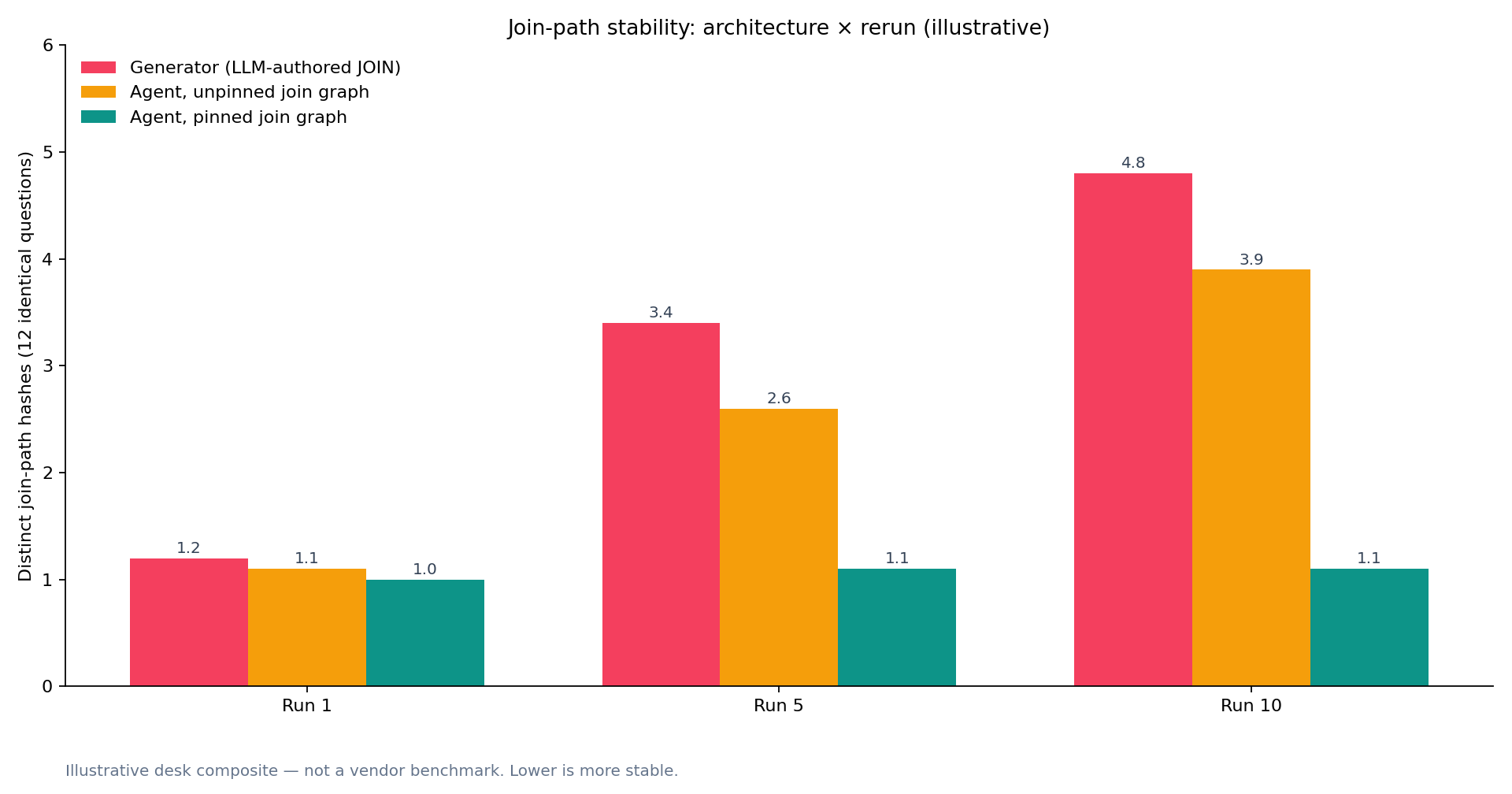
Figure — Illustrative desk composite (same 12 warehouse questions × 3 architectures). Distinct join-path hashes, not a vendor SLA.
Which architecture actually holds the join
| Workload | Generator | Agent without pinned graph | Agent with pinned graph |
|---|---|---|---|
| One-off, engineer reads SQL | Fine | Overkill | Overkill |
| Recurring dashboard | Joins drift; you correct | Still drifts if the model authors JOINs | Stable if unsigned routes refuse |
| Correcting more than using | Expected | Still expected | The failure you can retire |
If you are already correcting more than you use, do not buy a larger model first. Pin the graph, then re-score SQL agent vs text-to-SQL on run ten. For the layered planner/retriever/executor view, see LLM SQL generation architecture. For post-pilot join failures that are really missing contracts, see why text-to-SQL fails.
Common Failure Patterns
These patterns explain why many text to sql agent for data visualization pilots stall in week three.
Preventable process gaps dominate model gaps: demo-driven procurement, missing semantic definitions, weak change management, and fragmented review ownership. The fix is disciplined governance with transparent architecture. Teams that treat a text to sql agent for data visualization as production infrastructure outperform teams that treat it as a chat accessory. For the layered view behind agent debugging, see LLM SQL generation architecture; for post-pilot troubleshooting, why text-to-SQL fails.
Frequently Asked Questions
Is a SQL agent always better than text-to-SQL?
No. For one-off questions where an engineer reads and verifies the SQL, a plain generator is faster and adding an agent is over-engineering. A text to sql agent for data visualization earns its complexity when work repeats, runs unattended, or must be defended by someone other than its author.
How do we evaluate a text to sql agent for data visualization for production readiness?
Use a repeatable scorecard across correctness, recovery, governance, and rerun consistency. The same ten real questions should pass with stable logic over multiple runs, including one rerun after a deliberate schema change.
Why do prompt-only SQL demos fail later for a text to sql agent for data visualization?
They hide assumptions and fail silently under schema change. Evaluate with execution logs, reviewer sign-off, and post-incident learning loops—not a clean-schema demo.
Is benchmark rank enough to choose a platform?
No. Spider/BIRD are directional. Deployment outcomes depend on grounding, policy enforcement, and operational controls.
When should humans review a text to sql agent for data visualization output?
For high-stakes reporting, regulated domains, and any workflow where definitions are ambiguous or recently changed.
Our text-to-SQL agent joins warehouse tables differently every run. Fixes?
Yes: stop letting the model author the join. Publish one governed path per metric (FK, grain, hop bound), compile SQL from that path, and refuse unsigned routes. Diff the join clause across three identical reruns. If the hash still moves, you do not have an agent problem—you have an unpinned graph. See When joins change every run.
Why do joins change between identical prompts?
Because the join graph is sampled from a schema dump. Multiple shortest paths, ambiguous grain, and fan-traps all look “valid.” Temperature zero does not help if two routes remain legal. Pin one path; do not prompt harder.
What makes a text to sql agent for data visualization trustworthy?
Grounding on live schema and governed definitions, typed error recovery, and a replayable trace from question to chart—so reviewers verify evidence instead of re-deriving logic. For visualization workloads, trust also means the same question cannot emit a different join on the next unattended run.
Procurement packets that compare a text to sql agent for data visualization against a generator should attach the run-ten scorecard above, not a clean-schema demo clip.
References
Conclusion
The right text to sql agent for data visualization decision is workload-based, not brand-based.
If your text-to-SQL agent joins warehouse tables differently every run, fix the join graph before you re-run the buyer matrix. Model quality matters; operating design matters more. On run one, a generator and a text to sql agent for data visualization tie. They separate on rerun stability, recovery, and auditability—exactly where unattended dashboards and regulated reports live.
Choose deliberately: generator for engineer-verified one-offs, a text to sql agent for data visualization for recurring and defensible workloads. If you want to test an agent path with memory and replayable SQL trace, trial InfiniSynapse at https://app.infinisynapse.com/ against your own scorecard—after you have measured run ten, not just run one.
For adjacent depth, see nl2sql, the ranked tool list, and InfiniSynapse vs Vanna AI.