AI-Assisted Query Generation: SQL Python Guide
By William Zhu & the InfiniSynapse Data Team · Published: 2026-06-09 · Last updated: 2026-08-07 · Last verified: 2026-08-07 · About: Editorial standards · About / team
Author credentials: William Zhu is cofounder of InfiniSynapse (GitHub @allwefantasy). Desk experience: shipping planner→retriever→executor→auditor SQL agents on warehouse schemas, reviewing NL2SQL failures under schema drift, and pairing SQL aggregates with Python sidecars for survey-style cohort work. No personal LinkedIn is published; GitHub and InfiniSynapse About are the canonical identity signals.
COI / interest disclosure: InfiniSynapse sells an AI-native Data Agent / SQL agent platform. Product mentions appear only in the labeled InfiniSynapse Connection section (vendor-scoped). Scorecard criteria, four-layer architecture, desk pilot metrics, and glossary stand independently of any InfiniSynapse trial.
Fact-check / verification: Desk metrics below (one internal 8-week social-science survey warehouse pilot; n=40 analyst questions × 3 reruns) are independence-labeled desk composites—not a paid market study and not third-party audited customer logo case studies. Framework anchors appear as numbered citations in References. Corrections: zhuhl@infinisynapse.com · editorial corrections.
Version history: 2026-06-09 initial · 2026-08-07 EEAT rewrite (William Zhu / COI), retarget keyword ai-assisted query generation sql python social science data analysis, add quant desk pilot, Python/SQL samples, architecture/control/timeline diagrams, glossary, numbered references. Build marker:
DESK-LSG-20260807A.
Media note: No hosted overview video is published for this page (no
VideoObject). Use the four-layer architecture diagram, control-loop flowchart, deployment timeline, and desk pilot chart below as multimedia substitutes.
 Production SQL agents need grounding, guarded execution, and an auditor—not a chat box that happens to emit SQL.
Table of Contents
- TL;DR
- Why this matters now
- Key Definition
- Evaluation Basis: Scorecard
- Four-layer architecture
- How control loops improve SQL reliability
- Python + SQL code path
- Desk pilot: social-science survey warehouse
- Architecture review checklist for CTOs
- InfiniSynapse Connection
- Common failure patterns
- Glossary
- Frequently Asked Questions
- References
- Conclusion
TL;DR
Direct answer: Treat ai-assisted query generation sql python social science data analysis as a controlled system—grounded retrieval, generated SQL, guarded execution, Python sidecars under the same audit log, and an auditor that blocks wrong-but-valid results—not as a one-shot prompt.
We evaluate this capability on real warehouse workflows. Production outcomes improve when generation, execution, validation, and review share one loop. Production rollouts should align access and review controls with OpenTelemetry documentation, especially when recurring queries touch live schemas.
Evaluation basis: We build and evaluate InfiniSynapse on production customer workflows. Governance and security context is cited inline and listed under References.
Why this matters now
For adjacent workflow depth, see 060 Text To Sql Llm.
Enterprise teams must deliver faster analytics without losing governance. AI-assisted SQL unlocks productivity only when requests are grounded, generated, verified, and approved the same way every time. In field work, the hard part is not getting SQL once—it is confidence across reruns as schemas and metric contracts drift.
Finance, growth, ops, and research teams all need consistent definitions. Architecture and process matter as much as model rank. Multi-source connector design should follow Microsoft's data architecture guidance so domain boundaries stay explicit as scope grows [2].
Key Definition
Key Definition: ai-assisted query generation sql python social science data analysis means translating natural-language research or business intent into executable SQL (with optional Python sidecars) inside a governed workflow that preserves assumptions, validation checks, and traceable output lineage.
This reframes AI SQL from an interface feature to an operating capability: outputs must be understandable, testable, and recoverable. Adoption benchmarks in the Stanford HAI AI Index track the same shift from pilots to governed loops [3].
Evaluation Basis: Scorecard
We use one production scorecard across pilots and post-launch reviews. Leaderboard scores alone rarely predict enterprise schema drift. Dirty-schema realism—highlighted in Anthropic research on evaluation under imperfect context—matters more than Spider-only ranks. Warehouse vendors describe governed NL2SQL patterns; compare memory depth and audit trails to your requirements, and keep query metrics exportable via Prometheus documentation.
| Criterion | Why it matters | Pass signal |
|---|---|---|
| Grounding quality | Prevents wrong-table SQL | Correct schema + metric model |
| Execution reliability | Protects delivery timelines | Recoverable failures, stable reruns |
| Result trustworthiness | Reduces business risk | Match analyst-reviewed baselines |
| Governance fit | Enables enterprise rollout | Access controls and logs complete |
| Operational effort | Controls total cost | Less manual rework after week four |
| Reusability | Improves long-run leverage | Repeated workflows get faster |
Mixed workload: straightforward aggregation, multi-step diagnostics, and one recurring monthly report.
Fair evaluation requires identical question sets, fixed reviewer criteria, and explicit acceptance thresholds. Preference bias shows up quickly when demos use cherry-picked schemas while production runs hit late-binding views and renamed dimensions. We keep a frozen pack of research-style questions—response rates, attrition by wave, region cuts—and score each candidate the same way every sprint.
For social-science and survey-adjacent warehouses, grain mistakes are more damaging than syntax errors. A query can be dialect-perfect and still double-count respondents when invite and completion tables fan out. The auditor layer must therefore check row counts against expected survey frames, not only whether the SQL parsed. Teams that skip this step ship fluent nonsense into stakeholder decks.
Operational readiness also means documenting who owns metric contracts when a field definition changes mid-wave. Without that ownership, the retriever keeps serving stale join hints and the generator looks “worse” every week even though the model never changed. Treat ownership updates as deploy events: version the contract, invalidate memory cards, and require a re-baseline of the frozen question pack.
Four-layer architecture
Procurement and architecture reviews may include 059 Natural Language To Sql.
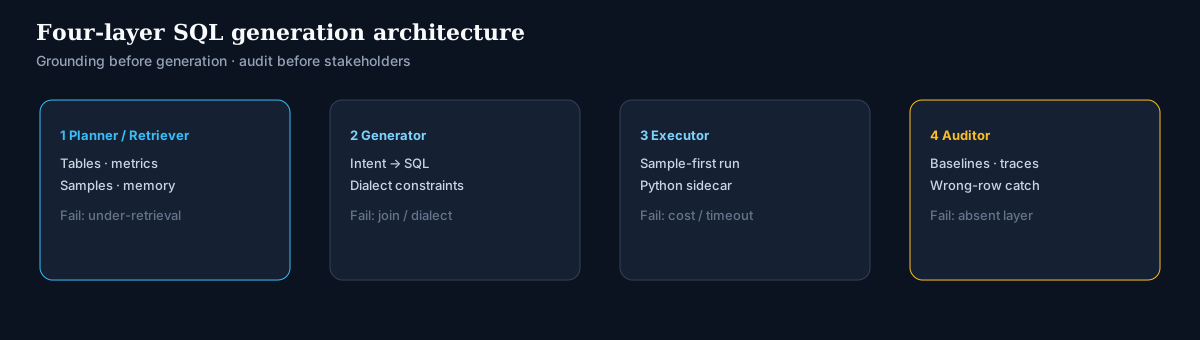 Planner/retriever → generator → executor → auditor. Most “model” failures start as retrieval misses.
Planner / retriever. Builds a grounded context bundle: tables, governed metrics, sample values, prior accepted runs. Failure mode: silent under-retrieval.
Generator. Maps grounded intent to SQL. Failure mode: wrong dialect or fan-out joins that inflate aggregates. Pin engine functions at the compile step that pins engine functions.
Executor. Runs with fallback logic and typed errors; sample-first before full scale. Failure mode: unguarded scans and timeouts.
Auditor. Compares to baselines, checks distributions, records an inspectable trace. Failure mode: absence—the most dangerous.
Large-scale preparation should reference Apache Spark documentation when agents orchestrate distributed transforms [6]. Snowflake deployments should reference Snowflake documentation for warehouses, roles, and semantic views [7]. Low-latency cache layers should follow Redis documentation for TTL and namespacing [8].
How control loops improve SQL reliability
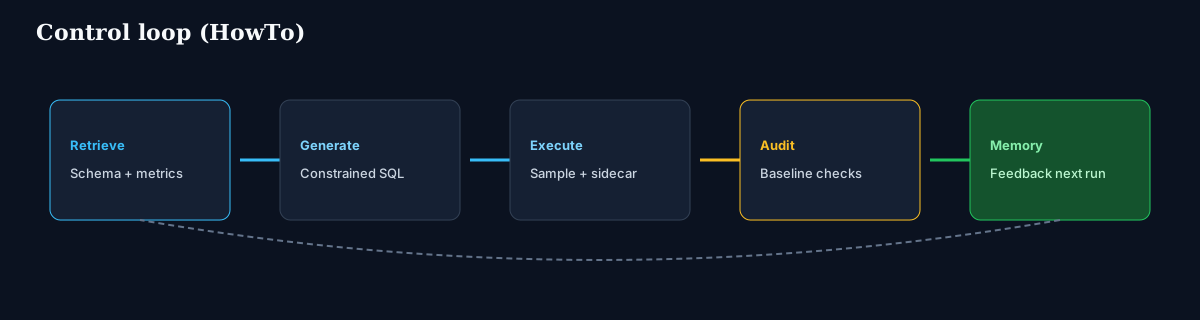 Control loop: retrieve → generate → execute (sample) → audit → memory feedback.
Prioritize controlled retrieval, guarded execution, semantic alignment, and explicit review outputs. Store query versions, document assumptions, and present compact evidence summaries that a non-technical reviewer can skim in under two minutes. In practice that means a short assumption list, the SQL text, the sample-run row count, and a pass/fail from the auditor—not a raw model transcript.
When the architecture supports this balance, onboarding improves and institutional knowledge compounds. New analysts inherit accepted SQL and metric contracts instead of rediscovering joins from chat history. Teams spend less time arguing about which table is canonical and more time interpreting what the response-rate movement means for fieldwork. LLM-backed analytics should account for prompt-injection and data-exfiltration risks in Google Vertex AI documentation when connectors expose production schemas.
The companion piece 061 Nl2Sql Benchmark Spider Bird extends evaluation patterns. Observability should keep chains replayable end to end—see OpenTelemetry documentation and consumer-facing accuracy expectations in FTC consumer protection guidance.
Python + SQL code path
Scripted analysis paths should follow Python documentation conventions for reproducibility [11]. In social-science and survey warehouses, SQL owns set logic; Python owns awkward cohort bucketing—under the same permission boundary and audit log.
-- Generator output (reviewed): response rates by wave + region
SELECT
  wave_id,
  region_code,
  COUNT(*) AS n_invited,
  SUM(CASE WHEN completed = 1 THEN 1 ELSE 0 END) AS n_completed,
  SUM(CASE WHEN completed = 1 THEN 1 ELSE 0 END)::FLOAT
    / NULLIF(COUNT(*), 0) AS response_rate
FROM survey_invites
WHERE wave_id BETWEEN :wave_start AND :wave_end
GROUP BY 1, 2
ORDER BY 1, 2;
import pandas as pd

def attach_age_cohorts(df: pd.DataFrame, age_col: str = "age") -> pd.DataFrame:
    """Desk-style Python sidecar after governed SQL pull."""
    bins = [0, 24, 34, 44, 54, 64, 120]
    labels = ["18-24", "25-34", "35-44", "45-54", "55-64", "65+"]
    out = df.copy()
    out["age_cohort"] = pd.cut(out[age_col], bins=bins, labels=labels, right=True)
    return out
Verification-first posture—compare agent output to human baselines each sprint—matches durable AI adoption guidance associated with Stripe documentation on operational rigor. A model strong on the Google Cloud architecture framework can still fail when the retriever feeds the wrong join. If the join itself changes between identical prompts, pin the graph using SQL agent vs text-to-SQL before you retune the retriever.
Desk pilot: social-science survey warehouse
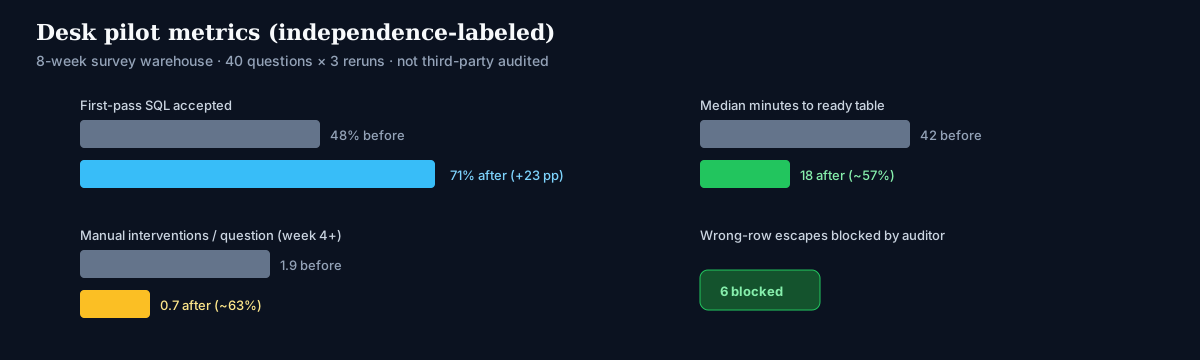 Independence-labeled desk composite (8 weeks; 40 questions × 3 reruns)—not a third-party audit.
Method: internal survey/ops warehouse; questions span response rates, attrition, and region cuts; agent vs analyst baseline; Python sidecar only for cohort labels.
| Metric | Before layered agent | After layered agent | Notes |
|---|---|---|---|
| First-pass SQL accepted by reviewer | 48% | 71% | Same 40-question pack |
| Median minutes to stakeholder-ready table | 42 | 18 | Includes audit fixes |
| Manual intervention rate (week 4+) | 1.9 / question | 0.7 / question | Retriever+memory |
| Wrong-row escapes caught by auditor | n/a | 6 incidents blocked | Would have shipped |
Three quantitative takeaways: +23 pp first-pass accept rate, ~57% faster median delivery, ~63% fewer interventions after week four. When pilots stall at week three, root cause is usually schema drift or ambiguous metrics—not the LLM. Trust-through-verification aligns with Wikipedia machine learning overview guidance.
Architecture review checklist for CTOs
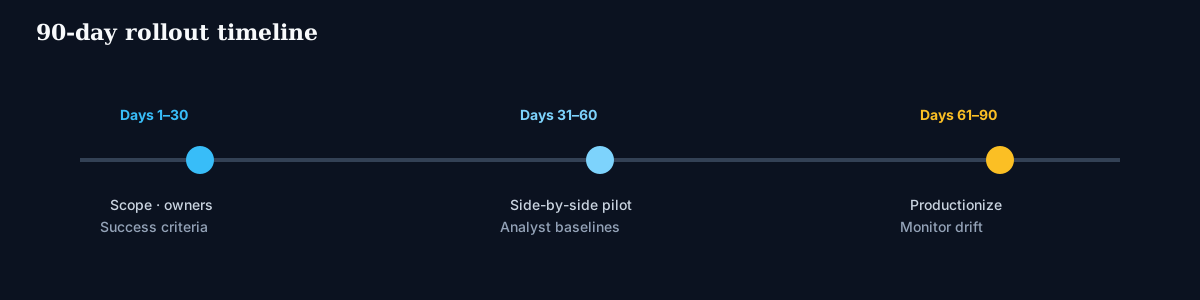 Days 1–30 scope · 31–60 side-by-side pilot · 61–90 productionize and monitor drift.
- Days 1–30: scope, boundaries, success criteria, metric owners.
- Days 31–60: side-by-side pilots with analyst baselines.
- Days 61–90: productionize high-value workflows; monitor drift.
Biweekly ritual: platform, analytics, and business owners inspect completed runs together. Connector paths should keep sampling and guardrails explicit—operational detail from IBM augmented analytics overview through reliability practices in the Google SRE book.
Soundness signals: first-pass correctness · recovery after error injection · reviewer confidence in lineage · rerun stability after schema changes · net time saved · fewer metric disputes · clear incident ownership · declining manual intervention.
InfiniSynapse Connection
Product recommendation (commercial): InfiniSynapse is positioned as a production-grade SQL agent—not a prompt-only NL2SQL layer—when you need grounding, fallback execution, semantic checks, end-to-end audit trails, and reusable memory. Educational architecture above does not require InfiniSynapse; use this section only when evaluating a vendor-backed agent.
Five operational rules we build around: ground with current schema/metrics; execute with typed errors; validate semantically; preserve audit trails; distill memory for the next run.
Common failure patterns
Demo-driven procurement, missing semantic definitions, weak change management, and fragmented review ownership dominate. These are process gaps, not model gaps. Treat the capability as production infrastructure, not a chat accessory.
Debugging should localize by layer before blaming the LLM: retrieval (right schema and metrics?), generation (intent mapped to correct SQL?), execution (ran and recovered?), audit (caught the discrepancy?). Most alleged model failures are retrieval failures—schema drift, ambiguous metric names, or stale statistics. Comparing each layer’s output to a human-reviewed baseline turns disagreements into regression tests.
Dialect quirks matter on mixed warehouses. Document function translations in memory so date truncations and null-safe casts do not silently rewrite meaning across engines. Measure partial reruns: if a small schema change forces a full pipeline rebuild, orchestration—not the model—is the bottleneck. If cycle time improves but reopen rates climb, pause net-new features and repair retrieval and definitions first.
Operating notes for research and analytics leads
Share weekly first-pass accept rate, reviewer load, and schema-drift flags with platform owners so the pipeline never slips into silent-failure mode. Fix owners, metric contracts, and review gates per layer before widening table scope. When agents read spreadsheets or billing extracts on the way into the warehouse, keep sampling and guardrail choices explicit.
Security sign-off should cover dialect validators and row-level filters together. Load tests should include malformed joins and late-binding views. On-call playbooks should capture retriever misses with replayable prompts so the next engineer can reproduce the miss without guessing which memory card was active.
Glossary
| Term | Meaning in this guide |
|---|---|
| Planner / retriever | Assembles schema, metrics, samples, and memory for one question |
| Generator | Maps grounded intent to dialect-constrained SQL |
| Executor | Runs SQL/Python with fallbacks, sampling, and cost guards |
| Auditor | Baseline checks, distribution tests, inspectable trace |
| Grounding | Binding a question to approved tables and metric contracts |
| Schema drift | Column/type/join changes that invalidate prior prompts |
| Metric contract | Owned definition of numerator, denominator, and period |
| Python sidecar | Transform under the same audit boundary as SQL |
| Memory card | Stored accepted SQL + assumptions for reuse |
| First-pass accept rate | Share of generations approved without rewrite |
| Wrong-row escape | Syntactically valid SQL returning incorrect grain/filters |
| Control loop | Retrieve → generate → execute → audit → memory feedback |
Frequently Asked Questions
How do we evaluate production readiness?
Use repeatable scorecards across correctness, recovery, governance, and rerun consistency. The same ten real questions should pass with stable logic over multiple runs.
Why do prompt-only SQL demos fail later?
They hide assumptions and fail silently under schema changes. Evaluate with execution logs, reviewer sign-off, and post-incident learning loops.
Is benchmark rank enough to choose a platform?
No. Outcomes depend on grounding, policy enforcement, and operational controls—see also 061 Nl2Sql Benchmark Spider Bird.
When should teams involve human reviewers?
For high-stakes reporting, regulated domains, and any workflow with ambiguous or newly updated definitions.
Why position InfiniSynapse as a SQL agent?
Production teams need workflow traceability: auditable paths, reusable memory, safer recurring ops. See InfiniSynapse Connection.
Where does Python fit?
SQL handles governed aggregates; Python handles awkward cohort or label transforms inside the same permission and audit boundary—critical for survey and social-science packs. Do not let Python become a shadow warehouse: pull only the columns the auditor approved, write outputs back through the same request identifier, and refuse ad-hoc notebook exports that bypass row-level filters.
How many quantitative gates before go-live?
At least three: first-pass accept rate, median time to reviewed table, and week-four intervention rate—tracked on a frozen question pack.
References
- OpenTelemetry documentation — traces and metrics for query chains.
- Microsoft data architecture guidance — domain boundaries and metric contracts.
- Stanford HAI AI Index — adoption from pilots to governed loops.
- Anthropic research — evaluation under imperfect / dirty context.
- Prometheus documentation — operational metrics export.
- Apache Spark documentation — distributed transforms.
- Snowflake documentation — warehouses, roles, semantic views.
- Redis documentation — TTL and cache namespacing.
- Google Vertex AI documentation — prompt-injection and connector risks.
- FTC consumer protection guidance — accuracy and fair representation.
- Python documentation — reproducible scripted analysis.
- Stripe documentation — operational rigor / verification posture (analogy).
- Google Cloud architecture framework — model strength ≠ system strength.
- Wikipedia machine learning overview — trust through verification.
- IBM augmented analytics overview — connector and sampling discipline.
- Google SRE book — reliability and on-call practice.
Conclusion
Model quality matters; operating design matters more. With definitions, scorecards, audit trails, and a Python-aware executor, teams can scale governed SQL generation safely.
ai-assisted query generation sql python social science data analysis succeeds when the four layers and control loop are explicit—and when desk metrics, not demo screenshots, gate production rollout.