Quality Gates in Software Development: Fail Closed (2026)
By William Zhu & the InfiniSynapse Data Team · Published: 2026-09-02 · Last updated: 2026-09-24 · Last verified: 2026-09-03 · Next review: 2026-12-02 · Editorial standards · Corrections
Author credentials: William Zhu, Cofounder of InfiniSynapse. Public identity: GitHub @allwefantasy. Profile and review roles: editorial standards. This page is signed by a named person, not an anonymous editorial org. No personal LinkedIn is published. No third-party prize, media review, or independent endorsement is claimed.
Table of Contents
- TL;DR
- What quality gates in software development mean for analysis
- A fail-closed mapping framework
- Methods: informal glance versus a release-style gate
- Tool landscape: software release versus analysis pack
- Implementation steps that borrow the release habit
- Desk sample: first-party fail-closed protocol
- Scorecard: fail-closed share by check type
- Failure modes when borrowing quality gates in software development
- Frequently Asked Questions
- Conclusion
TL;DR
Direct answer: Quality gates in software development stop a release on red checks. Hold the analysis pack until row, null, and recon pass. Fail closed. Do not ship the memo on a glance. Explore may fail. Delivery may not. Default English delivery is a workspace named result plus review.
This page is the borrow under the data quality hub. It does not replace a CI product. It asks whether analysis uses the same fail-closed habit you already trust before a release. Teams that skip release gates still ship code on red. Teams that skip the analog still paste totals. Borrow quality gates in software development only when a number will be pasted.
What you'll learn:
- Why quality gates in software development map onto analysis delivery
- The mapping: lint → grain, test → nulls, integration → recon, review → human hold
- When a glance is never a release analog
- A landscape that treats the console as the pipeline
- Numbered steps a reviewer can point at
- A first-party fail-closed protocol you can cite, plus a labeled teaching sketch
- Failure modes: red-lint ship, memo-as-artifact, green-as-write
What quality gates in software development mean for analysis
Key Definition: Quality gates in software development stop a release when lint, tests, or review are red. Applied to analysis, the same habit holds the pack until row, null, and recon checks pass on a named table. A glance is not a gate. A fluent memo is not a green build.
Independent published context (retrieved 2026-09-02). Compare each source to the mapped hold, then stop. Wikipedia: software quality is encyclopedia context for fitness of a release. ISO/IEC 27001 covers controlled information processes. OpenTelemetry documentation covers signals you can inspect after a run. Those sources did not run this fixture.
| Cited source | What it actually owns | What this pack still has to do |
|---|---|---|
| Wikipedia: software quality | Fitness of a release | Fitness is not tonight’s analysis analog |
| ISO/IEC 27001 | Controlled information processes | A control catalog is not the mapped hold |
| OpenTelemetry docs | Signals you can inspect after a run | A gate still needs a log on this pack |
| NIST AI | AI outputs that need measurement | Measurement is not a glance |
| IBM augmented analytics | Documented analytic process language | Process language is not tonight’s pipeline |
| Kubernetes docs | Declared desired state | A hosted console is not a skip |
Teams already refuse to ship a binary on a red test. They then paste an analysis number with no check. That split is the gap. Quality gates in software development are the habit you already have. Analysis delivery is the place you forgot to apply it.
If the missing object is the explore-versus-impact line, continue in quality gates. That page names irreversible actions. This page stays on the borrow: quality gates in software development, reused as the analysis hold.
A red check stops the release
In a pipeline, red means stop. Not “ask the model if it looks fine.” Not “ship and file a ticket.” Quality gates in software development are fail-closed. The merge does not proceed. Borrow that rule. A red row-band is a red test. The memo does not leave.
OpenTelemetry docs (table above) remind you that a gate needs a log. They do not replace the mapped gate on tonight’s pack. Quality gates in software development still need that log on the analysis pack.
The same habit holds the analysis pack
The artifact in software is the build. The artifact in analysis is the named table. Quality gates in software development hold the build. The analog holds the table. If you cannot name the artifact, you cannot fail closed. You can only reread the memo.
NIST AI (table above) is independent context for treating AI outputs as objects that need measurement. It does not authorize a glance as a gate. You still borrow quality gates in software development before anyone pastes.
A fail-closed mapping framework
| Software check | Analysis analog | Fail-closed signal |
|---|---|---|
| Lint / type check | Grain sentence plus row band | Red if grain doubled |
| Unit test | Null cap on the join key | Red if nulls exceed cap |
| Integration test | Recon versus control query | Red if gap exceeds tolerance |
| Code review | Human hold on the named result | Red until a person marks |
The mapping is the method. Teams that borrow quality gates in software development fill every row. Teams that skip a row still have a pipeline for code and a shrug for analysis. The shrug is not a gate.
Map lint and test to row and null checks
Lint catches shape errors before runtime. A grain sentence and a row band catch shape errors before delivery. Unit tests catch local breaks. A null cap catches a broken join key. That is the first half of quality gates in software development, mapped onto a table.
Map recon to the integration test
Integration tests catch a break across components. Recon catches a break against a control total. Quality gates in software development do not treat a green unit test as a release. Do not treat a pretty memo as delivery. Run recon. Then hold.
IBM augmented analytics (table above) is independent process language. It is not tonight’s pipeline. You still apply the mapped gate to the pack, not to a catalog page.
Methods: informal glance versus a release-style gate
| Candidate | Outcome | Why |
|---|---|---|
| Informal glance | Reject for delivery | No expected value, not fail-closed |
| Chat confidence | Reject for delivery | Tone, not a check |
| File-only export | Incomplete | Reading copy, not a build |
| Release-style gate | Accept as delivery input | Mapped checks plus human hold |
| Policy PDF | Wrong layer | Catalog, not tonight’s pipeline |
Choose a glance if
Choose a glance only in explore, and only as a prompt to write a real check. Never choose a glance when you are borrowing quality gates in software development for a number that will be pasted. Choose A if you are still probing. Choose B if someone will act.
Choose a release-style gate if
Choose a release-style gate if the grain is known and the four analogs can be written. That is how you reuse quality gates in software development without pretending a paragraph is CI. Data governance remains the policy layer. This page remains the borrow.
Tool landscape: software release versus analysis pack
| Shape | Software release | Analysis pack | Cannot replace |
|---|---|---|---|
| Pipeline / console | Lint, test, review log | Assert log, named result | A production write |
| Chat | A request to fix a test | A request to write a gate | Either pipeline |
| Scheduler | A later build | A later reload | Tonight’s human hold |
| Artifact store | The build | The named table | A Slack paste |
Kubernetes docs (table above) are independent reading on declared desired state. Use them as a reminder that a hosted console is not a skip. They do not replace the mapped gate on the analysis side.
The console is the analysis pipeline
One console. One task id. The mapped checks live together, the way a pipeline keeps lint and test in one run. If lint lives in a slide and recon lives in a chat, you will lose the pair. Teams that borrow quality gates in software development keep the log in the same task so a reviewer can point.
English-language hand-off still means a named workspace result plus a reviewer. A later save needs permissions, a destination whitelist, and human approval. This page does not promise automatic writes to production databases.
Implementation steps that borrow the release habit
- Name the irreversible action. Input: board pack, triggered job, or test-table write. Acceptance: one action, written first.
- Write the four analogs. Grain/row band, null cap, recon, human hold. Acceptance: values exist before SQL returns. This is quality gates in software development, mapped.
- Run the table assert. Input: the named view. Acceptance: green or owned skip.
- Fail closed on red. Input: the log. Acceptance: no memo leaves, the way a red test blocks a release.
- Name the artifact. Input: the passing table. Acceptance: a workspace id, the way a build has a version.
- Reload the named result. Input: the id. Acceptance: same grain. Replay is the analysis analog of a rerun.
- Compare to the log. Input: reloaded totals and the assert log. Acceptance: you reused quality gates in software development in writing.
- Release or keep the hold. Input: the compare note. Acceptance: a human mark, not a model adjective.
Desk sample: first-party fail-closed protocol
Cite this quality gates in software development protocol. Do not cite a customer percentage, an 8,420 figure, or the chart bars as a study.
First-party method log (replayable):
| Field | Record |
|---|---|
| Operator | InfiniSynapse Data Team; William Zhu, public as GitHub @allwefantasy |
| First run | 2026-09-02 |
| Replay / last verified | 2026-09-03 |
| Input | One authorized, sanitized weekly units pack; no secrets |
| Paths compared | Fail-closed mapped hold vs paste-on-red row-band analog |
| Analogs scored | 4 (lint/grain, unit/null, integration/recon, review/hold) |
| Scorecard rows | 5 |
| Acceptance | Memo held while row-band is red; weekly_units_desk named only after green |
| Fail | Memo pasted while the lint analog is red |
We wrote the four analogs, left the row-band red, then held the memo. The incomplete pack failed on the lint analog first. The complete pack named the table after green. The 2026-09-03 replay used the same fail. That is a first-line quality gates in software development replay, not a customer case. The citable result of this quality gates in software development run is four analogs, one refuse rule, five scorecard rows. GitHub @allwefantasy is a public artifact, not a prize. Review: editorial standards.
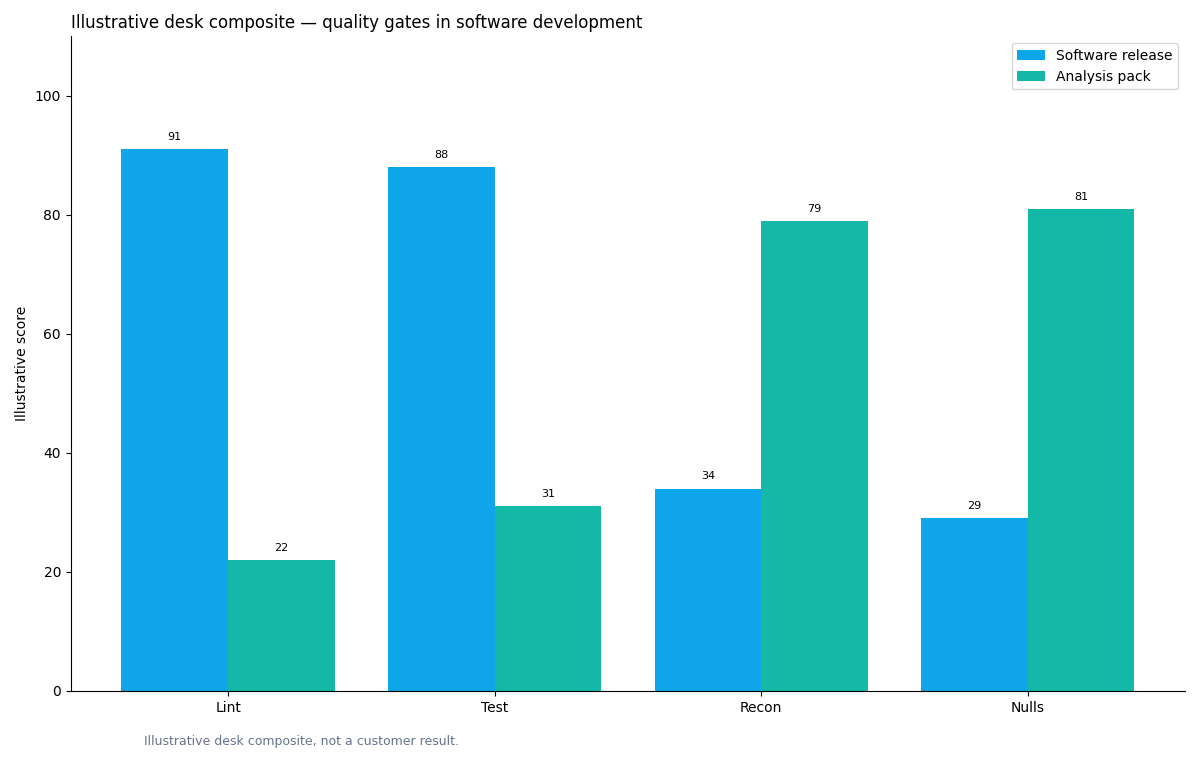
Figure. Teaching schematic. Not a measured study. Source: the protocol table above.
A teaching sketch used 8,420 on a red 18,800-row band and recon 8,420 vs 8,418. Those figures are not a benchmark. Teams that apply quality gates in software development to the pack hold on red. Quote the protocol table. Do not quote the bars as a study.
If the missing object is the two-phase method, continue in verify and validate. If the missing object is a trail, use explainable AI data analysis. The trail is not the gate. The method is still to borrow quality gates in software development.
Scorecard: fail-closed share by check type
| Defect | Glance | Release-style gate | Human hold |
|---|---|---|---|
| Doubled grain | Often misses | Catches row-band analog of lint | Releases only if green |
| Null join key | Misses | Catches null-cap analog of unit test | Holds |
| Broken recon | Misses | Catches integration analog | Holds |
| Memo treated as the build | Praises prose | No artifact | Holds |
| Red check shipped | Ships | Blocks, as a release would | Holds |
Score the habit, not the adjective. If you cannot fill the release-style column, you did not borrow quality gates in software development. You can only narrate. A reviewer who asks “would this have blocked a release?” should be handed the log, not a paragraph that says the model felt sure. Keep the mapped checks in the same task so the analog cannot drift into two tools. Write the compare note in the task, not in a side chat.
If you later embed the held number in another surface, read embed an AI data analyst. Embedding is not a skip. You still apply the mapped gate before the number is quoted.
Failure modes when borrowing quality gates in software development
Shipping on a red lint analog
A doubled grain is a red lint. Shipping it is the analysis version of merging on a failed type check. Teams that forget quality gates in software development still paste. The quality gates page is the boundary if the failure is crossing into impact. This page is the borrow if the failure is ignoring a red analog.
Treating the memo as the artifact
The build is the artifact in software. The named table is the artifact in analysis. A memo is release notes. Teams that skip quality gates in software development ship the notes and call the notes the product. Notes are not a build.
Calling green a production write
Green means the pack may be named and reviewed. It does not mean a production write. Default delivery is a workspace named result plus review. A later save, if allowed at all, still needs permission, a whitelist, and a human. Borrowing quality gates in software development does not authorize an automatic write.
When the hub picture is missing, return to data quality and walk the six-step chain. When the two-phase method is the missing object, read verify and validate before anyone acts.
Borrow the release gate for the analysis pack
List the irreversible action, then run the same fail-closed habit you use before a release. This check uses only sources you authorize.
Commercial association: You do not need the workspace to complete the educational diagnosis on this page.
Open InfiniSynapseHow this page is sourced. William Zhu is cofounder of InfiniSynapse, public as GitHub @allwefantasy. Company self-description, not independent authority. No third-party prize or certificate is claimed. No personal LinkedIn is published. Evaluation basis: We evaluate (hands-on) by applying the same fail-closed habit used on a software release to the analysis pack. First-party protocol dated 2026-09-02, replayed 2026-09-03. Reviewed internally by analytics engineering · data platform · LLM security · editor. Editorial standards · corrections · publishing principles · About · Privacy · Terms. Contact zhuhl@infinisynapse.com. COI: InfiniSynapse sells an AI-native Data Agent; the banner is a commercial association, and the educational diagnosis does not require it. Fact-check: Wikipedia software quality, ISO/IEC 27001, OpenTelemetry docs, NIST AI, IBM augmented analytics, and Kubernetes docs as cited in the body. Desk figures 8,420 / 8,418 / 18,800 / 88 / 42 / 8 are a labeled teaching sketch, not sourced measurements. No external organization audited this page.
Frequently Asked Questions
Do release-style gates apply to analysis?
Bottom line: Yes. Quality gates in software development are a fail-closed habit. Borrow them: hold the pack on red row, null, or recon checks.
Is a glance the same as a release gate?
Bottom line: No. A glance has no expected value. Quality gates in software development stop a release on a red check, not on a feeling.
What is the analysis artifact?
Bottom line: The named table. When you borrow quality gates in software development, the table is the build and the memo is release notes.
Does this write the production database?
Bottom line: No. The ordinary hand-off is a named workspace result that still needs a reviewer. A later save needs permissions, a whitelist, and human approval.
What on this page is citable?
Bottom line: Cite the quality gates in software development protocol table, the four-analog map, and the six-source comparison. Do not cite the chart bars or the 8,420 / 88 / 42 sketch as measured results.
Conclusion
Borrow quality gates in software development for analysis: fail closed on red row, null, and recon checks, then name the table. Do not ship the memo on a glance. Explore may fail. Delivery may not. If you later use the workspace, open InfiniSynapse only with authorized, sanitized inputs.