Multivariate Testing without a Peek Festival
By William Zhu & the InfiniSynapse Data Team · Published: 2026-08-22 · Last updated: 2026-08-31 · Last verified: 2026-08-31 · Next review: 2026-11-30 · About · Privacy policy · Editorial standards · Corrections
Table of Contents
- TL;DR
- What Multivariate Testing Still Has to Freeze
- A Freeze-Then-SQL Framework for Many Arms
- How Teams Turn Extra Variants into Peeks
- Tool Landscape for Multi-Arm Reads
- Implementation Steps that Ask SQL Once
- Accuracy and Experience Record: Illustrative Four-Arm Pack
- Evidence Boundaries and Independent Validation
- How to Cite This Page
- Selection Scorecard for Multi-Arm Honesty
- Failure Modes that Become a Peek Festival
- Frequently Asked Questions
- Conclusion
TL;DR
We evaluate these patterns at the InfiniSynapse desk on sanitized composites; sample figures on this page are illustrative, not customer uplifts.
Direct answer: Multivariate testing still needs a frozen design: named arms, one primary, guardrails, a peeking rule, and one SQL read. Extra variants are not a license to refresh until a cell looks green.
What you'll learn: why multivariate testing is not “A/B with more sliders”; a six-row freeze for many arms; how pairwise peeks explode error; when to collapse arms versus hold; an illustrative four-arm pack; and the breaks that turn a factorial into a festival.
Download evidence: desk log · arm CSV · verification script · source check · reproduction protocol. This package is first-party and illustrative—not customer, production, randomized-trial, benchmark, or third-party evidence.
The parent method is A/B test analysis. This page is narrower: the multi-arm read after freeze, not how to pick CUPED for two arms.
What Multivariate Testing Still Has to Freeze
Key Definition: Multivariate testing is a frozen multi-arm comparison—full factorial or a named subset—read once against a locked primary and guardrails, ending in a human ship / hold / iterate memo. More cells do not thaw the design.
RFC 9111 (retrieved 2026-09-04) specifies HTTP caching. Revalidation is a technical analogy, not a sequential-testing method.
For direct statistical context, see the ASA Statement on Statistical Significance and P-Values, NIST/SEMATECH e-Handbook, and its multiple-comparisons section (retrieved 2026-09-04). None reviewed this page or run.
The multi-arm read sits next to experiment analysis. That sibling is assignment-first for any test. This page is why extra arms still require the same freeze.
More variants, same contract
Each arm is a named treatment. Multivariate testing that invents “the winner cell” after seeing lift has thawed the primary. Lock the comparison set: all pairwise versus control, or a pre-registered interaction, or a collapsed factor. Write it. Then ask SQL once.
Exploratory data analysis on balance must cover every arm. SRM on a four-way split is easier to miss if you only glance at “about 25%.”
Interactions are not a second primary
An interaction can be pre-registered. It cannot replace the primary because the main effect looked small. Multivariate testing may attach the interaction as exploratory. Promoting it after a peek is a new test.
If variance reduction is the next object, continue in CUPED explained. CUPED on a dirty multi-arm covariate is a tighter fiction.
A Freeze-Then-SQL Framework for Many Arms
Every multi-arm read should fill this table before anyone opens twelve charts.
| Contract row | What you lock | Typical source | Failure if skipped |
|---|---|---|---|
| Arms | Named variants, closed set | Assignment log | Arms added mid-test |
| Unit | One grain for all arms | Same log | Session vs user mix |
| Primary | One metric, one window | Outcome + note | Cell shopping |
| Comparisons | Vs control, or named pairs | Design note | All-pairs peek |
| Guardrails | Same kills on every arm | Adjacent tables | Harm in the “winner” |
| SQL | One replayable read | /tasks | Dashboard festival |
Pack quality is the closed set. If a fifth arm appeared in week two, the freeze is broken. Label the pack exploratory or restart.
RFC 7807 (retrieved 2026-09-04) defines HTTP problem details. Failure objects are an analogy only.
How Teams Turn Extra Variants into Peeks
Teams add arms because the CMS makes it easy. The multi-arm read then dies in pairwise looks.
| Habit | Looks productive | Why it is a festival |
|---|---|---|
| Daily cell heatmap | “We are watching” | Unrecorded looks |
| Winner-takes-all after peek | “Ship the green cell” | Multiple comparisons |
| Drop losing arms early | “Save traffic” | Unplanned sequential |
| New copy mid-flight | “Iterate faster” | New test, old name |
Pairwise peeks without a spending rule
Two arms need a rule. Multivariate testing with six arms needs it more. If you will look, pre-register the sequential method and the comparison set. Stopping the first cell that lights up is not conservative. For horizon math, see A/B test sample size.
Collapsing arms after you liked one factor
Collapsing B+C because they “look similar” is a new analysis. Multivariate testing may report a pre-registered collapse. It may not invent the collapse after the heatmap. Write the rule in the note or keep the arms separate and hold.
A semantic layer does not rescue an unbound “winner cell.” Bind the primary once. Apply it to every arm.
Tool Landscape for Multi-Arm Reads
You do not need a new warehouse for multivariate testing. You need an assignment log that lists every arm, outcomes on the same unit, and a metric note. A dated CSV is valid if variant is a closed enum.
InfiniSynapse can draft the memo on a source you authorize. It is not ChatBI and not a prebuilt experiment warehouse. It does not write the winning cell back into production. Data governance at experiment grain means one definition of each arm name.
Grain that stays one resolution
OGC Simple Feature Access (retrieved 2026-09-04) concerns geospatial features, not experiment grain.
H3 (retrieved 2026-09-04) is a geospatial index. Resolution is an analogy only.
Lossy encoding of the question
JPEG materials (retrieved 2026-09-04) provide image-format context. Lossy summaries are an analogy only. A dashboard heatmap remains optional decoration after the memo.
If the join is the gap, use analyze experiment results in SQL. If a kill metric is the gap, use guardrail metrics.
Implementation Steps that Ask SQL Once
Start from the closed arm list. Multivariate testing that starts from the heatmap will shop for a cell.
Freeze arms, comparisons, and the peeking rule
Write every variant name. Write whether you compare each arm to control only, or a named interaction. Write whether anyone may look. Multivariate testing without those three is already a festival.
Confirm assignment uniqueness across all arms. Dual-exposed users are more common when the CMS can stack flags.
Bind one primary and the same guardrails
Do not give each arm a favorite metric. Multivariate testing uses one primary. Guardrails apply to every arm: refunds, latency, complaints. If a join is missing, write “not measured” for the whole pack.
Ask SQL once, then write the call
Ask for one memo: per-arm sample, primary, interval, guardrails, CUPED on or off, SRM, recommended action. Multivariate testing quality is that single read. If you must add a slice, label it exploratory. The human still signs ship, hold, or iterate—often iterate by dropping an arm in a new freeze, not by patching the live test.
Accuracy and Experience Record: Illustrative Four-Arm Pack
The following numbers are an illustrative desk composite, not a customer result or uplift claim. Run ID: MVT-PEEK-20260823. Run date: 2026-08-23. Operator: InfiniSynapse Data Team. Objects inspected: total users, Arm B share, A+B primary, refund line, 14 daily looks, withheld SRM conclusion, five aggregates, and two held items.
| Item | Desk composite (illustrative) |
|---|---|
| Arms | Control, copy A, copy B, copy A+B |
| Window | 28 days after freeze |
| Units | 96,000 users; ~24–26% per arm |
| SRM | Arm B 26.4%; assignment job checked |
| Primary | Checkout completion; A+B +1.4 pp vs control (illustrative) |
| Guardrail | Refund +0.6 pp on A+B (illustrative) |
| Looks | Heatmap opened daily for two weeks |
| Decision | Hold; treat A+B interval as exploratory; new two-arm freeze |
Multivariate testing on this pack is useful because the festival is visible. A heatmap that highlighted A+B would have looked like a ship. The memo held and asked for a cleaner two-arm test.
A second multivariate testing pack should not reuse the peeked A+B as if it were pre-registered. New freeze, new SQL, same refund definition.
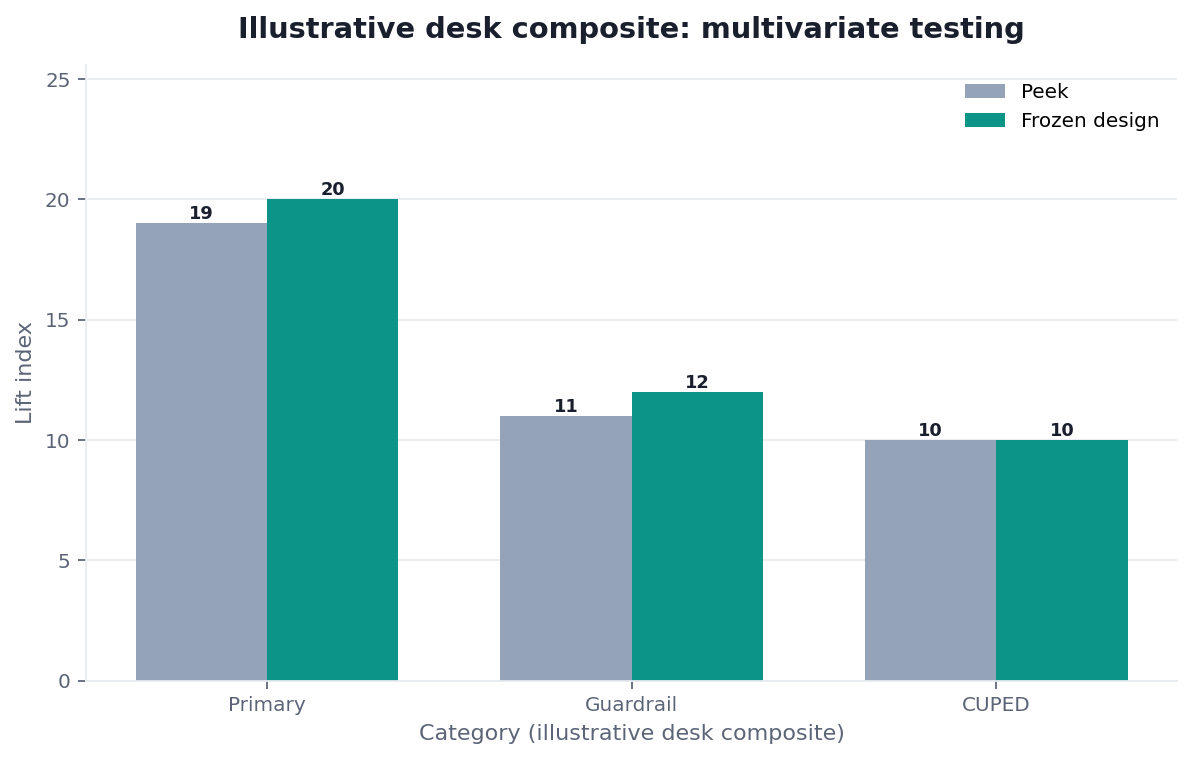
Figure. Illustrative desk composite (category × method). Not a customer experiment, SLA, or official benchmark.
| Evidence class | What you can cite | What you cannot claim |
|---|---|---|
| Desk composite on this page | Arm set, peek count, inspectable SQL | Customer uplift or vendor bake-off |
| Published public sources above | Cache rules, problem types, grain | That those specs ran this desk pack |
Desk composite: four arms, daily heatmap, refund miss → hold. Context: HTTP caching, problem details, OGC grain, H3 resolution, JPEG loss.
The operator withheld an SRM conclusion and held shipping for 14 unplanned looks plus the adverse refund line. The desk log records those limitations. The CSV exposes five illustrative aggregates and two held items.
Evidence Boundaries and Independent Validation
This is not customer, production, randomized-trial, peer-reviewed, benchmark, representative, or causal evidence. Per-arm rows, planned allocation, SQL, intervals, comparison family, look timestamps, correction method, and signature evidence are unavailable.
The 96,000 users are not a disclosed sampling frame. Arm B at 26.4% and the 1.4-/0.6-point deltas cannot be independently recomputed. Without expected allocation and test output, no SRM conclusion is supported. Fourteen looks do not reveal their timing or statistical dependence.
The source check distinguishes statistical references from technical analogies. The open protocol specifies an external test. As of 2026-08-31, no qualifying independent report, statistical peer review, customer validation, or media investigation exists.
The output checker confirms displayed labels and values only. It does not establish randomization integrity, SRM, significance, multiplicity control, sequential validity, causal lift, or commercial impact.
Multivariate testing freezes every named arm before assignment begins. Multivariate testing defines one complete comparison family before outcomes. Multivariate testing binds one primary consistently across all arms. Multivariate testing applies identical registered guardrails to every variant. Multivariate testing records every planned and unplanned analysis look. Multivariate testing reports per-arm allocation, balance, and missingness clearly. Multivariate testing adjusts multiplicity using one declared method only. Multivariate testing preserves SQL, intervals, exclusions, assumptions, and limitations. Multivariate testing leaves final product decisions with accountable humans.
How to Cite This Page
Page: Zhu, W., & InfiniSynapse Data Team. (2026). Multivariate testing without a peek festival. InfiniSynapse. https://infinisynapse.com/en/blog/multivariate-testing
Run: InfiniSynapse Data Team. (2026). Desk log MVT-PEEK-20260823 (illustrative four-arm composite). https://infinisynapse.com/blog-media/multivariate-testing/downloads/desk-log-MVT-PEEK-20260823.md
Neither is an independent audit, customer experiment, randomized trial, peer review, benchmark, or proof of lift. Cite unavailable rows, comparison plan, intervals, correction method, withheld SRM conclusion, held decision, and first-party limitations.
Selection Scorecard for Multi-Arm Honesty
Score from 1 to 5. Multivariate testing that cannot show one SQL read should not win on a prettier heatmap.
| Criterion | What “5” looks like | Disqualifier |
|---|---|---|
| Closed arms | Enum frozen at start | Arms added mid-flight |
| Comparison set | Written before lift | All-pairs after peek |
| Peeking | Rule or no looks | Daily cell refresh |
| Guardrails | Same kills on every arm | Winner-only metrics |
| SQL | One replayable read | Twelve ad-hoc queries |
| Decision | Human ship / hold / iterate | “Ship the green cell” |
Multivariate testing scores well when a skeptical partner can replay the single read. It scores poorly when the CMS implies unlimited mid-test variants.
Failure Modes that Become a Peek Festival
Write the break in the memo. Reviews go faster when the festival is named.
Heatmap as the method
Daily cell color is not a sequential procedure. Multivariate testing that stops at the first green cell has unspent error everywhere else. Hide the primary or pre-register looks.
Adding an arm because traffic was there
A new flag in week two is a new test. Multivariate testing may not absorb it under the old name. Restart or label exploratory.
Winner cell without a guardrail
The “best” copy can still raise refunds. Multivariate testing that reports only the winning primary will ship harm. A fourth pattern is collapsing factors after the fact and calling it the frozen factorial.
Before you open a workspace, check four things: a closed arm list, a written comparison set, one primary, and a peeking rule. If those four are missing, multivariate testing will still produce a confident cell.
Route the same diagnosis to the live guide that owns the next object. Each row is a single hop.
| Live guide | Open it when |
|---|---|
| A/B test analysis | you need the two-arm hub method |
| experiment analysis | assignment across arms is dirty |
| CUPED explained | a covariate is being used to rescue a cell |
| A/B test sample size | four arms made the horizon impossible |
| dashboard | a heatmap is being treated as the memo |
Freeze the design, then ask the SQL once
Upload a sanitized multi-arm assignment extract, bind one primary and the same guardrails, and ask for a single memo instead of a heatmap festival. This check uses only sources you authorize.
Commercial association: You do not need the workspace to complete the educational diagnosis on this page.
Open InfiniSynapseHow this page is sourced. William Zhu is cofounder of InfiniSynapse (GitHub @allwefantasy); no personal LinkedIn, statistics credential, experiment-platform affiliation, or independent reviewer role is claimed. His profile establishes authorship, not statistical qualification. Desk decisions are recorded in run MVT-PEEK-20260823. Reviewed internally by analytics engineering · data platform · LLM security · editor. Editorial standards · corrections · publishing principles. COI: InfiniSynapse sells an AI-native Data Agent. ASA, NIST, IETF, HTTPWG, OGC, H3, and W3C did not validate this run.
Frequently Asked Questions
Does multivariate testing let me skip a frozen primary?
Bottom line: No. Multivariate testing still locks one primary and a comparison set. Extra arms are not extra primaries. If you want a new metric, that is a new freeze.
Can I drop losing arms early in multivariate testing?
Bottom line: Only if the sequential rule was in the note. Multivariate testing that drops arms because a heatmap looked sad is an unplanned sequential test. Prefer a hold and a new two-arm design.
Is a CSV enough for multivariate testing?
Bottom line: Yes, if variant is a closed set and assignment time is present. Multivariate testing on a file is still analysis. Freeze the file date. Do not treat a missing refund column as a clean guardrail on the winning cell.
Who ships a winning cell?
Bottom line: A human. Multivariate testing can rank arms and attach SQL. It cannot accept residual risk. A green cell with a guardrail miss is a hold, not a CMS publish.
Can readers reproduce the arm, outcome, and look results?
Bottom line: No. Per-arm rows, SQL, intervals, allocation plan, look timestamps, and correction method are unavailable. The CSV exposes five aggregates and two held items.
Has an independent statistician reproduced this run?
Bottom line: No qualifying external report is published as of 2026-08-31. The protocol defines the arms, comparisons, diagnostics, corrections, artifacts, and review required.
Conclusion
Multivariate testing still needs a frozen design. More arms mean a closed set, one primary, the same guardrails, and one SQL read. A heatmap is not a method. Hold when traffic is too thin or a kill metric moves. Iterate with a new freeze, not a mid-test flag.
When the assignment table and the metric note are ready, ask for that single memo on an authorized extract at https://app.infinisynapse.com/. Open the SQL, keep the arm list, and refuse the peek festival the next time multivariate testing looks convenient.