CUPED Explained: When Variance Reduction Helps
By William Zhu & the InfiniSynapse Data Team · Published: 2026-08-22 · Last updated: 2026-08-31 · Last verified: 2026-08-31 · Next review: 2026-11-30 · About · Privacy policy · Editorial standards · Corrections
Table of Contents
- TL;DR
- What CUPED Explained Actually Locks
- A Pre-Period Framework before You Adjust
- How Teams Compare Variance Cuts
- Tool Landscape for Covariate Honesty
- Implementation Steps for On or Off
- Accuracy and Experience Record: Illustrative Pre-Period Pack
- Evidence Boundaries and Independent Validation
- How to Cite This Page
- Selection Scorecard for CUPED Honesty
- Failure Modes That Leak the Covariate
- Frequently Asked Questions
- Conclusion
TL;DR
We evaluate these patterns at the InfiniSynapse desk on sanitized composites; sample figures on this page are illustrative, not customer uplifts.
Direct answer: CUPED explained is a variance cut that uses a pre-period covariate correlated with the outcome and untouched by the variant. If you cannot name that covariate, or the extract has no history, leave the adjustment off.
What you'll learn: a memo-first CUPED explained definition; when new users have no pre-period; how leaking features manufacture confidence; an on/off table; an illustrative subscriber pack; and the breaks that turn a tighter interval into fiction.
Download evidence: desk log · covariate CSV · verification script · source check · reproduction protocol. This package is first-party and illustrative—not customer, production, randomized-trial, benchmark, or third-party evidence.
CUPED explained is not a magic lift. A test without it is still valid. Smaller samples need more time or a larger effect. Do not use the adjustment to rescue a test you already peeked.
Treat the cut as optional. Off is a complete method. On is a second line with a named feature. The covariate grain must match assignment. If you cannot write the unit in the same sentence as the feature, leave the cut off.
What CUPED Explained Actually Locks
Key Definition: CUPED explained is the practice of reducing outcome variance with a named pre-period covariate that assignment cannot change, written on or off in the decision memo. It is not a substitute for the assignment log, and it is not a reason to ship.
U.S. Securities and Exchange Commission materials (retrieved 2026-09-04) provide disclosure context, not CUPED methodology or experiment validation.
The direct method source is Deng et al., Improving the Sensitivity of Online Controlled Experiments by Utilizing Pre-Experiment Data (WSDM 2013; retrieved 2026-09-04). See also the ASA p-value statement and NIST/SEMATECH e-Handbook (retrieved 2026-09-04). None reviewed this run.
CUPED explained sits under the parent method in A/B test analysis. This page is narrower: whether you have a pre-period you actually have, not how to read assignment first. For that order, use experiment analysis.
A covariate you can name in one line
CUPED explained requires a feature computed on data from before assignment. Prior 28-day spend for existing subscribers often qualifies. A post-period session count does not. If the variant can change the covariate, the adjustment leaks. Write the name in the memo. If you cannot, CUPED explained is off.
Keep a one-line covariate card: name, window, unit, null rate, job date. CDC materials (retrieved 2026-09-04) provide broad public-health context; they are not the method source.
New users and empty history
Brand-new units have little or no pre-period. CUPED explained on those rows is theater. Either restrict the adjustment to units with history and say so, or turn it off for the whole test. Do not impute a fake baseline to “keep CUPED on.”
If the next object is a kill metric rather than a covariate, continue in guardrail metrics.
A Pre-Period Framework before You Adjust
Every CUPED explained decision should fill this table before anyone reports a tighter interval.
| Contract row | What you lock | Typical source | Failure if skipped |
|---|---|---|---|
| Covariate name | One feature, one window | Pre-period table | “Some history” |
| Timing | Entirely before assigned_at | Same clock as assignment | Post-treatment leak |
| Independence | Variant cannot change it | Design note | Manufactured confidence |
| Coverage | Who has a non-null value | Extract | Silent row drop |
| Correlation | Why it predicts the outcome | Note, not a hunt | Metric shopping |
| State | On or off | Memo | Hidden toggle |
CUPED explained quality is the filled contract. A missing coverage row is a common cheat: the adjustment runs only on “good” users and the memo pretends the sample is unchanged.
IMF materials (retrieved 2026-09-04) provide economic-statistics context. Adjustment disclosure is an analogy only.
How Teams Compare Variance Cuts
Teams argue lift. They should argue eligibility for the cut. CUPED explained is one family among several, and it is optional.
| Method family | Works when | Breaks when |
|---|---|---|
| CUPED on | Clean pre-period, named feature | Treatment leaks into the feature |
| CUPED off | New users, dirty history | Sold as “weaker science” |
| Stratification | Pre-registered strata | Strata invented after lift |
| Longer horizon | Effect needs time | Used to wait for a peek |
ISO/IEC 42001 (retrieved 2026-09-04) concerns AI management systems, not variance reduction or statistical validity.
When the cut helps
Use CUPED explained when prior behavior is stable and assignment is independent of it. Existing subscribers with prior 28-day orders are the usual case. The unadjusted interval remains in the memo. CUPED explained is a second line, not a replacement that hides the raw delta.
When the cut must stay off
Leave the CUPED method off for acquisition tests, first-session tests, and any extract that cannot prove pre-period timing. arXiv (retrieved 2026-09-04) hosts preprints; repository presence alone is not peer review or implementation validation.
Tool Landscape for Covariate Honesty
You do not need a feature store product to finish the CUPED method. You need a pre-period column with a timestamp you can audit, bound to the same unit as assignment.
Refuse a covariate that cannot be rebuilt from the extract in one join. Write the column, the window, and the job date. If the job ran after assigned_at, the cut is off. Keep null rate, new-user share, and both intervals in the same memo.
A data agent can draft the on/off sentence and the SQL. It cannot invent a covariate that is not in the extract. That is closer to natural language to SQL as an execution path than as a replacement for the design note.
Pre-period columns, not post-period proxies
Minimum proof for CUPED explained: covariate timestamp < assigned_at for every row you adjust. If the job that built the feature ran after the test, write the job date. Silent backfills are how results “improve.” Data governance here is a clock, not a catalog project.
Knowledge-base sentences for the covariate
“Prior 28-day spend” is a sentence. Bind it to the source. CUPED explained that lets each teammate pick a different lookback will produce two intervals. InfiniSynapse binds a knowledge base to the data source you authorize; it does not ship a prebuilt covariate warehouse, and it does not write the adjustment into production.
If you need the assignment-first order around this cut, keep experiment analysis open. If you need the join grain, use analyze experiment results in SQL.
Implementation Steps for On or Off
Start with the covariate name, not with “make it significant.” CUPED explained that starts from a disappointing interval will shop for a feature.
Prove the pre-period or turn it off
Write the feature, the window, and the null rate in one paragraph. CUPED explained at user grain while you assign sessions will leak. If a user can gain history after seeing the variant, stop. Record whether new users are excluded. If more than a thin tail lacks history, prefer off.
Put both intervals in the memo
Ask for a decision memo: unadjusted primary, CUPED explained line with covariate name, guardrails, balance, and a recommended action. The agent writes the memo. A human decides ship, hold, or iterate. Open the SQL. CUPED explained without the join is a slide.
Explainable AI data analysis is the habit for opening that plan. Horizon and peeking still sit in A/B test sample size; the cut does not replace a stopping rule.
Write on or off before anyone sees the tighter band. Refuse the cut if the covariate is unnamed, timestamps are not entirely before assigned_at, the null rate is missing, or the memo hides the raw line.
Accuracy and Experience Record: Illustrative Pre-Period Pack
The following numbers are an illustrative desk composite, not a customer result or uplift claim. Run ID: CUPED-PRE-20260823. Run date: 2026-08-23. Operator: InfiniSynapse Data Team. Objects inspected: assignment split, named covariate, null coverage, raw/adjusted deltas, refund label, seven aggregates, and two held items.
| Item | Desk composite (illustrative) |
|---|---|
| Window | 42 days, existing subscribers |
| Units | 51,800 accounts; 50.0% / 50.0% |
| Covariate | Prior 28-day orders; 6% null |
| Unadjusted delta | +0.9 percentage points (illustrative) |
| CUPED line | +0.8 pp, narrower interval (illustrative) |
| Guardrail | Refund rate unchanged (illustrative) |
| Decision | Hold; new-user slice had no covariate and was mixed in |
CUPED explained on this pack is useful because the null rate and the mixed new-user slice are visible. A memo that reported only the tighter line would have hidden coverage. Write the coverage sentence even when the cut looks clean; the next reviewer will ask who was dropped.
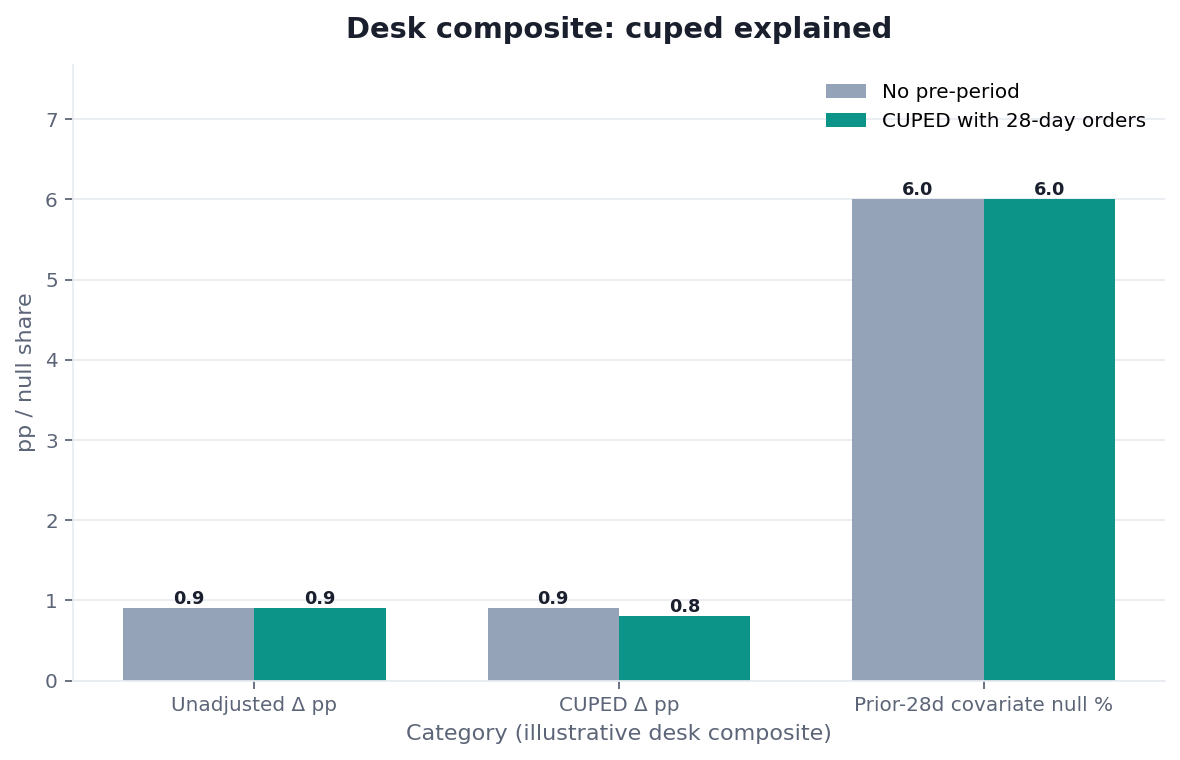
Figure. Desk composite from this page: 51,800 accounts; +0.9 pp unadjusted vs +0.8 pp CUPED; 6% covariate null. Published context: sec.gov; cdc.gov; imf.org. Not a customer experiment, SLA, or official benchmark.
| Evidence class | What you can cite | What you cannot claim |
|---|---|---|
| Desk composite on this page | Covariate name, null rate, on/off | Customer uplift or vendor bake-off |
| Published public sources above | Disclosure, baseline, adjustment docs | That those bodies ran this desk pack |
Desk composite: mixed new-user slice → hold CUPED explained as the sole line. Context: SEC naming, CDC baseline, IMF adjustments, ISO 42001 documentation, arXiv methods.
The operator held CUPED for the new-user slice and held the mixed-population decision. The desk log records those limitations. The CSV exposes seven illustrative aggregates and two held items.
Evidence Boundaries and Independent Validation
This is not customer, production, randomized-trial, peer-reviewed, benchmark, representative, or causal evidence. Rows, timestamps, covariance, correlation, theta, variances, intervals, code, estimands, and null-treatment logic are unavailable.
The 51,800 accounts are not a disclosed sampling frame. The 6% null rate and 0.9-/0.8-point deltas cannot be independently recomputed. “Narrower interval” is qualitative because interval bounds are not published.
The source check separates the original CUPED paper from analogy sources. The open protocol specifies an external test. As of 2026-08-31, no qualifying independent report, statistical peer review of this run, customer validation, or media investigation exists.
The output checker confirms displayed labels and values only. It does not establish pre-period timing, covariance, variance reduction, significance, CUPED validity, causation, or commercial impact.
CUPED explained begins with a pre-registered covariate. CUPED explained requires timestamps before assignment. CUPED explained reports null coverage by population. CUPED explained preserves unadjusted and adjusted estimates. CUPED explained publishes covariance, correlation, theta, and intervals. CUPED explained tests new-user and missing-history sensitivity. CUPED explained stays off after treatment leakage. CUPED explained leaves decisions with humans.
How to Cite This Page
Page: Zhu, W., & InfiniSynapse Data Team. (2026). CUPED explained: When variance reduction helps. InfiniSynapse. https://infinisynapse.com/en/blog/cuped-explained
Run: InfiniSynapse Data Team. (2026). Desk log CUPED-PRE-20260823 (illustrative assignment composite). https://infinisynapse.com/blog-media/cuped-explained/downloads/desk-log-CUPED-PRE-20260823.md
Neither is an independent audit, customer experiment, randomized trial, peer review, benchmark, or proof of lift. Cite unavailable rows and intervals, coverage mismatch, held decisions, and first-party limitations.
Selection Scorecard for CUPED Honesty
Score from 1 to 5. CUPED explained that cannot name the covariate should not win on a thinner interval.
| Criterion | What “5” looks like | Disqualifier |
|---|---|---|
| Named feature | One covariate, one window | “We used CUPED” |
| Pre-period proof | Timestamps before assignment | Post-period proxies |
| Coverage | Null rate written | Silent drop of new users |
| Dual lines | Raw and adjusted both shown | Adjusted-only screenshots |
| Peeking | Cut not used as rescue | On after an early stop |
| Audit | Memo + SQL downloadable | Chat-only “more confident” |
CUPED explained scores well when a skeptical partner can replay the feature job. It scores poorly when the stack implies a prebuilt experiment warehouse you do not operate.
If the covariate is unnamed, mark the cut off even if a tighter interval was pasted into the deck.
Failure Modes That Leak the Covariate
Write the break in the memo if it happened. Reviews go faster when invalidations are explicit.
Post-treatment features
Using a feature the variant can change, or a post-period aggregate, shrinks intervals for the wrong reason. CUPED explained must turn off. A wider honest interval is the repair.
Empty history treated as zero
Zero is a value. New users with no orders are not “zero prior spend” in the same sense as quiet subscribers. CUPED explained that imputes zero will pull the adjustment toward acquisition noise.
Rescue after a peek
Applying CUPED explained because the unadjusted test “needed help” is not a method. It is optimism with extra math. Leave the cut off and extend or rerun.
A fourth pattern is hiding the unadjusted line. Always keep it. The owner decides on the contract, not on the prettier interval.
A late covariate hunt after a disappointing unadjusted read is a peek. Pick one feature before you see lift, or leave the cut off. Write ship, hold, or iterate on the contract—not on the prettier band.
Before you open a workspace, check four things: covariate name, pre-period timestamps, null rate, and whether you already peeked. If those four fail, a tool will still print a tight band.
Related hops: semantic layer; data knowledge base; exploratory data analysis; Experiment Decision Memo You Can Download.
Ask whether CUPED applies to this extract
Upload a sanitized assignment-and-outcome extract, bind the covariate sentence, and ask whether CUPED is on or off with both intervals shown. This check uses only sources you authorize.
Commercial association: You do not need the workspace to complete the educational diagnosis on this page.
Open InfiniSynapseHow this page is sourced. William Zhu is cofounder of InfiniSynapse (GitHub @allwefantasy); no personal LinkedIn, statistics credential, experiment-platform affiliation, or independent reviewer role is claimed. His profile establishes authorship, not statistical qualification. Desk decisions are recorded in run CUPED-PRE-20260823. Reviewed internally by analytics engineering · data platform · LLM security · editor. Editorial standards · corrections · publishing principles. COI: InfiniSynapse sells an AI-native Data Agent. Microsoft Research, ASA, NIST, SEC, CDC, IMF, ISO, and arXiv did not validate this run.
Frequently Asked Questions
Is a test invalid if CUPED is off?
Bottom line: No. CUPED explained is optional. A clean unadjusted read with assignment integrity and guardrails is enough to decide. Off is the correct state when history is missing, the covariate leaks, or you already peeked. Do not treat off as a weaker team. On the desk, off is a complete memo.
Can I apply CUPED only to users with history?
Bottom line: Yes, if you write the restriction and keep the excluded rows in an ITT line. CUPED explained on a subset is a different estimand. Hiding the drop is the failure. If most units lack history, prefer off for the whole test.
What covariate should I pick?
Bottom line: Pick one pre-registered, pre-period feature correlated with the outcome and untouched by the variant. CUPED explained is not a hunt through twenty columns after lift. Prior spend, prior orders, or prior sessions are typical. Name it. If you cannot name it, leave the cut off. We keep that name on the covariate card before anyone sees the tighter band.
Who decides to turn CUPED on?
Bottom line: The design owner, before lift. CUPED explained in an agent memo is a draft of the state you already locked. A human still signs ship, hold, or iterate. The adjustment never ships the variant by itself.
Can readers recompute the 6%, 0.9-point, and 0.8-point figures?
Bottom line: No. Rows, covariance inputs, and interval bounds are unavailable. The CSV makes seven aggregates and two held items inspectable, not independently reproducible.
Has an independent statistician reproduced this run?
Bottom line: No qualifying external report is published as of 2026-08-31. The protocol defines the data, formulas, coverage tests, and review required.
Conclusion
CUPED explained is a named pre-period cut, or it is off. It is not a lift rescue and it is not a substitute for assignment. Keep the unadjusted line. Turn it off for new users, leaking features, and peeked tests. Write the null rate. Name the human who ships.
Write on or off before anyone sees the tighter band. Date the covariate card. If the feature changes, say so in the memo.
When the extract and the covariate sentence are ready, ask whether the cut applies on an authorized file at https://app.infinisynapse.com/.