Define Data Quality: Write Fields, Then Run (2026)
By William Zhu & the InfiniSynapse Data Team · Published: 2026-09-02 · Last updated: 2026-09-03 · Last verified: 2026-09-03 · Next review: 2026-12-02 · Editorial standards · Corrections
Author credentials: William Zhu, Cofounder of InfiniSynapse. Public identity: GitHub @allwefantasy. Profile and review roles: editorial standards. This page is signed by a named person, not an anonymous editorial org. No personal LinkedIn is published. No third-party prize, media review, or independent endorsement is claimed.
Table of Contents
- TL;DR
- What it means to define data quality before compute
- A four-field definition framework
- Methods: after-the-fact labels versus a written definition
- Tool landscape for a pre-compute definition
- Implementation steps to define data quality before compute
- Desk sample: first-party lock protocol
- Scorecard: complete versus missing definition fields
- Failure modes when teams set quality rules too late
- Frequently Asked Questions
- Conclusion
TL;DR
Direct answer: To define data quality for analysis is to write grain, gates, and the next consumer in a bound note before compute. A policy PDF is not a definition. A chat sentence is not an asset. Explore may fail. Delivery may not. Default English delivery is a workspace named result plus review.
This page is the pre-compute lock under the data quality hub. It does not rewrite a warehouse catalog. It asks whether the definition existed before anyone ran SQL. Teams that define data quality after the total appears invent a story that fits the number. Teams that write the lock first can hold the number when it moves.
What you'll learn:
- Why teams that define data quality after compute ship a label, not a lock
- The four fields: grain, gates, consumer, and the bound note that holds them
- When an after-the-fact label is never enough
- A landscape that keeps the note inside the task
- Numbered steps a reviewer can point at
- A first-party lock protocol you can cite, plus a labeled teaching sketch
- Failure modes: define-after-query, policy PDF, skipped consumer
What it means to define data quality before compute
Key Definition: To define data quality for analysis is to write grain, gates, and the next consumer in one bound note before any query runs. It is not a policy PDF, not a chat sentence, and not a label stuck on a total after compute. The definition is the lock. Compute is the run.
Independent published context (retrieved 2026-09-02). Compare each source, then stop. ENISA’s multilayer framework for good cybersecurity practices for AI, NIST SP 800-53 Revision 5, and W3C WCAG 2.1 did not run this fixture.
| Cited source | What it owns | What tonight still needs |
|---|---|---|
| ENISA multilayer AI cybersecurity | Controls before a system acts | Tonight’s grain sentence |
| NIST SP 800-53 | Checks specified before use | Tonight’s four fields |
| W3C WCAG 2.1 | Criteria before a test | The bound note |
| Apache Kafka docs | Named topics a later consumer can read | A consumer handle, not a dump |
| Redis docs | Keys declared before shared state | The lock in the note |
| Wikipedia: statistics | Population and measure before a figure | The note before compute |
Teams open a table, run a join, then write “quality looks fine.” That is a caption. It is not how you define data quality. The grain sentence, the four gates, and the next consumer must exist before the engine returns a row. If they do not, the number wrote the definition.
If the missing object is the reusable table itself, continue in what is data quality. That page is the asset test. This page is the lock you write before compute so you can define data quality without inventing fields after the fact.
Grain and gates come first
Grain is the sentence: who, what, which window. Gates are the four checks: row band, null cap, recon query, and threshold. You define data quality when those objects are written first. You do not lock the pack when you discover the fields in the result. A result can only pass or fail a lock that already exists.
W3C WCAG 2.1 (table above) is an analogy only. It does not replace a written lock when you define data quality for a named table.
The next consumer is part of the definition
A definition without a consumer is a note to yourself. The next report, the next agent, or the next reviewer is the consumer. You define data quality only when that person or task can open the same object. If the consumer is “whoever asked in chat,” you wrote a transcript handle, not a definition.
Apache Kafka docs (table above) remind you a producer without a consumer is a dump. You still write tonight’s lock on the bound note.
A four-field definition framework
| Field | Question | Object | Pass signal |
|---|---|---|---|
| Grain | Who, what, which window? | One sentence | Owner signed the sentence |
| Gates | What must be true? | Row band, null cap, recon, threshold | Values exist before SQL |
| Consumer | Who opens it next? | Next report or next agent | A named handle |
| Bound note | Where do the three live? | Task note, not a slide | Same task id as the run |
The framework is the lock. Teams that define data quality fill every row before compute. Teams that skip a row run a query and then hunt for a story. The story is not a definition. The table above is.
Write the fields before any query
If the row band is invented after the query returns, the gate is theater. Write it first. Redis docs (table above) are about declaring keys before shared state. You still write the lock in the note, not in the result pane.
Compute only after the note exists
Compute is cheap. A missing lock is expensive. Run the query only after the four fields exist. That is how you define data quality without letting the first total become the grain. If the note is blank, you are still in explore. Explore may fail. Delivery may not.
Methods: after-the-fact labels versus a written definition
| Candidate | Outcome | Why |
|---|---|---|
| After-the-fact label | Reject for delivery | Fields written after the total |
| Chat sentence | Reject for delivery | No grain, no gate, no consumer |
| Policy PDF | Wrong layer | Catalog, not tonight’s lock |
| Written bound note | Accept as definition | Fields exist before compute |
| File-only export | Incomplete | Reading copy, not a lock |
Choose a label if
Choose a label only in explore, and only as a prompt to write the real lock. Never choose a label when you must define data quality for a number that will be pasted. Choose A if you are still probing. Choose B if someone will open the object next week.
Choose a written definition if
Choose a written definition if the grain can be named and the consumer can be named. That is how you define data quality without pretending a caption is a lock. Data governance remains the policy layer. This page remains the pre-compute note.
Tool landscape for a pre-compute definition
| Shape | Holds the definition | Cannot replace |
|---|---|---|
| Task console | Bound note plus later assert | A production write |
| Chat | A request to write the note | The lock itself |
| Slide or PDF | A reading copy | Tonight’s signed fields |
| Warehouse catalog | Published contract | In-task grain and consumer |
Wikipedia: statistics (table above) reminds you that the estimand comes first. It does not replace a bound note when you define data quality for an analysis pack.
Bound notes live with the task
One console. One task id. The definition and the later assert live together. If the lock lives in a slide and the query lives in a chat, you will lose the pair. Teams that split the lock across two tools invent two truths.
English-language hand-off still means a named workspace result plus a reviewer. A later save needs permissions, a destination whitelist, and human approval. This page does not promise automatic writes to production databases.
Implementation steps to define data quality before compute
- Write the grain sentence. Input: the business question. Acceptance: one grain, one window, written before SQL.
- Write four gate values. Row band, null cap, recon query, threshold. Acceptance: values exist before the engine returns a row.
- Name the next consumer. Input: the next report or next agent. Acceptance: a handle a colleague can open.
- Bind the three fields in the task note. Input: grain, gates, consumer. Acceptance: same task id as the later run. This is how you define data quality.
- Refuse compute while a field is blank. Input: the note. Acceptance: no query until the lock exists.
- Run the table only after the note is signed. Input: the bound note. Acceptance: a human mark, not a model adjective.
- Assert the table against the written gates. Input: the named view. Acceptance: green or owned skip.
- Name the result for the consumer. Input: the passing table. Acceptance: a workspace id the next report can open. Rewrite the lock if the consumer cannot find it.
Desk sample: first-party lock protocol
Cite this define data quality protocol. Do not cite a customer percentage, an 8,420 figure, or the chart bars as a study.
First-party method log (replayable):
| Field | Record |
|---|---|
| Operator | InfiniSynapse Data Team; William Zhu, public as GitHub @allwefantasy |
| First run | 2026-09-02 |
| Replay / last verified | 2026-09-03 |
| Input | One authorized, sanitized weekly units pack; no secrets |
| Paths compared | Four-field bound note before compute vs caption after the total |
| Fields scored | 4 (grain, gates, consumer, bound note) |
| Scorecard rows | 5 |
| Acceptance | Note names grain, gates, and units_v2 before SQL; weekly_units_desk opens later |
| Fail | Grain blank; consumer is “the board”; “quality is fine” under the total |
We refused compute while grain and consumer were blank, then signed the four fields and ran. The 2026-09-03 replay used the same fail. That is a first-line define data quality replay, not a customer case. The citable result of this define data quality run is four fields, one refuse-compute rule, five scorecard rows. GitHub @allwefantasy is a public artifact, not a prize. Review: editorial standards.
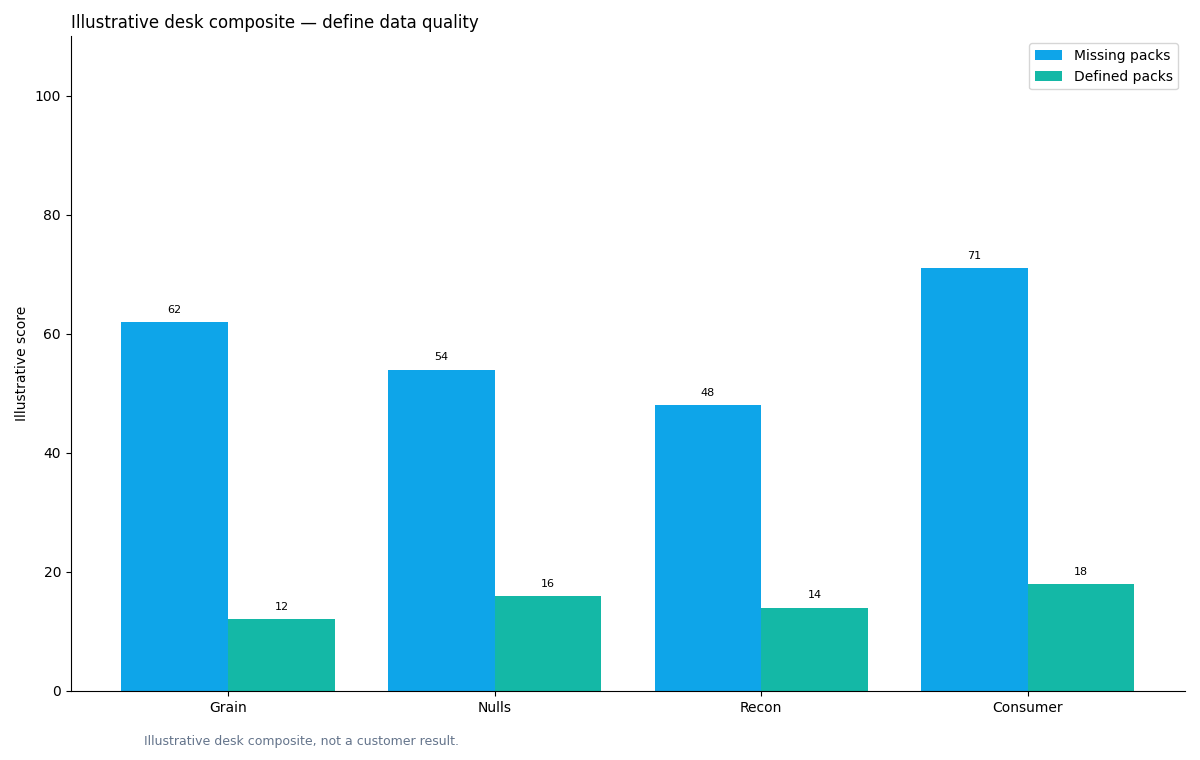
Figure. Teaching schematic. Not a measured study. Source: the protocol table above.
A teaching sketch used 8,420 in chat, 8,418 recon, and 42 / 88 missing-field counts. Those figures are not a benchmark. Teams that define data quality hold compute until the consumer is a handle. Quote the protocol table. Do not quote the bars as a study.
If you need a reading copy after the lock exists, use the AI data report generator. The file is not the definition. The method is still to define data quality before compute.
Scorecard: complete versus missing definition fields
| Defect | After-the-fact label | Written definition | Human hold |
|---|---|---|---|
| Grain invented from the total | Misses | Catches if sentence exists first | Holds compute |
| Null rule written after nulls appear | Misses | Catches if cap exists first | Holds |
| Recon invented to fit 8,420 | Misses | Catches if control is named first | Holds |
| Consumer is a meeting | Misses | Catches if handle is named | Rewrites the consumer |
| Policy PDF cited as the lock | Praises the PDF | No object for tonight | Holds |
Score the lock, not the caption. If you cannot fill the written-definition column, you cannot define data quality. You can only narrate. A reviewer who asks “what did we lock?” should be handed the bound note. Write the consumer as a handle, not as a room.
If the missing object is the product-field list after the lock exists, continue in the data quality definition. That page assetizes the pack. This page stays the pre-compute act: you define data quality first, then you run.
Failure modes when teams set quality rules too late
Defining after the query returns
“We define data quality” becomes “we labeled the total.” The lock disappears. Delivery becomes a tone. The grain is whatever the join produced. Teams that label after compute cannot fail the table. They can only praise it.
Calling a policy PDF the definition
A stewardship PDF is a program. It does not name tonight’s grain. Data management is the catalog layer for stores and stewardship. This page stays on tonight’s bound note. Mixing the two is how teams invent a third object—a slide that claims they define data quality while the task note is blank.
Skipping the consumer
A lock without a consumer is a diary. The next report cannot open a diary. Teams that define data quality and skip the consumer still ship a number. They cannot point at the next handle when the total moves overnight.
When the hub picture is missing, return to data quality and walk the six-step chain. When the reusable table is the missing object, read what is data quality before anyone pastes.
Write the definition, then run the gate
Write grain, null rule, and consumer in a bound note, then run the task. This check uses only sources you authorize.
Commercial association: You do not need the workspace to complete the educational diagnosis on this page.
Open InfiniSynapseHow this page is sourced. William Zhu is cofounder of InfiniSynapse, public as GitHub @allwefantasy. Company self-description, not independent authority. No third-party prize is claimed. No personal LinkedIn is published. Evaluation basis: We evaluate (hands-on) by writing grain, null cap, and consumer before the first
SELECT. Protocol dated 2026-09-02, replayed 2026-09-03. Reviewed internally by analytics engineering · data platform · LLM security · editor. Editorial standards · corrections · publishing principles · About · Privacy · Terms. Contact zhuhl@infinisynapse.com. COI: InfiniSynapse sells an AI-native Data Agent; the banner is a commercial association. The educational diagnosis does not require it. Fact-check: ENISA, NIST SP 800-53, WCAG 2.1, Kafka docs, Redis docs, Wikipedia statistics as cited. Figures 8,420 / 8,418 / 42 / 88 are a teaching sketch. No external organization audited this page.
Frequently Asked Questions
Can I set the rules after the query returns?
Bottom line: No. To define data quality you write grain, gates, and consumer before compute. A label on the total is not a lock.
Is a policy PDF enough to set the rules?
Bottom line: No. A PDF is a program. When you define data quality for tonight’s pack, the object is a bound note with four fields.
What if I skip the consumer?
Bottom line: You did not define data quality. You wrote a diary. The next report has no handle.
Does this write the production database?
Bottom line: No. Default delivery is a workspace named result plus review. A later save needs permissions, a whitelist, and human approval.
What on this page is citable?
Bottom line: Cite the define data quality protocol table, the four-field lock, and the six-source comparison. Do not cite the chart bars or the 8,420 / 42 / 88 sketch as measured results.
Conclusion
To define data quality for analysis, write grain, gates, and the next consumer before compute. Do not label the total after it appears. If you later use the workspace, open InfiniSynapse only with authorized, sanitized inputs.