CSAT Analysis Aligned to Ticket Themes (2026)
By William Zhu & the InfiniSynapse Data Team · Published: 2026-08-22 · Last updated: 2026-08-31 · Last verified: 2026-08-31 · Next review: 2026-11-30 · About · Privacy policy · Editorial standards · Corrections
Table of Contents
- TL;DR
- What CSAT Analysis Means When a Score Is a Mood
- A Framework for Score, Lag, and Theme
- How Teams Compare Quality Reads
- Tool Landscape for Surveys and Tickets
- Implementation Steps You Can Replay
- Accuracy and Experience Record: Illustrative Theme Scores
- Evidence Boundaries and Independent Validation
- How to Cite This Page
- Selection Scorecard for CSAT Packs
- Failure Modes That Invent Quality
- Frequently Asked Questions
- Conclusion
TL;DR
We evaluate these patterns at the InfiniSynapse desk on sanitized composites; sample figures on this page are illustrative, not customer uplifts.
Direct answer: CSAT analysis is a lagged survey joined to ticket_id and an optional theme—so a mean is a count you can defend, not a same-day mood, and never a license to auto-close tickets or rank agents from raw comments.
What you'll learn: a theme-first definition of csat analysis; a lag-and-sample contract; how means differ from comment mining; a replayable join path; an illustrative desk composite; a scorecard; and the failure modes that invent quality.
Download evidence: desk log · score CSV · verification script · source check · reproduction protocol. This package is first-party and illustrative—not customer, production, benchmark, or third-party evidence.
CSAT analysis fails when yesterday’s tickets are scored with today’s returns, or when three surveys become a headline. The fix is survey_return_at, a written lag, and n printed next to the mean. A score without a theme is a mood.
The parent method sits in support analytics. Lagged scores sit inside support ticket analytics. This page stays on score-plus-theme.
What CSAT Analysis Means When a Score Is a Mood
Key Definition: CSAT analysis is the audit of lagged customer-satisfaction scores joined to ticket facts and optional sanitized themes on an authorized export, so quality claims stay inspectable. The unit of work is a survey window with n—not a model that pretends the queue got happier overnight.
The ISO standard catalog entry (retrieved 2026-09-04) provides measurement context. It does not validate this survey, scale, sample, or run.
Direct survey-disclosure context comes from the AAPOR Transparency Initiative and UK Government Statistical Service harmonisation strategy (retrieved 2026-09-04). Privacy-risk context comes from the NIST Privacy Framework (retrieved 2026-09-04). None reviewed this page or dataset.
A helpdesk star is not a census. CSAT analysis is a dated survey file plus a ticket extract. If two leads disagree on whether a 0–5 and a 1–5 scale were mixed, stop. The disagreement is the work.
If the missing object is backlog math rather than a score, continue in ticket analytics. If the next failure is staffing grains, use support queue analysis.
Treat csat analysis as two tables. Tickets: ticket_id, created_at, queue, optional theme. Surveys: ticket_id, score, survey_sent_at, survey_return_at. Hash requester keys. Drop free-text comments unless policy allows a sanitized sample.
A score without a theme is a mood
A 3.9 mean on a mixed queue is a mood. CSAT analysis that cannot say “shipping ETA versus billing” cannot tell ops what to staff. Join a theme only after the ticket table has a written rule for that theme—or a sanitized subject sample bound as context, not a dump of threads.
Theme shares must carry volume. CSAT analysis that averages a five-ticket theme with a five-hundred-ticket theme will invent a crisis. Print n beside every mean.
Lag is part of the measure
Surveys arrive after the ticket. CSAT analysis that plots daily scores on daily creates will punish the wrong shift. Use survey_return_at or a stated lag (for example, “scores returned 3–14 days after resolve”). If return volume is thin, say so.
Stanford HAI materials (retrieved 2026-09-04) provide research context, not evidence for this illustrative score.
A Framework for Score, Lag, and Theme
Fill this contract before you rank quality. CSAT analysis without lag will blame today’s agents for last week’s tickets.
| Layer | What you lock | Typical source | Failure if skipped |
|---|---|---|---|
| Identity | ticket_id | Ticket + survey export | Orphan scores |
| Instrument | scale, survey name | Survey config | Mixed 0–5 and 1–5 |
| Time | sent_at, return_at | Survey export | Same-day CSAT myth |
| Queue | team, channel, product | Ticket export | One blob quality |
| Theme | written rule or sample | Ticket or subjects | Mood without cause |
| Privacy | comments you will not load | Policy note | PII in prompts |
ACM Digital Library (retrieved 2026-09-04) indexes peer-reviewed research. No cited ACM paper ran this desk composite.
The Schema.org documents guide (retrieved 2026-09-04) supplies schema context, not survey validation.
Library of Congress materials (retrieved 2026-09-04) are a cataloging analogy, not support-operations evidence.
How Teams Compare Quality Reads
Teams argue tools. They should argue lag and n. CSAT analysis models differ in what they claim to see.
| Model | Works when | Breaks when |
|---|---|---|
| Mean only | n is large and one queue | Themes differ |
| Comment mining only | You have a clean sample | Volume is ignored |
| Score × theme pack | Lag and n are printed | Filters change every Monday |
| Live quality wallboard | Intra-day staffing | Surveys have not returned |
Means versus comment mining
A mean answers: where did returned scores sit. Comments answer: which phrases appeared. CSAT analysis can use both if comments are sanitized and optional. It should not replace n with a word cloud.
Exploratory data analysis is a fit for checking score distributions before you headline a mean. It is a poor fit for treating three 1s as a company-wide collapse.
A wallboard is for today’s open tickets. A weekly review needs a pack: survey window, lag sentence, theme rule, and n. Replay it next week. If the mean moves, the memo should say whether returns moved or the export filter did.
Operators can use AI for data analysis on that pack if the extract is authorized. The acceptance test is still a second person opening the same grain. CSAT analysis that exists only in a chat will be re-argued at standup.
Tool Landscape for Surveys and Tickets
You do not need a native Zendesk connector to start. You need two dated exports you are allowed to use. CSAT analysis on CSVs is valid. Do not invent an integration the product does not have.
InfiniSynapse is a professional AI data analyst on sources you authorize. Bind a short note that states the lag and the scale. It does not write scores back to the helpdesk and it does not auto-close tickets.
Survey exports you can authorize
Minimum columns for csat analysis: ticket_id, score, survey_return_at. Add survey_sent_at if you will compute lag. Hash requester IDs. Drop emails. Prefer not to load raw comment bodies.
A second file holds ticket_id, queue, and optional theme. Join on ticket_id only. CSAT analysis that joins on requester name will leak and will mis-attach scores after a merge.
Theme samples without a write path
If you want language, bind a small set of sanitized subjects or macro names. CSAT analysis that pastes full threads into a prompt invites leakage and prompt injection. Review OWASP Top 10 for LLM Applications before a model reads free text.
A semantic layer is a fit only if “CSAT” and “theme” are already bound nouns. It is not a substitute for the lag sentence. CSAT analysis still needs n on the pack.
Data visualization can show score × theme bars. It cannot fix a mixed scale. Ticket analytics remains the volume spine; this page does not replace it.
Implementation Steps You Can Replay
Start with the survey contract. CSAT analysis that starts from “sentiment” will invent a theme to match the mood.
Sanitize and join the exports
- Drop PII columns you do not need.
- Hash remaining person keys.
- Freeze both file dates and the filters.
- Join on ticket_id only.
- Print n of tickets, n of returns, and return rate.
CSAT analysis at this step is dull on purpose. If two leads disagree on the scale, stop. Write the instrument. Then join.
You can upload the sanitized files at the InfiniSynapse app and ask a goal in natural language. Keep the agent read-only. CSAT analysis does not patch the helpdesk.
Bind lag and theme sentences
Write lag as a sentence: scores returned between day 3 and day 14 after resolve, or whatever your survey actually does. CSAT analysis without that sentence will mix in-window creates with out-of-window returns.
Theme: a written tag, a product field, or a sanitized subject sample. Do not let a model invent a taxonomy every Monday. CSAT analysis quality is the inspectable join, not a new cluster name.
Ask score by theme
Ask one goal: which themes had enough returns this week, and where the mean moved after the stated lag. CSAT analysis quality is the table with n, not a single company score. Open the counts. If a theme has n=8, do not headline it.
Download Markdown or PDF. Keep the query. Reuse the same goal next week. A chat-only result is not a pack.
Accuracy and Experience Record: Illustrative Theme Scores
The following numbers are an illustrative desk composite, not a customer result or operational benchmark. Run ID: CSAT-LAG-20260823. Run date: 2026-08-23. Operator: InfiniSynapse Data Team. Objects inspected: context tickets, returned surveys, stated scale and lag, two theme means and counts, eight aggregates, and three held items.
| Item | Desk composite (illustrative) |
|---|---|
| Window | returns 2026-08-10 to 2026-08-18 |
| Tickets in window | 6,200 created (context only) |
| Surveys returned | 740 |
| Overall mean | 3.9 on a 1–5 scale |
| Lag | median 6 days after resolve |
| Theme “shipping ETA” | mean 3.2, n=210 |
| Theme “billing” | mean 4.1, n=95 |
| Action | Staff carrier exceptions; do not close by macro |
CSAT analysis on this pack is useful because the lower mean sits on a theme with n, not on a vibe. A company-wide 3.9 would have hidden the split.
A second week should use the same lag sentence and the same scale. If shipping ETA rises, the pack should say whether n rose or the export filter changed.
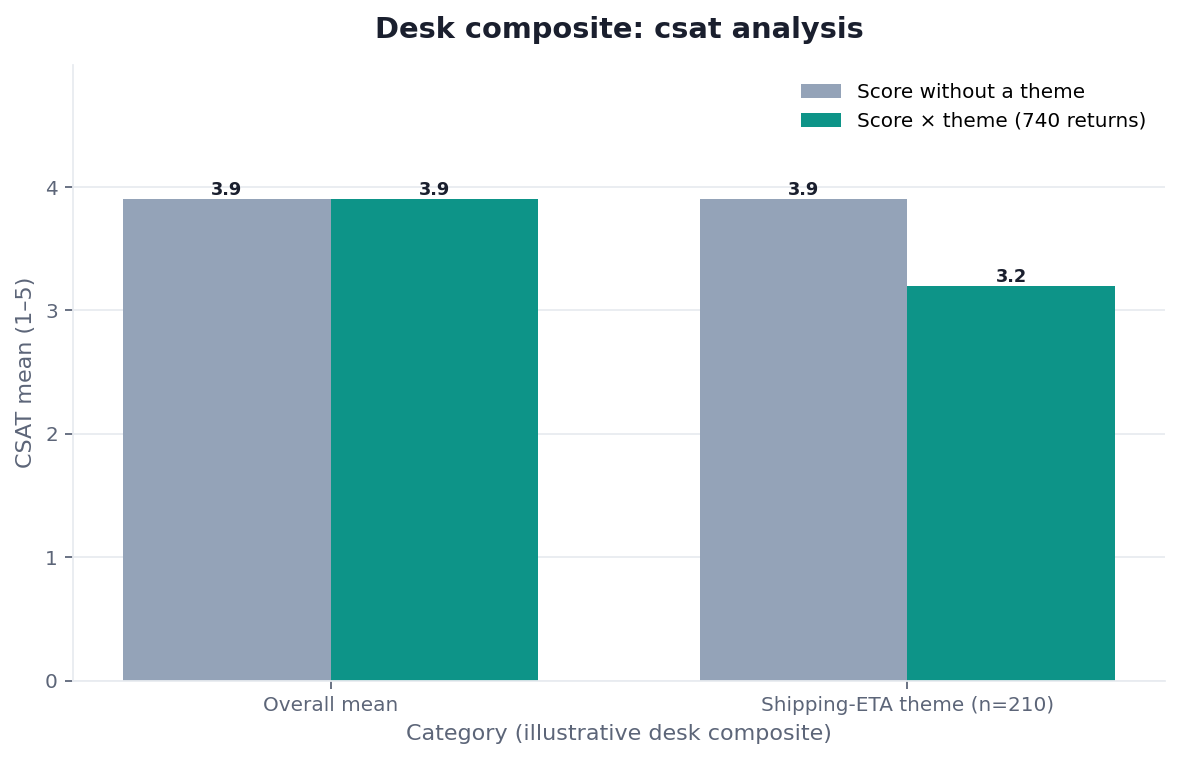
Figure. Desk composite from this page: 740 returns; overall 3.9; shipping ETA theme 3.2 (n=210). Published context: iso.org; dl.acm.org; hai.stanford.edu. Not a customer experiment, SLA, or official benchmark.
| Evidence class | What you can cite | What you cannot claim |
|---|---|---|
| Desk composite on this page | Grain, collision, inspectable artifacts | Customer uplift %, vendor bake-off win |
| Published authority (linked above) | Frameworks and definitions from the cited sources | That those sources ran this desk sample |
Desk composite: 740 returns, mean 3.9, shipping ETA 3.2 (n=210). Published context: ISO catalog, ACM Digital Library, Stanford HAI, Library of Congress, Schema.org documents.
The operator held response rate because the eligible-survey denominator was unavailable, held uncertainty because no distribution or interval was computed, and held staffing action as illustrative. The desk log records those limitations. The CSV exposes eight illustrative aggregates and three held items.
Evidence Boundaries and Independent Validation
This is not causal evidence. Survey rows, instrument wording, eligibility denominator, sampling frame, nonresponse, missingness, distributions, intervals, SQL, and privacy review are unavailable.
The 740 returns cannot yield a response rate without an eligible denominator. Theme means cannot be compared confidently without distributions or uncertainty. A stated 1–5 scale does not prove the instrument remained unchanged. The six-day median does not disclose the lag distribution.
The source check separates survey guidance from technical analogies. The open protocol specifies an external test. As of 2026-08-31, no qualifying independent report, customer validation, peer review, or media investigation exists.
The output checker confirms displayed labels and values only. It does not establish survey validity, representative response, statistical significance, causal effect, privacy compliance, staffing impact, or product performance.
CSAT analysis publishes denominators. CSAT analysis identifies instruments. CSAT analysis preserves scales. CSAT analysis records lag. CSAT analysis reports missingness. CSAT analysis tests nonresponse. CSAT analysis prints distributions. CSAT analysis estimates uncertainty. CSAT analysis freezes themes. CSAT analysis limits actions.
How to Cite This Page
Page: Zhu, W., & InfiniSynapse Data Team. (2026). CSAT analysis aligned to ticket themes. InfiniSynapse. https://infinisynapse.com/en/blog/csat-analysis
Run: InfiniSynapse Data Team. (2026). Desk log CSAT-LAG-20260823 (illustrative survey composite). https://infinisynapse.com/blog-media/csat-analysis/downloads/desk-log-CSAT-LAG-20260823.md
Neither is an independent audit, customer case, peer-reviewed study, benchmark, or proof of quality improvement. Cite unavailable survey rows, instrument, denominator, uncertainty, held action, and first-party limitations.
Selection Scorecard for CSAT Packs
Score from 1 to 5. CSAT analysis that cannot name lag should not win on a prettier comment chart.
| Criterion | What “5” looks like | Disqualifier |
|---|---|---|
| Field minimization | Comments dropped or sanitized | Full threads in prompts |
| Instrument | Scale and survey named | Mixed scales silently |
| Lag honesty | Return window written | Same-day CSAT vs new tickets |
| Theme honesty | n printed per theme | Tiny-n headlines |
| Audit | Pack + query downloadable | Chat-only mood |
| Write path | Read-only | Auto-close or agent ranking |
CSAT analysis scores well when a privacy reviewer can see the column list. It scores poorly when the tool implies it will raise the score by closing tickets.
Failure Modes That Invent Quality
Name the break on the pack.
Same-day scores on new tickets
Surveys arrive late. CSAT analysis that plots daily means on daily creates will punish the wrong shift and invent a recovery after a quiet Monday. Use return date or a stated lag.
Tiny-n themes as headlines
Eight angry surveys are not a theme program. CSAT analysis should set a floor (for example, n≥30) or show a wide interval.
Agent ranking from raw comments
Do not turn the pack into a performance weapon from unreviewed text. Aggregate to queue and theme. Individual ranking from comments is a different, usually inappropriate, program.
A fourth pattern is mixing two surveys (post-resolve versus relationship) under one “CSAT” noun. Print the instrument.
Before you open a workspace, check four things: scale, lag sentence, join key, and whether comments are sanitized.
Route the same diagnosis to the live guide that owns the next object.
When the next missing object is not this page, open Analyze Support Transcripts with the Ticket Table when Text themes only count when they join a ticket id, Zendesk Data Analysis from an Export when Use the export you have; do not invent a native connector, or Support Weekly Ops Pack as a Rerun when The ops pack is last week’s goal, replayed.
Ask CSAT by theme on a sanitized export
Upload ticket and survey extracts, bind the lag sentence, and ask which themes have enough returns to read. This check uses only sources you authorize.
Commercial association: You do not need the workspace to complete the educational diagnosis on this page.
Open InfiniSynapseHow this page is sourced. William Zhu is cofounder of InfiniSynapse (GitHub @allwefantasy); no personal LinkedIn, survey-research credential, support affiliation, or independent reviewer role is claimed. His profile establishes authorship, not subject-matter certification. Desk decisions are recorded in run CSAT-LAG-20260823. Reviewed internally by analytics engineering · data platform · LLM security · editor. Editorial standards · corrections · publishing principles. COI: InfiniSynapse sells an AI-native Data Agent. AAPOR, UK Analysis Function, NIST, ISO, Stanford, ACM, Schema.org, and LOC did not validate this run.
Frequently Asked Questions
Do I need a live helpdesk connector?
Bottom line: No. CSAT analysis is valid on dated, authorized exports. A connector helps when the store is already approved and read-only. It is not required for the first pack. Freeze both filters. Do not invent a native Zendesk integration if you only have CSVs.
Can the pack close tickets or send surveys?
Bottom line: No. CSAT analysis names lagged scores by theme. It does not write to the helpdesk, auto-close cases, or mail customers. If you want survey sends, that is a separate controlled system. Keep the analysis path read-only.
How should CSAT be joined to tickets?
Bottom line: Join on ticket_id. Treat the score as lagged. Print survey delay and n. If too few surveys returned, do not headline the mean. Never average CSAT across queues of very different volume without showing counts. CSAT analysis without n is a mood.
Are comment bodies required?
Bottom line: No. Queue-level means can run a week. Use text when the question is theme language. Prefer sanitized subjects. Full bodies raise privacy and prompt-injection risk. If comments are out of policy, ship a score pack and stop.
Can readers reproduce the displayed CSAT figures?
Bottom line: No. Survey rows, instrument, eligibility denominator, distributions, SQL, and intervals are unavailable. The CSV exposes eight aggregates and three held items, not a reproducible study.
Has an independent survey analyst reproduced this run?
Bottom line: No qualifying external report is published as of 2026-08-31. The protocol defines the survey disclosure, nonresponse analysis, uncertainty, privacy review, and artifacts required.
Conclusion
CSAT analysis is a pack you can defend: lagged scores, printed n, and themes that join on ticket_id. Lock the instrument, drop the fields you do not need, and refuse agent-level scores from raw comments. A score without a theme is a mood. The weekly memo is the product.
When the survey export and the lag sentence are ready, ask CSAT by theme on an authorized file at https://app.infinisynapse.com/. Download the pack, keep the query, and replay it next week with the same definitions.