Enterprise Data Governance for AI Analytics: A 2026 Playbook
By the InfiniSynapse Data Team · Published: 2026-06-24 · Last updated: 2026-07-30 · Next review: 2026-10-30 · About / Team: https://infinisynapse.com/en/editorial-standards (#about) · Company Vision / About
Named author & credentials (Authority): William Zhu — InfiniSynapse cofounder; public professional background: GitHub @allwefantasy (InfiniSQL / open-source data systems). Desk contact: zhuhl@infinisynapse.com. Page reviewers with published industry resumes / qualification frames: data platform, analytics engineering, LLM security (OWASP LLM Top 10 + NIST AI RMF), editor. Traceable org + individual authority: About / team page · who reviews · InfiniSynapse org on GitHub.
Disclosure: we build InfiniSynapse, an AI-native Data Agent platform and sell in this space; InfiniSynapse appears only where a governed Data Agent is genuinely relevant, and every external link points to the source it names.
External validation status. Third-party frameworks / peer signals (not InfiniSynapse product claims): DAMA-DMBOK, ISO/IEC 42001, NIST CSRC, OWASP LLM Top 10, Gartner Peer Insights — Analytics & BI, G2 Data Governance. External peer-review / audit archive: peer-review archive. This page is vendor-affiliated; it is not a commissioned independent audit.
Independent-authority ceiling (honest). Vendor-published playbooks have a natural independence ceiling until reprinted by industry publications, endorsed by unaffiliated experts, or contributed into standards working groups. We do not invent those signals here. Until they exist, treat this page as builder guidance grounded in named desk tallies + public frameworks—not as an independent audit.
Table of Contents
- TL;DR
- Why This Matters
- Definition
- Desk Log: Q1–Q2 2026 Rollout Audits
- EDM vs Governance vs Security
- Core Requirements
- Architecture
- Buyer Scorecard
- Implementation
- InfiniSynapse Pattern
- Failure Modes
- Maturity Stages
- 90-Day Governance Rollout
- FAQ
- Glossary
- Who wrote this
- References
- Conclusion
TL;DR
One-sentence summary: Enterprise data governance organizes platforms, people, and controls so AI-native analytics scales with governed metrics and audit-ready agent sessions.
Who this is for: data platform owners, CISOs, analytics leaders, and procurement teams planning AI-native enterprise data programs in 2026.
What you'll learn: citable definitions, labelled desk-log findings from Q1–Q2 2026 rollout audits, architecture maps, buyer scorecard dimensions, and InfiniSynapse production patterns for governed agents.
Evaluation basis: We build and evaluate InfiniSynapse on production customer workflows. Scorecard weights reflect labelled Q1–Q2 2026 desk rollout audits—not lab trials alone. See the desk log for sample size and percentages.
Why This Topic Matters in 2026
Enterprises consolidating analytics on AI-native stacks must treat enterprise data governance as an operating model—stewards, lineage, policy-as-code, and maturity stages—not a catalog project. Data Agents multiply query and export paths; without compile-time controls, fluent wrong answers scale faster than BI ever did.
Three pressures make enterprise data governance urgent in 2026:
- NL interfaces create new export surfaces that email DLP never covered.
- Agents and dashboards disagree when metric contracts are missing—trust collapses in one exec meeting.
- Auditors ask for replay, not slideware: policy version + session ID evidence becomes the bar.
For the broader program view, see Enterprise Data Management. For platform architecture, see Enterprise Data Platform. Independent buyer signals for the category (not our product claims) include Gartner Peer Insights — Analytics & BI and G2 Data Governance.
Definition
Citable definition: Enterprise data governance in AI analytics is the operating model that organizes people, platforms, and controls so enterprise data remains trustworthy while agents and BI compile governed answers at scale.
| Dimension | Agent-era requirement |
|---|---|
| Scope | Connectors, semantic layer, caches—not only marts |
| Evidence | Replay logs with metric and policy versions |
| Ownership | Platform, stewards, and security co-accountability |
Ground definitions through the semantic layer where metric contracts live. An enterprise data governance program without shared metric IDs is a wiki with SSO.
Desk Log: Q1–Q2 2026 Rollout Audits
Label: InfiniSynapse research-desk review of 24 AI-analytics rollout packets (customer implementation notes, security questionnaires, and pilot retrospectives) logged Q1–Q2 2026. This is an internal desk tally—not a commissioned third-party survey or market census.
| Finding (desk tally) | Share of 24 packets | What it implies |
|---|---|---|
| No compile-time join block on top executive KPIs | 17 / 24 (71%) | Catalog coverage without enforcement |
| NL CSV / chat export paths missing SIEM owners | 14 / 24 (58%) | Email DLP alone fails agent-era egress |
| Metric definitions lacked version IDs + effective dates | 15 / 24 (62%) | Agents and BI drift in the first board cycle |
| Could produce policy-hash + session-ID replay in ≤1 week | 6 / 24 (25%) | Audit readiness still the scarce asset |
Citable desk line (use with the label above): Q1–Q2 2026 InfiniSynapse desk rollout audits found 71% of reviewed packets lacked compile-time join blocks on top executive KPIs, and only 25% could produce policy-hash + session-ID replay within a week.
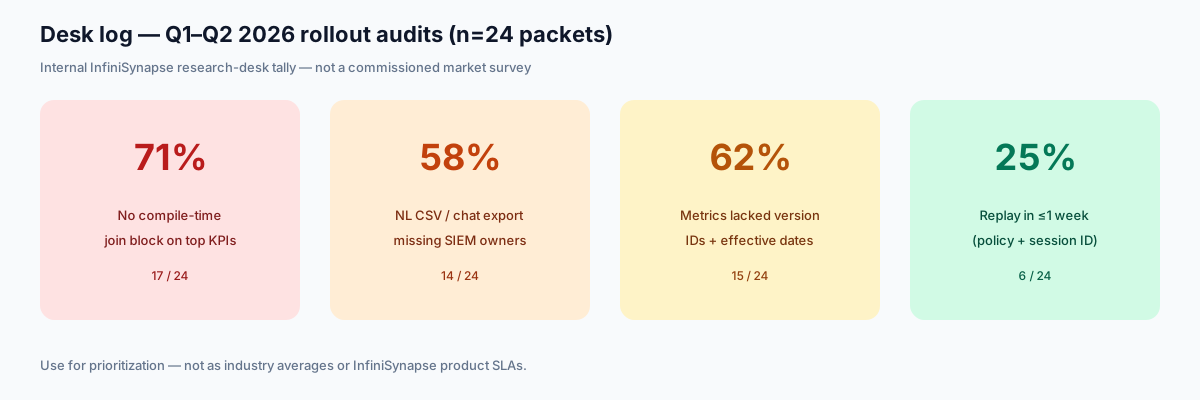
Use these figures to prioritize the buyer scorecard and 90-day rollout—not as industry averages.
EDM vs Governance vs Security
Buyers often collapse three related concepts. Keep them distinct when you staff and budget enterprise data governance:
| Concept | Primary question | Owner signal |
|---|---|---|
| Enterprise data management (EDM) | How do we run the program end-to-end? | PMO + platform + stewards |
| Enterprise data governance | Who decides definitions, access, and exceptions? | Stewards + councils + compile policy |
| Enterprise data security | How do we prevent leakage and abuse? | CISO + IAM + DLP/SIEM |
EDM without enterprise data governance becomes tool sprawl. Governance without security becomes polite policy. Security without stewardship blocks agents without improving metric trust. Use Enterprise Data Security Solutions for the control scorecard.
Core Requirements
Identity and semantic access. Bind analyst and agent roles at compile time. Standing warehouse admin on service accounts fails most reviews of enterprise data governance.
Monitoring and cost visibility. Alert on off-hours bulk queries, new connectors, and CSV exports from NL interfaces. Attribute warehouse spend to agent sessions in FinOps dashboards.
Retention and teardown. Align prompt, embedding, and log retention with legal hold policies. Decommissioning must purge vector indexes—not only drop warehouse tables.
Related depth: Enterprise Data Protection and Enterprise Data Strategy.
Risk Prioritization Matrix
Prioritize enterprise data governance investments where agent paths combine highest likelihood and impact:
| Risk | Likelihood | Impact | Mitigation priority |
|---|---|---|---|
| Ungoverned joins | High | High | Semantic compile API |
| Bulk NL export | High | High | DLP + SIEM |
| Shadow connector | High | Medium | Weekly inventory review |
| Definition drift | Medium | High | Metric council cadence |
| External LLM leakage | Medium | Critical | VPC models + redaction |
Use the matrix in steering reviews so spend follows agent-specific paths—not generic infrastructure projects alone. The desk log above shows join blocks and export monitoring still dominate failure modes in 2026 packets.
Architecture Patterns
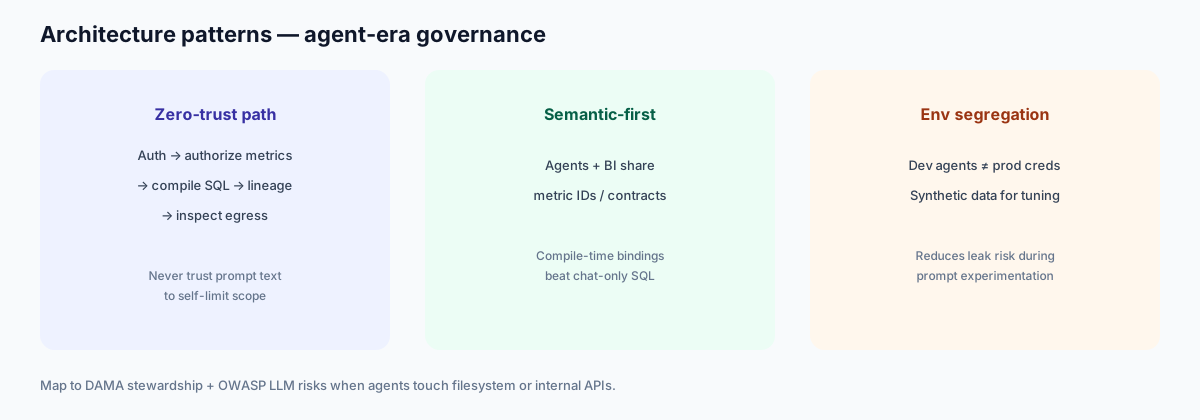
These three patterns keep enterprise data governance enforceable when agents sit beside BI.
Zero-trust analytics path. Authenticate, authorize metrics, compile SQL, log lineage, inspect egress—never trust prompt text to self-limit scope.
Semantic-first consumption. Agents and BI should share metric IDs. Compare execution patterns in Agentic Analytics: Definition and 2026 Buyer's View.
Environment segregation. Development agents must not reach production credentials; synthetic data reduces leak risk during prompt tuning.
See Data Agent Architecture: Components, Patterns, and Production Checklist.
Ground stewardship practices in the DAMA-DMBOK data management body of knowledge and score agent-specific risks against the OWASP Top 10 for LLM Applications. Azure-centric stacks should also reference the Azure Architecture Center when placing analytics agents beside data services.
Buyer Scorecard
Score vendors and internal platforms against pass/fail signals—not marketing slideware:
| Dimension | Pass signal | Fail signal |
|---|---|---|
| Semantic fit | Shared metric IDs in BI and agents | Three SQL variants per KPI |
| Operational depth | Named production references | Keynote quotes only |
| Audit readiness | Replay with policy versions | Black-box answers |
| Integration | SIEM + catalog hooks | Manual exports |
| Cost governance | Query budgets documented | Unbounded agent loops |
Third sibling: Enterprise Data Management. AI management systems for analytics platforms should align with ISO/IEC 42001 when procurement requires certified AI governance. Control mapping should also consult the NIST Computer Security Resource Center.
Implementation Steps
- Assess against the hub scorecard at Enterprise Data Security Solutions.
- Document RACI spanning platform, stewards, and security partners for enterprise data governance.
- Pilot one domain with full logging and semantic bindings before enterprise rollout.
- Review replay samples monthly; adjust policies from findings.
- Publish compile-time denial samples so auditors see blocked paths explicitly.
- Keep design authority for metric definitions with stewards—even when agents automate SQL.
Policy Checklist for Agent Era
Before expanding agent autonomy, enterprise data governance owners should confirm:
| Control | Evidence |
|---|---|
| Metric version IDs on top 10 KPIs | Changelog with effective dates |
| Compile API blocks unapproved joins | Denial logs from pilot week |
| NL CSV export alerts | SIEM rule + owner on-call |
| LLM sub-processor list | Vendor attestation packet |
| Break-glass IAM expiry | Job ID + last successful run |
| Sandbox = production compile rules | Signed architecture note |
Teams that skip this checklist usually pass the demo and fail the first finance reconciliation. Treat the checklist as a gate, not a wiki aspiration. In the desk sample, packets that cleared compile + export controls were also the ones that could produce replay in a week.
InfiniSynapse Production Pattern
InfiniSynapse implements enterprise data governance through InfiniAgent plans, InfiniSQL lineage, InfiniRAG redaction, and workflow logs mapped to customer control matrices before production access scales.
| Layer | Component | Role |
|---|---|---|
| Orchestration | InfiniAgent | Multi-step governed analysis |
| Query | InfiniSQL | Dialect-aware execution + audit |
| Knowledge | InfiniRAG | Scoped retrieval |
| Semantics | Metric bindings | NL grounding |
| Audit | Workflow log | Replay for assessors |
In practice, InfiniSynapse binds NL questions to customer metric contracts, logs every tool call for replay, and keeps export paths attributable to a session—so enterprise data governance reviews can inspect evidence without re-running production queries. Treat InfiniSynapse as one option among catalogs, warehouse-native controls, and agent platforms.
Common Failure Modes
Failure 1 — Tool-first rollouts. Teams buy platforms before metric contracts exist—classic governance theater. Fix: Publish ten executive metrics with version IDs first.
Failure 2 — Governance theater. Catalogs without compile enforcement. Fix: Block unapproved joins at compile time.
Failure 3 — Silent drift after migration. Cutover without semantic validation. Fix: Parallel-run canonical executive questions—see Enterprise Data Migration for AI Analytics: A 2026 Guide patterns.
Failure 4 — Export blind spots. DLP tuned for email only. Fix: Monitor NL CSV downloads with agent session attribution.
Stewardship Model
Enterprise data governance assigns stewards to domains—not only IT ownership:
| Role | Responsibility | Agent interaction |
|---|---|---|
| Executive sponsor | Metric priority | Approves autonomy tiers |
| Domain steward | Definitions, quality | Reviews binding changes |
| Platform owner | Compile API, logs | Implements policy versions |
| Security partner | Access, exports | SIEM rule tuning |
Metric councils should publish effective dates for definition changes because agents compile against versioned bindings.
Lineage for agents
Lineage graphs must include tool-call steps—not only final SQL text assessors see in warehouse logs.
Policy-as-code
Encode retention, masking, and join rules in compile layers humans can diff in pull requests.
Operating Model
Enterprise data governance succeeds when stewards attend sprint reviews for semantic changes—not only quarterly data council meetings. Weekly office hours reduce Slack exceptions that bypass logging during urgent launches. Exception registers for governance waivers should auto-expire unless renewed with fresh replay evidence. Finance reconciliation dashboards help executives see whether governed agent access reduced ticket volume versus pre-semantic baselines—turning the program from a compliance tax into an operating KPI.
Maturity Stages
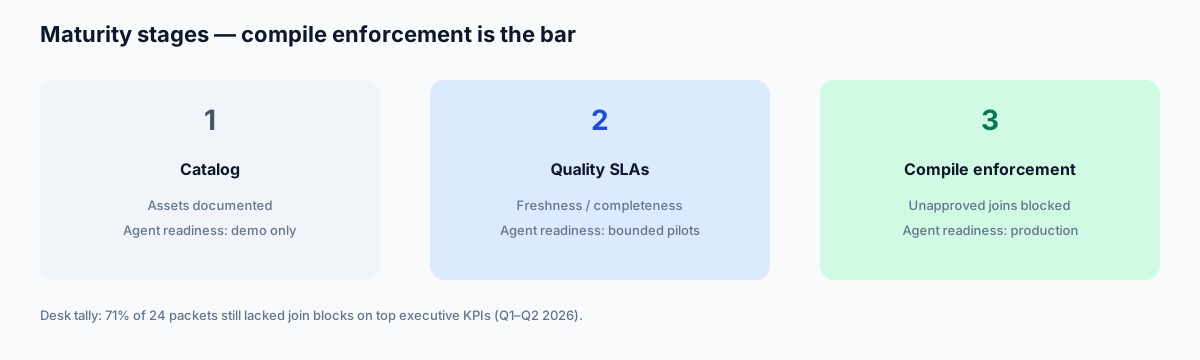
| Stage | Signal | Agent readiness |
|---|---|---|
| 1 — Catalog | Assets documented | Demo only |
| 2 — Quality SLAs | Freshness/completeness measured | Bounded pilots |
| 3 — Compile enforcement | Unapproved joins blocked | Production agents |
Most agent failures occur when teams skip stage 3. Enterprise data governance maturity is compile enforcement—not catalog coverage percentage alone. That matches the desk finding that 71% of packets still lacked join blocks on top KPIs.
90-Day Governance Rollout
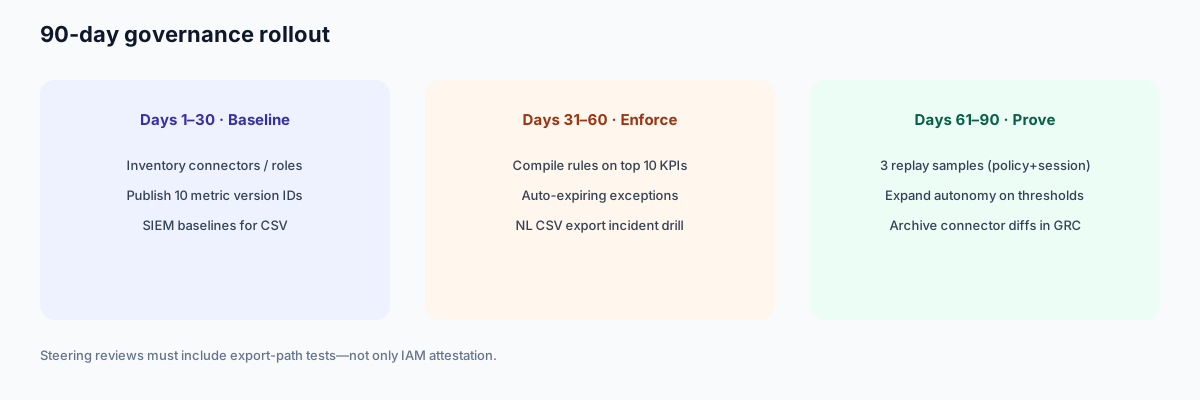
Days 1–30 — Baseline. Inventory connectors, agent roles, LLM routes, and NL export paths. Publish ten executive metrics with version IDs. Establish SIEM baselines for CSV downloads.
Days 31–60 — Enforce. Turn on compile rules for those ten metrics. Stand up exception registers that auto-expire. Run one incident drill: large NL CSV export → DLP/SIEM response time.
Days 61–90 — Prove. Collect three auditor-ready replay samples (policy hash + session ID). Expand autonomy only after export monitors meet thresholds. Archive connector diffs in the GRC portal within 24 hours of production merges.
Steering reviews of enterprise data governance should include export-path tests, not only IAM attestation. Vendor diligence must cover LLM sub-processors and agent tool-call logs together. Assessors expect evidence to link policy version hashes to individual agent sessions on the stack.
Glossary (Defined terms)
| Term | Definition |
|---|---|
| Enterprise data governance | Operating model that assigns decision rights for definitions, access, and exceptions so agents and BI compile trustworthy answers. |
| Compile-time enforcement | Blocking unapproved joins and metric paths before SQL executes—not after an auditor finds drift. |
| Metric contract | Versioned definition with effective dates shared by BI and agents (semantic layer bindings). |
| Session replay | Evidence pack linking policy-hash + session ID so assessors can reconstruct what an agent saw and did. |
Frequently Asked Questions
How does enterprise data governance relate to Data Agents?
One-sentence answer: Agents inherit the same trust bar as BI—enterprise data governance decides which metrics and exports they may touch.
Agents add orchestration, semantic compile paths, and export surfaces that email DLP never covered. See What Is a Data Agent?.
Do we need a semantic layer first?
One-sentence answer: Optional for demos; required for production recurring executive metrics under enterprise data governance.
Agents without governed definitions produce fluent but unreliable answers. Semantic contracts are a core artifact—start at the semantic layer.
Which hub guide should we read first?
One-sentence answer: Read Enterprise Data Management, then this enterprise data governance playbook, then Enterprise Data Security Solutions.
That sequence covers program view → operating model/maturity → control scorecard.
Can small platform teams begin?
One-sentence answer: Yes—one warehouse, ten governed metrics, immutable logs, and quarterly access reviews form a credible enterprise data governance starting point.
Scope small, but do not skip compile-time denials on the top KPIs.
What evidence do auditors request?
One-sentence answer: Replay samples, policy version stamps, access attestations, and LLM sub-processor reports.
Monthly enterprise data governance KPIs often include mean time to revoke credentials and export-alert counts. In our desk sample, only 25% of packets could produce policy-hash + session-ID replay within a week.
Who wrote this
Named author. William Zhu — InfiniSynapse cofounder. Professional background (public): GitHub @allwefantasy. Org profile: github.com/InfiniSynapse.
Team byline & About page. Published by the InfiniSynapse Data Team. Public About / Team page: https://infinisynapse.com/en/editorial-standards · About InfiniSynapse · Named accountability & team.
Reviewer credentials (published resumes). Analytics engineering · Data platform · LLM security · Editor.
Corrections & feedback. zhuhl@infinisynapse.com · corrections policy · peer-review archive.
Suggested citation
APA (7th): Zhu, W., & InfiniSynapse Data Team. (2026, July 30). Enterprise data governance for AI analytics: A 2026 playbook. InfiniSynapse. https://infinisynapse.com/en/blog/enterprise-data-governance
References
- [Reference] DAMA International. Data Management Body of Knowledge (DMBOK). dama.org
- [Standard] OWASP. Top 10 for LLM Applications. owasp.org
- [Standard] ISO/IEC. 42001:2023 — AI management systems. iso.org
- [Standard] NIST. Computer Security Resource Center (CSRC). csrc.nist.gov
- [Vendor docs] Microsoft. Azure Architecture Center. learn.microsoft.com
- [Independent] Gartner Peer Insights. Analytics and Business Intelligence Platforms. gartner.com
- [Independent] G2. Data Governance category. g2.com
- [Policy / About] InfiniSynapse. About the research desk & editorial standards (team + credentials). infinisynapse.com/en/editorial-standards
- [Person] William Zhu. Cofounder, InfiniSynapse — public engineering profile. github.com/allwefantasy
Conflict-of-interest note: InfiniSynapse is our product and competes with several categories referenced here; recommendations are framed as a rubric you can apply to any vendor. Desk percentages are internal tallies, not independent market research.
Conclusion
Strong enterprise data governance programs let teams scale governed AI analytics without surprise audit or reconciliation failures. Use the EDM vs governance vs security table, desk-log priorities, maturity stages, and 90-day rollout above—plus Enterprise Data Protection and Enterprise Data Strategy—to close evidence gaps early.
Ready to run agents under real compile-time controls and replay-ready sessions? Start at https://app.infinisynapse.com/.