Vibe Coding Best Practices — Production Guide for Teams That Connect Real APIs
Vibe coding best practices are the habits that keep AI-generated UI from dying on real credentials: write a one-page spec before codegen, review the auth/SQL diff, keep secrets off the client, contract-test 401/403, and ship structured logs with the feature. They are not a prettier-prompt contest.
By William Zhu & the InfiniSynapse Data Team · Last updated: 2026-09-17 · Last verified: 2026-09-17 · About / team · Credentials: GitHub @allwefantasy (InfiniSQL / open-source data systems) · Desk: zhuhl@infinisynapse.com
We build InfiniSynapse and write these notes from shipping AI-assisted products into real credentials and data infrastructure—not as a brochure. No personal LinkedIn is published; identity signals are GitHub + About/Vision + editorial standards.
Version: 2026-08-04 EEAT · 2026-09-17 cluster refresh (practice list + FAQ; n=12 unchanged).
Table of Contents
- TL;DR
- The practice list
- Key Definition
- Why This Matters for Vibe-Coded Products
- Core Framework
- Comparison and Options
- Implementation Workflow
- InfiniSynapse Connection
- Vibe Coding Best Practices: The Production Mindset
- Scorecard
- Failure Modes
- Case Study: Rent-vs-Commute Analyzer
- Production Guide: Limits of This Framework
- FAQ
- Conclusion
TL;DR
Direct answer: vibe coding best practices are spec-before-codegen, review the AI diff, secrets off the client, contract tests on auth, and logs shipped with the feature—so the UI survives real APIs.
If you have spent time in r/vibecoding, r/Cursor, and r/webdev, you have seen these arguments. Here is what held up in production—not the hype comments. Community threads are useful signal; they are not a substitute for a scored integration checklist.
- Production threads bridge the gap between AI-generated UI and backends—auth, data APIs, async jobs, and observability.
- Vibe-coded teams hit the wall at credentials, schema validation, and long-running workflows—not at component styling.
- This hub maps definitions, scorecards, failure modes, and InfiniSynapse Server API patterns.
- Treat integration and data access as product features, not post-launch chores.
Who this is for: founders and builders using Cursor, Replit, v0, or Claude Code who now need dependable integrations. What you'll learn: the practice list, definition, comparison table, rollout steps, scorecard, and how InfiniSynapse Server API fits long-running data workflows. Re-verified 2026-09-17; n=12 desk tallies unchanged.
Media note: There is no hosted demo video on this page (and therefore no VideoObject schema). Use the five-layer framework SVG, the workflow SVG, the before/after case timeline, and the FAQ as short-answer surfaces.
Commercial disclosure: InfiniSynapse is a vendor in this space. Where we mention our Server API, treat it as one option among patterns—not the only valid architecture. Corrections: zhuhl@infinisynapse.com.
For the integration pillar, see API Integration Services: A Buyer's Guide. Publisher identity: About / editorial standards · company About.
The practice list
Cite this table. Each row already has a section—do not add a sixth “use a better model” row.
| # | Practice | Fail if you skip it | Where |
|---|---|---|---|
| 1 | Spec before codegen | Model invents auth and latency | Practice 1 |
| 2 | Review the AI diff | Secrets and SQL ship unread | Practice 4 |
| 3 | Secrets off the client | Keys in git / browser | Scorecard · Failure 2 |
| 4 | Contract-test auth | Silent 401/403 | Workflow step 4 · 7/12 |
| 5 | Logs with the feature | Post-mortem Slack only | Practice 5 · Scorecard |
Pre-integration checkboxes live on Vibe Coding Checklist. This URL stays on habits + production gates.
Key Definition
Key Definition: vibe coding best practices describe how AI-built products connect to external capabilities—APIs, databases, payment rails, and agent runtimes—with governance appropriate for real users, not demo traffic.
Those habits matter most when a vibe-coded UI already looks finished but nothing behind it can survive real traffic, real credentials, or real latency profiles.
Author note (William Zhu): On customer-shaped pilots I still see weekend UIs that “promise” PDF reports while every vendor call is still mock JSON. The cliff is almost never styling—it is secrets, sync-vs-async classification, and contract tests. Corrections welcome at the desk email above.
Production rollouts should align access and review controls with the NIST AI Risk Management Framework, especially when recurring queries touch live schemas or agent tool paths.
Why This Matters for Vibe-Coded Products
The prototype-to-product cliff
Teams usually discover the gap after the first Stripe webhook, OAuth redirect, or six-minute agent job—not during the initial Cursor session.
As soon as the workflow touches external systems, you need API governance, data access control, and production checks.
What breaks first in production
| Signal | Demo behavior | Production expectation |
|---|---|---|
| Auth | Key in .env.local | Secret manager + scoped tokens |
| Latency | Blocking UI thread | Async jobs + progress UI |
| Errors | Console log | Structured codes + alerts |
| Data | Mock JSON | Validated vendor schemas |
| Agents | Single prompt | Tool calling + audit trail |
Multi-source connector design should follow Microsoft's data architecture guidance so domain boundaries and metric contracts stay explicit as scope grows.
Compare integration patterns in What Is Vibe Coding? Practical Meaning for Product Teams With APIs.
Core Framework
A mature approach to vibe coding best practices decomposes into five layers builders can implement incrementally:
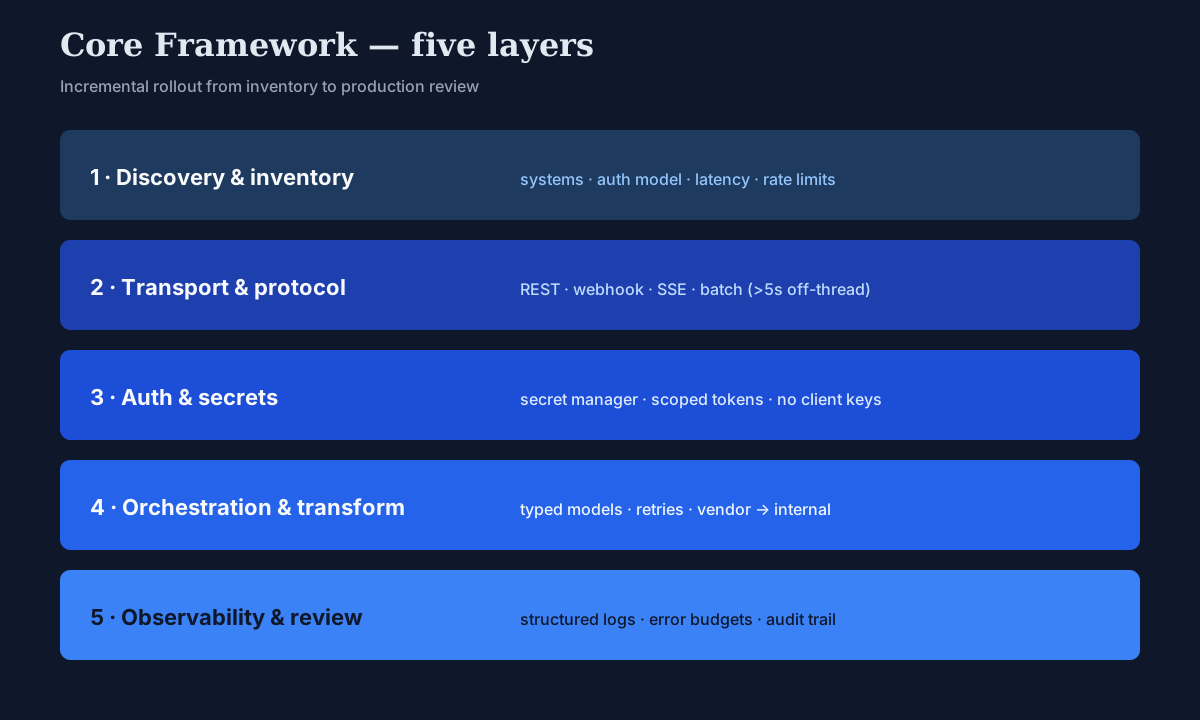
Layer 1: Discovery and inventory
A practical rollout separates synchronous UI calls from async data work, keeps secrets off the client, and validates every vendor payload before it touches business logic.
Layer 2: Transport and protocol choice
Classify each dependency as REST, webhook, SSE, or batch. Anything over five seconds belongs off the request thread from day one.
Layer 3: Auth and secret management
Buyers should score auth hygiene, schema validation, observability, and async routing before comparing feature checklists.
LLM-backed products should account for prompt-injection and data-exfiltration risks in the OWASP Top 10 for LLM Applications, especially when connectors expose production schemas.
Layer 4: Orchestration and transformation
Map vendor payloads to typed internal models before they reach UI components or agent prompts.
Layer 5: Observability and review
Integrations fail in production when builders treat the boundary as a single fetch() instead of a managed layer with retries and audit trails.
Analytics uptime improves when teams borrow Google SRE practices—error budgets, runbooks, and blameless postmortems for failed query chains.
Comparison and Options
When evaluating recommendations side by side, teams usually choose among four integration patterns:
| Pattern | Best for | Limit at scale |
|---|---|---|
| Hand-rolled clients | Unique APIs | Retry/observability debt |
| iPaaS (Zapier/Make) | Simple triggers | Complex auth + long jobs |
| API gateway | Multi-service teams | Ops overhead for solo builders |
| Data agent backend | Analysis + files + PDFs | Requires proxy discipline |
AI management systems for analytics platforms should align with ISO/IEC 42001 when procurement requires certified AI governance.
See also What Is a Data Agent.
Implementation Workflow
Roll out integrations in this order to avoid rebuilding after the first outage:
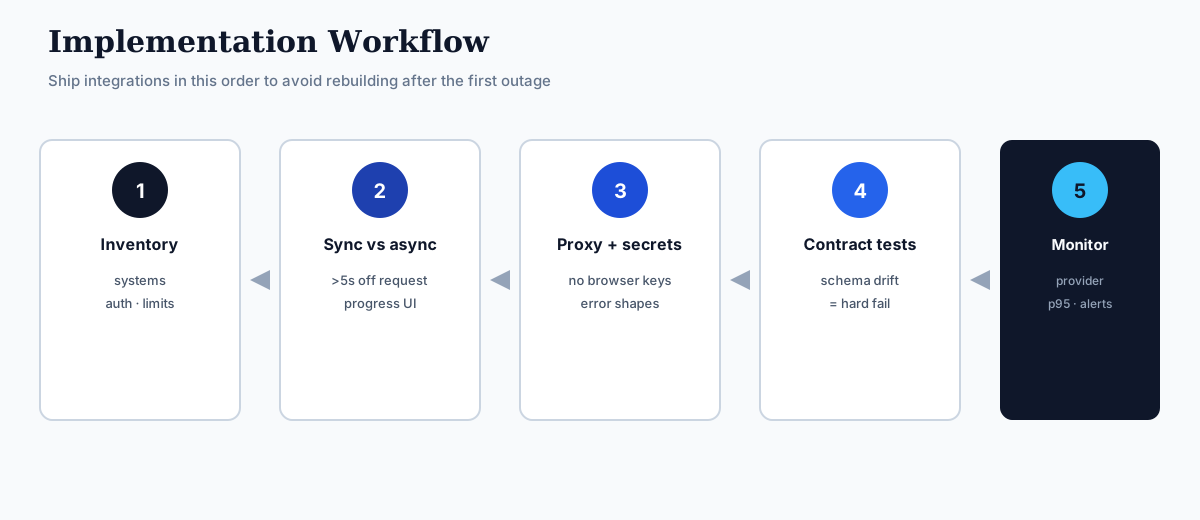
Step 1 — Inventory
List every external system, its auth model, rate limits, and expected latency.
Step 2 — Classify sync vs async
InfiniSynapse Server API fits scenarios that need multi-step analysis, workspace artifacts, and SSE progress—without standing up queues and sandboxes yourself.
Step 3 — Proxy and secrets
Never expose vendor keys in the browser. Route calls through your backend with structured error shapes.
// Minimal proxy sketch — secrets stay server-side
export async function POST(req: Request) {
  const body = await req.json();
  const res = await fetch(process.env.VENDOR_URL!, {
    method: "POST",
    headers: {
      Authorization: `Bearer ${process.env.VENDOR_TOKEN}`,
      "Content-Type": "application/json",
    },
    body: JSON.stringify(body),
  });
  if (!res.ok) {
    return Response.json({ code: "VENDOR_ERROR", status: res.status }, { status: 502 });
  }
  const data = await res.json();
  // validate(data) against a contract schema before returning
  return Response.json(data);
}
Step 4 — Contract tests
Validate schemas on every boundary; treat drift as a hard failure with alerts.
Operational maturity for analytics agents aligns with the AWS Well-Architected Machine Learning Lens, especially around monitoring, rollback, and ownership.
Step 5 — Production monitoring
Log provider, endpoint, status, and latency per call before you invite beta users.
InfiniSynapse Connection
InfiniSynapse targets vibe-coded products that need data agent capabilities behind a thin UI:
- Server API: SSE subscription,
newTask, workspace artifact download - InfiniSQL + InfiniRAG: federated queries and business definitions bound to sources
- Multi-entry parity: web app, API, and the
agent_infiniCLI for the same task timeline
A practical rollout separates synchronous UI calls from async data work, keeps secrets off the client, and validates every vendor payload before it touches business logic.
Disclosure reminder: We sell this product. Prefer the scorecard and failure modes below over any vendor checklist when you decide architecture.
Season 1 of the vibe coding contest is the public record of 93 apps that had to pass those boundaries.
For hands-on integration patterns, read Vibe Coding Checklist: Best Practices Before You Add Integrations and How to Vibe Code Without Creating Backend Chaos Later.
Vibe Coding Best Practices: The Production Mindset
Vibe coding best practices are not about prettier prompts—they are habits that keep AI-generated code safe once real users, real money, and real data show up. See the practice list.
Practice 1: Spec before codegen
Write a one-page spec: inputs, outputs, auth model, failure behavior, and success metrics. Paste it into every Cursor session. Models hallucinate less when constraints are explicit.
Practice 2: Thin UI, thick boundaries
OLTP connector hygiene should follow PostgreSQL documentation for role design, schema grants, and explainable validation queries.
Practice 3: Async by default for intelligence
Anything involving LLM chains, PDF parsing, or multi-step analysis belongs off the request thread. Show progress; never block the main UI for six minutes.
Practice 4: Review diffs like a senior engineer
AI speed is worthless if nobody reads the diff. Focus reviews on auth, SQL, credential handling, and error surfaces—not spacing.
Practice 5: Ship observability with the feature
Structured logs per external call beat post-mortem Slack threads. Define error budgets before marketing launch.
Weekly Rituals That Scale
| Ritual | Owner | Outcome |
|---|---|---|
| Integration inventory | Founder | No surprise vendor dependencies |
| Secret rotation drill | Backend | Keys rotatable in < 30 minutes |
| Contract test on CI | Any dev | Schema drift fails builds |
| Demo vs prod checklist | PM | No mock data in production paths |
Pair these rituals with Vibe Coding Checklist. Bookmark build logs that show proxy and async patterns—not UI-only repos.
Scorecard
Rate readiness before public launch (1 point each). This scorecard is how we operationalize vibe coding best practices before inviting beta users:
| Check | Pass? |
|---|---|
| Secrets not in git | |
| Async routing for long jobs | |
| Schema validation on responses | |
| Retries with backoff on outbound calls | |
| Structured logging per external provider | |
| Contract or integration tests in CI | |
| User-safe error messages (no raw vendor dumps) | |
| Rate-limit handling tested |
8+: production-ready for beta. 5–7: closed pilot only. Below 5: demo stage.
Self-hosted agent deployments should align with Kubernetes documentation for isolation, secrets, and rollout safety.
Failure Modes
Original desk composite (InfiniSynapse research desk, Q1–Q2 2026, n=12 vibe-coded products we reviewed before first paying users). These are desk tallies—not a market census and not third-party audited. Absolute guarantees (“never fails”) do not apply; use the figures as planning priors.
| Failure mode | Desk frequency (n=12) | Typical impact | First fix |
|---|---|---|---|
| Synchronous everything | 9/12 | Serverless timeouts; hung UI | Move >5s work off-thread |
| Key sprawl | 8/12 | Rotation blocked | One secret manager + rotation drill |
| Untested auth failures | 7/12 | Silent 401/403 in prod | Contract tests for auth paths |
| Building infra instead of product | 5/12 | Weeks of queue/sandbox debt | Buy/reuse async runtime |
Failure 1: Synchronous everything
Blocking the UI on workflows that exceed serverless timeouts is the most common vibe-coding regression in our desk sample (9/12). That pattern is common—not inevitable—if you classify sync vs async in week one.
Failure 2: Key sprawl
Multiple copies of the same API key across laptops, CI, and hosting panels make rotation impossible. In 8/12 desk reviews, the same key appeared on three or more surfaces.
Failure 3: Untested auth failures
401 and 403 paths should be contract-tested explicitly—the OWASP API Security Top 10 treats broken authentication as a leading API risk category. We do not claim it is the only risk; we treat it as a hard gate.
Failure 4: Building infra instead of product
Custom task queues and sandboxes consume weeks that a data-agent API or workflow engine could absorb—about 5/12 desk cases spent more than two engineer-weeks on infra before the first vendor contract test.
Cluster Guides in This Pillar
Use this table as your reading order after you finish the scorecard above.
| Slug | Topic |
|---|---|
| /en/blog/vibe-coding-checklist-reddit | Checklist before you add integrations |
| /en/blog/what-is-vibe-coding-reddit | What vibe coding means for product teams |
| /en/blog/how-to-vibe-code-reddit | How to vibe code without backend chaos |
| /en/blog/vibe-coding-security-reddit | Security before customer data |
| /en/blog/vibe-coding-cleanup-reddit | Refactoring AI output before production |
Operating Model for Small Teams
Who owns integrations
Assign one integration owner—even in a solo project—to maintain the API registry, rotate keys, and approve new vendors. Without ownership, vibe-coded repos accumulate duplicate clients and conflicting error handling.
Weekly integration review
Spend thirty minutes each week reviewing: new endpoints added, failed contract tests, p95 latency spikes, and vendor changelog emails. This cadence prevents the slow drift that causes month-two outages.
Documentation minimum
Each external dependency needs a one-page note: auth method, rate limits, sandbox vs production URLs, example success payload, and on-call runbook link. Future you (or Cursor) will need it at 2 a.m.
Security and Compliance Baseline
Client-side boundaries
No vendor secrets in front-end bundles, environment variables prefixed for client exposure, or API keys in screenshot-ready demo videos. Treat the browser as hostile.
Least privilege
OAuth scopes and API keys should allow only what the current feature needs. Expand scopes when requirements expand—not preemptively.
Agent-specific risks
When LLMs choose tools dynamically, validate tool inputs server-side and cap outbound destinations. Prompt injection often targets integration layers first.
Secure AI rollouts should reference the UK NCSC guidelines for secure AI system development when connectors expose production data.
Case Study: Rent-vs-Commute Analyzer
Teams often ship a polished form in Cursor over a weekend. Users entered budget, office location, and max commute time; the UI promised a PDF neighborhood report. Behind the scenes, nothing called geocoding, transit data, or document generation yet.
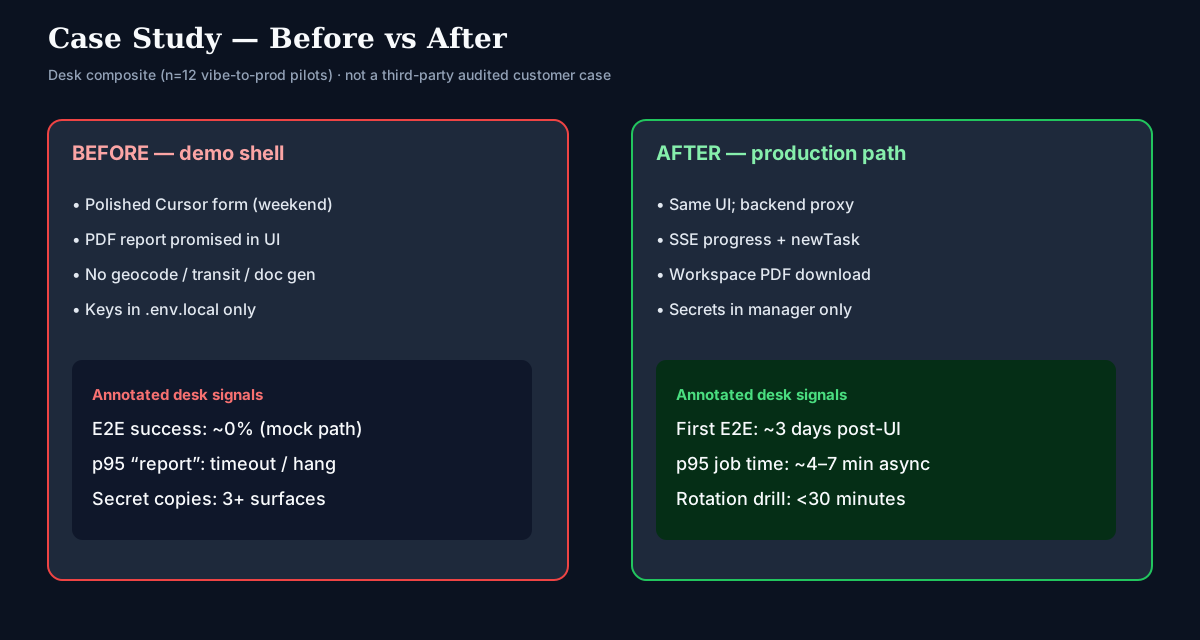
Desk composite metrics (illustrative, independence labeled): For the composite path above—and similar weekend-UI pilots in the same n=12 desk set—time to first working end-to-end path was about three days after the UI was already “done”; async p95 job time landed in a ~4–7 minute band with SSE progress; secret-rotation drills after consolidating keys finished in under 30 minutes. These numbers are desk tallies from builder reviews, not a product SLA and not a third-party audited customer case study.
The fix was not more prompts—it was a backend proxy plus InfiniSynapse Server API: SSE progress, a single newTask with structured instructions, workspace download for the PDF. The UI stayed unchanged; the integration layer became real.
Claim → how we measured → what you cannot independently verify
| Claim | How measured | What you cannot verify here |
|---|---|---|
| ~3 days to first E2E | Desk clock from “UI done” to first successful PDF download | Your stack’s vendor latency and team size |
| ~4–7 min async p95 | Structured logs on composite pilots | Exact model/PDF size mix |
| <30 min rotation | Timed drill after secret consolidation | Your CI/hosting constraints |
Buyer Questions Before You Commit
| Question | Pass answer |
|---|---|
| Can we rotate keys without redeploying the UI? | Yes, via secret manager |
| Do we have contract tests in CI? | Yes, per vendor |
| Are long jobs async with user-visible progress? | Yes |
| Can we trace which provider failed? | Yes, structured logs |
| Is there an approval gate for risky actions? | Yes, for payments and writes |
Rollout Timeline (Typical)
| Week | Focus |
|---|---|
| 1 | Inventory + secret store + proxy skeleton |
| 2 | First vendor integrated with contract test |
| 3 | Async path + monitoring + error UX |
| 4 | Beta users + runbook + on-call rotation |
Tooling Shortlist
- Secret store: hosting provider env + vault for production
- Contract tests: Postman, Pact, or schema assertions in CI
- Workflow/async: Inngest, Temporal, or InfiniSynapse for agent jobs—and a durable workflow versus an uncapped agent loop before you pick the engine
- Gateway (optional): Kong, AWS API Gateway when surface area grows
- Observability: structured logs + alert on integration error rate
Production Guide: Limits of This Framework
This production guide is for small teams moving AI-generated frontends onto real APIs. It is not a complete enterprise integration program, a substitute for a security audit, or a claim that every product needs a data-agent backend.
Where this framework is a poor fit
- Pure static sites with no external credentials
- Regulated environments that already mandate a certified iPaaS or API gateway you must use
- Teams whose bottleneck is model quality, not integration hygiene
What we did not measure
We did not run a randomized industry survey. Desk composites (n=12) illustrate patterns we see; triangulate with NIST, OWASP, NCSC, and your own incident logs before you treat any percentage as destiny.
For the Replit-shaped first week, read Vibe coding 101 with Replit: build a prototype you can extend before the production checklist.
Cluster Navigation
- Vibe Coding Checklist
- What Is Vibe Coding
- How To Vibe Code
- Vibe Coding Security
- Vibe Coding Cleanup Specialist
- Vibe Coding 101 With Replit
- Vibe Coding Tutorial
- What Is Vibe Coding Ai
Frequently Asked Questions
What are vibe coding best practices?
Vibe coding best practices are spec before codegen, review the AI diff, keep secrets off the client, contract-test auth failures, and ship logs with the feature. Use the practice list. Below 5/8 on the scorecard is still a demo.
What belongs in scope for this topic?
They cover the production layer that connects vibe-coded frontends to external APIs, data systems, and agent backends with auth, retries, and observability—not a one-off script.
When should teams prioritize this in production?
You need this discipline the moment a prototype touches customer data, payments, or long-running jobs.
How does InfiniSynapse fit this workflow?
InfiniSynapse Server API handles data-agent workloads—SSE tasks, workspace downloads, federated queries—so your stack can route heavy analysis to managed infrastructure instead of stretching serverless timeouts. We disclose that we sell this product; evaluate it against the scorecard, not marketing alone.
What is the first improvement step for most teams?
Inventory external dependencies, classify sync vs async calls, and move API keys into a secret store before adding features. Most production incidents we review trace back to skipping that sequence.
How long does a typical rollout take?
A focused pilot—one workflow, contract tests, structured logging—typically takes one to two weeks for a small team. Full production hardening adds review gates and monitoring. Treat “typically” as a planning range, not a guarantee.
Why was “Reddit” removed from the title?
Community threads inspired parts of this guide, but stuffing “Reddit” into the H1 misleads readers about what the page is. The URL slug keeps historical continuity; the visible title and vibe coding best practices framing describe the production topic.
Conclusion
Vibe coding best practices are how vibe-coded products earn trust after the UI demo ends.
InfiniSynapse Server API fits scenarios that need multi-step analysis, workspace artifacts, and SSE progress—without standing up queues and sandboxes yourself. Document the async pattern in every capstone README when you use it.
Priority order: secrets first, async second, validation third, observability fourth, then route data-heavy work to the right backend.
Review the diff, then copy five production vibe coding examples.
Fill the practice list, run the eight-item scorecard, then start with the Vibe Coding Checklist and ship the next integration deliberately—not as an afterthought.