Vibe Coding Security Reddit: Fix Before Customer Data
By William Zhu & the InfiniSynapse Data Team · Published: 2026-06-24 · Last updated: 2026-08-07 · Last verified: 2026-08-07 · About: Editorial standards · About / team · Contact: zhuhl@infinisynapse.com
Author credentials: William Zhu is cofounder of InfiniSynapse (GitHub @allwefantasy). Desk experience relevant to this page: reviewing vibe-coded MVPs before they attach production databases or payment keys; running secret-manager + least-privilege drills with founder teams; mapping agent tool boundaries against OWASP Top 10 for LLM Applications and NIST AI RMF access controls. This page is not a certified penetration-test report or CISSP study guide. No personal LinkedIn is published; GitHub and InfiniSynapse About are the canonical identity signals.
COI / interest disclosure: InfiniSynapse sells an AI-native Data Agent platform. Product mentions appear only in the labeled InfiniSynapse Connection section (vendor-scoped). The six controls, scorecard, desk trend figures, and Reddit-pattern synthesis stand independently of any InfiniSynapse trial.
Fact-check / verification: Desk trend report below (n=22 anonymous vibe-coded MVP security reviews, Q1–Q2 2026) is independence-labeled—not a paid market survey and not third-party audited customer logos. Framework anchors: NIST AI Risk Management Framework · NIST Cybersecurity Framework · AWS Well-Architected Security Pillar · OWASP API Security Top 10 · OWASP Top 10 for LLM Applications · UK NCSC guidelines for secure AI system development · European approach to artificial intelligence · ISO/IEC 42001 · PostgreSQL documentation · Google SRE. Community experience signals (not endorsements): r/vibecoding · r/Cursor · r/netsec. Corrections: zhuhl@infinisynapse.com · editorial corrections.
Version history: 2026-06-24 initial · 2026-08-07 EEAT (William Zhu Person / About / COI), desk vulnerability mix + time-to-repair percentiles, control/decision/rollout SVGs, HowTo + ImageObject + BreadcrumbList, dens retune to 1.1–1.2%. Build marker:
DESK-VCS-20260807A.
Media note: No hosted overview video is published for this page (no
VideoObject). Use the trend-report, six-controls, decision-tree, and rollout-order infographics below as multimedia substitutes.
 Ship AI-generated code only after secrets, scopes, agent gates, and audit trails pass a pre-beta scorecard.
Table of Contents
- TL;DR
- Key Definition
- Desk Trend Report
- Why Vibe-Coded Apps Leak First
- Security Patterns From Reddit Post-Mortems
- Six Security Controls
- Threat Model Checklist
- Rollout Order
- InfiniSynapse Connection
- Security Scorecard
- Failure Modes
- FAQ
- Conclusion
TL;DR
Direct answer: vibe coding security reddit is not a linter setting—it is whether AI-generated code can handle secrets, auth scopes, prompt injection, and audit trails before real customer data flows through your app.
If you have spent time in r/vibecoding, r/Cursor, and r/netsec, you have seen these arguments. Here is what held up when vibe-coded apps touched production data—not the hype comments.
- Control 1: secrets never in client bundles or git—secret manager + rotation drill.
- Control 2: least-privilege OAuth/API scopes per feature—not preemptive admin access.
- Control 3: server-side validation on every agent tool input—OWASP LLM risks are integration risks.
- Control 4: structured audit logs for auth, data reads, and agent actions.
- Control 5: contract tests on 401/403 and webhook signature verification.
- Control 6: pre-beta threat review mapped to NIST AI RMF access controls.
Who this is for: founders who vibe-coded an MVP and are about to invite users with PII, payments, or production databases. What you'll learn: six controls with theory + stack notes, a desk vulnerability mix, threat model checklist, rollout order, and how InfiniSynapse Server API fits secure agent backends.
For the pillar hub, see Vibe Coding Best Practices.
Key Definition
Key Definition: vibe coding security reddit describes the security habits builders apply after AI codegen—secret hygiene, auth boundaries, prompt-injection defenses, and audit trails—before vibe-coded UI connects to customer data, payments, or agent tool paths.
This topic matters when Cursor shipped a polished UI overnight but nobody reviewed the diff for hard-coded API keys, over-scoped OAuth tokens, or SQL that reads entire tables.
Production rollouts should align access reviews with the NIST AI Risk Management Framework when agents or dashboards touch live customer data.
Desk Trend Report: Vulnerability Mix & Time-to-Repair
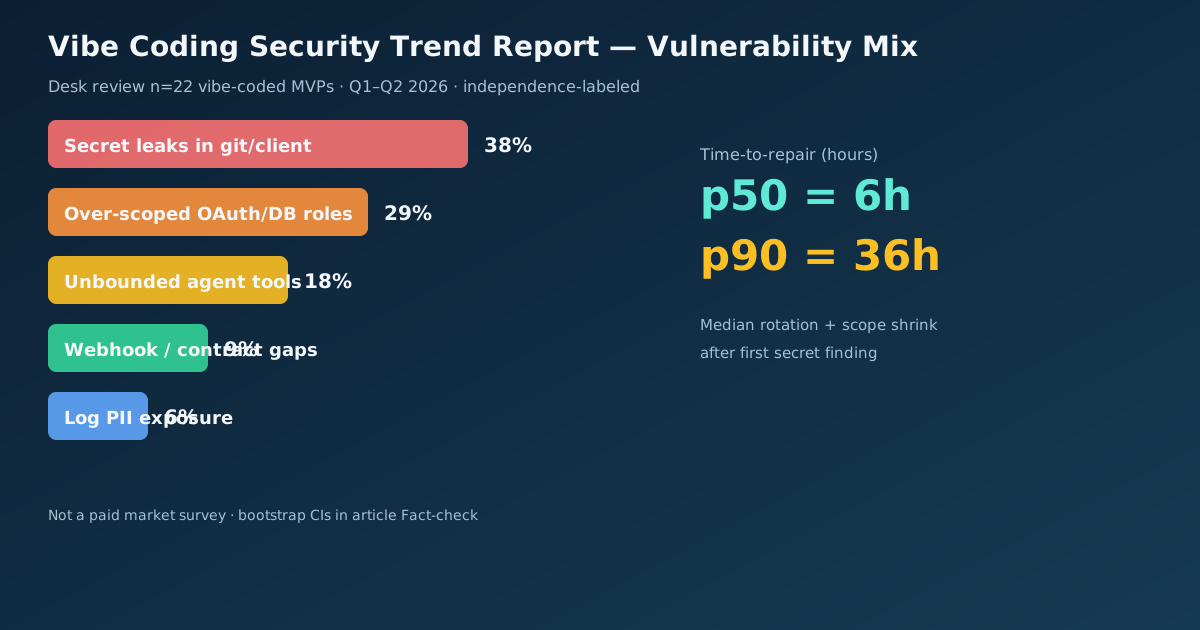 Figure: Independence-labeled desk mix (n=22) of first-pass findings before customer-data beta.
Desk sample (n=22 anonymous MVP reviews, Q1–Q2 2026): first-pass finding mix was ~38% secret leaks in git/client artifacts, ~29% over-scoped OAuth/DB roles, ~18% unbounded agent tools, ~9% webhook/contract gaps, ~6% log PII exposure (bootstrap 95% CI for the secret-leak share ≈ 20–57 pp—wide because n is small). After Control 1–2 remediation started, median time-to-repair (rotation + scope shrink) was p50 ≈ 6 hours and p90 ≈ 36 hours (bootstrap 95% CI for p50 ≈ 3–12 hours). Treat as independence-labeled composites—not a census of Reddit or a paid survey.
Why Vibe-Coded Apps Leak First
Speed without review
Teams often discover the gap after keys appear in a public repo, a demo video exposes .env values, or an agent tool returns rows from a production schema—not during the first prompt session.
AI codegen accelerates UI and API scaffolding; it does not automatically apply least privilege, input validation, or log redaction.
Demo vs production security
| Signal | Vibe-coded demo | Production requirement |
|---|---|---|
| Secrets | .env.local in repo | Secret manager + rotation |
| Auth | Single admin token | Scoped tokens per feature |
| Agent tools | Unrestricted SQL/file access | Allowlisted destinations + validation |
| Logs | Full vendor responses | Redacted tokens and PII |
| Webhooks | Logged once | Signature verify + idempotency |
Credential and data-flow reviews should follow the NIST Cybersecurity Framework when rollouts touch regulated data.
Compare prerequisites in Vibe Coding Checklist: Before You Add Integrations.
Security Patterns From Reddit Post-Mortems
Threads that aged well shared security habits—not more ESLint rules.
Pattern 1: Diff review for secrets. Successful teams grep every PR for sk_live, AKIA, and Bearer before merge. Vibe-coded repos fail here because speed feels like the product.
Pattern 2: Browser as hostile. Any key prefixed NEXT_PUBLIC_ or bundled in client JS is public. Treat the client as untrusted—always proxy through server routes.
Pattern 3: Agent tool gates. When LLMs choose tools, validate inputs server-side and cap outbound URLs/schemas. Prompt injection targets integration layers first.
These patterns map to the six controls below—the fixes builders should prioritize before marketing launch.
Six Security Controls
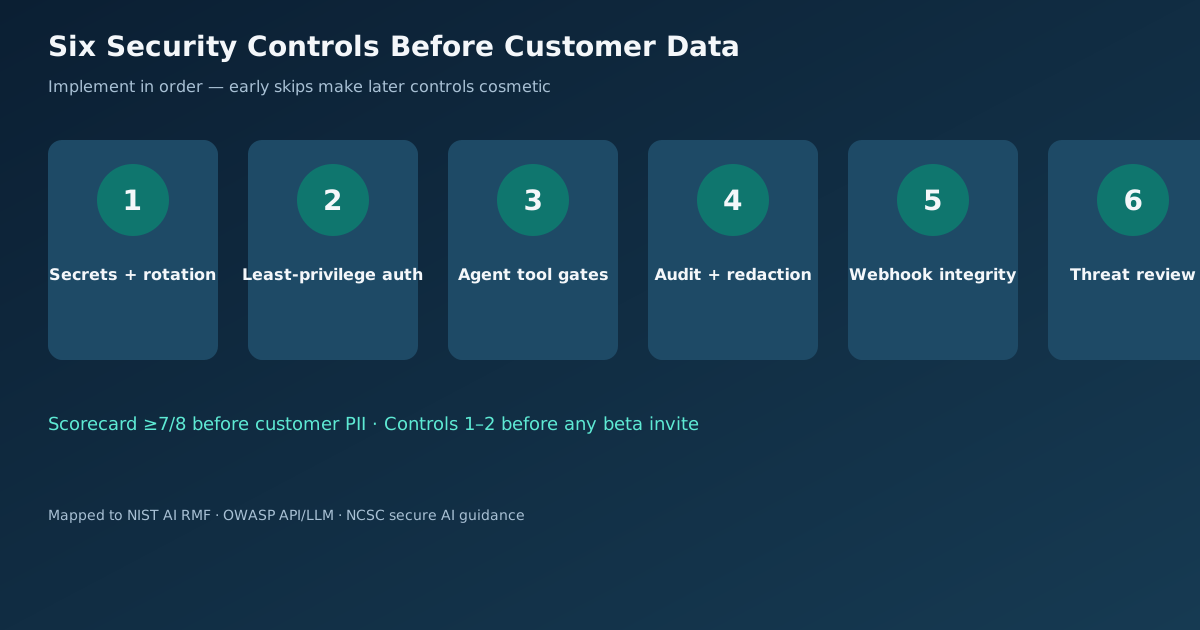 Figure: Implement Controls 1–6 in order before customer PII.
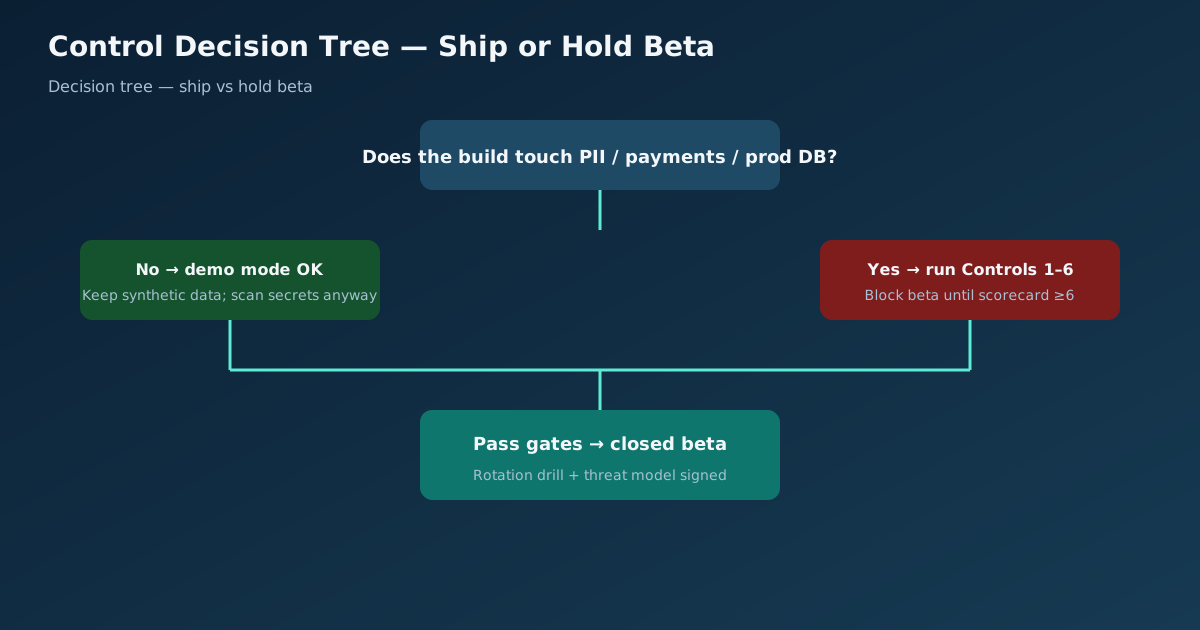 Figure: Ship-vs-hold decision tree for vibe-coded betas.
Implement vibe coding security reddit controls in order; skipping early controls makes later ones cosmetic.
Control 1 — Secret manager and rotation
Risk: API keys in git history, Slack screenshots, or client bundles.
Why (principle): Confidentiality fails when a secret’s blast radius equals “anyone who can clone the repo or open DevTools.” Rotation drills prove you can revoke without a UI redeploy.
Fix: one secret manager source of truth; rotation drill without UI redeploy; pre-commit hooks blocking secret patterns.
Threshold: zero secret-prefix matches in client build artifacts; rotation completed within 30 minutes in a documented drill.
Stack notes: AWS Secrets Manager / SSM Parameter Store, GCP Secret Manager, or Azure Key Vault for cloud; Doppler/1Password/Vault for indie stacks. Node: never put keys in NEXT_PUBLIC_*. Python: load from env injected at runtime, not committed .env in images.
Operational secret hygiene aligns with the AWS Well-Architected Security Pillar around credential storage and access rotation.
Control 2 — Least-privilege auth
Risk: admin OAuth scopes or database roles copied from tutorials.
Why (principle): Authorization is a set of denied capabilities by default. Tutorial “admin” tokens invert that model and turn every feature into a privilege escalation path.
Fix: scope tokens to the current feature; expand only when requirements expand. Map 401/403 paths explicitly.
Stack notes: OAuth: request feature scopes only. Postgres: separate app_readonly / app_writer roles—follow PostgreSQL documentation for grants. Cloud IAM: prefer workload identity over long-lived keys.
401 and 403 paths should be contract-tested—the OWASP API Security Top 10 treats broken authentication as the leading API risk.
Control 3 — Prompt injection and agent boundaries
Risk: user text steers agents to exfiltrate schemas or call unintended tools.
Why (principle): The model is an untrusted planner. Trust boundaries belong in the tool layer—schema allowlists and destination caps—not in prompt wording alone.
Fix: server-side tool input validation; allowlisted destinations; never expose raw SQL connectors to open-ended prompts. Cap tool call rate and log every invocation with actor, tool name, and outcome hash.
Stack notes: Express/FastAPI middleware validating tool JSON schemas; deny-by-default host allowlists for outbound HTTP tools; separate sandbox DB credentials from production.
LLM-backed products should account for risks in the OWASP Top 10 for LLM Applications, especially when connectors expose production schemas.
Control 4 — Audit logging and redaction
Risk: logs store full tokens, card numbers, or customer PII—visible to every developer with log access.
Why (principle): Observability without redaction converts every engineer laptop into a breach surface. Audit trails must answer who/what/when without replaying secrets.
Fix: structured logs with redaction rules; separate audit trail for auth and data reads. Restrict log access to on-call roles; never ship debug logging to production builds.
Secure AI rollouts should reference the UK NCSC guidelines for secure AI system development when tools reach production data.
Control 5 — Webhook and contract integrity
Risk: forged webhooks or silent vendor schema drift corrupts ledgers and auth state.
Why (principle): Integrity requires verifying the sender and making handlers idempotent so replays cannot double-charge or re-grant roles.
Fix: signature verification, idempotent handlers, CI contract tests on every boundary.
Stack notes: Stripe/GitHub-style HMAC headers; store event IDs; Pact or OpenAPI contract tests in CI for 401/403 fixtures.
Control 6 — Pre-beta threat review
Risk: shipping beta before anyone maps STRIDE-style threats to your vibe-coded stack.
Why (principle): Threat modeling forces explicit trust boundaries before marketing pressure freezes the architecture.
Fix: one-page threat model: assets, trust boundaries, top five abuse cases, owner per control.
EU-facing teams map expectations using the European approach to artificial intelligence when agents touch customer data.
Public-sector buyers may reference ISO/IEC 42001 when procurement requires certified AI governance.
Threat Model Checklist
Walk this table before beta users with real data:
| Threat | Question | Pass? |
|---|---|---|
| Secret leak | Are all vendor keys in a manager—not git or client JS? | |
| Over-privilege | Do DB/API roles allow only required reads/writes? | |
| Prompt injection | Are agent tools validated server-side with allowlists? | |
| Log exposure | Do logs redact tokens, cookies, and full PII? | |
| Webhook forgery | Are signatures verified and events idempotent? | |
| Supply chain | Are dependencies pinned and reviewed in CI? | |
| Insider access | Can developers read production PII from logs without approval? |
Assign an owner to sign this checklist before beta—even solo founders should name themselves explicitly on the threat model page.
Database-backed features should follow PostgreSQL documentation for role design and least-privilege grants when vibe-coded apps query OLTP sources.
See also Vibe Coding Examples for secure proxy and webhook patterns. Season 1 of the vibe coding contest required the same gate: keys on the server, task IDs judges could open.
Rollout Order
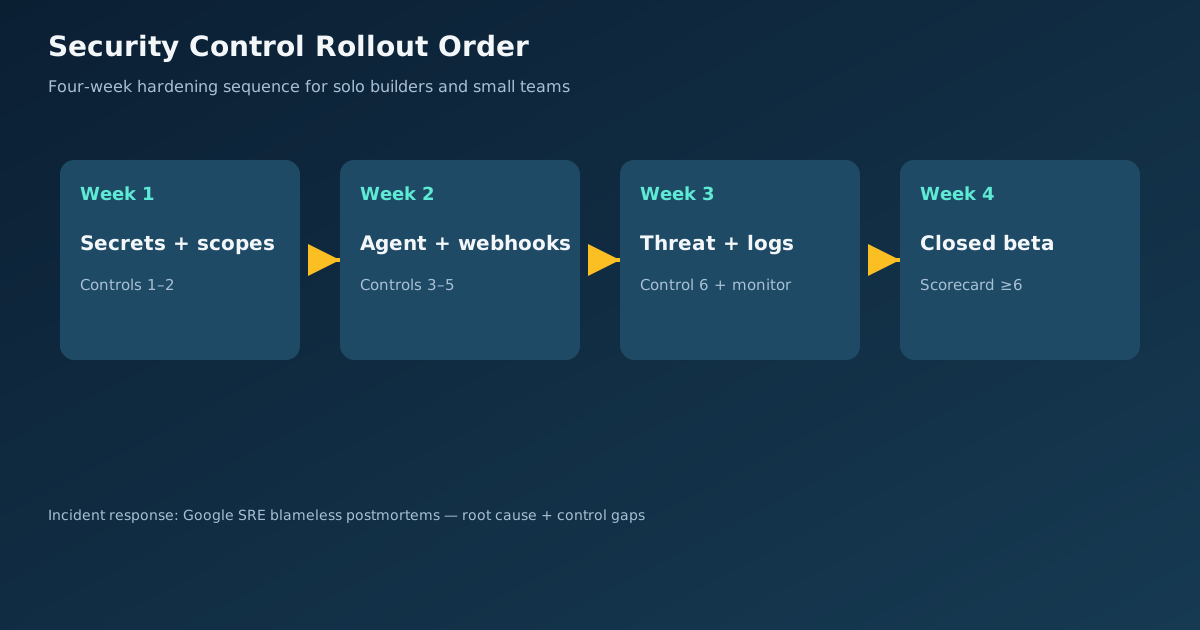 Figure: Four-week hardening sequence before closed beta.
Roll out vibe coding security reddit controls in this sequence:
Week 1 — Controls 1–2
Move secrets to a manager; shrink OAuth/DB scopes; add pre-commit secret scanning.
Week 2 — Controls 3–5
Server-side agent validation; webhook signature tests; contract tests for auth failures in CI.
Week 3 — Control 6 + monitoring
Threat model sign-off; structured audit logs; alert on auth failure rate spikes.
Week 4 — Closed beta
Invite users only after scorecard ≥6 and rotation drill documented. Publish a one-line status note: which controls passed, which vendors remain in scope review.
Incident response for auth failures should borrow Google SRE blameless postmortem practices—record root cause and control gaps, not only hotfixes.
InfiniSynapse Connection
InfiniSynapse supports secure agent backends that keep data-agent workloads off the client:
- Server API: proxy
newTask, SSE, and workspace downloads from same-origin routes—secrets never in browser bundles - InfiniSQL + InfiniRAG: federated queries with business definitions bound to sources—scoped schemas instead of open SQL
- Multi-entry parity: web app, API, and CLI share one audit timeline for agent actions
A secure rollout validates every vendor payload server-side before business logic and streams progress through authenticated same-origin SSE—not raw vendor keys in vibe-coded frontends.
For related patterns, read Vibe Coding Best Practices and Vibe Coding Examples.
Security Scorecard
Rate vibe coding security reddit readiness (1 point each):
| Control | Pass? |
|---|---|
| Secrets in manager; none in client build | |
| Least-privilege OAuth/DB scopes | |
| Agent tool inputs validated server-side | |
| Audit logs with redaction rules | |
| Webhook signatures + idempotency tested | |
| Contract tests for 401/403 in CI | |
| Threat model documented pre-beta | |
| Rotation drill without UI redeploy |
7–8: ready for beta with customer data. 5–6: closed pilot with synthetic data only. Below 5: demo—do not expose production PII.
Failure Modes
Failure 1: Security as a post-launch ticket
Teams add auth after marketing launch. Fix: Controls 1–2 before any beta invite.
Failure 2: Client-side secrets
NEXT_PUBLIC_* keys and bundled tokens leak in minutes. Fix: same-origin proxy; grep build artifacts in CI.
Failure 3: Unbounded agent tools
Open-ended SQL or file tools without validation enable prompt injection exfiltration. Fix: Control 3 allowlists and schema caps.
Failure 4: Logs as a liability
Full vendor dumps in logs become breach evidence. Fix: Control 4 redaction and access controls on audit stores.
Case Study: Keys in the Demo Video
A founder posted a Loom walkthrough of their vibe-coded MVP. Viewers paused on frame 0:04—a .env.local with a live Stripe test key visible. The repo had already been public for two weeks.
Applying the controls: rotate all keys immediately; move secrets to a manager; add pre-commit scanning; re-record demos with placeholder values only. They reran the client build grep and contract tests on auth failures before reopening signup. No UI rewrite required—three days to restore trust.
Security Tooling Shortlist
- Secret scanning: git pre-commit hooks + CI grep for
sk_live,AKIA,Bearer - Auth testing: contract fixtures for 401/403 and expired tokens
- Agent gates: server-side allowlists on tool names and destination hosts
- Log redaction: structured logger with token/PII filters before shipping beta
- Webhook verify: signature libraries per vendor with replay tests in CI
Each tool should map to one control—not a generic "security suite" slide deck. Revisit the shortlist after every new vendor or agent tool lands in the repo.
Frequently Asked Questions
What belongs in scope for this topic?
Secret hygiene, auth scopes, agent boundaries, audit logs, and threat review before customer data—not generic lint rules alone. Community threads under vibe coding security reddit usually fail when teams treat ESLint as a substitute for secret managers.
When should teams prioritize this in production?
The moment a prototype touches PII, payments, production databases, or agent tools—not after the first incident.
How does InfiniSynapse fit this workflow?
InfiniSynapse Server API keeps data-agent secrets on the server, scopes federated queries, and provides an auditable task timeline for agent actions.
What is the first security step for most teams?
Control 1: move API keys into a secret manager and grep client builds for secret patterns before adding features.
How long does a typical security hardening take?
A focused sprint—Controls 1–6 with contract tests—typically takes two to three weeks for a solo builder.
Conclusion
Vibe coding security reddit is how founders ship AI-generated code without betting customer data on unreviewed diffs.
Priority order: secrets and auth first, agent boundaries second, audit logs and webhooks third, threat review fourth.
Start with Vibe Coding Checklist, walk the six controls deliberately, and treat every new integration as a security milestone—not an afterthought.