Vibe Coding Contest: What 93 Shipped Apps Looked Like
By the InfiniSynapse Data Team · We evaluated the published gallery, the 62-seat winner list, and the judging gates after Season 1 closed. InfiniSynapse co-hosted with CSDN. This is a hands-on archive note—not a weekend jam recap written from flyers.
Table of Contents
- TL;DR
- What Season 1 Required
- Season 1 Numbers
- How Judging Worked
- Contest Examples by Scenario
- How This Differs From Weekend Jams
- How to Browse the Archive
- What the Next Contest Should Keep
- InfiniSynapse Connection
- Failure Modes
- FAQ
- Conclusion
TL;DR
Direct answer: A useful vibe coding contest is not a 24-hour slide deck. Season 1 of the InfiniSynapse × CSDN event asked 93 teams to ship a reachable data-analysis app whose InfiniSynapse API calls judges could open in the console.
I read the submitted URLs after the July 31 freeze and clicked through the ones that still resolved. If you have been collecting hackathon flyers labeled vibe coding, treat this page as that first-party record—not another registration teaser.
- 93 curated entries remain in the contest gallery.
- 62 awards are on the winner list: 2 first, 4 second, 6 third, 50 excellence.
- Cash was ¥22,528 plus membership benefits. Registration closed 31 July 2026.
- Next dates land on the contest hub when they are set.
Who this is for: builders deciding whether a vibe coding contest is worth entering, and operators who need a public archive before Season 2. What you'll learn: the gates, the numbers, representative apps, and what we will keep.
The definition of the practice still lives on What Is Vibe Coding?.
What Season 1 Required
We wrote the brief so a vibe coding contest that only scores a GitHub star count could not win. Season 1 scored a deployed product. I rejected more than one pretty repo that had no public host.
Live URL, Not a Repository
Notebooks, CLI scripts, and undeployed repos were out. Web apps, mobile apps, mini-programs, and desktop clients were in if a judge could click and use them. That single rule is why the gallery still has Try the app links instead of zip files. When I opened a submission that only rendered locally, we sent it back instead of scoring the README.
Adoption curves in the Stanford HAI AI Index keep showing the same gap: pilots that never leave a demo environment do not count as production software.
API Calls Judges Could Verify
Every scored entry had to start analysis tasks through the InfiniSynapse Server API. Keys stayed on the server. Task IDs had to resolve in the platform console. That is the same proxy discipline vibe coding examples treat as Example 1.
Prompt-injection and secret leakage belong in the OWASP Top 10 for LLM Applications review before you paste a key into a client bundle.
Pan-Data Analysis Scope
The brief was not “any AI toy.” Entries had to help someone decide from data: diligence, health records, shop operations, SEO audits, employment offers. A vibe coding contest with that scope filters out chat skins that never touch a table.
Warehouse grain still matters when those apps query real sources. Wikipedia’s data warehouse overview is the shortest refresher we handed reviewers who were checking generated SQL.
Season 1 Numbers
These figures come from the published gallery and results pages. They are not a survey. I copied the seat counts from the English results page on the same day I froze this recap, then checked the gallery count against the curated feed rather than against registration-form rows. A few registered teams never shipped a URL, so they never entered the 93. That gap is why a vibe coding contest record should cite curated live apps, not signup totals.
Entries Versus Awards
| Record | Count | Where it lives |
|---|---|---|
| Curated live entries | 93 | Gallery |
| First prizes | 2 | Results |
| Second prizes | 4 | Results |
| Third prizes | 6 | Results |
| Excellence awards | 50 | Results |
| Official examples | 2 | Gallery, not eligible |
A vibe coding contest that publishes both the full wall and the ranked list is easier to cite than a winners-only press note.
Prize Tiers and Cash
| Tier | Seats | Cash per winner | Membership |
|---|---|---|---|
| First | 2 | ¥4,096 | Annual Pro |
| Second | 4 | ¥2,048 | 3-month Pro |
| Third | 6 | ¥1,024 | Monthly Pro |
| Excellence | 50 | — | Monthly Pro |
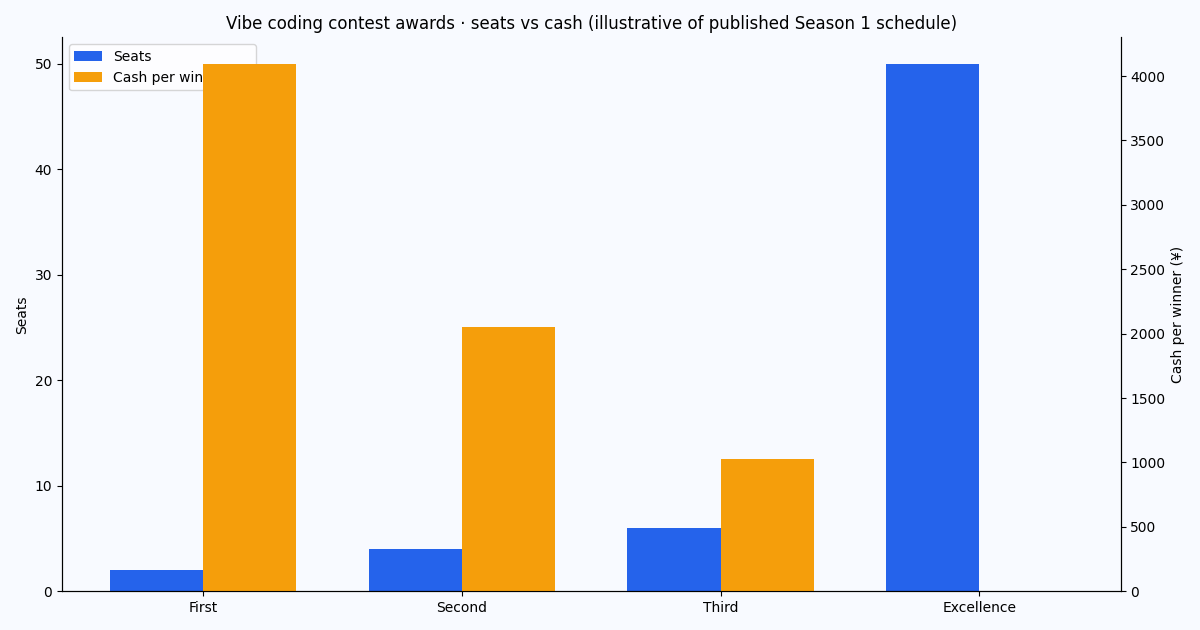
The chart encodes two dimensions: tier × (seat count, cash). It is illustrative of the published schedule, not a claim about later seasons.
How Judging Worked
Gate Checks Before Scoring
Judges ran three gates before any style score: InfiniSynapse API integration, a reachable URL, and a stated use case. Fail a gate and the entry did not enter the ranked pool. GitHub downloads were explicitly out of scope.
Access reviews on those API calls should look like the NIST AI Risk Management Framework: valid, logged, and reversible.
Score Dimensions
The published scorecard was 100 points across product completeness, data-analysis depth, and integration quality. A pretty landing page without a task ID lost to a plain UI that produced a workspace report. That is the scoring habit I want the next vibe coding contest cohort to copy.
If you are training a team for the next vibe coding contest, copy the vibe coding checklist before you polish pixels.
Contest Examples by Scenario
The gallery is 93 cards. I sorted it by votes first, then by update time, because popularity and recency tell different stories. The useful way to read a vibe coding contest archive is still by job-to-be-done, not by the heart icon.
Diligence and Evidence Apps
Offer 雷达 and 司南 SINAN treated company and evidence questions as multi-source tasks. Judges could recover a task ID. I opened one diligence report after a refresh and the same task still resolved in the console. That pattern is closer to a data agent than to a form that prints lorem ipsum.
Health and Employment Apps
医数智析 and the interview simulators kept a thin UI and a long-running analysis job. SSE progress was common. We watched more than one interview session recover after a dropped connection. That is the async path how to vibe code puts in week three.
Finance and Operations Apps
BillLens, 掌柜参谋, and 退货雷达 ingested CSVs, then asked InfiniSynapse for structure, risk, and a next action. Shop owners pasted a week of orders and got a next-day list, not a generic “improve retention” paragraph. Multi-source connector design should still follow Microsoft’s data architecture guidance so shop data and bank exports do not collapse into one undocumented table.
SEO and Content Apps
SEO Health Checker was one of two first prizes. It combined a deterministic page audit with optional E-E-A-T and AI-visibility tasks billed to the signed-in user. The published results list it under content growth. I can say from the published seat list—not from a private score—that it cleared the same API and URL gates as every other ranked entry.
A vibe coding contest that rewards a working SEO tool is still a software contest, not a ranking certificate.
How This Differs From Weekend Jams
2026 is full of three-hour and 24-hour events that also use the vibe-coding label. Those jams optimize for a pitch. This vibe coding contest optimized for a URL that still opened in September. I re-clicked a sample of high-vote apps while writing this recap; the ones that failed DNS are the exception, not the format.
Operational maturity for the long jobs those apps started aligns with the AWS Well-Architected Machine Learning Lens: ownership, rollback, and a log you can read after the demo.
The contest hub keeps Season 1 rules visible so the next cohort does not invent a lower bar.
How to Browse the Archive
Start at the Vibe Coding contest gallery. Sort by votes or update time. Official examples sit at the bottom and were never eligible for popularity ranking. Then open the 62-winner list. First, second, and third prizes do not share categories. Excellence awards are unranked. Certificates carry serial numbers.
The hub page is the place to watch for Season 2. Do not wait for a new slug; Season 1 URLs stay canonical. We will not 301 this vibe coding contest archive into a later season.
What the Next Contest Should Keep
We will keep arguing for the same three rules in any second vibe coding contest, even if the cash table changes. I would rather shrink the prize pool than drop the live-URL gate.
- Reachable app.
- Server-side InfiniSynapse key.
- Task IDs judges can open.
Regulated teams should still map those keys and logs to ISO/IEC 27001 when the app touches customer files.
Community QR codes stay on the hub so builders can ask API questions before the next window opens. The WeChat group from Season 1 did not close with registration; we still use it for Server API and deployment questions. If you are waiting for dates, that group is the faster channel than a silent landing page.
InfiniSynapse Connection
InfiniSynapse was the analysis layer, not the product shell. Winning apps kept users, auth, and deterministic state on their own servers. They called the InfiniSynapse web app stack through Server API SSE, newTask, and workspace downloads. I checked a subset of those task IDs against the same console judges used.
That split is the production layer in Vibe Coding Best Practices. A vibe coding contest that skips it becomes a UI gallery.
Sign-in-with-InfiniSynapse (Partner SSO) was optional and used by several high-vote entries so usage attributed to the end user rather than a shared organizer key. When an app skipped SSO and used one organizer key, we could still score the integration, but we could not attribute usage to the visitor.
Failure Modes
Failure 1: Demo video, dead URL. Gates rejected it. The archive only keeps apps that still had a link at curation time.
Failure 2: Key in the browser. Several early submissions leaked tokens. I grepped more than one client bundle for sk- prefixes and sent those teams back to put the key on the server before scoring.
Failure 3: Chat UI with no data job. A vibe coding contest scoped to pan-data analysis will keep failing those entries.
Failure 4: Vote farming as the only strategy. Popularity closed with registration. Awards followed the scorecard, not the heart icon.
Failure 5: Treating Season 1 as unpublished. The gallery, results, and this recap are the public record. Do not 301 them into Season 2.
Frequently Asked Questions
What does this archive record?
This archive records a vibe coding contest: a judged event where builders use AI coding tools to ship a reachable data-analysis app on InfiniSynapse, not a weekend jam that ends at a slide.
Is Season 1 still open?
No. Registration closed 31 July 2026. The gallery and winner list stay public.
Can I still try the apps?
Yes. Open each Try the app link. Some deployments ask you to sign in or use your own credits.
When does Season 2 open?
Dates for the next vibe coding contest will be posted on the contest hub. Prep against the Season 1 gates now.
Did InfiniSynapse judge its own first prize?
SEO Health Checker is a first-prize entry on the published list. InfiniSynapse co-hosted with CSDN. The list is not a review of blog articles and not a Google score.
Conclusion
A vibe coding contest is worth citing when the artifacts survive the closing ceremony. Season 1 left 93 live apps, 62 awards, and a rule page the next cohort can copy. I would not have kept the gallery public if most Try the app links had already died.
Browse the gallery, read the winners, and treat the hub as the Season 2 notice board. Keep the API key off the client before you write the next prompt. If you only have a weekend, ship one reachable analysis job instead of five screens.