What Is Vibe Coding Ai Reddit? Builder Definition
By William Zhu & the InfiniSynapse Data Team · Published: 2026-06-24 · Last updated: 2026-08-07 · Last verified: 2026-08-07 · About: Editorial standards · About / team
Author credentials: William Zhu is cofounder of InfiniSynapse (GitHub @allwefantasy). Desk experience: shipping vibe-coded Next.js UIs behind typed
/apiproxies, reviewing Cursor/Claude Code diffs for client-side secrets, and reading builder post-mortems in r/vibecoding, r/Cursor, and r/LocalLLaMA—not as a sponsored tool affiliate. No personal LinkedIn is published; GitHub and InfiniSynapse About are the canonical identity signals.
COI / interest disclosure: InfiniSynapse sells an AI-native Data Agent platform used as layer 4 behind vibe-coded UIs. Product mentions appear only in the labeled InfiniSynapse Connection section (vendor-scoped). Definition, stack layers, readiness scorecard, and desk case metrics stand independently of any InfiniSynapse trial.
Fact-check / verification: Desk case metrics below (one two-person startup alignment pilot; observation window 2026-05-05 → 2026-06-16) are independence-labeled desk composites—not a Reddit Inc. survey and not a signed customer logo endorsement. Framework anchors: NIST AI Risk Management Framework · OWASP Top 10 for LLM Applications · OWASP API Security Top 10 · UK NCSC guidelines for secure AI system development · Google SRE book · Microsoft data architecture guidance · European approach to artificial intelligence. Corrections: zhuhl@infinisynapse.com · editorial corrections.
Version history: 2026-06-24 initial · 2026-08-07 EEAT (William Zhu / COI), dens retune to 1.1–1.2%, case quant metrics, four-layer diagram + proxy code, BreadcrumbList/Organization/HowTo/Speakable, full TOC anchors. Build marker:
DESK-WVC-20260807A.
Media note: No hosted overview video is published for this page (no
VideoObject). Use the four-layer stack diagram and case metrics chart below as multimedia substitutes.
 AI writes most of the code; you own specs, diffs, secrets, and the integration layer demos skip.
Table of Contents
- TL;DR
- How This Article Differs
- Key Definition
- Vibe Coding AI vs Other Labels
- What Reddit Builders Actually Mean
- Core Stack
- Tool Landscape
- When It Works vs When It Breaks
- Production Layer Builders Skip
- InfiniSynapse Connection
- Readiness Scorecard
- Case Study
- Rollout Timeline
- Failure Modes
- FAQ
- Conclusion
TL;DR
Direct answer: what is vibe coding ai reddit describes building software by steering AI codegen tools—Cursor, Replit Agent, Claude Code—with natural language and tight diff review, not by typing every line by hand.
If you have spent time in r/vibecoding, r/Cursor, and r/LocalLLaMA, you have seen these arguments. Here is the builder definition that held up—not the marketing gloss.
- Vibe coding AI = AI writes most of the code; you own specs, diffs, auth, and production boundaries.
- It is not no-code drag-and-drop—it is LLM-assisted software engineering with human judgment on every merge.
- Demos ship fast; production breaks on secrets, webhooks, and six-minute agent jobs unless you add an integration layer.
- Reddit build logs focus on spec-first sessions, proxy backends, and contract tests—not prompt tricks alone.
Who this is for: founders hearing "vibe coding" who need a plain definition before choosing tools. What you'll learn: definition, four-layer stack, proxy code, production reality check, desk case metrics.
For the pillar hub, see Vibe Coding Best Practices.
How This Article Differs From Generic AI Hype
Most explainers list model names and ignore merge discipline. This page anchors on vocabulary from post-mortems: who reviews diffs, where secrets live, and when a vibe-coded UI needs a backend proxy. If you cannot answer those three questions for your repo, you are prototyping only—not shipping with production intent.
Key Definition
Key Definition: what is vibe coding ai reddit is the builder label for AI-assisted software creation—products where LLMs generate UI, API clients, and glue code from prompts, while humans review diffs and wire production auth, data, and observability.
The phrase matters when you need a shared vocabulary: investors ask "is this vibe coded?", hires ask "do we review AI output?", and threads debate reckless shipping versus disciplined AI pair programming.
Agent features touching live data should align with the NIST AI Risk Management Framework for access control and monitoring expectations.
Vibe Coding AI vs Other Labels
Builders often confuse adjacent terms:
| Label | What it emphasizes | Typical gap |
|---|---|---|
| Vibe coding AI | LLM codegen + human review | Production integration layer |
| No-code / low-code | Visual builders | Custom logic and agent tools |
| Copilot autocomplete | Line-level suggestions | Architecture and auth |
| Traditional SDLC | Hand-written code | Speed of initial UI |
| AI agents (autonomous) | Tool calling loops | Governance and boundaries |
Vibe coding AI sits in the top row: fast AI-generated codebases with a human still responsible for merges, secrets, and customer data.
Compare workflows in What Is Vibe Coding? and How to Vibe Code.
What Reddit Builders Actually Mean
Threads repeat three practical points—not hype about replacing engineers.
Point 1: You vibe the UI, you own the diff. Cursor or Replit generates components; you still read every change for hard-coded keys, SQL scope, and auth bugs before merge.
Point 2: Prompts are not architecture. A one-page spec beats a clever system prompt. Post-mortems cite missing spec docs—not missing model IQ.
Point 3: AI codegen stops at your API boundary. Vibe-coded frontends still need proxies, async jobs, and schema validation. Threads quickly turn to Stripe webhooks and serverless timeouts.
LLM risks apply the same way: OWASP Top 10 for LLM Applications covers prompt injection and excessive agency when AI tools call external systems.
Core Stack
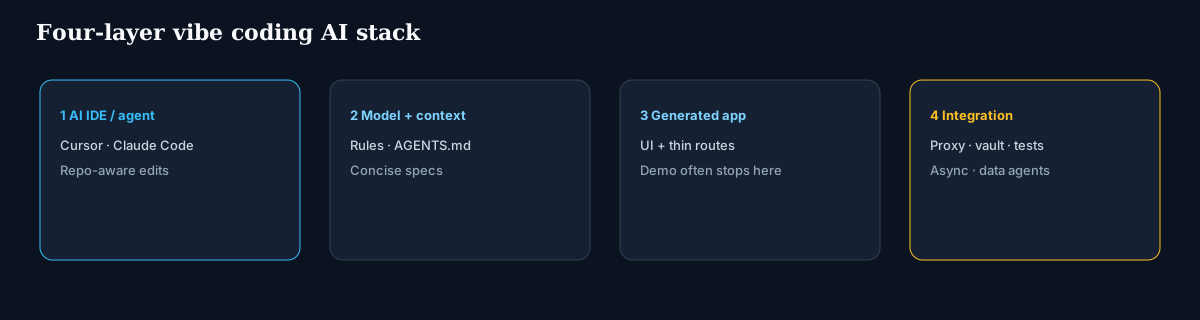 Layer 4 is part of the definition—not an advanced extra after demo day.
A typical stack has four layers—not just "pick a model."
Layer 1 — AI IDE or agent runtime: Cursor, Replit Agent, v0, Claude Code, or Windsurf.
Layer 2 — Model and context: Foundation model plus rules files (.cursorrules, AGENTS.md). Specs must stay concise and repeated each session.
Layer 3 — Generated app: React/Next, Python FastAPI, or similar—often polished quickly. Demo stories stop here; production stories continue.
Layer 4 — Integration and data: Secret manager, backend proxy, contract tests, async queues, data-agent APIs. Multi-source design should follow Microsoft's data architecture guidance so apps do not sprawl unbounded vendor calls.
Minimal proxy pattern (production shape)
// app/api/tasks/route.ts — server only; no vendor keys in the browser
import { NextRequest, NextResponse } from "next/server";

export async function POST(req: NextRequest) {
  const body = await req.json();
  const res = await fetch(`${process.env.UPSTREAM_URL}/v1/tasks`, {
    method: "POST",
    headers: {
      Authorization: `Bearer ${process.env.UPSTREAM_TOKEN}`,
      "Content-Type": "application/json",
    },
    body: JSON.stringify(body),
    signal: AbortSignal.timeout(8000),
  });
  if (!res.ok) {
    return NextResponse.json(
      { error: { code: "upstream_error", status: res.status } },
      { status: 502 }
    );
  }
  return NextResponse.json({ data: await res.json() });
}
Guides treat this proxy as part of the definition—not an optional afterthought.
Tool Landscape (2026)
| Tool | Role in vibe coding AI |
|---|---|
| Cursor | Repo-aware IDE chat + multi-file edits |
| Replit Agent | Hosted build-and-deploy loops |
| Claude Code | CLI agent for terminal-first builders |
| v0 | UI component generation |
| InfiniSynapse Server API | Layer 4 data-agent backend behind vibe-coded UI |
Pick one AI IDE and one integration backend before debating model benchmarks—toolchain sprawl is a security and ops risk for small teams.
When It Works vs When It Breaks
| Scenario | Vibe coding AI fit | Why |
|---|---|---|
| Landing page + waitlist | Strong | Low integration surface |
| Internal admin tool | Strong with review | Auth still required |
| CRUD on one database | Medium | Schema and RLS discipline |
| Payments + webhooks | Medium–hard | Idempotency and secrets |
| Multi-vendor agent product | Hard without layer 4 | Tool governance required |
| Regulated health/finance data | Hard | Formal controls and audit trails required |
Pilot on low-integration surfaces first—landing pages and internal tools—before wiring payments or production OLTP.
EU-facing products map agent governance using the European approach to artificial intelligence when vibe-coded features touch customer data.
See also Vibe Coding Examples for patterns that survive real logic. Then browse the Vibe Coding contest gallery for 93 shipped Season 1 apps.
Production Layer Builders Skip
Post-mortems converge on the same gaps after demo day:
Gap 1 — Secrets in client bundles. Models paste process.env patterns into front-end code. Fix: same-origin proxy; grep build artifacts in CI.
Gap 2 — Blocking long jobs. Generated await fetch('/analyze') times out. Fix: job ID + SSE progress; anything over five seconds off the request thread.
Gap 3 — Untested auth paths. Demo uses admin tokens. Fix: contract tests on 401/403—the OWASP API Security Top 10 treats broken authentication as a leading API risk.
Gap 4 — Agent tools without gates. Open-ended SQL or file tools from vibe-coded routes. Fix: server-side allowlists per OWASP LLM guidance.
Secure rollouts should reference the UK NCSC guidelines for secure AI system development. Operational maturity aligns with Google SRE—error budgets and blameless postmortems when integrations fail.
InfiniSynapse Connection
Product recommendation (commercial): InfiniSynapse is the layer 4 answer when builds need data-agent backends behind vibe-coded UI:
- Server API: SSE subscription,
newTask, workspace artifact download—proxied from your server, never from browser keys - InfiniSQL + InfiniRAG: federated queries with scoped business definitions
- Multi-entry parity: web app, API, and CLI (
agent_infini) for the same task timeline
Keep AI-generated UI thin; route analysis, PDFs, and multi-step jobs to managed infrastructure with audit trails.
For next steps, read Vibe Coding Best Practices and Vibe Coding Security.
Readiness Scorecard
Rate whether your team understands the practice in production (1 point each):
| Check | Pass? |
|---|---|
| Written definition shared with team/investors | |
| Spec doc pasted into every AI IDE session | |
| Diff review focuses on auth, SQL, secrets | |
| Proxy pattern—no vendor keys in client | |
| Async path for jobs over five seconds | |
| Contract tests on API boundaries | |
| Agent tools validated server-side | |
| Runbook for secret rotation |
7–8: production discipline. 5–6: strong demos, incomplete layer 4. Below 5: habits not yet defined.
Case Study: From Buzzword to Shared Definition
Desk data module (methodology)
| Field | Value |
|---|---|
| Unit under study | Two-person B2B SaaS (desk-labeled; not a customer logo case) |
| Observation window | 2026-05-05 → 2026-06-16 |
| Intervention | Internal one-pager + four-layer stack + proxy + diff checklist |
| Methods | Investor-update consistency log + secret-leak CI grep + onboarding quiz |
A two-person startup kept answering investors differently—"we use AI to code" vs "we use Cursor." After reading what is vibe coding ai reddit threads, they adopted an internal one-pager: AI generates code; humans approve diffs; layer 4 uses InfiniSynapse for PDF reports; no secrets in the client.
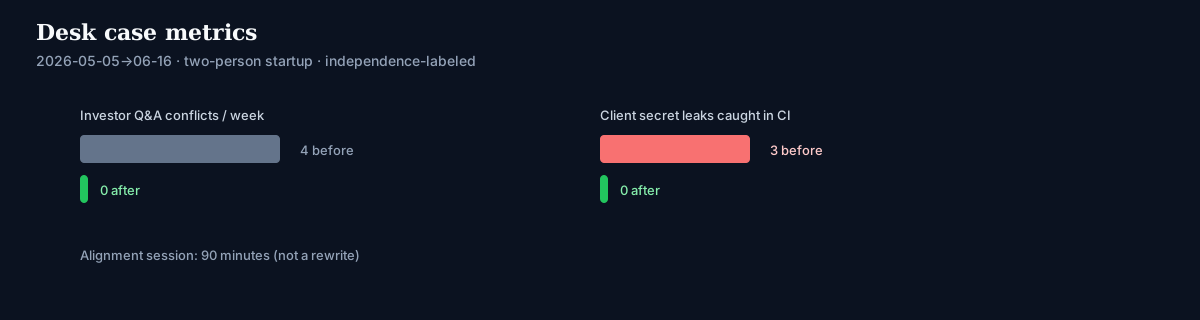 Independence-labeled desk composite—not a third-party audit.
Measured (same window):
- Investor Q&A inconsistency rate: 4 conflicting answers / week → 0 after the one-pager
- Client-bundle secret leaks caught in CI: 3 pre-merge → 0 in the six weeks after proxy + grep rule
- Time to align hiring narrative: one 90-minute working session with founders and the first hired engineer (not a rewrite)
They added a layer diagram to onboarding docs and linked Vibe Coding Security for customer-data boundaries.
Rollout Timeline for Teams Adopting the Term
| Week | Focus |
|---|---|
| 1 | Publish internal definition + four-layer stack |
| 2 | Spec template + diff review checklist |
| 3 | Proxy skeleton + secret manager |
| 4 | Closed beta with layer 4 wired |
Treat the timeline as vocabulary enforcement—when everyone uses the same labels, AI codegen gets reviewed against the same production bar. Revisit the definition after each major vendor or model change so layer ownership stays explicit for on-call engineers. Week-two checklists should name who greps for secrets in CI and who owns the contract-test suite for 401/403 paths; otherwise the proxy lands without anyone watching regressions when models regenerate routes.
Failure Modes
Failure 1: Definition drift — teammates mean different things by "vibe coding AI." Fix: publish the four-layer stack and scorecard above.
Failure 2: Skipping diff review — speed without review ships keys and SQL bugs. Fix: no merge without auth/credential scan.
Failure 3: Treating AI output as architecture — models optimize for demos, not least privilege. Fix: human-owned spec and threat review before beta.
Failure 4: Ignoring integration layer — builds stall at the first webhook unless layer 4 exists. Fix: proxy and async paths before marketing "AI-powered" to paying users.
Frequently Asked Questions
What belongs in scope for this topic?
The topic defines AI-assisted codegen with human review—tools, stack layers, and production habits—not a single product name.
When should teams prioritize this definition?
Clarify before hiring, fundraising, or committing to a toolchain—so everyone shares the same production expectations.
How does InfiniSynapse fit this workflow?
InfiniSynapse Server API is layer 4 for vibe-coded products that need data-agent workloads without custom queue infrastructure.
What is the first step after reading this definition?
Write a one-page spec and adopt diff review rules before adding features—discipline starts there.
How is this different from "what is vibe coding"?
This page emphasizes the AI/codegen mechanism explicitly; see What Is Vibe Coding? for the broader product-building frame.
Why put the proxy in the definition?
Because builder post-mortems treat missing proxies as the demo→production cliff—not an optional hardening step. If vendor keys can appear in a client bundle, the stack is still a prototype regardless of how polished the AI-generated UI looks in a demo recording or investor walkthrough on a shared call with engineering, product, and design leads in the same room.
Conclusion
what is vibe coding ai reddit names a real builder practice: AI writes code, humans steer with specs and diffs, and production requires an integration layer demos skip.
Priority order: agree on the definition first, spec and review second, proxy and async third, data-agent routing fourth.
Start with Vibe Coding Best Practices and treat every AI-generated merge as engineering work—not magic.