Spam Update SEO: Policy Violations, Not a Core Twin
By William Zhu · Cofounder, InfiniSynapse · Last updated: 2026-09-10 · Last verified: 2026-09-10 · Methods: SEO Health daily sync of the Google Search Status Dashboard and Search Central Blog at aimeetup.center, then overlay a GSC export. Not an official Google score. Does not predict updates. Observed CLI contract 2026-09-10 on
infinitegrowth@0.1.1:seo-health check --format jsoncan exit 0 whileissues[].statusiserror.
Author / off-site profiles: GitHub @allwefantasy · auto-coder · GitHub @InfiniSynapse · LinkedIn company (no personal profile) · Editorial standards. No personal LinkedIn or vendor badge. Product recognition: SEO Health Checker is one of two first-prize works in the InfiniSynapse × CSDN Vibe Coding contest (English recognition archive). InfiniSynapse co-hosted the contest. That list is not a review of this article.
Reviewed by: InfiniSynapse Data Team · method review 2026-09-10. First-party method review, not a third-party award.
Trust / COI: About · Corrections · Publishing principles · Privacy · Terms. SEO Health is commercial. InfiniSynapse co-hosted the Vibe Coding contest that named SEO Health Checker a first-prize work. The CLI contract below is observed. First-party desk tables stay illustrative. The InfiniSynapse Data Team publishes this desk method.
Table of Contents
- TL;DR
- What spam update SEO actually means
- A policy-not-twin framework
- Policy violations versus a core-week twin
- Landscape of spam surfaces you will mix up
- How to read a spam week without twinning core
- Desk sample: policy cited versus treated as core
- Selection scorecard
- Failure modes that twin a spam week
- Cluster guides for policy weeks
- Frequently Asked Questions
- Conclusion
TL;DR
spam update SEO is a policy job. You read official spam-policy rows and Search Central posts that name spam systems. You overlay a GSC export for that window. You do not treat the week as a quieter core twin. SEO Health on aimeetup.center daily-syncs Search Status and Search Central. The product does not invent a spam week from a rumor.
Direct answer: Run spam update SEO against Google’s spam policies, not against a core-update playbook. Cite the official row. Name movers in your file. Eight lights are not a Google 100. A scaled-down core story is the wrong object.
What you'll learn:
- How spam update SEO separates policy violations from a named core window
- Which two official Google surfaces SEO Health syncs before anyone writes “mini core”
- Why a link scheme is not a quality-rereank story
- An illustrative desk table with two dimensions: policy cited versus treated as core twin
- A scorecard and failure modes that copy a core deck onto a spam week
The social card at ./images/og-cover.png matches the hero. Paste a public URL you can stand behind. Do not paste secrets.
We evaluate official Google pages hands-on as the InfiniSynapse Data Team. We build InfiniSynapse to overlay a GSC export after those pages are cited.
What spam update SEO actually means
Key Definition: spam update SEO is a dated check against Google’s published spam policies and official spam-system rows, plus an optional overlay of your Search Console export for that window. It is not a core-update twin, not a rank crawler, and not a forecast of the next named week.
Observed CLI contract (2026-09-10, infinitegrowth@0.1.1): For this official-update overlay pass, the same two public URLs were re-used so this page does not invent a private run. seo-health check https://infinisynapse.com/en/blog/data-agent-memory --format json --lang en exited 0 with page.title present and Image Alt Text = warning. The same command on https://example.com also exited 0 while issues[].status listed error on Meta Description, Robots.txt, and Sitemap.xml. Parse those status fields. Exit 0 is not a clean page. Desk tables below stay illustrative.
Independent citation: According to [spam policies](https://developers.google.com/search/docs/essentials/spam-policies), Google's spam policies treat scaled content abuse and related spam tactics as violations. Google's spam policies page is the third-party rule this write-up holds to. Illustrative desks below are not that rule.
Spamdexing is the practice of manipulating retrieval with deceptive techniques. spam update SEO exists because teams rename that practice as “just another core week” and then run the wrong loop.
Google’s spam policies are the public rules. Read them as the job description. A link farm is one pattern those rules name. It is not a quality rereank.
The Google algorithm update tracker is the hub that keeps both official feeds. This page is the policy cut. The Google core update changelog sibling stays on official core rows. Do not paste that changelog into a spam update SEO brief as if the systems were twins.
This page does not retarget a tech-first click cliff. Eligibility still matters. Policy is the extra object a spam week adds.
A policy-not-twin framework
Keep the stack short. Policy text first. Official spam row second. Eligibility third. Export fourth. spam update SEO fails the moment you copy a core deck and change the title.
Official pages stay the source
SEO Health on /seo-tools copies the Search Status Dashboard and the Search Central Blog on a daily sync. It does not scrape private forums. It does not claim the next core week or the next spam week. spam update SEO uses those rows as citations.
If the row says spam, write spam. If the row says core, write core. Do not average them into “algorithm week.”
Policy text stays the job description
Open the published spam policies before you overlay anything. Name the pattern you can defend: cloaking, expired-domain abuse, scaled unoriginal content, a link farm, or another labeled violation. spam update SEO without a policy name is a vibe.
The OWASP Web Security Testing Guide is a public method for testing web applications. Use the same honesty: name the test, name the evidence. Your policy ticket needs a named pattern.
Eight lights still apply on a spam week
Before you blame a spam row, paste the URL at aimeetup.center/seo-tools#check. The eight modules are title, meta, headings, density, images, links, tech, and speed. Traffic lights are not an official Google score. spam update SEO that skips the live URL will date a 404 as if it were a policy hit.
An SEO health checker pass is the cheap first cut. Chrome completes the base check locally unless you start AI EEAT. EEAT, visibility, and GSC overlays need an InfiniSynapse login and credits.
Policy violations versus a core-week twin
A policy violation is a pattern Google’s spam documentation names. A core-week twin is a story that says “same as core, smaller.” spam update SEO only sells the first object.
What a policy citation can support
A policy citation can support “this pattern is named in Google’s spam policies, and these queries moved in the official spam window.” You may list pages you will clean. You may list links you will remove. You may not list a quality-rereank calendar.
ISO 27001 is an information-security management standard. Name the control. Name the evidence. spam update SEO that cannot name the policy paragraph is not a control.
The CISA AI page states a public-sector posture for AI risk. It is useful as a caution when a model narrates the overlay, not as a ranking manual. The model must not rewrite cells.
What a core twin cannot support
A core twin cannot support a spam week. Core windows and spam windows are different official objects. If someone wants the core process, they open core update recovery. spam update SEO stays on violations.
A ranking drop after update join still applies: official dates on the left, export on the right. The left side must be a spam row if you are writing a spam brief.
Title and snippet work still sit in on-page modules. A SEO title checker pass can explain a CTR dip that never needed a policy label. Do not promote that dip into spam update SEO theater.
Website indexation remains the eligibility check. A noindex page does not need a spam name.
Landscape of spam surfaces you will mix up
The landscape is Google’s spam policies, official spam-system rows, vendor “mini core” slides, link-scheme cleanup, and your export. Only the first, the second, the fourth, and the fifth belong in spam update SEO you will defend.
A site-wide template failure is not a spam verdict. A website SEO audit samples 50–500 URLs from the sitemap and keeps the crawl honest. Status codes on the sample do not become a policy name.
GSC analysis is limited to the export window. Sampling and anonymization stay in the file. The model must not rewrite cells. If a query is hidden, it is hidden. spam update SEO that invents a missing query is a rewrite.
How you pull the file is documented on Google Search Console analysis. Analyze Search Console with AI is the sister job when the file needs a long-task narrative after the official spam dates exist.
The seo-health CLI (npm i -g infinitegrowth) can emit JSON for a gate. None of that predicts the next official row. spam update SEO remains a policy citation plus a file.
If trust copy is the actual gap, use how to improve EEAT as the evidence job. Do not invent an official EEAT score. Cannot score EEAT is the honest sibling when the page is empty, blocked, or has no body.
How to read a spam week without twinning core
Run spam update SEO as four inspectable steps. Official Google pages are the update source. Overlay a GSC export in an InfiniSynapse task to name which queries moved.
Step 1 — Open the daily official sync and the policy text
Open /seo-tools and read the synced Search Status and Search Central rows. If the row names spam, copy that label. Open the spam policies and write the pattern you can defend. spam update SEO that starts from a “mini core” Slack thread will inherit the wrong object.
If you need a live page check in the same sitting, paste the URL at aimeetup.center/seo-tools#check and keep the eight lights next to the official list.
Step 2 — Prove eligibility, then name the violation
Confirm title, meta, headings, density, images, links, tech, and speed. Confirm indexation. Then name the policy pattern. spam update SEO without both objects will either miss a 404 or miss a link farm.
A capped sitemap sample helps when scaled unoriginal templates are the suspected pattern. Cap the draw. Do not pretend 500 URLs saw the whole host.
Step 3 — Export the matching GSC window
Export Performance for a window that covers the official spam dates, plus enough days to see the slope. Do not export a random quarter and then “find” a spam week inside it. spam update SEO without that file can only repeat Google’s sentences.
Step 4 — Overlay movers, clean the named pattern, re-check lights
Join official dates to query × page rows. Name movers. Do not name a core twin. Do not name a recovery timeline. spam update SEO stops at “these queries moved in this spam window, and this policy pattern is assigned.”
Re-paste the URL after you clean what you can assign. A brief that never re-checks lights will date a missed deploy as stubborn spam.
Credits, login, and the export window
Chrome stays local for the base check. AI EEAT, AI visibility, and GSC overlays need login and credits. The official feed itself is the daily sync and does not require a forecast budget. Deep narrative of the export is a long task. Numbers stay in the file.
Independent citation 2: According to [Spamdexing](https://en.wikipedia.org/wiki/Spamdexing), Spamdexing is documented in that encyclopedia article as a public third-party definition. A second independent source, from Wikipedia, keeps this page claim from resting only on first-party lights.
Desk sample: policy cited versus treated as core
The table below is illustrative. It is a first-party desk composite, not a customer uplift and not a third-party bake-off. Two dimensions: policy paragraph cited (yes/no) and treated as core twin (yes/no). spam update SEO that reports only one of those dimensions will hide the miss.
| Query (illustrative) | Policy cited | Treated as core twin | Export clicks vs prior 28d | Desk note |
|---|---|---|---|---|
| brand + pricing | Yes | No | −14% | Overlay allowed |
| generic “best tool” | No | Yes | −11% | Delete the twin |
| docs + error code | Yes | Yes | −21% | Keep policy, drop twin |
| competitor brand | No | No | −3% | Tech first |
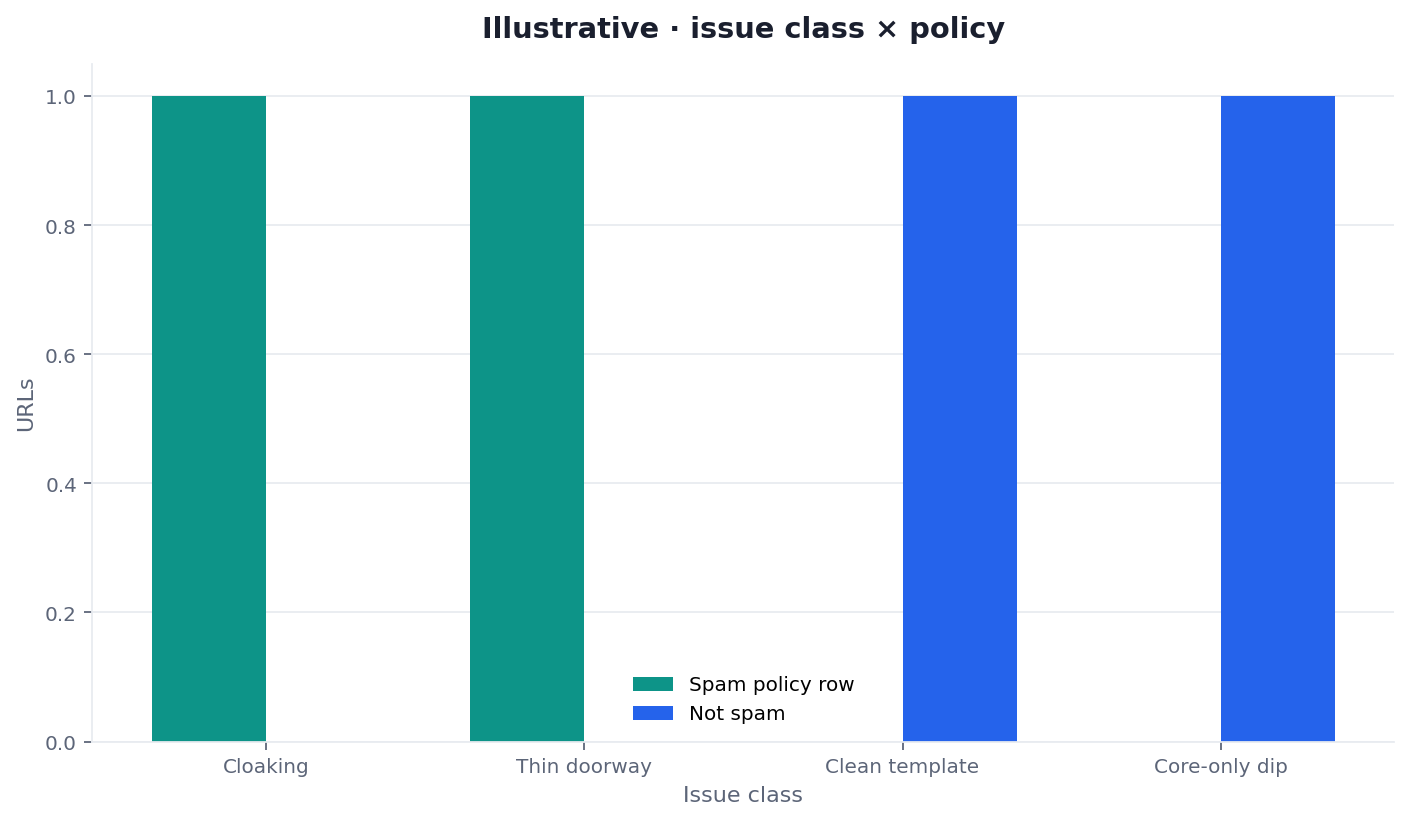
Two dimensions on the illustrative chart
The chart encodes the same two dimensions: whether a policy paragraph was cited, and whether someone treated the week as a core twin. Caption: illustrative / two dimensions. The desk does not publish a recovery percentage. A service-case traffic story is not product proof for this policy job.
Selection scorecard
Use this scorecard to keep spam update SEO honest. Each row is a yes/no you can inspect. None of the rows is an official Google health score.
| Test | Pass | Fail |
|---|---|---|
| Official spam row or policy URL | Dashboard, blog, or policy link | Screenshot with no URL |
| Not treated as a core twin | Spam labeled as spam | “Mini core” deck |
| Live URL lights reviewed | Eight modules checked | Policy used as a skip for tech |
| Dates match the export | Window covers the publication | File starts after the named week |
| Narrative credits disclosed | Login + credits for GSC ask | Model presented as Search Console |
spam update SEO that fails the first two rows is a newsletter. A brief that fails the live-URL row is a blame engine.
Failure modes that twin a spam week
Most cliffs are not spam weeks. spam update SEO that cannot say “no official spam row” will invent a twin.
Copying a core playbook onto a spam row
Forums date volatility. They do not rewrite Google’s policy list. If spam update SEO has no official spam URL, leave the spam column empty. Do not keep “unconfirmed mini core” in a client deck.
Naming spam before the 404 is closed
Soft 404s, accidental noindex, and broken canonicals move clicks without a policy hit. Run tech first. Then cite policy. spam update SEO is the later pass when the official row actually names spam.
If the question is a join of official dates to positions, use the ranking-drop note after the left side is a spam row, not a core row.
Cluster guides for policy weeks
This note stays on spam update SEO as policy violations, not a core twin. The hub keeps both official feeds. Later cluster notes cover how to read the dashboard, how to refuse a recovery calendar after a named core window, and how to keep a changelog of official core rows separate from spam rows. Those notes will not retarget banned phrases.
Trust work after a named spam week is still evidence work, not a score. Keep this page for the policy Google published and the cells you exported.
Cite the spam row, then overlay the file
Open the daily Search Status and Search Central sync, then paste a public URL and attach a GSC export for the same window.
Run SEO Health CheckerFrequently Asked Questions
Is a spam week just a smaller core update?
Bottom line: No. spam update SEO treats policy violations as the job. A core window is a different official object. Do not copy a core deck onto a spam row.
Is the daily sync an official Google score?
Bottom line: No. Traffic lights are eight modules on a pasted URL. The official sync is a citation list plus an optional file. Neither object is an official Google health or EEAT score.
What if clicks dropped and there is no official spam row?
Bottom line: Keep the spam column empty. Re-run lights, check indexation, and do not fill the gap with a “mini core” label. Policy needs a page Google published.
Can I overlay a GSC export without login?
Bottom line: The official sync is readable on /seo-tools. GSC overlay, EEAT, and visibility need an InfiniSynapse login and credits. The official feed does not rewrite export cells.
Conclusion
spam update SEO earns trust when every violation cites a policy Google published and every movement claim cites a cell you exported. Policy first. Official spam row second. File last, inside the window, on credits—and never a core twin. Open the InfiniSynapse web app only when you need that overlay task. Then paste the live URL again and keep the eight lights honest.