Organization Schema: One Entity You Can Defend
By William Zhu · Cofounder, InfiniSynapse · Last updated: 2026-09-10 · Last verified: 2026-09-10 · Methods: Chrome extracts structured data locally; JSON-LD parse is deterministic. Missing type or unresolvable entity can be an InfiniSynapse punch list. Not an official Google score. Observed CLI contract 2026-09-10 on
infinitegrowth@0.1.1:seo-health check --format jsoncan exit 0 whileissues[].statusiserror.
Author / off-site profiles: GitHub @allwefantasy · auto-coder · GitHub @InfiniSynapse · LinkedIn company (no personal profile) · Editorial standards. No personal LinkedIn or vendor badge. Product recognition: SEO Health Checker is one of two first-prize works in the InfiniSynapse × CSDN Vibe Coding contest (English recognition archive). InfiniSynapse co-hosted the contest. That list is not a review of this article.
Reviewed by: InfiniSynapse Data Team · method review 2026-09-10. First-party method review, not a third-party award.
Trust / COI: About · Corrections · Publishing principles · Privacy · Terms. SEO Health is commercial. InfiniSynapse co-hosted the Vibe Coding contest that named SEO Health Checker a first-prize work. The issues[] table below is observed. Topic desks stay illustrative. The InfiniSynapse Data Team publishes this desk method.
Table of Contents
- TL;DR
- What Organization schema is
- A one-entity framework
- Organization schema versus a sameAs pile
- Landscape of identity and knowledge graphs
- How to run the local check
- Desk sample: one entity versus sameAs
- Selection scorecard
- Failure modes that mint a second org
- Frequently Asked Questions
- Conclusion
TL;DR
Organization schema should name one legal entity you can defend, then list sameAs profiles you actually own. Two names on one homepage is a conflict, not richer markup. A green parse is not rich-result eligibility. Traffic lights are not a Google 100.
Direct answer: Ship Organization schema for one entity you can stand behind. Drop undefendable
sameAs. Do not treat a valid block as a Knowledge Panel ticket or an official score.
What you'll learn:
- Why Organization schema is a one-entity job, not a logo dump
- How
sameAsbecomes a punch list when you cannot defend the profile - An illustrative desk table with two dimensions: entity count versus sameAs defense
- When identity evidence belongs on EEAT pages instead of a second
@type
The social card at ./images/og-cover.png matches the hero. Paste a public URL at aimeetup.center/seo-tools#check. Do not paste secrets.
We evaluate Organization schema hands-on as the InfiniSynapse Data Team. We build InfiniSynapse only for a missing-type punch list, not for eligibility.
What Organization schema is
Key Definition: Organization schema is a local, deterministic read of one Organization entity on a URL—name, @id, and sameAs you can defend. It is not a Knowledge Panel admission ticket, not an official Google health score, and not a substitute for organization-entity SEO copy.
Observed page CLI (2026-09-10, infinitegrowth@0.1.1): seo-health check https://schema.org/Organization --format json --lang en exited 0. issues[].status listed Title Length (warning), Meta Description (warning), Page Structure (warning). Process exit 0 is not a clean page.
issues[].name | issues[].status |
|---|---|
| Title Length | warning |
| Meta Description | warning |
| Page Structure | warning |
| H1 Tag | good |
| URL | good |
| Robots.txt | good |
| Sitemap.xml | good |
| Image Alt Text | good |
The topic desk below stays illustrative.
Independent citation: According to [Organization](https://schema.org/Organization), Organization is the Schema.org type for a company or other organization. Schema.org's Organization page is the third-party rule this write-up holds to. Illustrative desks below are not that rule.
Organization is the type this check looks for. Organization schema starts there because that is the block homepages and about pages actually ship. It does not start with a wish list of logos.
Google’s Organization structured data documentation is the official appearance book. Organization schema is not that book. Official testers stay official. This page stays on one entity you can defend.
A legal entity is what the block should name. W3C Data on the Web Best Practices still treat identifiers as something a third party can resolve. If the footer says InfiniSynapse Ltd and the script says a dormant DBA, Organization schema should say “conflict,” not “extra coverage.”
This page stays on the Organization type. The hub schema markup audit is the wider type list. Organization schema is the narrower job: one entity, defendable sameAs.
Identity narrative that is not markup lives on organization entity SEO. That sibling is a different Target. Do not retarget it here. Chain the idea: the entity you name in Organization schema should be the same entity that page can explain.
One name, one @id
A knowledge graph rewards consistent identity. A block that mints a second Organization because a plugin added a LocalBusiness with a different name will split the graph you were trying to clarify.
Wikidata’s introduction is how public identifiers get maintained: one item, stated sources, no duplicate minting for convenience. This check should treat sameAs the same way. If you cannot defend the link, drop it.
What this check will not do
This check will not rewrite robots. Use the robots.txt checker when the question is allow or disallow. It will not score experience. An EEAT checker reads author and experience evidence. Cannot score EEAT is the honest sibling when the body is empty. A service-case traffic story is not product proof; it is not product proof that an Organization block is consistent.
ISO/IEC 27001 is an information-security management standard, not a schema type. Mention it only if the organization actually holds that claim. A block that stuffs certifications it cannot defend is the same failure as an undefendable sameAs.
A one-entity framework
Keep parse local. Keep the legal name inspectable. Keep eligibility official. Organization schema that skips any layer will sell a logo JSON as a panel. A parse that mixes those three layers will sell a logo JSON as a panel.
Parse Organization on the machine
Chrome extracts structured data on the machine unless you start AI EEAT. An extract that depends on a remote crawl for the first read is already past the product’s local path.
Paste the URL at aimeetup.center/seo-tools#check for the eight modules around the markup: title, meta, headings, density, images, links, tech, and speed. Those lights still apply after a clean Organization schema pass. An SEO health checker pass is the cheap companion, not a substitute for the entity test.
Collapse duplicates, then defend sameAs
The extract does not invent a second company. It lists what the page claimed. A report that says “has Organization” with three name values is a slide, not a check.
If the encoding itself is the question, open the JSON-LD checker. Syntax versus entity is that sibling. This page still answers one entity and defendable sameAs.
Eight lights still apply after Organization
A page can ship a valid Organization block and still fail title, canonical, or speed. Ignoring the eight modules will celebrate a script tag on a parked domain. Traffic lights are not a Google 100. Organization schema still lists one entity after the lights.
Organization schema versus a sameAs pile
A pile of profiles is not identity. The block is a short list you can stand behind in a review.
Official testers stay in another book
Official testers answer “does this URL currently look eligible for a named rich result.” This check answers “did we ship one entity, and can we defend the links.” Keep both. When you want the official book as its own Target, open rich results eligibility. Do not paste a green Organization parse into a ticket titled “we should get a panel.”
Article pages still need a Person
Blog templates have their own date-and-author job. Open Article schema SEO when the page is a byline. Do not replace a named author with a publisher Organization because the publisher is easier to copy. The publisher Organization and the author Person are different nodes.
Landscape of identity and knowledge graphs
The landscape is local extractors, official testers, and identity pages. Organization schema belongs with the first. Only the first is this page’s job. Official testers stay official. Entity copy stays on its own URL.
The extract is closer to a batch job than to a chat. It should fail loud when two Organizations disagree, when sameAs 404s, or when the legal name on the invoice is not the name in the script. Prefer one Organization @id site-wide.
How you validate after the first parse is a sibling. Open how to validate schema when the question is the sequence of local parse then official test. This page stays on one defendable entity.
Query movement after you ship Organization still uses Search Console. That overlay is a sister job. It does not prove the sameAs links were yours on the day you shipped them.
A logo ImageObject is not a second Organization schema node. LocalBusiness on a store locator can share the same @id as the parent Organization when it is the same legal entity. When it is a franchisee, give it its own @id and do not copy the parent sameAs. Brand name and legal name can differ; pick the legal name for name and put the trading name in alternateName if you need both.
Preview hosts often inject a demo Organization you never ship. Re-extract the live homepage after merge. The seo-health CLI (npm i -g infinitegrowth) can fail a pull request when the homepage template drops Organization. That gate is a fail/pass on parse, not a Knowledge Panel ticket.
How to run the local check
Run Organization schema as four inspectable steps. JSON-LD parse is local. Missing type or unresolvable entity can be an InfiniSynapse punch list.
Step 1 — Extract Organization in Chrome
Open the page in Chrome with the SEO Health extension. Confirm the extract happened on the machine. An extract that waits for a remote rewrite of the JSON is already past the local path. Paste the same URL at aimeetup.center/seo-tools#check if you also need the eight lights.
Step 2 — Confirm one entity, then defend sameAs
List @type values. Confirm there is one Organization you can name on an invoice. Walk each sameAs. A stop at “JSON parsed” will miss a Wikipedia page you do not control. That miss is the whole reason Organization schema has a defense column.
Step 3 — Leave siblings aside
If the question is whether GPTBot may fetch the URL, leave this page. The robots.txt checker is the live tool for allow and disallow. llms.txt is a hint file with its own cluster note. Organization schema does not rewrite those files.
Step 4 — Turn gaps into an assignable list
Name the second Organization, the undefendable sameAs, or the missing type as a ticket. Do not name a Knowledge Panel deadline. The check ends at an assignable gap. Optional narrative of that list is a credited InfiniSynapse task. Chrome stays local unless you start AI EEAT.
Do not present the punch list as an official Google score. Do not present a service-case traffic story as Organization proof.
Independent citation 2: According to [Organization structured data](https://developers.google.com/search/docs/appearance/structured-data/organization), Organization markup describes the entity behind a site. A second independent source, from Google, keeps this page claim from resting only on first-party lights.
Desk sample: one entity versus sameAs
The table below is illustrative. It is a first-party desk composite, not a customer uplift and not a third-party bake-off. Two dimensions: entity count (one / many) and sameAs defense (defendable / orphan). Organization schema that reports only parse will hide the second name.
| URL role (illustrative) | Entity count | sameAs defense | Desk note |
|---|---|---|---|
| Homepage | One | Defendable | Keep |
| Footer plus hero | Many | Mixed | Collapse names |
| About | One | Orphan wiki | Drop link |
| Blog index | Zero | n/a | Missing type |
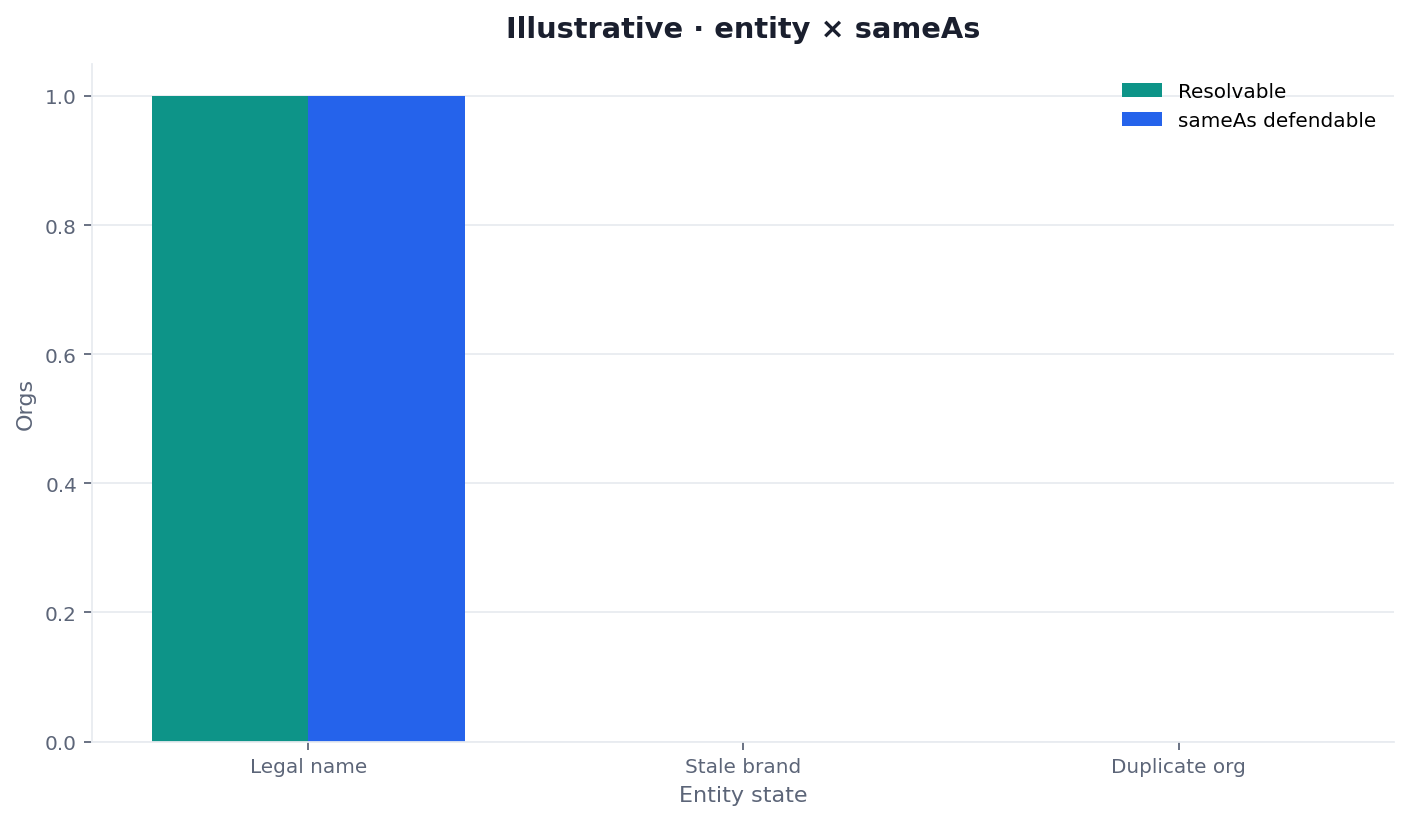
Two dimensions on the illustrative chart
The chart encodes the same two dimensions: entity count and sameAs defense. Caption: illustrative / two dimensions. The Organization schema desk does not publish a panel rate. A valid row is not a Knowledge Panel. Site-wide identity gaps still belong in a 50–500 sitemap sample, not in a single-URL celebration.
Selection scorecard
Use this scorecard to keep Organization schema inside its job. Each row is inspectable. None of the rows is an official Google health score.
| Test | Pass | Fail |
|---|---|---|
| Extract is local | Chrome or deterministic parse | Remote rewrite of the JSON |
| Entity is singular | One legal name and @id | Two Organizations on one URL |
| sameAs is defendable | Profiles you own or control | Orphan wiki or dead social |
| Check scope | One entity + defense | Panel promise |
| Sibling files left aside | robots / GPTBot / llms.txt elsewhere | This check edits robots |
A row that fails the last test is a crawler ticket. A row that fails the panel test is a sales slide.
Failure modes that mint a second org
Most disappointment after Organization schema is a category error. The parse was never a ticket into a panel.
Inventing a panel from a valid Organization
A valid Organization block can still be ineligible, unused, or later ignored. The extract should say “one entity, defendable sameAs.” It should not say “we will get the panel.” Do not attach an invented brand-search percent.
Copying every social URL you ever owned
A sameAs list that includes a shuttered Facebook page and a Wikidata item you never edited is an undefendable pile. This check should fail that pile even when the script parses. Keep the profiles you can log into. Then re-run the extract on the live URL.
Name one entity before you pile sameAs
Extract Organization locally on a public URL, then defend or drop every sameAs link.
Run SEO Health CheckerFrequently Asked Questions
Does a valid Organization mean a Knowledge Panel?
Bottom line: No. Organization schema confirms one defendable entity. Eligibility is a separate official test. Markup is not eligibility.
Is the parse an official Google score?
Bottom line: No. Traffic lights are eight modules on a pasted URL. Organization schema is a local one-entity read. Neither object is an official Google health or EEAT score.
Do robots or llms.txt belong in this check?
Bottom line: No. They are siblings in this pillar. Use the robots tool for allow and disallow. Keep Organization schema on the entity.
When does InfiniSynapse write the punch list?
Bottom line: Parse stays on the machine. A missing type or unresolvable entity can be a credited long-task list. Organization schema does not spend that budget on the parse itself.
Conclusion
Organization schema earns trust when it reports one entity, defendable sameAs, and gaps—and stops before panel theater. Parse locally. Collapse duplicates. Leave crawler files to their own tools. Open the InfiniSynapse web app only when you want that punch list written as a task. Then paste the live URL again and keep the eight lights honest.