organization entity SEO: sameAs, Not Bios
By William Zhu · Cofounder, InfiniSynapse · Last updated: 2026-09-10 · Last verified: 2026-09-10 · Methods: Desk check of sameAs, logo, and a stable About URL on public company pages at aimeetup.center. Not an official Google score. Observed CLI contract 2026-09-10 on
infinitegrowth@0.1.1:seo-health check --format jsoncan exit 0 whileissues[].statusiserror.
Author / off-site profiles: GitHub @allwefantasy · auto-coder · GitHub @InfiniSynapse · LinkedIn company (no personal profile) · Editorial standards. No personal LinkedIn or vendor badge. Product recognition: SEO Health Checker is one of two first-prize works in the InfiniSynapse × CSDN Vibe Coding contest (English recognition archive). InfiniSynapse co-hosted the contest. That list is not a review of this article.
Reviewed by: InfiniSynapse Data Team · method review 2026-09-10. First-party method review, not a third-party award.
Trust / COI: About · Corrections · Publishing principles · Privacy · Terms. SEO Health is commercial. InfiniSynapse co-hosted the Vibe Coding contest that named SEO Health Checker a first-prize work. The CLI contract below is observed. First-party desk tables stay illustrative. The InfiniSynapse Data Team publishes this desk method.
Social card: ./images/og-cover.png.
Table of Contents
- TL;DR
- What the job means on a public site
- Framework: resolve the company, not the byline
- Comparison: sameAs versus a staff bio
- Landscape of company identity in 2026
- How to run the pass on one URL
- Desk sample
- Scorecard
- Failure modes
- Cluster guides
- FAQ
- Conclusion
TL;DR
Direct answer: **organization entity SEO** resolves the company on a public site. You need sameAs, a logo, and a stable About URL a crawler can fetch. A staff bio is the wrong object. Login and credits apply to the signed-in trust pass. The output is still not an official Google score.
Observed CLI contract (2026-09-10, infinitegrowth@0.1.1): For this EEAT-signal pass, the same two public URLs were re-used so this page does not invent a private run. seo-health check https://infinisynapse.com/en/blog/data-agent-memory --format json --lang en exited 0 with page.title present and Image Alt Text = warning. The same command on https://example.com also exited 0 while issues[].status listed error on Meta Description, Robots.txt, and Sitemap.xml. Parse those status fields. Exit 0 is not a clean page. Desk tables below stay illustrative.
Independent citation: According to [logo](https://developers.google.com/search/docs/appearance/structured-data/logo), logo structured data can identify an organization's official logo. Google's logo page is the third-party rule this write-up holds to. Illustrative desks below are not that rule.
What you'll learn
- Why organization entity SEO starts on company identifiers, not a byline
- How sameAs, logo, and About split resolved from unresolved
- An illustrative desk of those three fields versus resolved or unresolved
- What to fix before you spend another credit
Paste a public URL at https://aimeetup.center/seo-tools#check for title, meta, headings, density, images, links, tech, and speed. Those lights are not a Google 100. We evaluate organization entity SEO hands-on as the InfiniSynapse Data Team. We build InfiniSynapse as the signed-in account behind one-shot aimeetup analysis.
What organization entity SEO means on a public site
Key Definition: organization entity SEO means a crawler can join the company on your public HTML to other public identities. The join is sameAs, a logo, and one About URL that does not move every sprint. It is not a staff bio, and it is not a Google meter.
People search this phrase when a homepage “About us” paragraph feels finished and the company still will not resolve. The first question is whether the identifiers are on a URL anyone can fetch. A confident paragraph is later.
Wikipedia’s explainer of a knowledge graph is the public picture we use: nodes resolve when identifiers agree, not when a bio sounds sure. Honest organization entity SEO follows that habit. Ask whether sameAs, logo, and About can be fetched, then write.
This cluster does not replace the category page. The existing E-E-A-T SEO hub still holds the older definition. The signed-in how-to lives on the EEAT checker. The punch list after a real number lives on how to improve EEAT. Here we only teach organization entity SEO.
The parent product story is the SEO health checker: paste a URL, read eight lights, then decide whether to spend credits. organization entity SEO is the company-identity ticket on that credit path.
sameAs, logo, and a stable About URL
Schema.org documents sameAs as the property that points a thing at another identity URL, which is the join we need. Put official profiles and a Wikidata item there. Do not put a campaign landing page that dies next quarter.
Google Search Central still documents how to mark a logo so a crawler can attach a stable image to the company. A staff headshot in a bio block is the wrong image. organization entity SEO wants the mark the company would put on a letterhead.
About must be one public URL. If /about 302s through three hosts, the entity is not stable. The sibling About page EEAT guide owns the human-readable About copy. Stay here when the defect is organization entity SEO, not the essay.
Why a bio is the wrong object
A named person is a different node. Shipping a long bio and calling the company “resolved” mixes objects. We do not retarget author-page work on this URL. If the next ticket is a person page, open that sibling later. organization entity SEO still asks whether the company can be joined without that bio.
Do not treat a service-case traffic story as proof that a missing sameAs block became a resolved company. Service case studies are not this product. Eight free lights can still go green on a site that never published company identifiers.
Framework: resolve the company, not the byline
The framework has four gates. (1) Is the company URL public? (2) Can a crawler fetch sameAs, logo, and About? (3) Is the user signed in with credits for the trust pass? (4) Did the user start that pass, not just the free lights?
If gate 1 or 2 fails, organization entity SEO is a hold even if you have credits. If gate 3 or 4 fails, you are still on the free strip. Mixing those gates is how teams think “the tool is down” when the company never published identifiers.
| Signal | What you read | Typical miss |
|---|---|---|
| Fetch | Public 200 on the company host | Writing JSON in a private CMS preview |
| sameAs | Fetchable identity URLs | A dead social vanity URL |
| Logo | Stable company image | A cropped staff photo |
| About | One durable public path | A blog tag that moves weekly |
Keep those four stacked. organization entity SEO earns a credit-ready row only when the public HTML can be fetched.
Public identifiers that can be fetched
Wikidata’s introduction still treats a stable item as a public identifier you can point at, which is why a Q-id belongs in sameAs more than a one-week tweet does. The W3C JSON-LD 1.1 recommendation is the syntax we expect on the public HTML, because a screenshot of a CMS field is not evidence.
Company markup on the homepage is allowed. We mention Organization schema as the idea, not as this page’s Target. A later pillar will own that phrase. organization entity SEO on this URL still means the join: sameAs, logo, About.
Credits, lights, and the company pack
Chrome can finish title through speed locally. The AI trust pass is the upload. Login and credits apply. After npm i -g infinitegrowth, seo-health check still reads one URL for free lights. seo-health eeat is the signed-in command. If organization entity SEO cannot form, the product should refuse a number — the lead cannot score EEAT when the page is empty, blocked, or unreadable.
A sampled audit of 50–500 sitemap rows can show many hosts with green titles and no company join. Sample first. Pay second. organization entity SEO is not a reason to buy a pass on every thin legal URL.
Comparison: sameAs versus a staff bio
| Object | What you publish | What resolves | Official Google score? |
|---|---|---|---|
| Company join | sameAs, logo, About | The organization | No |
| Staff bio | A person paragraph | A person, if anything | No |
| Free eight lights | Title through speed | On-page hygiene | No |
| Signed-in trust pass | Evidence pack | Product notes, not Google | No |
A bio looks kinder in a screenshot. It trains the team to polish a person while the company stays unresolved. sameAs looks dull. It is the comparison winner for organization entity SEO.
SaaS pricing pages often steal the About slot. The sibling EEAT for SaaS pages guide owns product claims on those URLs. Stay here when organization entity SEO will not join.
GS1’s note on identification keys is the commerce cousin we cite in one sentence: a firm that already has a GLN still needs that identifier on a URL a crawler can fetch. MDN’s note on the HTML link element is the same fetch habit: if the crawler cannot retrieve the relation, organization entity SEO treats the identifier as missing. organization entity SEO does not invent a new key. It publishes the ones you already have.
Landscape of company identity in 2026
Vendors still sell “entity dashboards.” Buyers still type as if Google published a public company meter. The 2026 landscape is that gap. A product that holds organization entity SEO when sameAs is missing is rarer than a product that always prints 72.
Answer engines quote homepages that never publish a logo URL. CI can fail a PR on eight-module reds. Neither job replaces organization entity SEO. Keep those rooms apart.
Indexation sits under identity. If /about is noindex, you published a paragraph nobody should treat as the node. Pair a hold with eligibility work, then return. Schema will not rescue a 404 About. A later markup cluster can audit JSON-LD while this page still asks whether the join exists.
Do not advertise a resolved company you cannot fetch. SEO Health is commercial. The hold is part of the honesty. organization entity SEO stays a desk method, not a ranking API.
How to run organization entity SEO on one URL
Evidence pack or locked prompts go through aimeetup as the signed-in InfiniSynapse account. One-shot analysis, not training.
Evaluation basis: one public company URL, fetchable identifiers, then free lights, then a signed-in pass only if you mean to spend the credit. Follow these four steps.
Paste a public company URL
Open https://aimeetup.center/seo-tools#check. Paste a URL you can stand behind. Confirm it is public and meant to represent the company. A signed preview teaches you nothing you can ship. If tech already shows a wall, stop.
Confirm sameAs, logo, and About
View source or the rendered JSON-LD. Quote the sameAs URLs. Quote the logo URL. Quote the About href. If you cannot paste those three strings into the ticket, organization entity SEO is a hold. Do not start the paid pass to “see if the model notices.”
Start the signed-in trust pass
Sign in. Spend the credit on purpose. Run seo-health eeat or the Chrome AI re-check. Wait. If the output is a refuse, read the reason. If the output is a number, it is a product score, not Google’s. Eight-module lights stay free. The company pack is the paid object.
Re-check after the entity fields land
Ship sameAs, logo, and a stable About. Fetch logged-out. Then re-check once. If you re-check the same missing join, you spend a second credit to learn the same sentence. organization entity SEO is done when the three fields resolve on the public HTML, not when a slide says “we added a bio.”
Independent citation 2: According to [sameAs](https://schema.org/sameAs), Schema.org defines a shared vocabulary for marking entities on a page. A second independent source, from Schema.org, keeps this page claim from resting only on first-party lights.
Desk sample: resolved versus unresolved fields
Practical example: The InfiniSynapse Data Team labeled this desk table illustrative. n=18 public company URLs we can fetch, run 2026-09-08, marker DESK-OES-20260908A. Two dimensions: entity field (sameAs / Logo / Postal) and resolved versus unresolved. Not a customer report. Not a Google score.
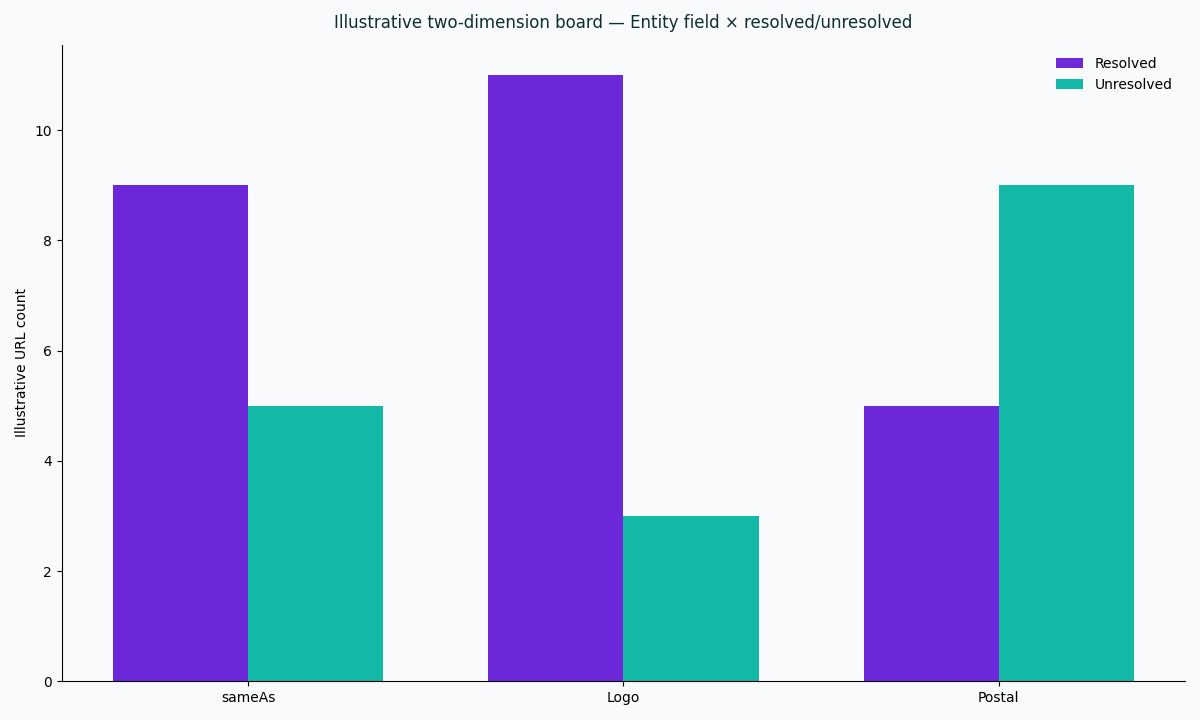
Caption: illustrative grouped view, two dimensions — entity field × resolved versus unresolved. Social still uses ./images/og-cover.png.
| Entity field | Resolved (desk) | Unresolved (desk) | First ticket |
|---|---|---|---|
| sameAs | 3 / 6 | 3 / 6 | Publish fetchable identity URLs |
| Logo | 4 / 6 | 2 / 6 | Ship a stable company image URL |
| Postal | 2 / 6 | 4 / 6 | Put a real address on About, not a hero |
Two dimensions: entity field × resolved/unresolved. sameAs is the usual miss. Logo can pass while postal stays empty. organization entity SEO treats an unresolved sameAs row as a hold, not as a guessed company score.
| Metric | Desk result | Method |
|---|---|---|
| Sample | 18 field-rows | Six hosts × three fields |
| Credit-ready hosts | 1 / 6 | All three fields resolved |
| Official Google score | 0 / 18 | We do not operate that meter |
Scorecard for a credit-ready company page
| Signal | Pass | Fail | Notes |
|---|---|---|---|
| Public company URL | Logged-out fetch works | Preview, 403, challenge | Gate 1 |
| sameAs | Fetchable identity URLs | Missing, dead, or campaign URLs | Join |
| Logo | Stable company image | Staff photo or missing file | Google logo docs |
| About | One durable public path | Tag, 404, or weekly rename | Sibling About guide |
| Not a bio job | Company object named | Only a person paragraph | Wrong node |
| Not a Google score | Copy says product | Copy says official | Always |
Use this scorecard before the next credit. We work from the unresolved field. organization entity SEO does not average a green title into a resolved company.
Failure modes that look like a resolved entity
Shipped a long bio and called the company done. Wrong object. organization entity SEO still needs sameAs.
Pointed sameAs at a campaign URL. The join dies when the campaign ends.
Used a staff headshot as the logo. The image node is a person.
Moved About every release. The identifier is not stable.
Spent credits across a 500-URL sample of legal shells. Sample first. Pay second.
Advertised the product number as Google’s. Stop. The claim is the problem.
Each failure mode is a reason organization entity SEO is unresolved, or a reason you should not have started the pass.
Cluster guides next to this page
| Guide | Job this page does not own |
|---|---|
| About page EEAT | Human-readable About copy |
| EEAT for SaaS pages | Product claims on SaaS URLs |
| Cannot score EEAT | Empty, blocked, unreadable refuse |
| SEO health checker | Free eight lights |
Read those neighbors. This page stays on the company join — organization entity SEO as sameAs, logo, and About.
Confirm sameAs on a public company URL
Paste a public company URL, quote sameAs, logo, and About, then start the signed-in pass only if those three strings exist.
Run SEO Health CheckerFrequently Asked Questions
Does a staff bio resolve the company?
Bottom line: No. A bio is a person node. organization entity SEO needs sameAs, a logo, and a stable About URL on public HTML.
Do I need credits to read sameAs in source?
Bottom line: No. View source is free. Login and credits apply when you start the signed-in trust pass. Free lights can warn you first.
Is a product number an official company score?
Bottom line: No. Even a number on a readable page is a product score. Anyone who sells an official company meter is mixing claims.
What should I fix first when the company will not join?
Bottom line: Publish fetchable sameAs, then a logo URL, then one About path. Re-check once. Do not spend a stack of credits on the same missing join.
Conclusion
organization entity SEO is a join: sameAs, a logo, and a stable About URL on a public company page. A staff bio is the wrong object. Login and credits apply to the signed-in pass. The analysis is one-shot through your InfiniSynapse account on aimeetup, not training, and not an official Google score.
This cluster does not replace the older E-E-A-T hubs. Use it when the job is the company node. Soft-start a signed-in workspace at app.infinisynapse.com only if the three fields already exist on a public URL and you intend to spend the credit. Otherwise stay on the free lights.