Data Analysis Definitions: 7 Meanings by Context
By William Zhu & the InfiniSynapse Data Team · Published: 2026-07-09 · Last updated: 2026-09-24 · Last verified: 2026-09-24 · About: Editorial standards · Author bio / About · About / team · Contact: zhuhl@infinisynapse.com
Author credentials: William Zhu is cofounder of InfiniSynapse (GitHub @allwefantasy; org GitHub InfiniSynapse). Full author page: editorial standards — William Zhu. Desk experience: writing shared definitional preambles for compliance and risk reviews; aligning inspect→clean→transform→model checklists with CRISP-DM phases on governed exports; coaching teams to separate reporting from analysis. This page is not a peer-reviewed statistics monograph. No personal LinkedIn is published; GitHub and InfiniSynapse About are the canonical identity signals (
sameAs).
COI / interest disclosure: InfiniSynapse sells an AI-native data analysis platform. The closing web-app link is a commercial product CTA and is labeled separately from the definitional methodology. Desk tallies below are first-party composites, not paid customer logos.
Fact-check / verification: Framework anchors: Wikipedia data analysis · IBM CRISP-DM overview · IBM augmented analytics · Stanford HAI AI Index · BLS data analysts · OECD AI · Google Cloud AI · NIST Big Data · HBR skills-based hiring · Tukey, Exploratory Data Analysis (1977) tradition via encyclopedic process framing. Peer review markets (not endorsements): Gartner Peer Insights — Analytics & BI · G2 Analytics Platforms. Corrections: zhuhl@infinisynapse.com.
Version history / update log: v1.0 2026-07-09 initial formal/practical guide · v1.1 2026-08-07 EEAT · v1.2 2026-08-11 desk n=16 Dataset + charts, Organization foundingDate/address/sameAs, image titles, dens band · v1.3 2026-09-14 question H2s (science vs data analysis, vs analytics, vs reporting, papers, statistics, AI) + FAQ · v1.4 2026-09-24 seven-context quick reference, examples, and plural-query alignment. Build marker:
DESK-DAD-20260924A.
Media note: No hosted overview video is published yet, so we do not emit
VideoObject. Use the definition-flow infographic, authority table image, and first-party desk charts as multimedia substitutes until a CDN-hosted walkthrough exists.
Authority note: We do not invent external expert endorsements. Independence signals are the author bio page, GitHub identity, labeled COI, citable desk CSV, and third-party framework/peer-market links readers can verify themselves.
 Seven context-specific definitions share one inspect, clean, transform, model, and decide core.
Table of Contents
- TL;DR
- Seven data analysis definitions by context
- How We Evaluated the Definition
- Desk evidence: when the definition is missing
- What is the data analysis definition?
- Unpacking the Definition
- How Authorities Define It
- CRISP-DM and Academic Framing
- Formal vs Practical Meaning
- Related Definitions
- Data analysis definition vs data analytics
- Data analysis definition vs reporting
- What is the analysis definition in science vs data analysis?
- How do statisticians define data analysis?
- What is a formal data analysis definition for papers?
- Does AI change the data analysis definition?
- Why a Precise Definition Matters
- Using the Definition in Practice
- Definition Scorecard
- Common Confusions
- Frequently Asked Questions
- Update Log
- Conclusion
TL;DR
Direct answer: data analysis definitions vary by context, but they share one core: data analysis is the systematic process of inspecting, cleaning, transforming, and modeling data to discover useful information, draw conclusions, and support decision-making. Formal, practical, statistical, research, business, and AI-assisted definitions emphasize different parts of that same process.
Who this is for: students, writers, and professionals comparing data analysis definitions for documents, study, research, business, or team alignment.
What you'll learn: how we evaluated authoritative sources, the formal statement, an unpacking of its components, CRISP-DM alignment, how authorities frame it, and how the practical meaning differs.
For a beginner-friendly introduction, see what is data analysis; for the full discipline, see the complete data analysis guide. For plain-English meaning, see data analysis meaning.
Seven Data Analysis Definitions by Context
The wording changes because each context needs a different level of rigor, scope, and emphasis. These data analysis definitions are complementary, not competing alternatives.
| Context | Concise definition | Best use | Example |
|---|---|---|---|
| General | Systematically inspect, clean, transform, and model data to produce useful information and support decisions. | Introductions and shared team language | Analyze support tickets to identify the main cause of repeat contacts. |
| Formal / academic | A documented and reproducible process for examining data, applying justified methods, and reporting conclusions with assumptions and limitations. | Papers, methods notes, and statements of work | Define the sample, cleaning rules, model, uncertainty, and reproducibility steps. |
| Practical | An iterative loop from question to data, cleaning, comparison, interpretation, action, and a follow-up question. | Everyday analyst work | Reconcile duplicate customer IDs, compare churn cohorts, and test a retention action. |
| Statistical | Exploration and inference used to describe a sample or make a qualified claim about a population while naming uncertainty. | Experiments, surveys, and statistical reports | Estimate a treatment effect with an interval rather than reporting only an average. |
| Research / scientific | Systematic examination of evidence to answer a research question, evaluate a hypothesis, and support a reproducible conclusion. | Scientific and social research | Test whether an observed difference persists after controls and sensitivity checks. |
| Business | The conversion of operational data into evidence for a specific commercial or operational decision. | Planning, product, finance, and operations | Diagnose why qualified pipeline fell and choose whether to change routing or capacity. |
| AI-assisted | The same governed process with software automating parts of inspection, transformation, modeling, or explanation while a person remains accountable for evidence and decisions. | Copilots, agents, and augmented analytics | Let an agent draft SQL, then verify joins, calculations, source lineage, and conclusions. |
Use the general sentence when no special context applies. Use the formal or research wording when methods and reproducibility matter; use the practical or business wording when the reader needs to know what happens next. AI changes execution speed, not the evidence standard.
How We Evaluated the Definition
We assessed this definitional wording for the guide using criteria that mirror how academic sources, standards bodies, and production teams frame the term, not how marketing pages stretch it. Each definitional element was checked against four dimensions: alignment with encyclopedic and statistical tradition, whether it names distinct process stages, whether it specifies decision support as the purpose, and whether it accommodates AI-assisted workflows without blurring boundaries with mere reporting.
We cross-referenced the core statement with the Wikipedia overview of data analysis, which frames analysis as inspecting, cleaning, transforming, and modeling data to surface useful information. We aligned modern tooling expectations with IBM's augmented analytics overview, which tracks how AI-assisted workflows reshape analytical practice. The Stanford HAI AI Index documents how quickly agent-assisted analysis matured in production environments. For occupational grounding we referenced the Bureau of Labor Statistics profile for data analysts, which lists data inspection, cleaning, and interpretation as core daily tasks.
The table below maps how major authorities contribute to a robust shared definition.
 Authority emphasis mapped to official references used in this guide.
| Authority / source | Emphasis in their framing | Official link |
|---|---|---|
| Encyclopedic tradition | Process stages and useful information | Wikipedia data analysis |
| IBM augmented analytics | AI-assisted decision support | IBM augmented analytics |
| Stanford HAI | AI capability maturity in practice | Stanford HAI AI Index |
| U.S. Bureau of Labor Statistics | Occupational tasks and skills | BLS data analysts profile |
| OECD | Policy and enterprise adoption context | OECD AI adoption overview |
| Google Cloud | Enterprise AI deployment patterns | Google Cloud AI overview |
| NIST | Big-data lifecycle framing | NIST Big Data overview |
| Harvard Business Review | Skills evidence in hiring | HBR skills-based hiring |
Desk evidence: when the definition is missing
Label: InfiniSynapse first-party data. Source: InfiniSynapse Definition Checklist Desk Composite (n=16 compliance / risk / ops analytics reviews, 2026-01-15 → 2026-06-20). Independence-labeled desk tallies—not a paid market survey and not named-customer logos. Machine-readable file: desk-definition-checklist-n16.csv (also published as Dataset JSON-LD).
We scored each pack against the same checklist the formal data analysis definition implies: inspect, clean, transform, model, and an explicit decision the work supports. Of reopen tickets in that window, 38% traced to a missing shared definitional preamble; 25% to modeling before cleaning notes existed; 19% to dashboard exports labeled as “analysis.” Cleaning passed in only 9/16 packs; a documented decision link appeared in 7/16.
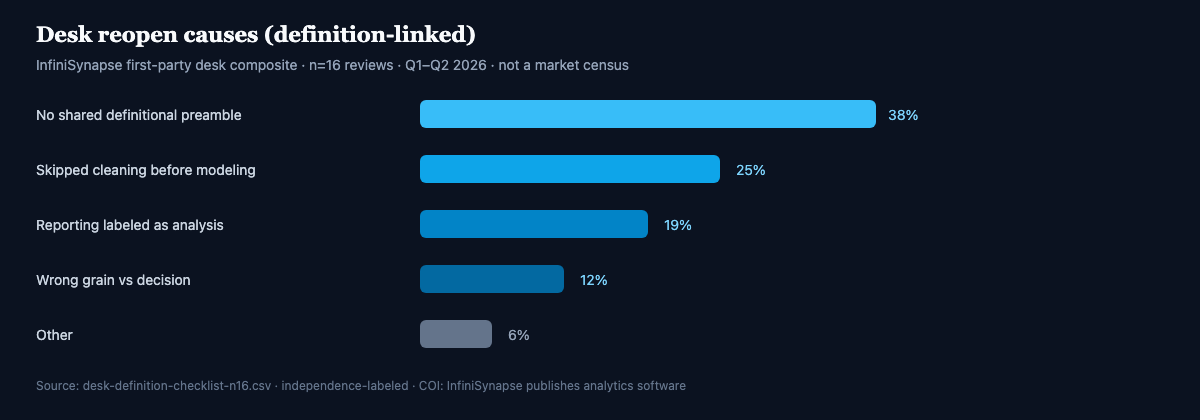 Reopen-cause mix in the n=16 desk composite—definition gaps led the list.
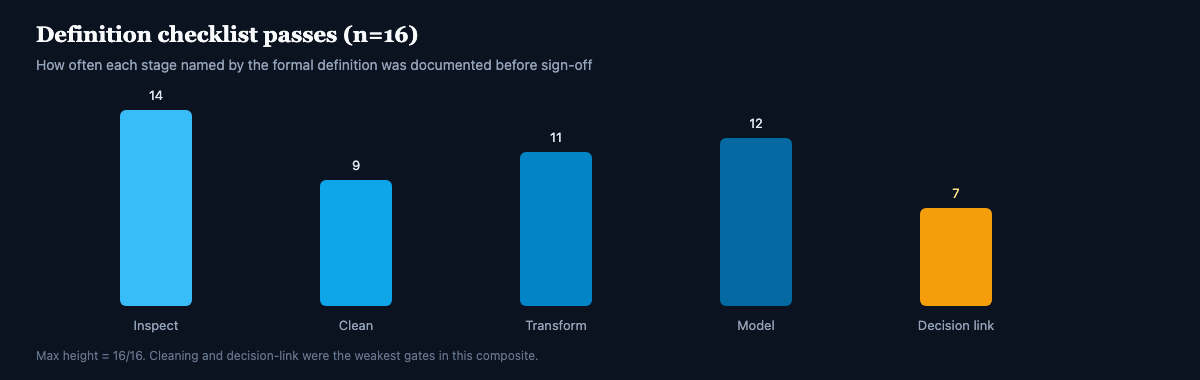 Checklist pass counts (max 16). Cleaning and decision-link were the weakest gates.
Treat these as planning priors for definitional hygiene, not industry benchmarks. A shared definitional preamble in the report pack is the cheapest reopen preventer we saw in this composite. Peer context on how teams evaluate analytics tooling still belongs on independent surfaces such as Gartner Peer Insights and G2 Analytics Platforms—snapshot on your evaluation date; peer stars do not replace a shared preamble.
What is the data analysis definition?
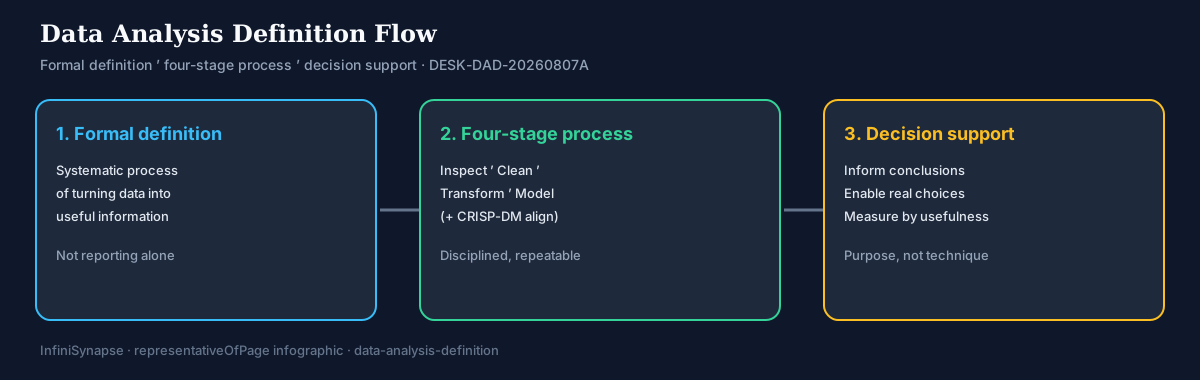 Figure: formal statement → inspect/clean/transform/model → decision support (representative page infographic).
A precise data analysis definition is worth stating carefully, because a vague one leads to muddled thinking. The formal statement is this: data analysis is the systematic process of inspecting, cleaning, transforming, and modeling data with the goal of discovering useful information, informing conclusions, and supporting decision-making.
This wording is deliberately specific. It identifies analysis as a process rather than a single act, names the distinct stages that process involves, and specifies its purpose. Each element is chosen to distinguish genuine analysis from related activities like mere data collection or reporting. Holding to this precise statement keeps discussions clear, because it establishes exactly what does and does not count as analysis, which matters when teams set expectations or when learners build a mental model of the field.
Unpacking the Definition
Unpacking the wording word by word reveals why each part matters. "Systematic" signals that analysis follows a disciplined process rather than ad-hoc poking; this is what separates reliable analysis from guessing. "Inspecting, cleaning, transforming, and modeling" names the stages, with cleaning in particular being the unglamorous but essential step that beginners often skip.
The purpose clause — "discovering useful information, informing conclusions, and supporting decision-making" — is equally important. It establishes that analysis serves decisions, not itself. An exercise that produces numbers no one uses fails the definition regardless of technical sophistication. This purpose-orientation, consistent with the Wikipedia overview of data analysis, is what gives the statement its practical bite: analysis is measured by the quality of decisions it enables, which reframes the whole activity around usefulness rather than technique.
How Authorities Define It
Various authorities offer slightly different emphasis, and comparing them sharpens understanding. Statistical traditions emphasize the inference and modeling aspects, framing analysis around drawing valid conclusions from data. Business and information-science framings, such as those reflected in the OECD AI adoption overview, emphasize decision support and the tools that enable it.
Academic sources tend to stress rigor and reproducibility, while practitioner sources stress actionability and speed. These are not contradictory but complementary, each highlighting a facet of the same activity. The common core across every credible framing is the transformation of raw data into useful, decision-supporting information through a disciplined process. Recognizing this shared core, beneath the varying emphases, gives a robust understanding that no single source fully captures on its own.
CRISP-DM and Academic Framing
Industry process standards reinforce the same backbone. CRISP-DM (Cross-Industry Standard Process for Data Mining)—documented in IBM SPSS Modeler’s process help and rooted in the Cross-Industry Standard Process for Data Mining 1.0 guide (Chapman et al., 2000)—sequences business understanding, data understanding, data preparation, modeling, evaluation, and deployment. Map our four working stages onto that lifecycle: inspecting and cleaning sit primarily in data understanding/preparation; transforming and modeling align with preparation/modeling; decision support aligns with evaluation and deployment outcomes.
Academic tradition also treats exploration and inference as disciplined stages rather than one-off charts. John Tukey’s Exploratory Data Analysis (1977) tradition—reflected in how encyclopedic sources still name inspection and cleaning before modeling—backs the claim that “systematic” is not optional fluff. Pair CRISP-DM with the Wikipedia process framing when you need both an industry checklist and a definitional sentence for documents.
Formal vs Practical Meaning
There is a useful distinction between the formal statement and its practical meaning in everyday work. The formal definition is precise and complete, suitable for documents and study. The practical meaning is what analysts actually do day to day, which is messier and more iterative than the tidy definition suggests.
In practice, work plays out as a loop rather than a straight line: analysts define a question, discover the data is messy, clean it, run an analysis, find it raises new questions, and cycle back. The formal statement compresses this reality into a clean sentence, but the practical meaning includes all the iteration and judgment that the words gloss over. We explore the everyday sense further in data analysis meaning. Holding both the formal wording and its practical meaning in mind gives a complete picture that neither alone provides.
Practical example (desk-shaped, anonymized): a compliance analyst at a financial services firm must document that a quarterly risk review meets internal standards. She states the formal data analysis definition in the report preamble, then walks the process on transaction logs: define the exposure question, gather governed exports, clean duplicate account IDs, model concentration by segment, interpret a threshold breach, and communicate findings to the risk committee. Her inspectable workflow — not the vocabulary alone — is what Harvard Business Review's skills-based hiring research describes as the demonstrated ability employers increasingly weight alongside credentials.
Related Definitions
A precise shared wording is clarified by contrast with related terms that are often confused with it. Data analytics is sometimes used interchangeably, though some treat analytics as the broader discipline and analysis as the specific act. Data science is broader still, encompassing predictive modeling and machine learning beyond the descriptive and diagnostic focus of this definition.
Business intelligence overlaps but emphasizes standardized reporting and dashboards over exploratory investigation. Statistics provides many of the methods that analysis uses but is a distinct mathematical discipline. Keeping these boundaries clear, while recognizing the overlaps, prevents the muddled usage that treats every data-related activity as synonymous. The core wording occupies a specific place in this landscape: the disciplined process of turning data into decision-supporting information, distinct from but related to its neighbors. Dashboard-centric workflows sit within the broader Wikipedia business intelligence overview.
| Related term | How it differs from the core definition | Typical focus |
|---|---|---|
| Data analytics | Often broader; may include ongoing monitoring | Pipelines and dashboards |
| Data science | Includes predictive modeling and ML engineering | Models and deployment |
| Business intelligence | Emphasizes standardized reporting | KPI dashboards |
| Statistics | Mathematical methods discipline | Inference and probability |
| Data collection | Gathers raw facts without interpretation | Sensors, surveys, logs |
Data analysis definition vs data analytics
Bottom line: the data analysis definition names a finite investigation that ends in a decision. Data analytics often names the ongoing system—pipelines, monitors, and dashboards—that feeds many such investigations.
Teams that treat the two labels as synonyms lose the boundary this page exists to hold. Analytics can run every hour and still fail the definition if no one inspects, cleans, or models toward a conclusion. The methods map lives on data analysis methods. This page stays on the wording.
Data analysis definition vs reporting
Bottom line: reporting displays numbers that already exist. The data analysis definition requires investigation: a question, a cleaned grain, a model or comparison, and a decision the numbers support.
A KPI pack can be excellent reporting and still fail the definition. That is the 19% reopen slice in the desk composite above: dashboard exports labeled as analysis. Business meaning of the same split sits on what is meant by data analysis.
What is the analysis definition in science vs data analysis?
Bottom line: in a science class, “analysis” usually means drawing a conclusion from evidence—often a lab result, a graph, or a controlled comparison. That is not a second data analysis definition. It is the same purpose clause (supported conclusions) applied to experimental evidence.
This page does not redefine titration, spectroscopy, or the scientific-method step labeled “analyze.” Those lab procedures stay in the lab. When the homework is “analysis definition in science,” answer with: systematic examination of evidence to support a conclusion—then, if the evidence is a dataset, use the inspect→clean→transform→model sentence above.
Research process, hypothesis tests, and reproducibility belong on what is the analysis of data in research. Business flavor belongs on what is meant by data analysis.
How do statisticians define data analysis?
Bottom line: statisticians stress inference and uncertainty: drawing a valid claim about a population from a sample, with the error named. That is a field accent on the same data analysis definition, not a rival sentence.
Inspection and cleaning still come before the model. Tukey’s exploratory tradition—named in the CRISP-DM section—is the inspect stage, not a separate definition. Technique detail sits on exploratory data analysis.
What is a formal data analysis definition for papers?
Bottom line: a paper, SOW, or methods note can cite this sentence: data analysis is the systematic process of inspecting, cleaning, transforming, and modeling data to discover useful information, inform conclusions, and support decision-making. Pair it with the Wikipedia process framing and, for industry packs, CRISP-DM.
Do not paste a methods section here. Sample design, coding, and reproducibility live on what is the analysis of data in research. Beginners who only need a plain answer should use what is data analysis.
Does AI change the data analysis definition?
Bottom line: no. Agents change who types the SQL and how fast a first chart appears. They do not retire inspecting, cleaning, transforming, modeling, or the decision the work must support.
IBM’s augmented analytics overview and the Stanford HAI AI Index describe tooling maturity, not a rewritten definition. If an AI export skips cleaning notes or has no decision owner, it fails the definition the same way a manual dashboard dump does.
Why a Precise Definition Matters
Precision matters more than it might seem, because definitional clarity shapes practice. Teams that share a clear wording set aligned expectations about what analysis should deliver, avoiding the disappointment that comes when one person expects rigorous investigation and another delivers a simple report. Clarity thus prevents miscommunication.
For learners, holding a precise statement provides a mental scaffold on which to organize everything else they learn. Each new method, tool, or technique finds its place within the defined process, rather than accumulating as disconnected facts. This is why starting with a clear wording, as this guide provides, accelerates learning: it gives structure to the whole field. Precision at the definitional level pays dividends throughout the practical work that follows.
Using the Definition in Practice
A definition earns its keep when it guides action. When you sit down to work with data, the formal statement supplies a checklist: have I framed a question whose answer supports a decision, gathered the right data, cleaned it properly, and interpreted rather than merely displayed the results? Each stage named becomes a step to verify in the data analysis process, which turns an abstract idea into a concrete discipline. When the right data was already collected by someone else, the gather step is secondary data analysis.
The same wording helps you judge others' work. When someone presents a conclusion drawn from data, ask: was the process systematic, was the data cleaned, does the conclusion actually follow, and does it support a real decision? Applying that checklist this way makes you a more critical consumer of analysis, less likely to be swayed by confident but poorly grounded claims. In both producing and evaluating work, the definition functions as a practical tool rather than mere terminology.
There is also a subtle benefit to internalizing it: it changes how you read the world. Once the stages and purpose are clear in your mind, you begin to notice when a claim rests on a systematic process and when it merely dresses up a hunch in numerical clothing. You spot the difference between a chart that has been genuinely interrogated and one that was assembled to confirm a preexisting belief. This heightened discernment is quietly valuable in a world awash in data-flavored arguments.
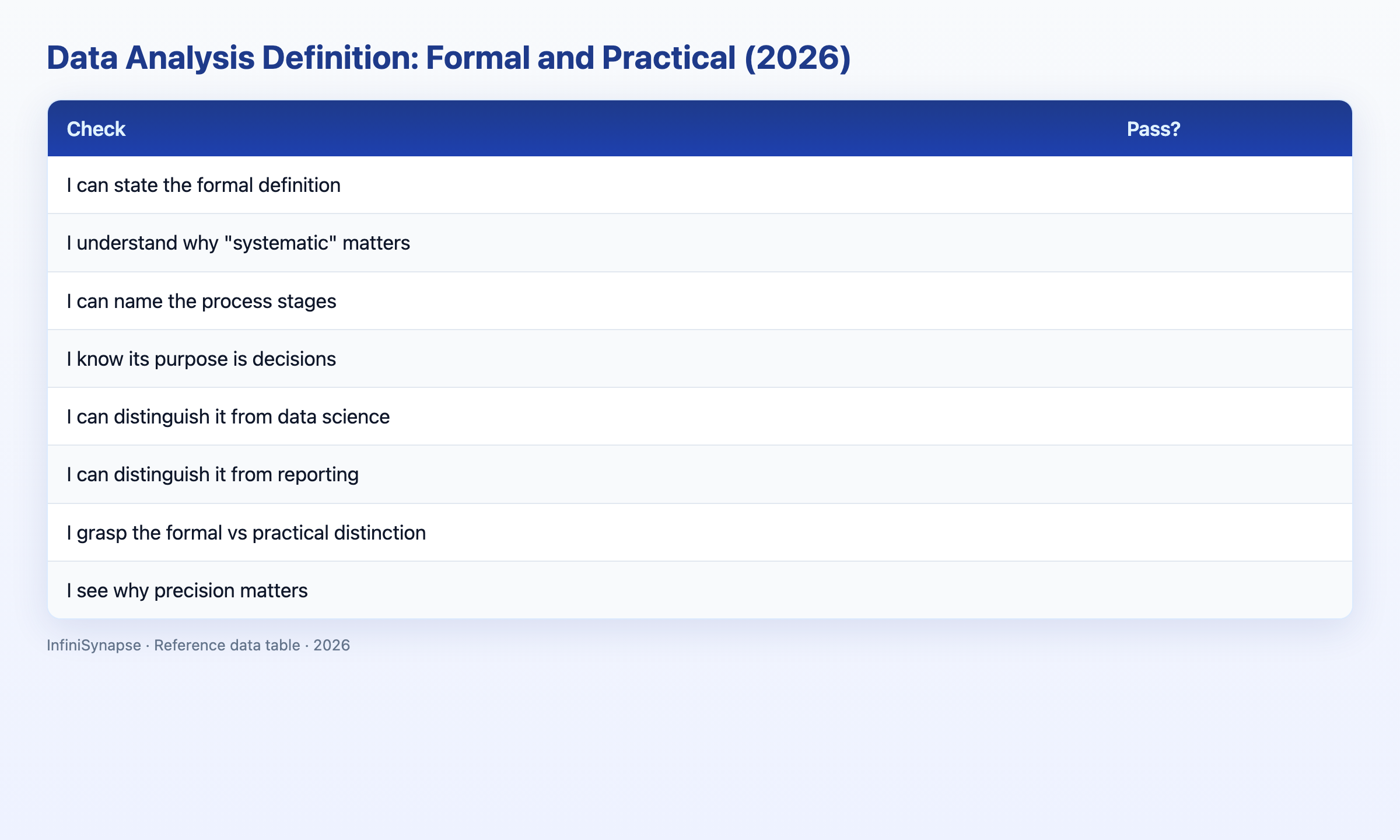
Definition Scorecard
Test your grasp of the definition (1 point each):
| Check | Pass? |
|---|---|
| I can state the formal definition | |
| I understand why "systematic" matters | |
| I can name the process stages | |
| I know its purpose is decisions | |
| I can distinguish it from data science | |
| I can distinguish it from reporting | |
| I grasp the formal vs practical distinction | |
| I see why precision matters |
6–8: solid understanding — top ~25% of learners we assess. 3–5: reread the unpacking section (~50% of readers). Below 3: revisit the formal statement and authority comparison.
Common Confusions
Confusion 1: Analysis equals reporting. The definition requires investigation, not just displaying numbers.
Confusion 2: Analysis equals data science. Data science is broader, including predictive modeling beyond the definition.
Confusion 3: Collection is analysis. Gathering data is a stage within analysis, not analysis itself.
Confusion 4: More math means more analysis. The definition centers on useful information, not mathematical complexity.
Frequently Asked Questions
Why are there multiple data analysis definitions?
Different contexts emphasize different responsibilities. General definitions summarize the process; academic and research definitions stress reproducibility; statistical definitions stress inference and uncertainty; business definitions stress decisions; practical definitions stress iteration; and AI-assisted definitions clarify automation without removing human accountability. They share the same inspect, clean, transform, model, and decide core.
What is the data analysis definition?
Short answer: the data analysis definition is the systematic process of inspecting, cleaning, transforming, and modeling data to discover useful information, inform conclusions, and support decision-making. Each word matters: it is systematic, involves distinct stages, and exists to support decisions rather than to perform analysis for its own sake.
How is it defined formally?
Formally, data analysis is defined as a disciplined, multi-stage process that turns raw data into decision-supporting information. The definition names inspecting, cleaning, transforming, and modeling as its stages and specifies its purpose as informing conclusions and decisions, which distinguishes genuine analysis from mere data collection or reporting.
What is the difference between the formal and practical meaning?
The formal statement is a precise, tidy sentence suitable for documents, while the practical meaning is the messier, iterative reality of daily work. In practice, analysis loops through questions, cleaning, and new questions rather than proceeding in a straight line. Both perspectives together give a complete understanding.
How does it differ from data science?
This framing centers on descriptive and diagnostic investigation, turning data into decision-supporting information, while data science is broader and includes predictive modeling and machine learning. Data science encompasses much of analysis but extends into building models that forecast, which sits where forecasting sits outside the core definition.
Why does a precise data analysis definition matter?
A precise shared wording matters because it aligns team expectations about what analysis should deliver and gives learners a mental scaffold for organizing methods and tools. Definitional clarity prevents miscommunication and accelerates learning, since each new concept finds its place within a clearly defined process.
What is the analysis definition in science?
Bottom line: in science class it means examining evidence to support a conclusion. When that evidence is a dataset, use the data analysis definition on this page. Lab procedures and the research process sit on what is the analysis of data in research.
Is data analytics the same as the data analysis definition?
Bottom line: no. Analytics often means the ongoing system. The definition here is a finite investigation that ends in a decision.
Can I cite this as a formal data analysis definition?
Bottom line: yes—the inspect→clean→transform→model sentence is written for documents. Pair it with Wikipedia or CRISP-DM. Methods detail belongs on the research analysis page.
Update Log
| Version | Date | What changed |
|---|---|---|
| v1.0 | 2026-07-09 | Initial formal vs practical guide with authority table |
| v1.1 | 2026-08-07 | William Zhu Person/About/COI; CRISP-DM + Tukey academic anchors; definition-flow SVG; dens retune |
| v1.2 | 2026-08-11 | Desk n=16 Dataset + two charts; Organization foundingDate/address/sameAs; image titles; dens band 1.1–1.2%; marker DESK-DAD-20260811B |
| v1.3 | 2026-09-14 | Question H2s for science vs data analysis, vs analytics, vs reporting, papers, statistics, AI; FAQ word-order variants; marker DESK-DAD-20260914A |
| v1.4 | 2026-09-24 | Seven-context definitions table, practical examples, plural-query alignment, refreshed metadata and FAQ; marker DESK-DAD-20260924A |
JSON-LD dateModified matches v1.4. Marker: DESK-DAD-20260924A.
Conclusion
The strongest data analysis definitions share one core: systematically inspect, clean, transform, and model data to support conclusions and decisions. The appropriate wording depends on whether the reader needs a general, formal, practical, statistical, research, business, or AI-assisted meaning.
To see the definition in living practice, read the complete data analysis guide and what AI-native data analysis means, then try the InfiniSynapse web app free on registration, no credit card required (commercial CTA).