What Is the Analysis of Data in Research?
By the InfiniSynapse Data Team · Last updated: 2026-07-09 · We build an AI-native data analysis platform and support research teams with auditable workflows; this guide addresses what is the analysis of data in a research context specifically.

Table of Contents
- TL;DR
- How We Evaluated Research Analysis
- The Answer in a Research Context
- Its Role in the Research Process
- Research Methods Compared
- Rigor and Reproducibility
- Qualitative and Quantitative
- How AI Assists Research Analysis
- Interpreting and Reporting Findings
- Research Scorecard
- Common Pitfalls
- Ethics and Integrity
- Frequently Asked Questions
- Conclusion
TL;DR
Direct answer: what is the analysis of data in research is the stage where collected data is examined systematically to test hypotheses and answer research questions. It applies rigorous, reproducible methods so that conclusions are defensible, and it stands between data collection and the reporting of findings.
Who this is for: students and researchers asking what is the analysis of data in a research setting.
What you'll learn: how we evaluated research analysis methods, the answer in a research context, methods compared, the importance of rigor, and how AI assists.
This guide sits under the complete data analysis guide. For the general activity, see analysis of data. The citation-ready sentence lives on the citation-ready data analysis definition. For related depth in this pillar, see Whats a Data Analysis and Data Analysis Techniques That Actually Work in 2026.
How We Evaluated Research Analysis
We framed this guide using criteria that mirror what peer review and reproducibility standards actually demand, not casual business analytics alone. Each research workflow was checked against four dimensions: whether the analysis plan is specified before data collection, whether methods match the data type and design, whether every decision is documented for replication, and whether interpretation stays within what the evidence supports.
We cross-referenced these criteria with the general statistical toolkit in the Wikipedia overview of data analysis and with reproducibility guidance from the NIH principles and guidelines for reporting research. What is the analysis of data in research is the pivot where raw observations become defensible evidence — a stage where speed matters less than transparency.
The Stanford HAI AI Index tracks how AI assistants accelerated routine computation, but what is the analysis of data in rigorous settings still requires human judgment on design, assumptions, and limits. IBM's augmented analytics overview describes how governed tooling preserves audit trails; we favor workflows where others can reproduce the same conclusion from the same data and documented code. Dashboard-centric reporting sits within the broader Wikipedia business intelligence overview, but research analysis demands documented methods that withstand external scrutiny. For warehouse-scale work, align outputs with Databricks documentation on governed data access and audit trails.
The Answer in a Research Context
In research, what is the analysis of data refers to the systematic examination of collected data to answer the research question and test the study's hypotheses. It is a defined stage of the research process, distinct from collecting data beforehand and reporting findings afterward. Understanding what is the analysis of data here means seeing it as the point where raw observations become evidence.
The research framing carries particular weight because conclusions must be defensible to peers and reviewers. Unlike casual analysis, research analysis demands documented, reproducible methods so that others can verify the work. This rigor is what distinguishes the research context from the looser sense the phrase carries in everyday use, and it shapes every method and choice that follows.
Its Role in the Research Process
To understand what is the analysis of data in research, place it within the research process. A study typically moves from question, to design, to data collection, to analysis, to interpretation and reporting. What is the analysis of data occupies the pivotal stage where the collected data is finally examined to see whether it supports or refutes the hypotheses.
This position makes the stage consequential, because errors here undermine everything built on the study's conclusions. If the analysis is flawed, the reported findings are unreliable no matter how careful the earlier collection. This is why researchers plan the analysis before collecting data, choosing methods in advance to avoid the temptation of fishing for a desired result. Understanding what is the analysis of data as a pre-planned, pivotal stage is central to sound research practice.
Research Methods Compared
The methods that answer what is the analysis of data in research are more formal than in casual settings. Method selection is itself a rigorous decision: researchers must match the statistical or qualitative approach to their data type, sample size, and assumptions. The table below compares the methods we see most in published research.
| Method | Data type | Rigorous use | Typical output |
|---|---|---|---|
| Descriptive statistics | Numerical | Summarize sample characteristics | Means, distributions, tables |
| Inferential tests | Numerical | Test hypotheses with stated assumptions | p-values, confidence intervals, effect sizes |
| Regression / modeling | Numerical | Examine relationships controlling for covariates | Coefficients, predictions, diagnostics |
| Thematic coding | Text, interviews | Systematic coding with inter-rater checks | Themes, exemplar quotes |
| Mixed methods | Both | Integrate quantitative and qualitative strands | Convergent or explanatory findings |
Understanding what is the analysis of data also means recognizing that misapplying a method invalidates the conclusions. We survey the broader landscape in data analysis methods. The formality of method selection is a defining feature of research analysis, where the wrong test applied to the right data produces a confident but false result that peer review is designed to catch. Enterprise adoption patterns in Google Cloud's AI overview mirror the shift from pilots to governed analytics.
Rigor and Reproducibility
Rigor and reproducibility are central to what is the analysis of data in research. A conclusion is only as trustworthy as the analysis behind it, so researchers document every step, from data cleaning decisions to the exact statistical tests applied, so that others can reproduce the work. Reproducibility is a cornerstone of credible research, and it depends on transparent analysis.
This emphasis distinguishes what is the analysis of data in research from other contexts. Where a business analyst might value speed, a researcher values defensibility, accepting slower, more documented work in exchange for conclusions that withstand scrutiny. The reproducibility crisis in some fields has heightened attention to what is the analysis of data, pushing researchers toward pre-registration of analysis plans and open sharing of data and code.
Qualitative and Quantitative
A complete answer to what is the analysis of data in research covers both quantitative and qualitative approaches. Quantitative analysis works with numerical data using statistical methods, as described above. Qualitative analysis works with non-numerical data such as interviews, texts, or observations, using systematic coding and thematic methods to draw out patterns of meaning.
Both are legitimate answers to what is the analysis of data, suited to different research questions. A study measuring an effect size needs quantitative analysis; a study exploring lived experience needs qualitative analysis; and mixed-methods research combines them. We explore the qualitative side in depth in our advanced-methods coverage of qualitative data analysis. Recognizing that what is the analysis of data spans both traditions prevents the common error of assuming analysis must be numerical.
How AI Assists Research Analysis
In 2026, what is the analysis of data in research increasingly involves AI-native tools that assist without replacing the researcher's judgment. Agents can automate data cleaning, run standard analyses, and surface patterns, freeing researchers to focus on design, interpretation, and the judgment that rigor demands. Used carefully, these tools accelerate research while preserving reproducibility through inspectable trails.
For warehouse-scale or multi-source work, supplement fundamentals with governed AI-assisted analysis. We explain the paradigm in what AI-native data analysis means, and the Stanford HAI AI Index tracks how quickly agent-assisted analysis matured. For research, this auditability matters as much as speed, since it supports the reproducibility that answers what is the analysis of data demand.
Practical example: a psychology lab pre-registers a t-test on reaction-time data, runs the analysis in a versioned notebook with documented exclusion rules, and archives both the script and the de-identified dataset. A colleague reruns the notebook and obtains the same effect size within rounding — evidence that what is the analysis of data was done transparently, the reproducibility standard that Harvard Business Review's skills-based hiring research parallels when organizations hire for demonstrated analytical rigor, not just tool familiarity.
Interpreting and Reporting Findings
Analysis does not end when the numbers are computed; interpreting and reporting the findings is an equally rigorous part of the research process. Interpretation means asking what the results actually support, distinguishing statistical significance from practical importance, and resisting the pull to overstate a finding beyond what the evidence justifies.
Reporting demands the same discipline as the earlier stages. A credible research report states the methods precisely enough that another investigator could reproduce them, presents the results honestly including inconvenient ones, and situates the conclusions within the study's limitations. Selective reporting, where only favorable results appear, corrupts the literature and is a serious breach of research integrity. The reproducibility movement has rightly pushed toward complete, transparent reporting so that readers can judge the strength of the evidence for themselves.
Peer review then subjects the interpretation and reporting to external scrutiny, which is why documenting every choice matters so much. Reviewers probe whether the methods suited the data, whether the conclusions follow, and whether alternative explanations were considered. Understanding that interpretation and reporting are integral to rigorous research, not afterthoughts appended to the computation, is essential to producing work that others can trust and build upon.
Research Scorecard
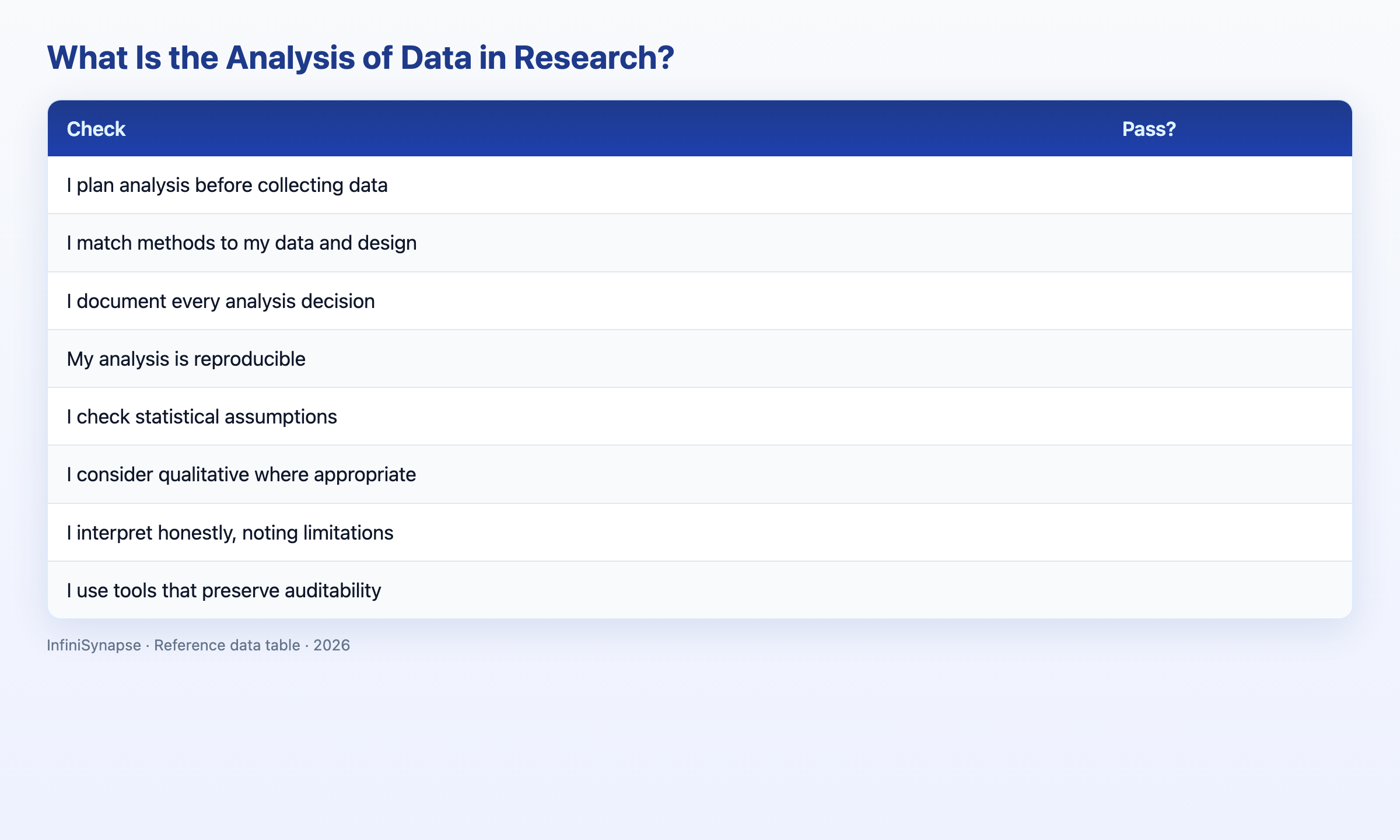
Assess your research analysis practice (1 point each):
| Check | Pass? |
|---|---|
| I plan analysis before collecting data | |
| I match methods to my data and design | |
| I document every analysis decision | |
| My analysis is reproducible | |
| I check statistical assumptions | |
| I consider qualitative where appropriate | |
| I interpret honestly, noting limitations | |
| I use tools that preserve auditability |
6–8: rigorous practice. 3–5: strengthen a step. Below 3: revisit research fundamentals.
Common Pitfalls
Pitfall 1: Fishing for results. Choosing the analysis after seeing the data undermines what is the analysis of data in research.
Pitfall 2: Misapplied methods. The wrong test on the right data produces false conclusions.
Pitfall 3: Unreproducible work. Undocumented analysis cannot be verified and is not credible.
Pitfall 4: Ignoring assumptions. Statistical methods have assumptions that, if violated, invalidate results.
Ethics and Integrity
Research integrity shapes what is the analysis of data in scholarly settings. Pre-registration, honest reporting of null results, and transparent data-sharing policies prevent the literature from filling with unverifiable claims. When AI tools assist the work, documenting which steps were automated and which were human-reviewed preserves the audit trail peer reviewers expect.
Ethical analysis also means protecting participant privacy, obtaining appropriate consent, and avoiding analyses that could harm vulnerable groups even when the data technically permit them. Understanding what is the analysis of data in research therefore includes understanding the ethical boundaries that govern how evidence may be collected, examined, and reported.
Frequently Asked Questions
What role does data examination play in research?
In research, data examination is the stage where collected data is tested systematically against hypotheses and the research question. It applies rigorous, reproducible methods so conclusions are defensible, and it sits between data collection and reporting as a pivotal, pre-planned stage.
Why is this stage important in scholarly work?
This stage is important because errors here undermine every conclusion built on the study. It is where raw observations become evidence, so its rigor determines whether findings are trustworthy. Researchers plan the analysis in advance and document every step for reproducibility.
What methods do researchers typically use?
Researchers use formal methods: descriptive statistics to summarize, inferential tests to judge whether results generalize, and regression or advanced modeling to examine relationships in quantitative studies. Qualitative research uses systematic coding and thematic methods. The method must match the data type, sample size, and assumptions.
How do qualitative and quantitative approaches differ?
Quantitative approaches work with numerical data using statistical methods, while qualitative approaches work with non-numerical data like interviews or texts using systematic coding and thematic methods. Both are rigorous, suited to different questions, and mixed-methods research combines them.
How can AI tools support rigorous research?
AI-native tools automate cleaning, run standard analyses, and surface patterns while preserving reproducibility through inspectable, auditable trails. They accelerate the work without replacing the researcher's judgment on design and interpretation, and their auditability supports the rigor that credible research requires.
Conclusion
What is the analysis of data in research is the pivotal, pre-planned stage where collected data is examined with rigorous, reproducible methods to test hypotheses and answer the research question. It spans quantitative and qualitative traditions, demands documented rigor, and in 2026 is increasingly assisted by AI-native tools that preserve auditability.
The enduring lesson is that in research, rigor is not an optional extra but the very source of a conclusion's value. A finding is only as trustworthy as the analysis and reporting behind it, so the care invested at each stage, from planning through interpretation, is what earns a place in the shared body of knowledge.
To see rigorous, auditable analysis in modern tools, read the complete data analysis guide and what AI-native data analysis means, then try the InfiniSynapse web app free on registration, no credit card required.