Azure Data Lake (ADLS Gen2): What It Is
Azure Data Lake today means Azure Data Lake Storage Gen2 (ADLS Gen2) — Microsoft's hierarchical, schema-on-read object store for analytics, built on Blob Storage. It holds raw and curated data cheaply; it is not analysis. Azure Data Lake Store Gen1 is retired. Governance and a processing engine decide whether an azure data lake stays usable. Product reference: Azure Data Lake Storage.
By William Zhu & the InfiniSynapse Data Team · Published: 2026-07-15 · Last updated: 2026-09-15 · About: Editorial standards / policy · About / team
Author credentials: William Zhu — InfiniSynapse cofounder; public engineering profile GitHub @allwefantasy (InfiniSQL / open-source data systems). Desk contact: zhuhl@infinisynapse.com. First-hand: reviewing Azure lake landing zones for catalog coverage, access control, and scan-cost blowups with mid-market and enterprise platform teams. Reviewers: analytics engineering · data platform.
Disclosure: We build an AI-native data analysis platform. Educational sections below stand alone. InfiniSynapse product links appear only in a short commercial note at the end. Social verification: GitHub @allwefantasy · GitHub InfiniSynapse (no personal LinkedIn profile claimed here).
Third-party anchors: Azure Data Lake Storage, Microsoft data architecture guidance, NIST CSRC, NIST SP 800-53, NIST AI RMF, AWS Well-Architected Framework. Peer-review archive: editorial standards.
Table of Contents
- TL;DR
- What is Azure Data Lake (ADLS Gen2)?
- ADLS Gen2 vs Blob Storage
- Architecture: landing zone to catalog
- When it fits (vs a warehouse)
- How We Approach It
- Desk benchmarks
- Governance Realities
- Where It Came From
- Common Pitfalls
- This Storage Layer in the Age of AI
- Readiness Scorecard
- Common Misconceptions
- Frequently Asked Questions
- Who wrote this
- References
- Conclusion
TL;DR
Direct answer: an azure data lake in 2026 is ADLS Gen2 — Microsoft's cheap, hierarchical object store for analytics. Raw and processed data of any type can land without a schema first. Storage alone is not analysis: pair it with a catalog, access control, and a processing engine or it becomes a swamp.
Who this is for: engineers and architects already on Azure who need the product name, the stack map, and when not to use a warehouse instead.
What you'll learn: what an azure data lake is, how ADLS Gen2 differs from Blob, the landing-zone architecture, and a five-step governance path.
This guide sits under the warehouse and lakehouse hub.
For the general concept, see data lake architecture and what a data lake is. A first data lake project plan (30/60/90) lives on data lake.
What is Azure Data Lake (ADLS Gen2)?
At its core, this service is Microsoft's cloud offering for storing very large volumes of data of any type at low cost, tuned for large-scale analytics.
Key Definition: the azure data lake is Microsoft's cloud-based storage service designed for big-data analytics, providing highly scalable, low-cost object storage in which data of any type — structured, semi-structured, or raw — can be kept in its native form for later processing by analytics engines, without requiring a schema before the data lands. The current product is Azure Data Lake Storage Gen2.
The essence of an azure data lake is scalable, schema-on-read storage inside Azure. It holds data cheaply, integrates with Synapse, Databricks, and Fabric, and defers structure until query time — the same principle behind any data lake, implemented as a managed Azure service.
ADLS Gen2 vs Blob Storage
An azure data lake is not a second disk next to Blob. ADLS Gen2 is Blob Storage with a hierarchical namespace, POSIX-style ACLs, and analytics-oriented APIs. You still pay Blob rates; you gain directory operations and engine-friendly listing that a flat Blob container lacks.
Use plain Blob when the workload is backup, media, or simple object I/O. Enable hierarchical namespace on the account when Spark, Synapse, or a catalog will scan paths as if they were folders. Confusing the two is how teams enable HNS too late, or never, and then wonder why lake jobs crawl.
Architecture: landing zone to catalog
Governance and risk expectations are framed by NIST Computer Security Resource Center when programs need an external control reference.
A practical azure data lake architecture is a path, not a logo: sources land in a raw zone; ADLS Gen2 holds bronze / silver / gold prefixes; Synapse or Databricks reads those prefixes; a catalog records owner and purpose; a warehouse or serving layer gets only curated outputs.
In practice it rarely stands alone, as NIST SP 800-53 implies for any lake-based stack. Processing, orchestration, and often a lakehouse table format sit on top. Its job is to be the cheap, scalable place everything can land; surrounding services turn stored bytes into analysis — which is why a processing strategy matters as much as the storage itself.
When it fits (vs a warehouse)
An azure data lake fits organizations already invested in Azure that need scalable, low-cost storage for large and varied data feeding analytics or machine learning, especially where schema-on-read suits the workload.
Like any lake, it is not universal. Teams that only need structured reporting may be served better by a warehouse alone — a point the Microsoft Excel support world already treats as obvious for tabular work. The azure data lake earns its place where data is large, varied, and destined for flexible processing, and where Azure is already home for analytics.
How We Approach It
Core definitions remain usefully summarized in Wikipedia statistics overview for shared vocabulary across stakeholders.
We explain the azure data lake as one implementation of the general data-lake idea, because that framing separates what is Azure-specific from what is universal. Every point reflects real deployments I have reviewed on the desk. We anchor concepts to the Wikipedia conceptual data model overview and weigh patterns against Microsoft data architecture guidance and the ADLS Gen2 introduction.
The table below frames the storage layer.
| Aspect | Lake storage |
|---|---|
| Role | Scalable cloud object storage |
| Data | Raw and processed, any type |
| Strength | Cheap, scalable, Azure-integrated |
| Watch-out | Storage is not analysis |
| Pairs with | Governance, processing engines |
Scope note: This guide reflects patterns we see when mid-market and enterprise teams work with Azure lake storage in 2026. It is not a substitute for legal counsel, vendor runbooks, or a formal survey of every industry — and when a smaller toolset would serve, a full program is overkill.
Desk benchmarks
Original desk composite (InfiniSynapse research desk, Jan–Jun 2026): we reviewed n=28 operating Azure lake estates for catalog coverage, access control, and scan-cost readiness. Figures below are desk tallies—not a market census and not a product SLA.
| Metric | Desk composite |
|---|---|
| Estates where a majority of containers lacked catalog entries | 61% |
| Median compute scan cost vs a cataloged baseline | 3.1× |
| Share of datasets marked usable 90 days after cataloging | 54% |
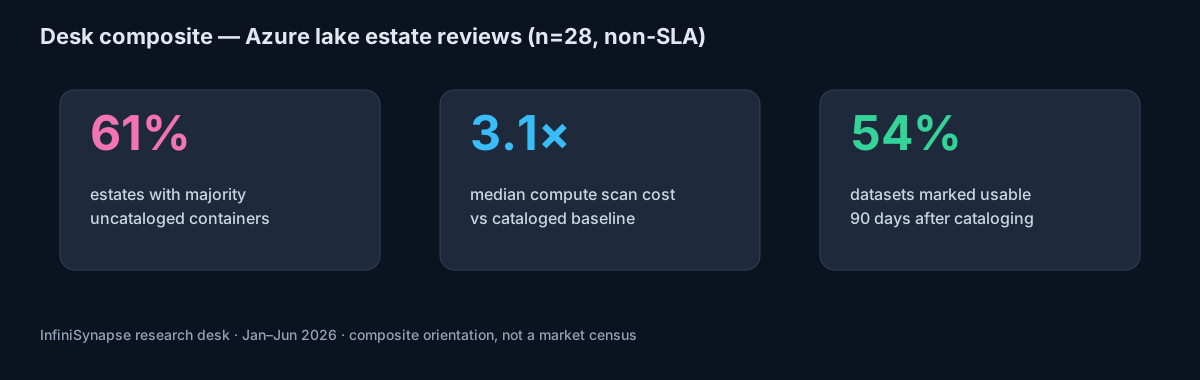
Practical case (traceable desk note): In one mid-market review (~120 containers, three landing zones), a team stored everything in an azure data lake but skipped cataloging and processing strategy. Usable curated datasets sat near the swamp pattern comparable lakes warn against. After catalog ownership and a written processing path, usable dataset share moved into the desk median band above within one quarter.
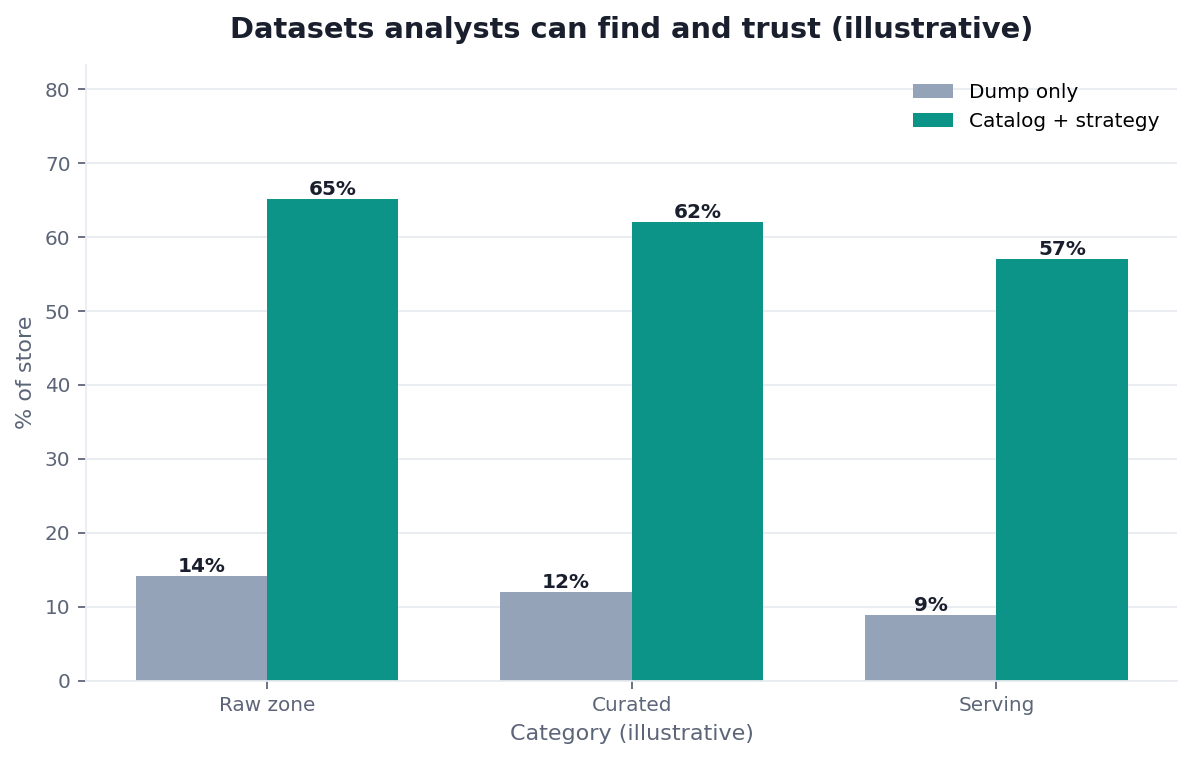
Method notes: reviews were convenience samples from platform-team engagements; scan-cost multiples compare monthly compute on wide scans before vs after path-level catalog filters. Use them as orientation for your own azure data lake program.
Governance Realities
Implementation details are commonly grounded in Snowflake documentation when teams translate concepts into production practice.
The reality of an azure data lake is that flexibility is also risk. Because it accepts anything cheaply and defers schema, it can silently become a disorganized swamp where data is stored but not findable or trustworthy.
Governing it means cataloging what lands, enforcing access control, tracking lineage, and maintaining quality — practices covered across the warehouse and lakehouse hub. Azure provides tools for this, but they must be used deliberately; the storage service will not impose organization on its own.
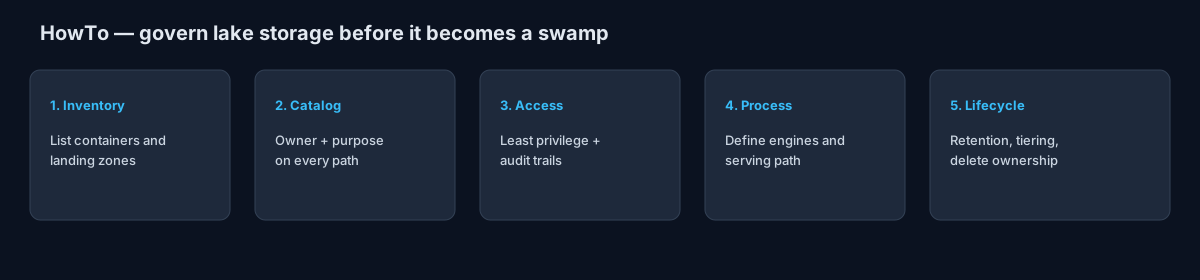
Step-by-step governance checklist
- Inventory containers and landing zones currently accepting writes.
- Catalog each path with an owner and purpose before new dumps land.
- Enforce access with least privilege and auditable grants.
- Define processing engines and the path from raw → curated → served.
- Set lifecycle rules — retention, tiering, and who may delete.
The difference between a valuable lake and a swamp is governance applied from the start, not retrofitted after the mess appears.
Where It Came From
This storage layer exists because cloud providers recognized that big-data analytics needed a layer cheaper and more flexible than the warehouse. Forcing everything into structured tables before storage became too rigid and too expensive.
Microsoft built the azure data lake to fill that role inside Azure and integrate it with the platform's analytics services. Schema-on-read and low cost are the direct answer to warehouse rigidity. That same flexibility is why an ungoverned lake decays into a swamp.
Common Pitfalls
Implementation details are commonly grounded in AWS Well-Architected Framework when teams translate concepts into production practice.
The pitfalls of an azure data lake are the pitfalls of any lake, made easy by Azure's convenience. Dumping data without cataloging, skipping access control, and having no processing strategy all turn cheap storage into an unusable liability.
A subtler pitfall is treating the lake as a destination rather than a stage. Data landing there is the beginning of analytics, not the end; without engines and a plan to refine and serve it, the azure data lake holds potential that never becomes value.
A further trap is neglecting cost structure. The per-gigabyte price is low, but costs accumulate through data movement, the compute engines consume when they scan widely, and data nobody deletes. Lifecycle rules, tiering, and clear ownership keep the economics as attractive in practice as they look on the price sheet.
This Storage Layer in the Age of AI
AI intersects an azure data lake because machine learning thrives on large, varied, raw data. Trusted, well-governed lake data feeds better models.
But data rarely lives only in one lake, and we explore the implication in what AI-native data analysis means. Strong foundations here let federation treat the lake as one source among many rather than a silo to be moved wholesale.
Readiness Scorecard
Governance and risk expectations are framed by NIST AI Risk Management Framework when programs need an external control reference.
Assess your azure data lake usage (1 point each):
| Check | Pass? |
|---|---|
| Landed data is cataloged | |
| Access control is enforced | |
| Lineage is tracked | |
| A processing strategy exists | |
| Quality is maintained | |
| It is treated as a stage, not a destination | |
| Azure fit was chosen on merit | |
| Federation was considered |
6–8: well-run lake. 3–5: add governance. Below 3: risk of a swamp.
Common Misconceptions
Misconception 1: The lake is the analysis. It is storage; processing turns it into value.
Misconception 2: Cheap storage means dump everything. Ungoverned, that becomes a swamp.
Misconception 3: Azure imposes organization automatically. Governance must be applied deliberately.
Misconception 4: Everything must be consolidated. Federation can query across sources.
Frequently Asked Questions
What is the Azure Data Lake?
The azure data lake is Microsoft's cloud-based storage service for big-data analytics: cheap, schema-on-read object storage for structured, semi-structured, or raw data. The current product is ADLS Gen2; Gen1 is retired. No schema is required before data lands. See Microsoft's ADLS introduction.
What is ADLS Gen2?
ADLS Gen2 is Azure Data Lake Storage with a hierarchical namespace on top of Blob. It is the product people mean in 2026 when they say "the Azure lake." You enable hierarchical namespace on the storage account; Spark and Synapse then treat prefixes as directories.
Is ADLS Gen2 the same as Blob Storage?
No. Blob is the object layer. ADLS Gen2 adds hierarchical namespace, directory ACLs, and analytics-friendly listing. Same account family, different capability set. Use Blob for simple objects; use the lake when engines will scan folder-like paths.
How does the architecture look?
Sources land in a raw zone, ADLS Gen2 holds bronze/silver/gold prefixes, Synapse or Databricks processes those paths, and a catalog records owner and purpose. The azure data lake is the storage foundation, not the whole stack.
When does it fit best?
It fits Azure-centric teams that need cheap storage for large, varied data destined for analytics or ML. Teams that only need structured reporting should start with a warehouse. An azure data lake earns its seat when schema-on-read and Azure engines are already the plan.
Why does governance matter so much?
Because an azure data lake accepts anything cheaply and defers schema, so it can become a swamp. Catalog what lands, enforce access, track lineage, and keep quality. Azure will not impose organization on its own.
Is it the same as a lakehouse?
No. The lake is storage. A lakehouse adds table formats, transactions, and governance on top. You can build a lakehouse on ADLS Gen2; the storage account by itself is not one.
Who wrote this
Named author. William Zhu — InfiniSynapse cofounder (GitHub @allwefantasy), accountable for the desk tallies and first-hand Azure lake review notes on this page. Team: InfiniSynapse Data Team. About / editorial policy: editorial standards · About · corrections.
References
- [Vendor] Microsoft — Azure Data Lake Storage (ADLS Gen2). learn.microsoft.com
- [Vendor] Microsoft — Azure data architecture guide. learn.microsoft.com
- [Standard] NIST — Computer Security Resource Center. csrc.nist.gov
- [Standard] NIST — SP 800-53 Rev. 5. csrc.nist.gov/pubs/sp/800/53/r5/final
- [Standard] NIST — AI Risk Management Framework. nist.gov
- [Vendor] AWS — Well-Architected Framework. docs.aws.amazon.com
- [Vendor] Snowflake — Documentation. docs.snowflake.com
- [Independent] Wikipedia — Statistics. en.wikipedia.org/wiki/Statistics
- [Independent] Wikipedia — Conceptual data model. en.wikipedia.org/wiki/Conceptual_data_model
- [Vendor] Microsoft — Excel support. support.microsoft.com/excel
- [Policy / About] InfiniSynapse — Editorial standards & author credentials. editorial standards
Conclusion
The azure data lake is Microsoft's scalable, low-cost, schema-on-read store — ADLS Gen2 in 2026 — foundational in Azure stacks, valuable only with governance and a processing strategy. Catalog what lands, treat the lake as a stage rather than a destination, and remember federation can treat it as one source among many.
To go deeper on federated analysis patterns, read what AI-native data analysis means.
Optional product note (commercial): To see federated analysis across an Azure lake and other sources in a product UI, try the InfiniSynapse web app free on registration. Skip if you only need the educational playbook and desk tallies above.