What Is a Data Lake? (2026)
By the InfiniSynapse Data Team · Last updated: 2026-07-15 · We build an AI-native data analysis platform and work across lakes, warehouses, and lakehouses; this explainer answers what is a data lake in plain terms for 2026, not with a vendor pitch.
Table of Contents
- TL;DR
- How We Answer This
- What It Means
- How It Works
- Lake Versus Warehouse
- When It Helps
- The Swamp Problem
- Governing a Lake Well
- Lakes in the Age of AI
- Readiness Scorecard
- Common Misconceptions
- Frequently Asked Questions
- Conclusion
TL;DR
Direct answer: so what is a data lake? It is a central repository that stores large volumes of data in its raw, native form — structured, semi-structured, and unstructured — until it is needed. In 2026, understanding what is a data lake matters because lakes offer cheap, flexible storage for any data type, but without governance they degrade into unusable "data swamps," so the discipline around the lake matters as much as the lake itself.
Who this is for: anyone asking what is a data lake in 2026.
What you'll learn: a plain-language definition, how a lake works, how it differs from a warehouse, the pitfalls, and how AI fits in.
This guide sits under the warehouse and lakehouse hub.
The one-sentence data lake definition comes before the longer explanation below.
For the architecture blueprint, see data lake architecture.
Also see data lake challenges.
How We Answer This
Governance and risk expectations are framed by FTC consumer protection guidance when programs need an external control reference.
We answer what is a data lake from experience with lakes that thrived and lakes that rotted, because the difference is instructive. Every point reflects real systems. We anchor the definition to the Apache Spark documentation and weigh design choices against the reference architectures at MariaDB documentation, which pioneered much of the modern approach.
The table below frames what is a data lake against the warehouse.
| Dimension | Data lake | Data warehouse |
|---|---|---|
| Data form | Raw, any type | Structured, modeled |
| Schema | On read | On write |
| Cost | Low storage | Higher, curated |
| Best for | Flexibility, ML | Reliable reporting |
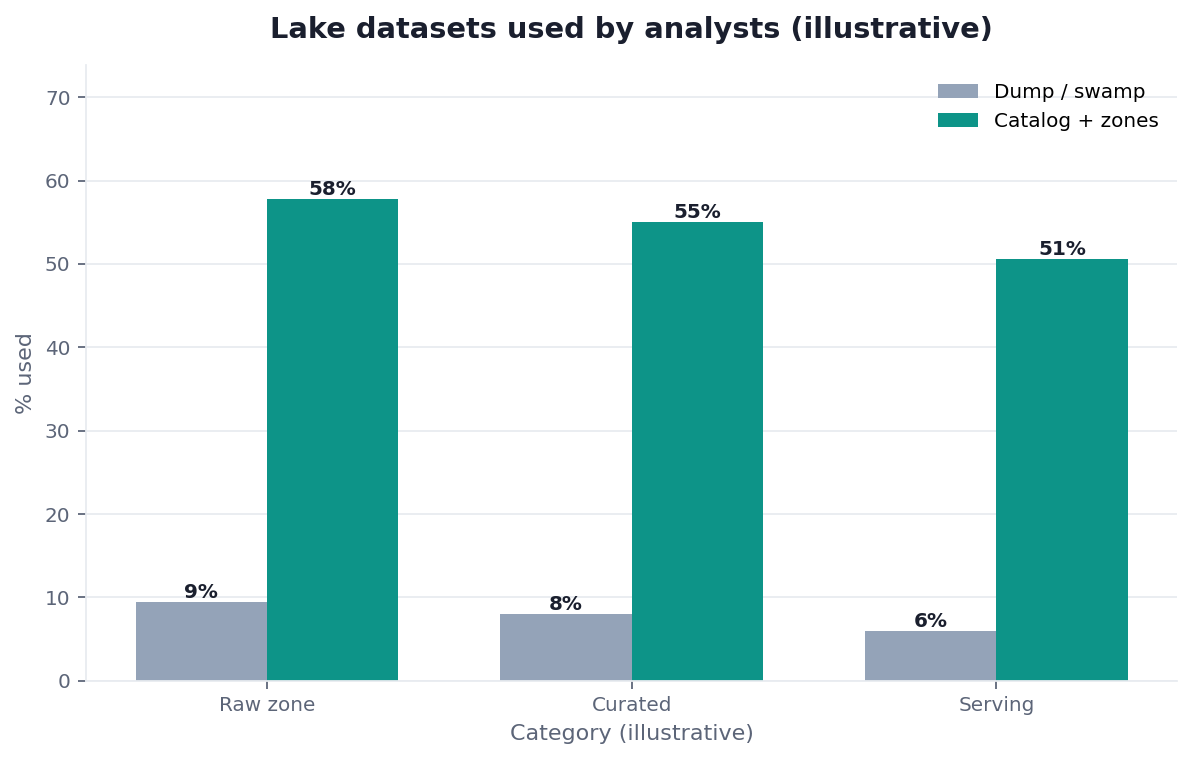
Practical example: a team that could not say what is a data lake dumped everything into cheap storage and got a swamp nobody could use. Adding a catalog and zones — a governance discipline echoed at Stanford HAI AI Index — turned the swamp back into a usable lake.
Scope note: This guide reflects patterns we see when mid-market and enterprise teams work with what is a data lake in 2026. It is not a substitute for legal counsel, vendor runbooks, or a formal survey of every industry — and when a smaller toolset or lighter process would serve, a full program is overkill.
What It Means
At its core, the answer to what is a data lake is a store for raw data of any kind, kept in its native format until someone needs it, at which point structure is applied on read.
Key Definition: a data lake is a centralized repository that holds large volumes of data in its raw, native format — structured tables, semi-structured logs and JSON, and unstructured documents, images, audio, and video — applying schema only when the data is read, which gives maximum flexibility at low storage cost.
The phrase that defines what is a data lake is schema on read. Unlike a warehouse, which structures data before storing it, a lake stores data as-is and defers structure until query time, which is what makes it flexible enough to hold data whose future use is not yet known.
How It Works
Implementation details are commonly grounded in Kubernetes documentation when teams translate concepts into production practice.
Understanding how it works clarifies what is a data lake in practice. Data flows in from many sources and lands in cheap object storage in its original form. Metadata and cataloging describe what is there, and processing engines apply structure when the data is read for analysis or machine learning.
The mechanics behind what is a data lake rely on separating storage from compute. The reference patterns at Wikipedia data quality overview show why this separation matters: storage stays cheap and virtually unlimited, while compute is applied on demand, so a lake can hold petabytes affordably and process only what a given query touches. This economic model is a large part of why lakes became popular for big-data and machine-learning workloads.
Lake Versus Warehouse
The clearest way to grasp what is a data lake is by contrast with a warehouse. A warehouse structures and models data before storing it, optimizing for reliable, fast reporting on known questions. A lake stores raw data and structures it on read, optimizing for flexibility and unknown future questions.
Different jobs, not rivals
The distinction in what is a data lake versus a warehouse is one of job, not quality. The comparison at Stripe documentation reflects a broader truth: lakes and warehouses solve different problems, and many organizations run both. We explore this trade-off fully in data lake vs data warehouse.
The lakehouse convergence
The line answering what is a data lake has blurred with the rise of the lakehouse, which adds warehouse-like structure and reliability on top of lake storage. This convergence, covered in our sibling guide, aims to give the flexibility of a lake with the dependability of a warehouse, and it is where much of the industry is heading.
When It Helps
Implementation details are commonly grounded in Python documentation when teams translate concepts into production practice.
A lake helps most when the question what is a data lake good for has clear answers: storing diverse raw data cheaply, supporting machine learning that needs raw inputs, and preserving data whose future use is uncertain.
The strength behind what is a data lake is optionality. By keeping raw data affordably, a lake lets you ask questions later that you had not imagined when the data arrived, which is invaluable for exploratory analysis and machine learning. The Azure architecture center makes the same point: the value is in preserving raw detail that a warehouse's up-front modeling would discard, keeping future analytical doors open.
The Swamp Problem
The dark side of what is a data lake is the data swamp. Without governance, a lake accumulates undocumented, unquality-checked data until no one knows what is there or whether it can be trusted, and the lake becomes useless.
The swamp is the defining failure mode behind what is a data lake, and it is a governance failure, not a technology one. When data lands with no catalog, no ownership, and no quality checks, cheap storage becomes a liability rather than an asset. Avoiding the swamp is why the discipline around a lake — cataloging, zoning, ownership — matters as much as the storage technology itself, a theme we return to across the warehouse and lakehouse hub.
Governing a Lake Well
Implementation details are commonly grounded in Google Cloud architecture framework when teams translate concepts into production practice.
Governing a lake well is what keeps the answer to what is a data lake positive. The core practices are zoning (raw, cleaned, curated layers), cataloging so data is discoverable, assigning ownership, and applying quality checks before data is trusted for analysis.
Good governance turns what is a data lake from a risk into an asset. Organizing data into zones lets raw data land freely while curated zones stay trustworthy; a catalog makes the lake searchable; ownership ensures someone is accountable for each dataset. These practices do not sacrifice the lake's flexibility — they make that flexibility usable, which is the whole point of building a lake rather than a pile of files.
The most successful lakes treat governance as a gradient rather than a gate. Raw zones stay deliberately permissive so that new data can land quickly and cheaply without bureaucracy, which preserves the speed that makes a lake attractive in the first place. Curated zones, by contrast, enforce strict standards for documentation, quality, and ownership, so that anything promoted into them can be trusted for real analysis. This graduated model lets an organization capture data fast while still producing trustworthy outputs, and it avoids the two opposite failure modes: a lake so tightly controlled that nobody bothers to use it, and a lake so loose that nothing in it can be believed. Getting the gradient right — permissive at the edges, rigorous at the core — is, in the end, the practical art of running a lake that stays genuinely healthy and useful as it grows.
Lakes in the Age of AI
AI intersects what is a data lake in two ways. Machine learning often needs the raw, diverse data a lake preserves, and AI-native platforms change how much you must move into a lake before you can use it.
That second shift is worth weighing, and we describe it in what AI-native data analysis means. In the InfiniSynapse web app, zero-config federation lets an agent analyze across sources — including files and object storage — without first consolidating everything into a single lake, so the modern answer to what is a data lake increasingly includes asking whether you need to centralize the data at all.
Readiness Scorecard
Assess your data lake (1 point each):
| Check | Pass? |
|---|---|
| Data is organized into zones | |
| A catalog makes data discoverable | |
| Datasets have clear ownership | |
| Quality is checked before trust | |
| Storage and compute are separated | |
| Raw detail is preserved for future use | |
| It has not become a swamp | |
| Federation was considered before centralizing |
6–8: a healthy lake. 3–5: add catalog and zones. Below 3: swamp risk — govern now.
Common Misconceptions
Misconception 1: A lake replaces a warehouse. They do different jobs; many run both.
Misconception 2: A lake is just cheap storage. Without governance it becomes a swamp.
Misconception 3: Everything should go in the lake. Federation can avoid centralizing at all.
Misconception 4: Schema on read means no structure. Structure is applied at query time, not skipped.
Frequently Asked Questions
What is a data lake?
It is a centralized repository that holds large volumes of data in its raw, native format — structured tables, semi-structured logs, and unstructured documents, images, audio, and video — applying schema only when the data is read. This schema on read approach defers structure to query time, giving maximum flexibility at low storage cost and letting you keep data whose future use is not yet known.
How is a data lake different from a warehouse?
A warehouse structures and models data before storing it, optimizing for reliable, fast reporting on known questions, while a lake keeps raw data and applies structure on read, optimizing for flexibility and unknown future questions. The difference is one of purpose rather than quality, which is why many organizations run both, and why the lakehouse has emerged to combine their strengths.
What is a data swamp?
A data swamp is what a lake becomes without governance: a growing pile of undocumented, unquality-checked data that nobody can trust or even find their way around. It is a governance failure rather than a technology one, arising when data lands with no catalog, no ownership, and no quality checks. Avoiding it is why zoning, cataloging, and ownership matter as much as the storage itself.
When should you use a data lake?
Use one when you need to store diverse raw data cheaply, support machine learning that needs raw inputs, or preserve data whose future use is uncertain. The core benefit is optionality: keeping raw detail affordably lets you ask questions later that you had not imagined when the data arrived. That flexibility is most valuable for exploratory analysis and machine learning rather than fixed, well-understood reporting.
How does AI change the data lake?
Machine learning often needs the raw, diverse data a lake preserves, so lakes remain relevant, but AI-native platforms change how much you must centralize before you can use data. Federation lets an agent analyze across sources — including files and object storage — without first consolidating everything into one lake, so a modern design asks whether centralizing is necessary rather than assuming every dataset must flow into a single repository.
Conclusion
What is a data lake? A central store for raw data of any type, structured on read, prized for cheap, flexible storage — but only as useful as its governance allows, since an ungoverned lake becomes a swamp. In 2026, zone and catalog your lake, preserve raw detail deliberately, and remember AI-native federation can reduce how much you need to centralize at all.
To see how federated analysis works across sources without a single lake, read what AI-native data analysis means and try the InfiniSynapse web app free on registration.