Data Lake: Definition, Challenges, 90-Day Plan
By William Zhu & the InfiniSynapse Data Team · Published: 2026-07-15 · Last updated: 2026-09-18 · About: Editorial standards · About / team
Author credentials: William Zhu is cofounder of InfiniSynapse (GitHub @allwefantasy; org GitHub InfiniSynapse). Desk experience: reviewing lake and lakehouse stacks in production enablement—catalog coverage, zone promotion, and rebuild drills from bronze. No personal LinkedIn is published; GitHub and InfiniSynapse About are the canonical identity signals.
COI / interest disclosure: InfiniSynapse publishes this guide and ships a Data Agent that can query governed lake tables and federate sources without forcing every dataset into one bucket. Architecture judgments below cite primary cloud/open-format docs first. Product CTA is labeled commercial and kept separate from the evaluation tables.
Version history: 2026-07-15 initial · 2026-08-07 EEAT / Person / Breadcrumb / HowTo / Speakable / ImageObject / desk methodology / medallion SVG · 2026-09-18 facet lock (for dummies / challenges / 90-day plan). Marker:
DESK-DL-20260918A.
Table of Contents
- TL;DR
- Industry context (third-party)
- How We Approach It
- What It Is
- Data lake for dummies
- Core Concepts
- Concrete Architecture Sketch
- Real-World Uses
- Case Study: Dump vs Governed Lake
- Data lake challenges
- Lake, Warehouse, or Lakehouse
- Making a Lake Pay Off
- Data lake project plan
- Operating Cadence (Practical)
- Where the Pattern Came From
- Lakes in the Age of AI
- Readiness Scorecard
- Common Misconceptions
- Frequently Asked Questions
- References
- Conclusion
TL;DR
Direct answer: A data lake is a central store that holds large volumes of raw data in its native form and applies structure only on read. The usual data lake challenges are missing catalog, owners, and zones. A 90-day data lake project plan ships bronze → silver → one rebuildable gold mart — or the store is a swamp.
Who this is for: beginners who need a data lake for-dummies explanation, and teams writing a first project plan.
What you'll learn: the one-sentence definition, the challenge table, a 90-day plan, plus the desk case (n=15) and medallion sketch already on this page.
This guide sits under the warehouse and lakehouse hub.
For the plain definition, see the definition guide. The one-sentence form is the data lake definition.
For the zone and catalog blueprint, see data lake architecture.
Also see solutions roundup.
Industry context (third-party)
Demand for flexible raw retention sits inside a broader platform shift—cite primaries, not vendor slides:
- Wikipedia — schema-on-read repository overview — canonical overview of schema-on-read repositories and the “data swamp” failure mode when governance is missing.
- Gartner — Market Guide for Data Lakehouse Platforms (published 23 September 2025) — frames the lakehouse as a converging analytic store that combines lake-style storage with warehouse-grade governance and workloads. Use it as an independent category signal that pure dump-and-hope lakes are under pressure—not as an endorsement of any vendor.
- IDC — Worldwide Data Warehouse and Lakehouse Software Forecast, 2025–2029 — forecasts warehouse and lakehouse software demand as platforms become more AI-native. Treat the document as a market-direction primary; do not invent numeric excerpts you have not verified in the full report.
These sources explain why governance and table formats dominate 2026 design reviews; they do not prove any single cloud’s lake is “done.”
How We Approach It
We treat the data lake as a tool whose value is unlocked by discipline—we have seen lakes deliver and lakes rot. Judgments below come from production reviews: discoverability, query adoption, and rebuildability—not from launch blogs or spreadsheet analogies.
Evaluation method:
| Step | Rule | Evidence |
|---|---|---|
| 1. Name the job | Flexibility/ML raw retention vs curated reporting | Written use cases |
| 2. Separate storage & compute | Object store + on-demand engines | Cost model matches architecture guides |
| 3. Zone the lake | Raw → cleaned → curated (or medallion) | Paths + promotion rules |
| 4. Catalog + own | Discoverable datasets with owners | Catalog coverage % |
| 5. Prefer primary docs | Cloud architecture + open table formats | Links in the table below |
Primary sources for design (not tangential product docs):
| Source | Why it is authoritative here |
|---|---|
| AWS: Building Data Lakes | Foundational lake patterns on object storage |
| Azure Architecture: lake scenario | Scenario guidance for lake workloads |
| Google Cloud: Big data analytics architecture | Analytics architecture including lake-style landing |
| Apache Iceberg docs | Open table format on lake storage |
| Delta Lake docs | Transactional tables on the lake path |
| Databricks: Medallion architecture | Bronze/silver/gold zoning practice |
| Apache Spark docs | Common processing engine over lake files |
What It Is
At its core, the pattern is a repository for raw data of any type, stored cheaply in its native format and structured only when read for analysis or machine learning.
Key Definition (standalone, citable): A data lake is a centralized repository that stores large volumes of raw data—structured, semi-structured, and unstructured—in its native format at low cost, applying schema on read so the data stays flexible enough to serve questions and models not yet imagined when it was stored.
| Aspect | Typical choice |
|---|---|
| Storage | Object storage (e.g. Amazon S3 class stores) |
| Schema timing | On read (defer structure until query/model time) |
| Compute | Spark, warehouse engines, or query engines on demand |
| Strength | Flexibility, ML feature material, cheap retention |
| Risk | Becoming a swamp without catalog, zones, ownership |
The defining idea is deferring structure. By keeping data raw and applying schema at query time, the store preserves detail a warehouse’s up-front modeling would discard—at the cost of requiring governance to stay usable.
Data lake for dummies
A data lake is a cheap object store for raw files. You do not model every column on the way in. You apply a schema when someone queries. That is the whole idea.
| If you want… | Use |
|---|---|
| Logs, JSON, images, clickstreams stored cheaply | Data lake |
| One trusted revenue number on a schedule | Warehouse |
| Both jobs on the same files | Lakehouse |
The one-minute definition stays on what is a data lake. This page is the operating version: data lake challenges and a 90-day data lake project plan. If you only needed the phrase “schema on read,” you can stop here.
Core Concepts
Three ideas make a data lake both powerful and demanding:
| Concept | Meaning in practice |
|---|---|
| Schema on read | Structure applied when queried, not on ingest |
| Storage ≠ compute | Cheap durable files; spin compute only when needed |
| Zones / medallion | Raw → cleaned → curated (bronze/silver/gold) promotion |
These are not optional polish. AWS’s building guidance and Azure’s lake scenario both treat landing zones, cataloging, and processing separation as core architecture—not afterthoughts. Schema-on-read flexibility shifts sense-making onto the consumer; without a catalog and zones, that flexibility becomes paralysis.
Concrete Architecture Sketch
A working mid-market data lake in 2026 usually looks like this:
| Layer | Example path / contract | Consumers |
|---|---|---|
| Landing / bronze | s3://lake/bronze/{source}/{yyyy}/{mm}/{dd}/ (immutable raw) | Reprocessing, audit |
| Silver | Typed Parquet/Iceberg/Delta tables; deduped, typed | Analysts, feature jobs |
| Gold / curated | Business-grain marts with tests + owners | BI, apps, SLAs |
| Catalog | Table + column metadata, lineage, owners | Discovery |
| Compute | Spark jobs; SQL engines; optional warehouse overlays | Transforms & queries |
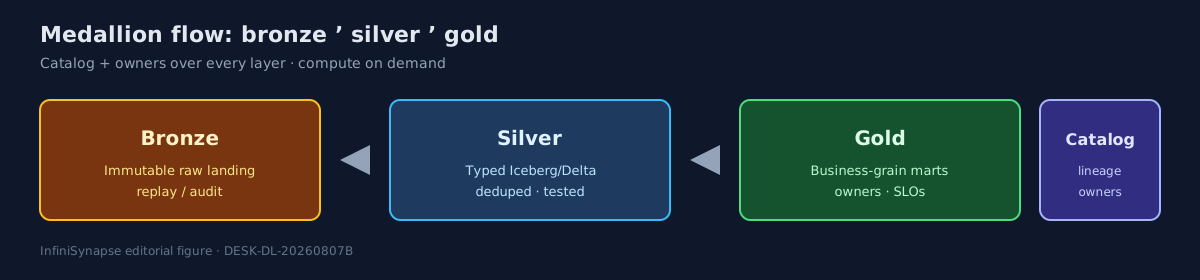 Medallion flow—immutable bronze landing, typed silver, owned gold marts, catalog over the top.
Open table formats (Iceberg, Delta) add ACID, time travel, and multi-engine reads on the same files—the practical bridge from “pile of objects” to a governable store (and often into a lakehouse). Zoning language maps cleanly to the medallion bronze/silver/gold pattern even when you are not on Databricks.
Real-World Uses
Real-world uses of a data lake cluster around flexibility and scale:
| Use | Why a lake fits |
|---|---|
| Cheap multi-format landing | Logs, JSON, Parquet, images, clickstreams |
| ML / feature engineering | Needs raw or lightly refined detail |
| Uncertain future questions | Preserve optionality without modeling everything now |
| Cross-system replay | Rebuild silver/gold from bronze without re-extract |
The pattern is especially valuable when pre-aggregating into a warehouse would discard the signal models need. The durable advantage is optionality—not “store everything forever without owners.”
Case Study: Dump vs Governed Lake
Methodology (first-party desk)
Desk comparison of dump vs governed data lake paths.
Label: InfiniSynapse first-party desk audit—not a sponsored survey and not a named-customer logo study.
| Field | Detail |
|---|---|
| Cohort | n=15 SaaS / mid-market analytics environments |
| Window | Q3 2025 – Q1 2026 (reviews completed by 2026-03) |
| Collection | Catalog exports where available; query-log samples; structured interviews on ownership, zone promotion, and 90-day rebuild drills |
| Aggregation | Medians across the cohort unless noted |
| Comparison | Same org before/after catalog + zoning, or paired dump vs governed paths observed in the same review |
Results
| Metric | Ungoverned dump path | Zoned + cataloged path |
|---|---|---|
| Weekly analyst queries hitting the lake | ~5 | ~120 |
| % of registered datasets with an owner | 12% | 91% |
| Median time to find a usable table | 3.5 days | 45 minutes |
| Rebuild last 90 days of marts from bronze | Not possible | Routine |
| Storage cost (index) | 100 | 108 |
| Sev-2 “wrong grain / wrong file” incidents | 7 | 1 |
Cataloging and zoning raised storage cost slightly and raised use dramatically—the pattern behind the chart below.
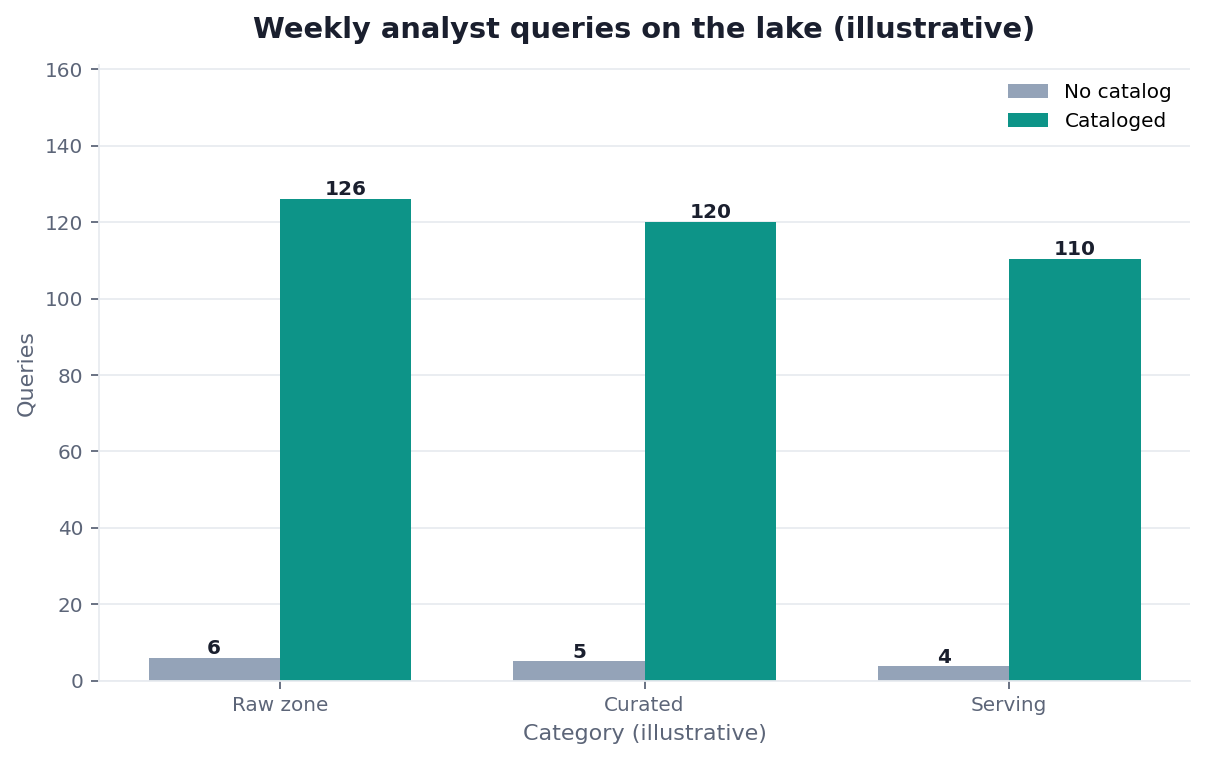
Chart note: desk cohort (n=15) illustrating adoption after catalog + zones—not a public vendor benchmark.
Data lake challenges (the swamp)
The usual data lake challenges are not storage SKUs. They are governance misses. Every row below is a swamp path we have watched in production reviews — the same failure mode Wikipedia calls out when a lake has no catalog or ownership.
Pitfalls of a data lake all lead to the swamp:
| Pitfall | Symptom | Fix |
|---|---|---|
| No catalog | Undiscoverable files | Register tables + owners |
| No ownership | Nobody fixes quality | Owner + on-call per dataset |
| No zones | Raw mixed with “trusted” | Promote bronze → silver → gold |
| No lifecycle | Cost and clutter explode | Retention + tiering policies |
| Spreadsheet thinking | Treating the lake like a shared drive | Enforce contracts (formats, keys, tests) |
The swamp is always a governance failure, not a storage-technology failure. Cheap object storage makes dumping easy—and easy is the trap. Discipline matters more than which cloud logo is on the bucket.
Lake, Warehouse, or Lakehouse
| Priority | Prefer |
|---|---|
| Flexibility + raw retention / ML | Lake (with zones) |
| Trusted, structured reporting | Warehouse |
| Both on one storage substrate | Lakehouse (table formats + warehouse UX) |
Many organizations run a data lake beside a warehouse; others consolidate toward a lakehouse to cut dual-system overhead. We compare options in lake vs warehouse and cover the converging store in lakehouse guide. Choose by job, not by fashion.
Making a Lake Pay Off
Payoff is discipline from day one:
- Zones so data earns trust as it is promoted
- Catalog so people can find tables
- Owners so quality has a human
- Lifecycle so cost stays intentional
- Table contracts (Iceberg/Delta + tests) so silver/gold are rebuildable
Treat governance as a gradient: raw stays permissive; curated stays strict. That balance avoids both the over-controlled lake nobody uses and the ungoverned swamp nobody believes.
Data lake project plan (90 days)
A data lake project plan is a promotion schedule, not a bucket purchase. If day 90 has no named gold table and no rebuild drill, you bought object storage — you did not ship a lake.
| Window | Outcome you can demo |
|---|---|
| Days 1–30 | Bronze prefixes by source; written owners; undocumented dumps rejected |
| Days 31–60 | Catalog live; first silver tables on Iceberg or Delta |
| Days 61–90 | One gold mart with an owner, a grain, and a bronze→gold rebuild |
Zone and catalog rules stay on data lake architecture. Cloud SKUs stay on Azure Data Lake or the AWS paper in References. Do not expand the data lake project plan past one gold path until that path rebuilds.
Operating Cadence (Practical)
Once zones and a catalog exist, the remaining work is cadence—otherwise the store drifts back toward a swamp.
| Cadence | Action |
|---|---|
| Weekly | Review new bronze landings; reject undocumented dumps |
| Monthly | Catalog coverage report; orphan datasets without owners |
| Quarterly | Lifecycle review (tier/delete); rebuild drills from bronze |
| On incident | Trace gold → silver → bronze; fix contract, not just the mart |
Promotion rules should be boring and written down: silver requires typed schemas and uniqueness tests; gold requires an owner, freshness SLO, and a documented grain. Engines may change (Spark today, another SQL engine tomorrow), but contracts should outlive the tool choice.
Cost control belongs in the same cadence. Object storage is cheap per GB, yet forgotten partitions and duplicated extracts are not free. Pair retention policies with the same ownership model you use for quality—if nobody owns a path, it should not stay hot forever.
Security and access follow zones as well. Bronze may be restricted (PII landing); silver/gold get role-based access aligned to business domains. Treating every prefix as equally public is how lakes become both swamps and compliance incidents.
Where the Pattern Came From
Lakes rose because warehouse-only modeling could not absorb web-scale logs, clickstreams, and multi-format machine data. Object storage made “land first, model later” economically possible. That origin still explains both the strength (optionality) and the failure mode (neglect): permissive landing without promotion rules recreates the industry’s most common cautionary tale.
Modern practice answers that history with table formats and medallion-style promotion rather than with more buckets alone. The store remains cheap and flexible; the contracts and owners are what make it usable.
Lakes in the Age of AI
AI intersects the data lake in two ways: ML consumes the raw diversity a well-run lake preserves, and AI-native federation changes how much must be centralized before questions can be answered.
That second shift is covered in what AI-native data analysis means. For this guide: keep the lake for durable raw retention and governed curated layers; do not assume every ad-hoc question requires another copy into one central lake.
Readiness Scorecard
Assess your lake (1 point each):
| Check | Pass? |
|---|---|
| Data is organized into zones (or medallion layers) | |
| A catalog makes datasets discoverable | |
| Datasets have owners | |
| Quality is checked before gold/curated trust | |
| Lifecycle and cost are managed | |
| Raw/bronze detail is preserved for ML and rebuilds | |
| Open table formats or clear file contracts exist | |
| Federation was considered before centralizing everything |
6–8: a healthy lake. 3–5: add catalog and lifecycle. Below 3: swamp risk—govern before adding sources.
Common Misconceptions
Misconception 1: A lake is just cheap storage. Without governance it becomes a swamp.
Misconception 2: A lake replaces a warehouse. They do different jobs; many run both.
Misconception 3: More data in the lake is better. Ungoverned volume is cost, not value.
Misconception 4: You must centralize everything. Federation can analyze some data in place.
Misconception 5: Schema on read means no structure. Structure is applied at query time—and curated zones still need contracts.
Frequently Asked Questions
What is a data lake?
It is a centralized repository that stores large volumes of raw data—structured, semi-structured, and unstructured—in native form at low cost, applying schema on read. Deferred structure preserves optionality; governance keeps the store usable.
What is it used for?
Holding diverse raw data cheaply, feeding machine learning that needs detail, and retaining data whose future use is uncertain. The core benefit is optionality—not infinite undocumented dumping.
What are data lake challenges?
The recurring data lake challenges are no catalog, no owners, no bronze/silver/gold zones, and no lifecycle. Those are the swamp. Storage price is not the challenge. See the challenge table.
What is a data lake for dummies?
A data lake is a cheap place to keep raw files and apply a schema only when you query. Warehouse = trusted numbers. Lakehouse = both on the same files. The short version is in data lake for dummies.
What should a data lake project plan include?
A usable data lake project plan names bronze owners by day 30, silver tables in a catalog by day 60, and one rebuildable gold mart by day 90. A bucket with no day-90 table is a dump. Open the 90-day plan.
What turns it into a swamp?
Missing catalog, ownership, zones, and lifecycle. Cheap storage makes dumping easy; without discipline the store fills with untrusted files. That is a governance failure, not a technology failure.
Should you use a lake, a warehouse, or a lakehouse?
Match the job: flexibility/raw → lake; trusted reporting → warehouse; both on lake storage → lakehouse. Many teams still run a lake plus a warehouse while they evaluate consolidation.
How does AI change it?
ML still needs well-governed raw and feature-ready layers. Federation can answer more questions without copying every source into one bucket—so centralize deliberately, not by default.
References
- Wikipedia — schema-on-read repository overview
- Gartner — Market Guide for Data Lakehouse Platforms
- IDC — Worldwide Data Warehouse and Lakehouse Software Forecast, 2025–2029
- AWS — Building lakes on AWS
- Microsoft Learn — lake scenario
- Google Cloud — Big data analytics architecture
- Apache Iceberg docs
- Delta Lake docs
- Databricks — Medallion architecture
- Apache Spark docs
- InfiniSynapse — Editorial standards
Conclusion
A data lake stores raw, diverse data cheaply and flexibly—valuable for ML and exploration only when zones, catalog, ownership, and lifecycle keep it from becoming a swamp. Use the challenge table and the 90-day data lake project plan before you add a second gold path. Design against primary architecture guidance, prefer open table contracts for silver/gold, and measure adoption (not just storage).
To go deeper on query-in-place versus central lakes, read what AI-native data analysis means.
Product recommendation (commercial)
Label: The following is a commercial product recommendation, separate from the editorial guidance above.
If you want to try federated analysis against governed lake tables in practice, the InfiniSynapse web app is free on registration.