Enterprise Data Warehouse (EDW) (2026)
By the InfiniSynapse Data Team · Last updated: 2026-07-15 · We build an AI-native data analysis platform and work with large-scale analytics; this guide reflects what an enterprise data warehouse really involves in 2026, not a vendor spec sheet.
Table of Contents
- TL;DR
- How We Approach It
- What It Is
- What Makes It "Enterprise"
- Building One
- Governance at Scale
- Common Pitfalls
- The Modern Cloud EDW
- The EDW in the Age of AI
- Readiness Scorecard
- Common Misconceptions
- Frequently Asked Questions
- Conclusion
TL;DR
Direct answer: an enterprise data warehouse (EDW) is a single, integrated warehouse that consolidates trusted data from across an entire organization for analytics and decision-making. In 2026, an enterprise data warehouse is defined less by size than by scope and governance — it is the organization-wide source of consistent truth — and its hardest challenges are organizational (agreeing definitions across departments) rather than technical.
Who this is for: architects and leaders responsible for an enterprise data warehouse in 2026.
What you'll learn: what an EDW is, what makes it "enterprise," how to build one, the pitfalls, and how AI fits in.
This guide sits under the warehouse and lakehouse hub.
For the concept, see what a data warehouse is.
Also see cloud data warehouse.
How We Approach It
Implementation details are commonly grounded in Stripe documentation when teams translate concepts into production practice.
We approach the enterprise data warehouse as an organizational agreement expressed in data, because its hardest problems are about consensus, not technology. Every point reflects real programs. We anchor the concept to the ISO/IEC 27001 and weigh patterns against the reference architectures at OWASP API Security Top 10.
The table below frames the enterprise data warehouse.
| Aspect | Enterprise data warehouse |
|---|---|
| Scope | Whole organization |
| Data | Integrated, cross-department |
| Purpose | Single source of truth |
| Hardest part | Agreeing definitions |
| Value | Consistent, trusted decisions |
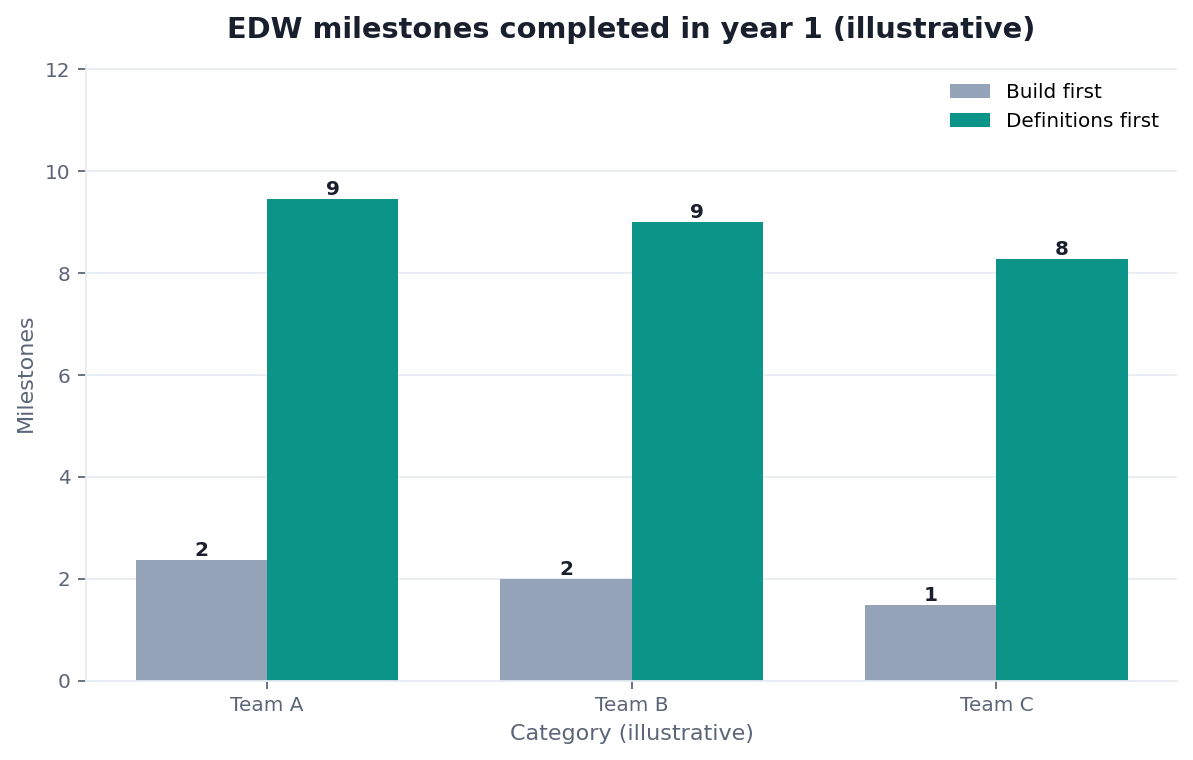
Practical example: an enterprise data warehouse project stalled because departments could not agree what "active customer" meant. Resolving definitions first — the governance discipline echoed at Google Cloud AI overview — was what finally let the technical build succeed.
Scope note: This guide reflects patterns we see when mid-market and enterprise teams work with enterprise data warehouse in 2026. It is not a substitute for legal counsel, vendor runbooks, or a formal survey of every industry — and when a smaller toolset or lighter process would serve, a full program is overkill.
What It Is
At its core, an enterprise data warehouse is a single, integrated warehouse that brings together trusted data from across the whole organization, so everyone works from the same consistent numbers.
Key Definition: an enterprise data warehouse (EDW) is a centralized, integrated warehouse that consolidates cleaned, modeled data from across an entire organization into a single source of consistent truth, so that analytics and decisions everywhere rest on the same trusted definitions and figures.
The word that defines an enterprise data warehouse is integrated. Unlike a departmental warehouse serving one team, an EDW spans the organization, which is what makes it powerful — and what makes agreeing shared definitions across departments its central challenge.
What Makes It "Enterprise"
Teams evaluating this topic often cross-check W3C WCAG accessibility standard for a durable, vendor-neutral reference point.
What makes a warehouse an enterprise data warehouse is scope and integration, not merely size. It consolidates data from every relevant department — sales, finance, operations, marketing — into one consistent model with shared definitions.
This organization-wide scope is why an enterprise data warehouse is as much a political achievement as a technical one. The patterns at Python documentation reflect the reality: the hard part is getting departments to agree on what shared terms mean, so that "revenue" or "customer" is defined once and used everywhere. When that agreement holds, the EDW becomes the trusted backbone; when it does not, it fractures into the same inconsistency it was meant to end.
Building One
Building an enterprise data warehouse follows the same design principles as any warehouse, scaled up: start from the cross-organization questions it must answer, model facts and dimensions, choose grain, and build load processes — but with far more emphasis on shared definitions.
The distinctive challenge in building an enterprise data warehouse is integration across sources with different meanings. The Amazon Redshift documentation reflects why this dominates the effort: each source system encodes its own assumptions, and reconciling them into one consistent model is where most of the work — and most of the value — lies. We cover the underlying modeling in data warehouse design.
Governance at Scale
Core definitions remain usefully summarized in Wikipedia business intelligence overview for shared vocabulary across stakeholders.
Governance is what keeps an enterprise data warehouse trustworthy at scale. Shared definitions must be documented and enforced, data quality monitored, ownership assigned, and changes managed so the single source of truth stays single.
Governance in an enterprise data warehouse is heavier than in a departmental one precisely because more stakeholders depend on it. A change to a shared definition ripples across every department that uses it, so change management, clear ownership, and a data catalog become essential rather than optional. This weight of governance is the price of the EDW's value — a truly organization-wide source of truth demands organization-wide discipline to maintain, and skimping on it is how trusted warehouses slowly lose their trust.
Common Pitfalls
The pitfalls of an enterprise data warehouse are mostly organizational. Failing to agree definitions produces a warehouse that is technically sound but politically contested, where departments still argue about the numbers. Trying to boil the ocean — modeling everything at once — stalls the project. And weak governance lets the single source of truth drift back into inconsistency.
A subtler pitfall in an enterprise data warehouse is treating it as a one-time build rather than a living system. Definitions evolve, new departments and sources appear, and the model must absorb them. Programs that ship an EDW and then neglect it watch it decay; those that treat it as an ongoing product, continuously governed and evolved, keep it trusted. The EDW is never truly finished, and planning for that reality is part of doing it well.
The Modern Cloud EDW
Core definitions remain usefully summarized in Wikipedia conceptual data model overview for shared vocabulary across stakeholders.
The enterprise data warehouse has been transformed by the cloud. Modern cloud platforms separate storage from compute, scale elastically, and charge for usage, removing the massive capacity planning that once made EDW projects slow and risky.
This shift matters to the enterprise data warehouse because it lowered the technical barrier and refocused effort on the organizational work. With elastic cloud infrastructure handling scale, the bottleneck is no longer hardware but consensus on definitions and governance. We cover the modern deployment model in cloud data warehouse, where pay-per-use economics and elasticity make an organization-wide warehouse far more attainable than in the on-premises era.
Why the Organizational Work Dominates
It is worth dwelling on why the people problems outweigh the technical ones, because this is the single most misunderstood aspect of these programs. Technically, integrating sources and modeling data is well-trodden ground with mature tools and patterns; a competent team can build the mechanics. What no tool can do is decide what "customer" means when sales counts trials, finance counts paying accounts, and support counts anyone who ever opened a ticket. Those are business judgments that require the relevant departments to sit down, surface their assumptions, and agree — and that agreement is slow, political, and easy to defer.
This is why programs that lead with technology and treat definitions as a detail to sort out later so often stall. The build races ahead, then grinds to a halt the moment a report has to reconcile three incompatible meanings of the same term, and the project loses momentum in exactly the debates it should have had first. The programs that succeed invert this order: they treat definitional alignment as the primary work and the technical build as the comparatively straightforward part that follows. Leaders who internalize this allocate their scarcest resource — senior attention and cross-departmental facilitation — to the consensus problem, and they measure early progress by definitions agreed rather than tables loaded. That reordering of priorities is, more than any technical decision, what separates the programs that deliver a trusted organization-wide source of truth from the ones that quietly become another contested data silo.
The EDW in the Age of AI
Implementation details are commonly grounded in Azure architecture center when teams translate concepts into production practice.
AI intersects the enterprise data warehouse in two ways. AI analysis depends on the trusted, consistent data an EDW provides, and AI-native platforms change how much must be physically consolidated into one warehouse.
That second shift is worth weighing, and we describe it in what AI-native data analysis means. In the InfiniSynapse web app, zero-config federation and business definitions bound to sources let an agent apply consistent meaning across systems without physically moving everything into one store, so the enterprise data warehouse goal of consistent, trusted answers can increasingly be pursued through a semantic layer plus federation, not consolidation alone.
Readiness Scorecard
Assess your EDW program (1 point each):
| Check | Pass? |
|---|---|
| Shared definitions are agreed | |
| Definitions are documented and enforced | |
| Integration across sources is planned | |
| Governance scales with stakeholders | |
| The scope is phased, not boil-the-ocean | |
| It is treated as a living system | |
| Cloud elasticity is leveraged | |
| Federation was considered for a semantic layer |
6–8: a strong EDW program. 3–5: fix definitions and governance. Below 3: align the organization first.
Common Misconceptions
Misconception 1: An EDW is just a big warehouse. Its defining trait is organization-wide scope and integration.
Misconception 2: The hard part is technical. Agreeing definitions across departments is harder.
Misconception 3: Build it once and you are done. An EDW is a living system that must evolve.
Misconception 4: Everything must be consolidated. A semantic layer plus federation can help.
Frequently Asked Questions
What is an enterprise data warehouse?
It is a centralized, integrated warehouse that consolidates cleaned, modeled data from across an entire organization into a single source of consistent truth, so analytics and decisions everywhere rest on the same trusted definitions and figures. The defining trait is that it is integrated and organization-wide, unlike a departmental warehouse serving one team, which is what makes it powerful and also what makes agreeing shared definitions its central challenge.
What makes a warehouse "enterprise"?
Scope and integration, not merely size. An EDW consolidates data from every relevant department — sales, finance, operations, marketing — into one consistent model with shared definitions. This organization-wide scope makes it as much a political achievement as a technical one, because the hard part is getting departments to agree what shared terms like revenue or customer mean, so each is defined once and used everywhere across the business.
How do you build one?
Follow the same design principles as any warehouse, scaled up: start from the cross-organization questions it must answer, model facts and dimensions, choose grain, and build load processes — with far more emphasis on shared definitions. The distinctive challenge is integrating sources that each encode their own assumptions, and reconciling them into one consistent model is where most of the work, and most of the value, actually lies.
What are the main pitfalls?
Most are organizational: failing to agree definitions produces a technically sound but politically contested warehouse where departments still argue about numbers; trying to boil the ocean by modeling everything at once stalls the project; and weak governance lets the single source of truth drift back into inconsistency. A subtler pitfall is treating the EDW as a one-time build rather than a living system that must continuously absorb new definitions, departments, and sources.
How does AI change the enterprise data warehouse?
AI analysis depends on the trusted, consistent data an EDW provides, so it remains central, but AI-native platforms change how much must be physically consolidated. Federation and business definitions bound to sources let an agent apply consistent meaning across systems without moving everything into one store, so the EDW goal of consistent, trusted answers can increasingly be pursued through a semantic layer plus federation rather than physical consolidation alone.
Conclusion
An enterprise data warehouse is the organization-wide, integrated source of consistent truth — defined by scope and governance more than size, with its hardest challenges being agreement on definitions rather than technology. In 2026, resolve definitions first, govern at scale, treat the EDW as a living system, leverage cloud elasticity, and consider whether a semantic layer plus AI-native federation can extend consistent meaning without full consolidation.
To see how federated analysis applies consistent definitions across systems, read what AI-native data analysis means and try the InfiniSynapse web app free on registration.