Data Governance Tools: A 2026 Buyer's Guide
By the InfiniSynapse Data Team · Last updated: 2026-07-15 · We build an AI-native data analysis platform and evaluate governance tooling constantly; this buyer's guide reflects what we look for in 2026, not a vendor comparison sheet.
Table of Contents
- TL;DR
- How We Evaluated
- What They Are
- The Main Categories
- How to Choose
- Build vs Buy
- Common Mistakes
- Tooling in the Age of AI
- Selection Scorecard
- Common Misconceptions
- Frequently Asked Questions
- Conclusion
TL;DR
Direct answer: data governance tools are software that automates the mechanics of governance — cataloging data, tracking lineage, enforcing access, and monitoring quality. In 2026, the best data governance tools are the ones your teams actually adopt, because a governed catalog nobody uses governs nothing, and AI agents increasingly rely on that catalog to answer reliably.
Who this is for: data leaders and engineers evaluating data governance tools in 2026.
What you'll learn: what these tools do, their main categories, how to choose, the build-versus-buy trade-off, and how tooling supports trustworthy AI.
This guide sits under the data governance frameworks hub.
For the broader market, see data governance software.
Also see data governance solutions.
How We Evaluated
Implementation details are commonly grounded in Databricks documentation when teams translate concepts into production practice.
We assess data governance tools the way a buyer must: by whether they make the right thing easy rather than by feature count. Every recommendation reflects what we see when teams adopt — or abandon — governance software in 2026. We anchor category definitions to the Wikipedia data quality overview, and we weigh security expectations against the AWS Well-Architected Machine Learning Lens, which treats access control and data provenance as core requirements.
The table below maps the categories of data governance tools. Use it as a map; the sections below go deeper.
| Category | What it does | Primary user |
|---|---|---|
| Catalog | Inventory + ownership | Stewards |
| Lineage | Traces data flow | Engineers |
| Access control | Enforces permissions | Security |
| Quality monitoring | Measures data health | Analysts |
| Policy management | Codifies rules | Governance leads |
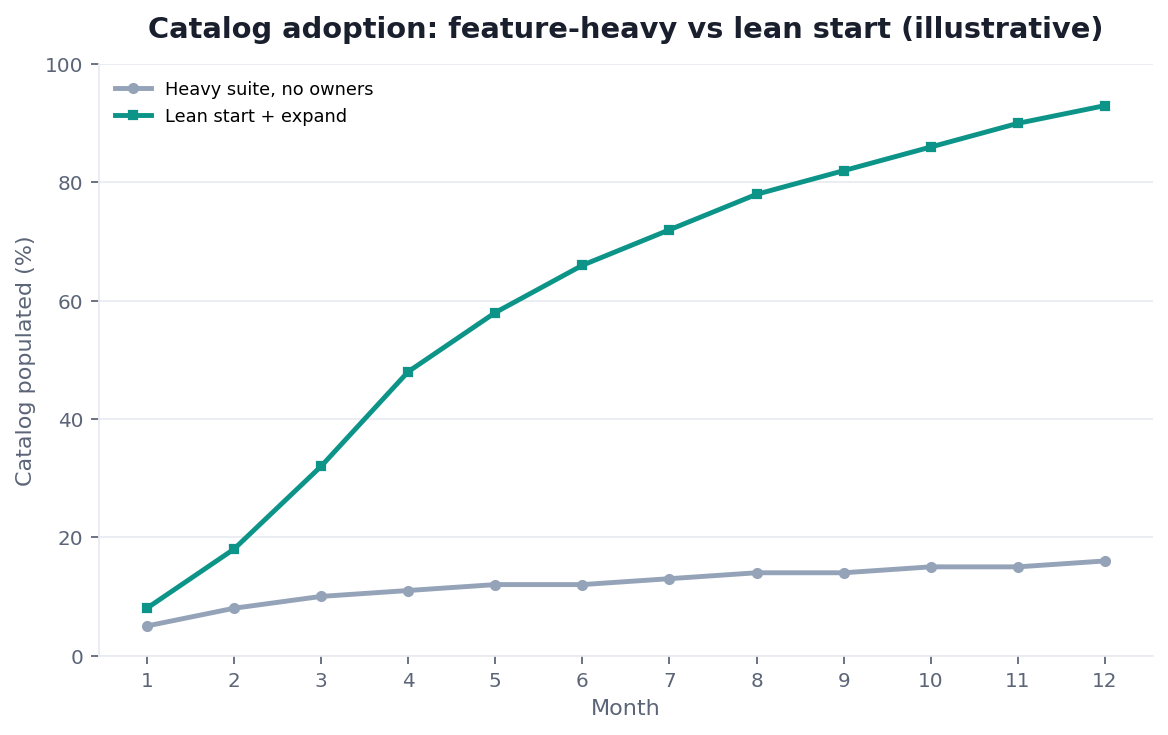
Practical example: a scale-up bought a heavyweight suite of data governance tools before agreeing on owners, and adoption stalled — an expensive catalog nobody maintained. A peer started with a lightweight catalog, proved value, and expanded, guided by enterprise patterns from OpenTelemetry documentation. Fit and adoption, not feature breadth, decided the outcome.
Scope note: This guide reflects patterns we see when mid-market and enterprise teams work with data governance tools in 2026. It is not a substitute for legal counsel, vendor runbooks, or a formal survey of every industry — and when a smaller toolset or lighter process would serve, a full program is overkill.
What They Are
Core definitions remain usefully summarized in Wikipedia natural language processing overview for shared vocabulary across stakeholders.
At their core, data governance tools automate decisions that humans make first. They do not decide who should own a dataset or what "active customer" means; they enforce and scale those decisions once made.
Key Definition: data governance tools are software systems that automate the operational mechanics of governance — cataloging assets, tracing lineage, enforcing access policy, and monitoring quality — so that human decisions about ownership, definitions, and rules can be applied consistently at scale.
The distinction that matters is that tools amplify governance; they do not create it. A team with clear owners and definitions gets enormous leverage from data governance tools; a team without them gets an expensive inventory of ungoverned data. The definitional work comes first, and the tool comes second.
The Main Categories
Implementation details are commonly grounded in AWS Well-Architected Framework when teams translate concepts into production practice.
Effective use of data governance tools starts with knowing what each category actually does.
Catalogs and lineage
A catalog is the inventory: it records what data exists, who owns it, and what it means. Lineage traces how data flows from source to report. Together these are the foundation category of data governance tools, because you cannot govern what you cannot see, and the enforcement and orchestration patterns documented at Apache Spark documentation show how catalog metadata drives downstream controls.
Access and quality
Access-control tools enforce who can use which data, and quality-monitoring tools measure whether the data is trustworthy. These are the enforcement category of data governance tools; the quality checks and expectations documented at NIST AI Risk Management Framework illustrate how monitoring can run inside pipelines rather than as a separate audit.
How to Choose
Teams evaluating this topic often cross-check Elastic documentation for a durable, vendor-neutral reference point.
Choosing among data governance tools comes down to fit with your stack, your scale, and the decisions you have already made. The longest feature list rarely wins; the tool your teams will actually adopt does.
We recommend scoring candidates on three axes: how easily a steward can attach an owner and definition to a dataset, how well the tool integrates with the systems you already run, and how transparent its pricing is at your scale. The best data governance tools make the right action the easy action, and they connect to your data governance framework rather than forcing a new one. If a demo requires a consultant to add a single owner, adoption will suffer.
A structured pilot is the surest way to test these axes before committing. Rather than trusting a scripted demo, we recommend running a two-week trial in which your own stewards catalog one real domain, wire one real access policy, and add a handful of real quality checks using your actual data. This exposes the friction that demos hide: the connector that does not quite fit, the permission model that fights your identity provider, the metadata field that cannot represent your reality. Teams that pilot this way rarely regret their choice, because they have watched the tool succeed or fail on their own data rather than on a vendor's curated example. Skipping the pilot is how organizations end up with data governance tools that impressed in the demo and disappointed in production, and it is a mistake that is far cheaper to avoid than to unwind.
Build vs Buy
Implementation details are commonly grounded in Google BigQuery documentation when teams translate concepts into production practice.
A recurring question is whether to build data governance tools in-house or buy them. For most teams, the answer is to start by building the minimum — a shared catalog in SQL, a few quality checks in your pipeline — to prove the process, then buy a platform to scale it.
Building first keeps you honest about what you actually need, so the data governance tools you eventually buy fit a working process rather than inventing one. Buying first, before the process exists, is how teams end up with shelfware. The exception is regulated environments where certified controls justify buying early, because the cost of proving a home-grown control to an auditor can exceed the license fee of a certified platform. Even then, we advise buying the certified piece and building the rest, rather than assuming a single suite will fit every need without adaptation.
Common Mistakes
The mistakes we see are consistent. Buying before deciding produces ungoverned inventories. Choosing on feature count rather than adoption produces powerful tools nobody uses. Ignoring integration produces islands of metadata that never connect. And treating data governance tools as the strategy, rather than the enforcement of a strategy, produces motion without progress.
A subtler mistake is neglecting the human workflow. The best data governance tools fail if stewards find them painful, so we weigh day-to-day usability as heavily as capability. A tool used daily by ten stewards beats a comprehensive one used by none.
Total Cost of Ownership
The sticker price of data governance tools is rarely the real cost, and evaluating on license fees alone is one of the most common budgeting mistakes we see. The larger costs are integration, administration, and the human time to keep the tool populated and current. A catalog that is cheap to license but expensive to integrate, and that requires a dedicated administrator to maintain, can easily cost more over three years than a pricier tool that plugs into your stack and stays useful with little upkeep.
We encourage buyers to model total cost of ownership across three years and three dimensions. The first is direct cost: licenses, infrastructure, and support. The second is implementation: the engineering time to connect the tool to your sources and wire its controls into your systems. The third, and most often underestimated, is ongoing operation: the steward and administrator hours required to keep metadata accurate, because a catalog that drifts out of date is worse than none at all. When teams model these honestly, the cheapest-to-license option frequently loses, and a tool that makes daily stewardship effortless wins even at a higher list price. This is why we weigh adoption and usability so heavily; the tools that stay populated deliver governance, and the ones that require heroic maintenance quietly decay into expensive, misleading inventories that erode rather than build trust.
Tooling in the Age of AI
AI raises the value of data governance tools sharply. When an autonomous agent reads your data to answer questions, it relies on the catalog and definitions your tools maintain; ungoverned metadata produces inconsistent AI answers. Good governance tooling becomes the substrate that makes automated analysis trustworthy.
An AI-native platform closes the gap by binding governed definitions to the data an agent queries, an approach we describe in what AI-native data analysis means. In the InfiniSynapse web app, governance context travels with the data, so the work your data governance tools do directly improves the reliability of AI answers rather than sitting in a separate silo.
Selection Scorecard
Score each candidate (1 point each):
| Check | Pass? |
|---|---|
| A steward can add owner + definition easily | |
| It integrates with our existing stack | |
| Pricing is transparent at our scale | |
| It covers catalog and lineage | |
| It enforces access policy | |
| It monitors quality | |
| Stewards find it usable daily | |
| It supports AI/agent access to metadata |
6–8: strong fit. 3–5: pilot before committing. Below 3: keep looking.
Common Misconceptions
Misconception 1: Tools are the strategy. Data governance tools enforce a strategy; they do not replace it.
Misconception 2: More features are better. Adoption beats breadth every time.
Misconception 3: Buy before you build. Prove the process first, then scale with a platform.
Misconception 4: Metadata is optional for AI. Agents rely on governed metadata to answer reliably, so a well-maintained catalog is now part of your AI infrastructure, not a separate concern.
Frequently Asked Questions
What are data governance tools?
Data governance tools are software systems that automate the operational mechanics of governance — cataloging assets, tracing lineage, enforcing access policy, and monitoring quality. They apply human decisions about ownership, definitions, and rules consistently at scale, but they do not make those decisions for you; the definitional work comes first, and the tooling amplifies it.
What are the main categories?
The main categories are catalogs, lineage tools, access-control tools, quality-monitoring tools, and policy-management tools. Catalogs inventory data and ownership, lineage traces data flow, access control enforces permissions, quality monitoring measures data health, and policy management codifies rules. Most platforms combine several of these into a suite.
How do you choose the right tool?
Score candidates on fit with your stack, ease of the core steward action (attaching an owner and definition), and pricing transparency at your scale. The longest feature list rarely wins; the tool your teams actually adopt does. Make sure it connects to your existing framework rather than forcing a new one.
Should you build or buy?
For most teams, build the minimum first — a shared catalog and a few pipeline quality checks — to prove the process, then buy a platform to scale it. Building first keeps you honest about your real needs so the tool you buy fits a working process. Regulated environments that need certified controls are the main exception.
How do these tools support AI?
AI agents rely on the catalog and definitions governance tools maintain; ungoverned metadata produces inconsistent answers. Good tooling becomes the substrate that makes automated analysis trustworthy, and an AI-native platform that carries governance context with the data ensures the metadata work directly improves the reliability of agent answers.
Conclusion
Data governance tools automate the mechanics of governance, but they enforce a strategy rather than replace it. Choose for adoption and fit, build the minimum before buying a platform, and remember that AI agents increasingly depend on the governed metadata these tools maintain.
To see how governance context travels with data into automated analysis, read what AI-native data analysis means and try the InfiniSynapse web app free on registration.