What Is ChatBI? Chat BI Over One Warehouse
ChatBI is chat-based business intelligence: ask a warehouse question in plain English, get a chart. Power BI Copilot, ThoughtSpot Sage, Tableau Ask Data, and Looker conversational analytics share this pattern—they translate against a semantic model. They do not plan or verify across sources. That is ChatBI, not agentic analytics. Pick ChatBI when the metric already lives in the model; pick an agent when the question spans systems the model does not know.
By the InfiniSynapse Data Team · Published 2026-05-20 · Updated 2026-09-15 · Next review 2026-12-15 · Disclosure: we build an agentic platform, listed as one option. Editorial standards. Sources: Spider 2.0 · Gartner Peer Insights · G2.
TL;DR
The ChatBI vs agentic analytics debate is not about which tool is better — it's about which architecture fits your data. ChatBI adds a chat interface on top of a semantic model. Agentic platforms deploy AI agents that plan, execute, and verify multi-step analysis across databases, documents, and media. Confusing the two costs teams months of wasted evaluation.
- ChatBI: conversational UI on a semantic layer in one warehouse. Translates natural language against pre-defined metrics into SQL. Fast when the question fits the model; silent or partial when it doesn't.
- Agentic platforms: agents plan analytical workflows — retrieve schemas on the fly, federate across databases, verify results, and iterate. No single-warehouse assumption.
- Practical difference: ChatBI answers questions the semantic model already knows. Agents discover answers the model doesn't have. If questions regularly span more than one source, you've outgrown ChatBI.
Related reading: Agentic analytics · What Is a Data Agent? · Best Agentic Analytics · AI-native data platform.
Table of Contents
- What is ChatBI?
- What is agentic analytics?
- Head-to-head comparison
- The architectural gap
- When ChatBI is the right choice
- When you need agentic analytics
- Moving from ChatBI to agents
- Independent signals
- FAQ
What is ChatBI?
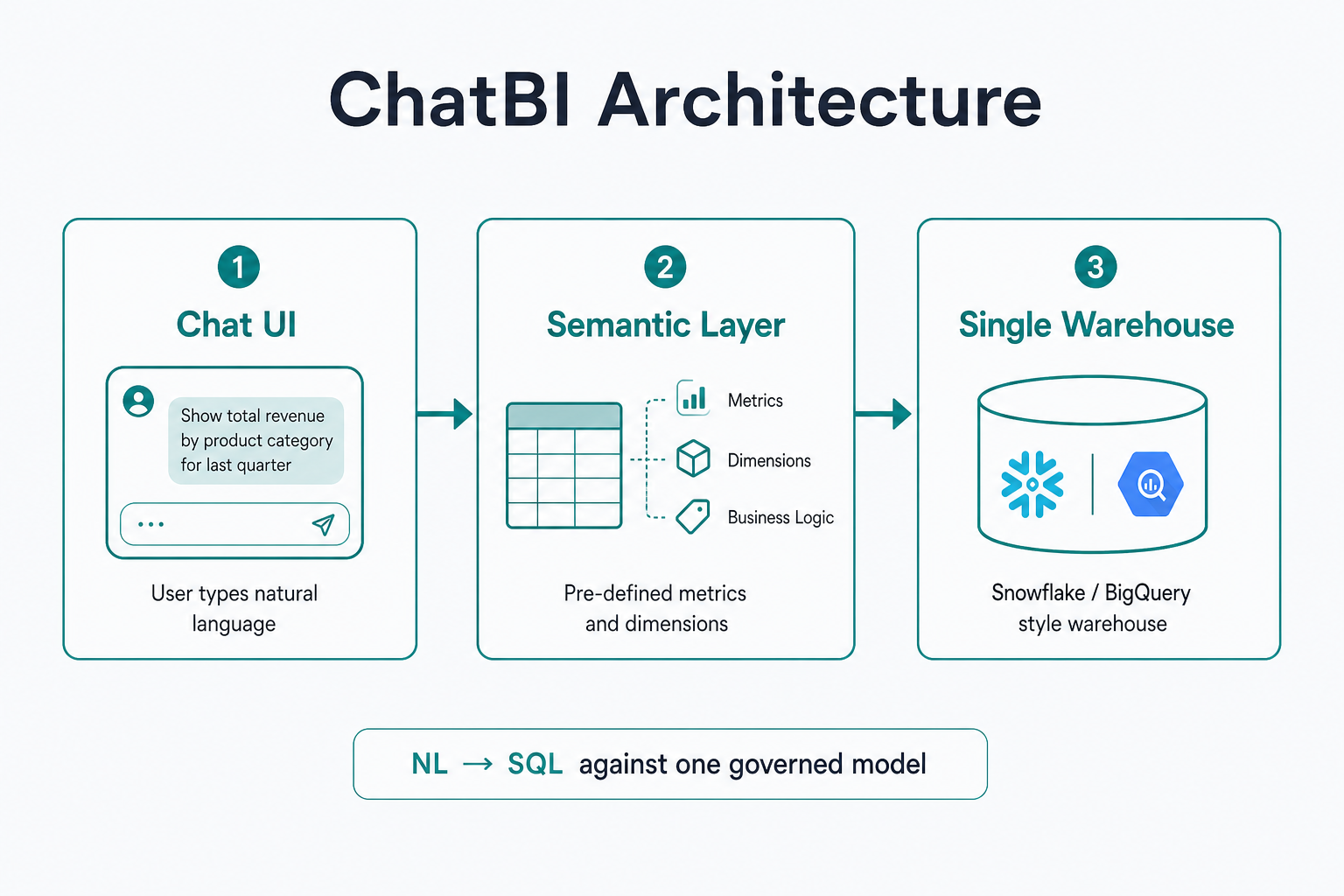
In the ChatBI vs agentic analytics split, ChatBI is a conversational analytics interface that translates natural language questions into SQL queries against a pre-built semantic model in a single data warehouse. It bridges the gap between business users and SQL by letting people type questions like "show me revenue by region for Q3" and getting a chart back — without writing a line of code.
Under the hood: a semantic layer (metrics/dimensions upfront), an LLM translator to SQL, and multi-turn chat. ThoughtSpot Sage, Power BI Copilot, Tableau Ask Data, and Looker conversational analytics share this pattern — translate, not plan/verify/discover. Microsoft middle path: Fabric Data Agent vs Copilot.
Where ChatBI works well
These conditions tip a ChatBI vs agentic analytics decision toward ChatBI:
- All data lives in one governed warehouse (Snowflake, BigQuery, Redshift) with a maintained semantic model.
- Questions are dashboard-style: "What were sales last month?", "Show me churn by cohort."
- Business users need self-service access to metrics that have already been defined by the data team.
Where ChatBI falls short
These limits show up repeatedly in ChatBI vs agentic analytics evaluations:
- The semantic model is always incomplete. Business questions routinely touch data outside the model. When they do, ChatBI either fails or gives a partial answer with no indication that something is missing.
- Single-source only. ChatBI queries one database at a time. If your revenue data is in Snowflake, your user activity is in MongoDB, and your quarterly forecast is in a PDF, ChatBI cannot answer questions that span them.
- No self-verification. On Spider 2.0, non-agentic Text-to-SQL baselines struggled on enterprise schemas while agentic loops (plan → retrieve → iterate) led Snow leaderboards (Feb 2026 public board). Accuracy note for ChatBI vs agentic analytics: treat scores as directional, not a product bake-off — Jin et al. (2026) report high gold-SQL annotation error rates that can reshuffle ranks. ChatBI typically returns SQL results without a verification loop.
- Unstructured data is invisible. PDFs, call transcripts, Excel reports, and video transcripts contain valuable context that ChatBI cannot incorporate into analysis.
What is agentic analytics?
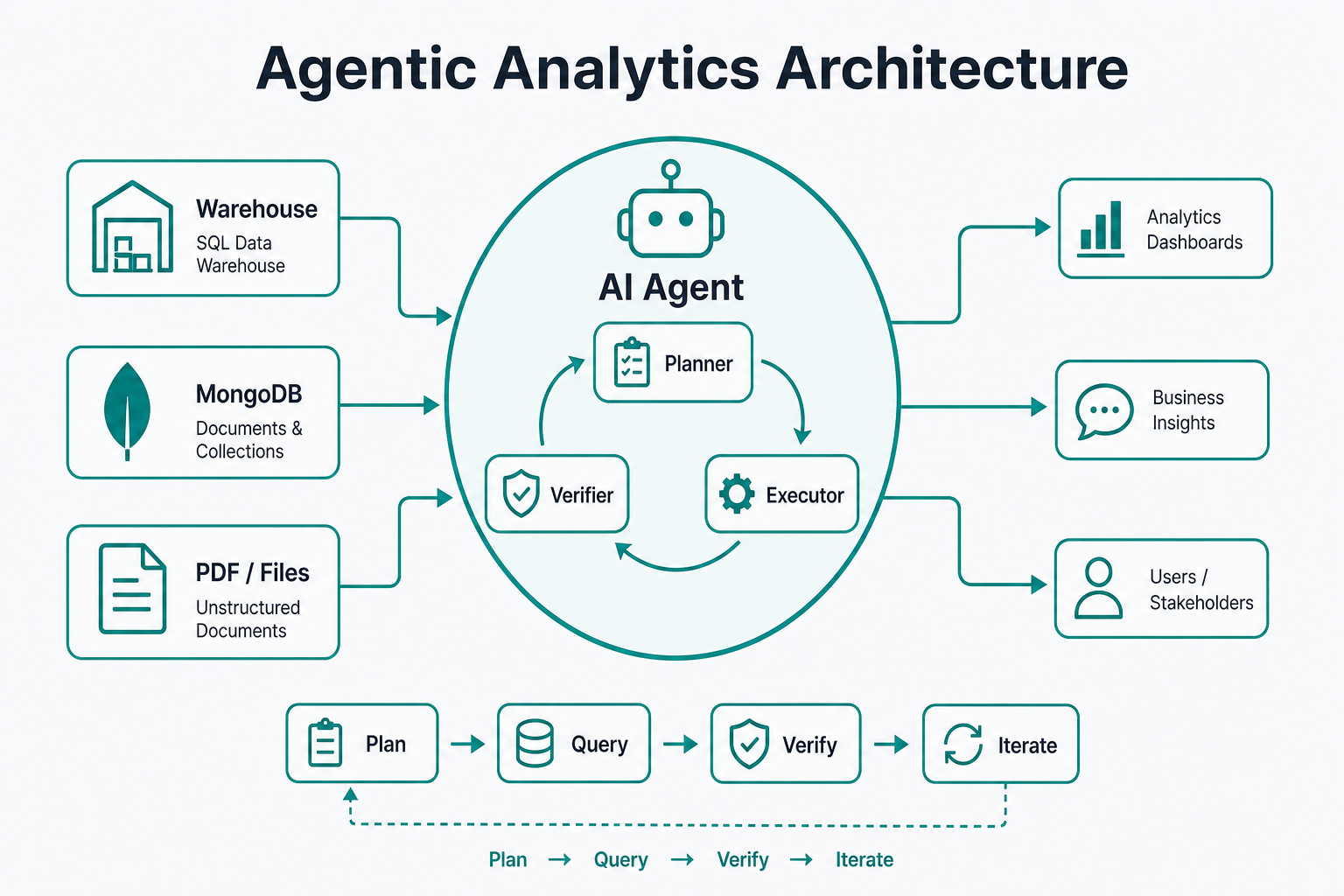
On the agent side of ChatBI vs agentic analytics, agentic analytics is an AI-powered approach where autonomous agents plan, execute, and verify multi-step analytical workflows across multiple databases, documents, and media — functioning as a professional data analyst rather than a query translator.
The defining word is "agentic": goals, plans, tools, and self-checks — the bar Anthropic describes for effective agents. In a ChatBI vs agentic analytics workload, that means schema retrieval, multi-step plans, federated execution, and iteration — not one English→SQL hop. Example: forecast-vs-actual by region plus support-call sentiment spans warehouse + PDF + transcripts — four steps, three systems.
Platform moves (public announcements): Tableau Agentic Analytics (TC 2026), ThoughtSpot Agentic Analytics / Analyst Studio (2026), InfiniSynapse (RAG schema retrieval + InfiniSQL verification). Analyst color (named voices, not InfiniSynapse scores): Donald Farmer on ThoughtSpot's agentic shift; Matt Aslett (ISG) on Tableau's knowledge-engine pivot. Consensus for ChatBI vs agentic analytics: query translation ≠ analysis.
Core capabilities of agentic platforms
Capabilities that usually decide ChatBI vs agentic analytics POCs:
- Cross-source federation: Query Snowflake, PostgreSQL, MongoDB, MySQL, and other databases in one session. The agent retrieves schemas from each, generates federated queries, executes them at the source, and joins results in memory.
- Multi-modal analysis: Gartner (Document Management MQ, Dec 2024) estimates ~70–80% of enterprise information is unstructured and much of it under-analyzed — treat as category context, not a warehouse-only statistic. Agents can ingest PDFs, Excel, and transcripts alongside DB results in one session — a common ChatBI vs agentic analytics differentiator.
- Self-verification loop: The agent doesn't trust its own output. It checks result distributions against expected ranges, flags anomalies, and re-queries when something looks wrong. This is the difference between "here's a number" and "here's a number I've verified."
- On-premises deployment: For regulated industries, the entire stack runs inside the organization's infrastructure. Data never leaves the building. Some platforms (e.g., InfiniSynapse) deploy as native desktop apps for Windows and macOS. Others (e.g., Tableau Server, ThoughtSpot) offer private cloud or on-premises options.
ChatBI vs agentic analytics: head-to-head comparison
These two categories are often conflated in vendor marketing. Here is an honest ChatBI vs agentic analytics comparison by architecture, not brand.
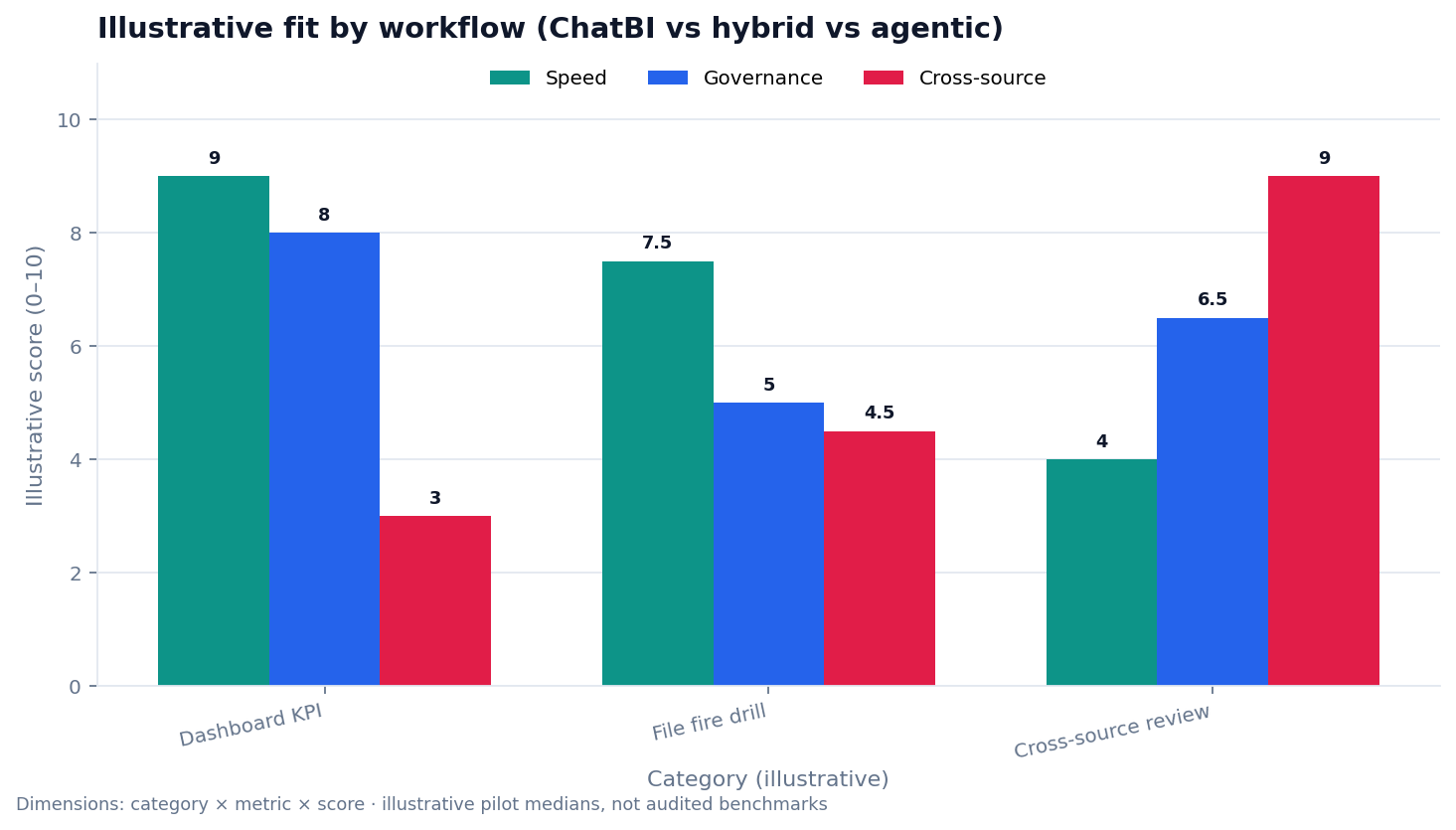
If your backlog is mostly single-warehouse dashboard queries, ChatBI is simpler. If it includes cross-source work that takes hours of manual plumbing, you need an agent layer. Middle path: Augmented analytics.
ChatBI Architecture
Agentic Analytics Architecture
Test the gap with one cross-source question
Connect a read-only warehouse plus one file or secondary DB. Ask a question ChatBI cannot answer from the semantic model alone. Compare: chat reply vs phased plan, inspectable SQL, and a verification step.
The architectural gap: why ChatBI hits a ceiling
The ChatBI vs agentic analytics difference is not "ChatBI with more features." It is a different architecture for a different problem.
The semantic model problem
Semantic-model completeness is often the first failure mode in ChatBI vs agentic analytics trials.
ChatBI assumes metrics are pre-modeled. When they are not, answers fail or go partial. Agents retrieve schemas on the fly (e.g. RAG over catalogs) and build the path dynamically — the practical ChatBI vs agentic analytics split on semantic completeness.
The single-source problem
ChatBI tools are designed around a single data warehouse. Mid-size enterprises often run 50–200 data systems; large enterprises 200–1,000+ (Scalytics, 2024 — survey ranges, not a census). Telemetry sources grew ~32% YoY (Cribl, 2024); 42% of enterprises need 8+ connected sources for AI agents (Tray.ai, Dec 2024). Cross-source work is common in 2026, but treat those counts as directional. That is the core ChatBI vs agentic analytics architecture gap: ChatBI assumes one governed warehouse; agents assume federation.
If questions regularly span more than one source or need more than one query, ChatBI is the wrong tool for that workload — regardless of vendor — in any honest ChatBI vs agentic analytics comparison.
The verification gap
Verification is the second major ChatBI vs agentic analytics accuracy gap after federation.
SQL can be syntactically wrong (DB error) or semantically wrong (runs, wrong number). ChatBI usually retries syntax; semantic errors need a verification loop. Agents re-check distributions/row counts and re-plan — InfiniSQL predicates, Tableau Knowledge Engine cross-checks, ThoughtSpot anomaly flags are vendor implementations of the same idea in ChatBI vs agentic analytics evaluations.
ChatBI vs agentic analytics example: "Compare regional revenue (Snowflake) with Q3 targets (PDF) and flag regions where support-call sentiment contradicts the numbers." ChatBI typically returns warehouse revenue only — PDF/transcript context is invisible. An agent can plan across warehouse + file + transcript DB, join in memory, and verify — with source-traceable steps. Treat the "under 3 minutes" sketch as illustrative, not a timed bake-off.
When ChatBI is the right choice
ChatBI is not obsolete. In many ChatBI vs agentic analytics evaluations it remains the simpler, faster deploy for the right workload.
Choose ChatBI in a ChatBI vs agentic analytics decision when: one governed warehouse; semantic model stays current; questions are dashboard-style; unstructured data is out of scope; cloud-only is acceptable. If those hold, ChatBI remains the simpler path.
When you need agentic analytics
In a ChatBI vs agentic analytics fit check, adopt an agent layer when:
- Questions routinely span 2+ sources (manual cross-source > ~20% of analyst time).
- Unstructured files hold answers excluded from quantitative work.
- On-prem / air-gapped deployment is required.
- Prep dominates analysis time — IDC (Bond, 2023) cites ~80/20 prep/analysis (often 60–80%+). A key ChatBI vs agentic analytics signal.
- Plans branch across steps — not one SQL statement.
If cross-source questions go unasked, agents usually pay back fastest. Context: Stanford HAI AI Index. Memory: Data agent memory.
Moving from ChatBI to agentic analytics
Most ChatBI vs agentic analytics journeys are expand-the-surface, not rip-and-replace. Keep ChatBI for primary-warehouse self-serve; add agents for cross-source, multi-modal, and multi-step work. Autonomy framing: Autonomous data agent.
Start with cross-source questions your team already does manually — highest ROI. Tableau Agentic Analytics, ThoughtSpot Analyst Studio, and InfiniSynapse each connect multiple sources without migration. Then add unstructured inputs (PDFs, transcripts, Excel) once the verification loop is trusted.
Try a warehouse-connected data analyst with a bound knowledge base
Connect a Postgres, MySQL, Snowflake, or Supabase warehouse read-only. Seed a small knowledge base of business definitions. Ask one question that crossed two sources and watch the plan, SQL, and verification step before deciding whether to add an enterprise agent to your stack.
Enterprise connector design should follow Microsoft's data architecture guidance so domain boundaries stay explicit as you add sources. Warehouse-native semantic expectations are also documented in Snowflake Cortex Analyst.
Production access reviews should align with the NIST AI Risk Management Framework, and LLM-backed query surfaces should account for risks in the OWASP Top 10 for LLM Applications. Operational maturity for long-running agent workflows also maps to the AWS Well-Architected Machine Learning Lens.
Independent signals (not our scores)
This ChatBI vs agentic analytics guide is vendor-published. For Authority and Accuracy, balance our framing with sources InfiniSynapse does not control:
- Text-to-SQL benchmarks: Spider 2.0 for enterprise schemas; treat leaderboard gaps as directional — Jin et al. (2026) document pervasive gold-SQL annotation errors that can reshuffle ranks.
- Agent design: Anthropic on effective agents — expose plans and tool traces, not final prose alone.
- Peer markets: Gartner Peer Insights and G2 Analytics Platforms for support/renewal signals (weak on architecture taxonomy).
- Standards: NIST AI RMF, OWASP LLM Top 10, AWS ML Lens.
- Adoption context: Stanford HAI AI Index.
Gap we could not close: no commissioned independent bake-off of ChatBI vs agent platforms on one shared cross-source fixture, and no licensed analyst report that scores the same taxonomy. The fit chart is illustrative. Reproduce with the POC checklist in the FAQ; contradicting results welcome via editorial corrections.
Related Guides
- What Is a Data Agent? — definition and architecture
- Best Agentic Analytics — 2026 shortlist and scorecard
- Agentic analytics — category framing
- AI-native data platform · Data agent memory · Autonomous data agent
Frequently Asked Questions
What is ChatBI?
ChatBI is chat-based business intelligence: ask a warehouse question in plain English and get a chart or table. It translates against a pre-built semantic model in one warehouse. Power BI Copilot, ThoughtSpot Sage, Tableau Ask Data, and Looker conversational analytics share this pattern.
What is ChatBI chat?
ChatBI chat is the conversation loop: type a metric question, get SQL-backed results, follow up in the same thread. You do not write SQL. It only answers what the semantic model already knows.
Is ChatBI the same as Power BI Copilot or ThoughtSpot Sage?
Same architecture, different brands. They translate natural language against a governed semantic model in one warehouse. They are not agentic analytics: they do not plan, federate, or verify across sources.
What is the main difference between ChatBI and agentic analytics?
In ChatBI vs agentic analytics terms: ChatBI chats over a semantic model in one warehouse; agents plan, federate, verify, and iterate across sources. ChatBI answers what the model already knows; agents discover what it does not.
Can ChatBI tools query multiple databases at once?
No — usually decisive in ChatBI vs agentic analytics POCs. ChatBI is one semantic model / one warehouse; agents federate at the source and join in memory.
Is agentic analytics harder to set up than ChatBI?
In ChatBI vs agentic analytics, ChatBI front-loads semantic modeling; agents front-load connectors + schema retrieval. Desktop vs cloud varies by vendor — compare total time-to-first trustworthy cross-source answer, not install wizards.
Which is better for enterprise data teams: ChatBI or agentic analytics?
No universal winner in ChatBI vs agentic analytics. One governed warehouse + dashboard questions → ChatBI. Cross-source / unstructured / multi-step / on-prem → agents. Many teams run both.
Do I need to migrate data to use agentic analytics?
No — a structural ChatBI vs agentic analytics difference. Agents query at the source and federate in memory; ChatBI expects data in the warehouse behind the semantic model.
How do I know when I've outgrown ChatBI?
In ChatBI vs agentic analytics terms: cross-source questions go unasked; the semantic model lags; prep dominates analysis; unstructured answers are excluded; or data cannot leave your infrastructure.
Can ChatBI and agentic analytics run side by side?
Yes — most mature ChatBI vs agentic analytics stacks should. ChatBI for warehouse self-serve; agents for cross-source, unstructured, and verified multi-step work.
What should a fair side-by-side POC include?
For a fair ChatBI vs agentic analytics POC: one business goal, no coaching; score completion, inspectable SQL/charts, second-source behavior, and definition persistence on rerun. Prefer a real cross-source question.
Conclusion
ChatBI vs agentic analytics is a fit decision, not a brand war. ChatBI wins when metrics live in one governed warehouse and users need fast, model-bound answers. Agents win when questions span sources, documents, and multi-step verification—and when the second run must survive analyst turnover.
Use ChatBI for self-service dashboard questions; add an agent layer when cross-source work is already eating analyst time.
About this guide
Last updated: 2026-09-15
Methodology: Architecture comparison from public docs for ChatBI (ThoughtSpot Sage, Tableau Ask Data, Power BI Copilot, Looker conversational analytics) and agent platforms (ThoughtSpot / Tableau agentic announcements, InfiniSynapse). Benchmarks cited with accuracy caveats. No shared audited bake-off.
Conflict of interest: Published by InfiniSynapse, an agentic vendor. Third-party claims from public docs/announcements as of May 2026 — verify independently. This is a ChatBI vs agentic analytics fit guide, not a neutral market ranking.
Update cadence: Quarterly. Benchmark figures refresh as platforms ship.
References & Further Reading
- Spider 2.0 Benchmark — Enterprise Text-to-SQL evaluation with 632 real-world problems across Snowflake, BigQuery, and DuckDB.
- Jin et al. (Jan 2026) — "Pervasive Annotation Errors Break Text-to-SQL Benchmarks and Leaderboards." Documents 62.8% annotation error rate in Spider 2.0 gold-SQL examples.
- Gartner (Dec 2024) — Magic Quadrant for Document Management. Reiterates 70–80% of enterprise information is unstructured.
- IDC (Oct 2023) — Stewart Bond, "Accelerating Time to Value in Modern Data Environments." Reports 80% of analyst time spent on data preparation vs. 20% on analysis.
- Cribl (2024) — "Navigating the Data Current." Reports 32% YoY growth in telemetry data sources.
- Tray.ai (Dec 2024) — "State of AI Agent Development." 42% of enterprises require 8+ data sources for AI agent deployment.
- Tableau (May 2026) — Agentic Analytics Platform announcement at Tableau Conference 2026.
- ThoughtSpot (Feb 2026) — Agentic Data Prep / Analyst Studio announcements.
- Stanford HAI — AI Index
- NIST — AI Risk Management Framework
- Anthropic — Building effective agents
- OWASP — Top 10 for LLM Applications
- Gartner Peer Insights — Analytics and BI Platforms
- G2 — Analytics Platforms