InfiniSynapse Vibe Coding Hackathon 2026
Hackathon Projects a Reviewer Can Open and Try
Hackathon projects for this event are working web, mobile, or desktop apps. A slide deck, a notebook with no app, or fake JSON is not the published brief.
By InfiniSynapse · Last updated October 2, 2026
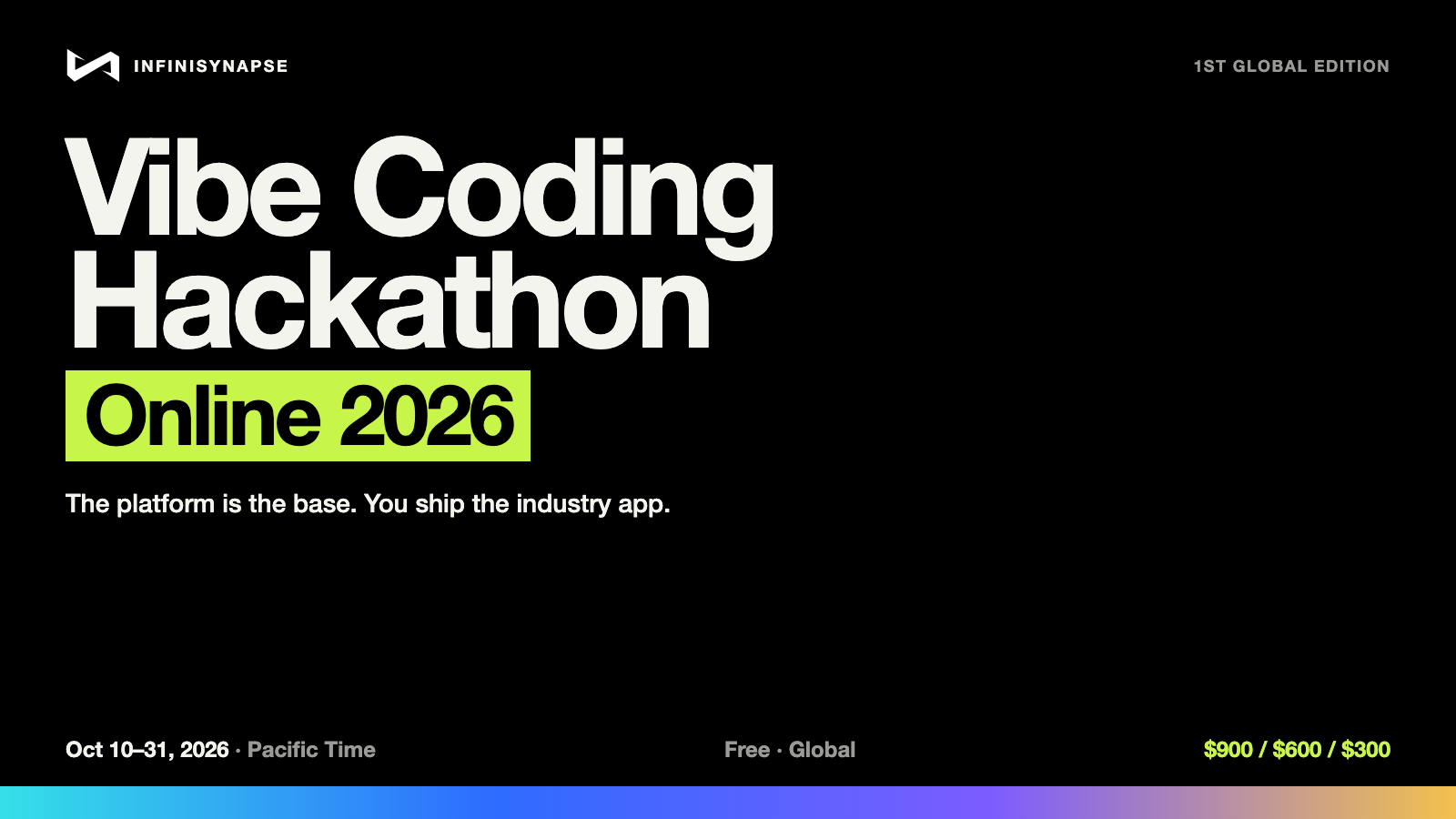
1st Global Edition
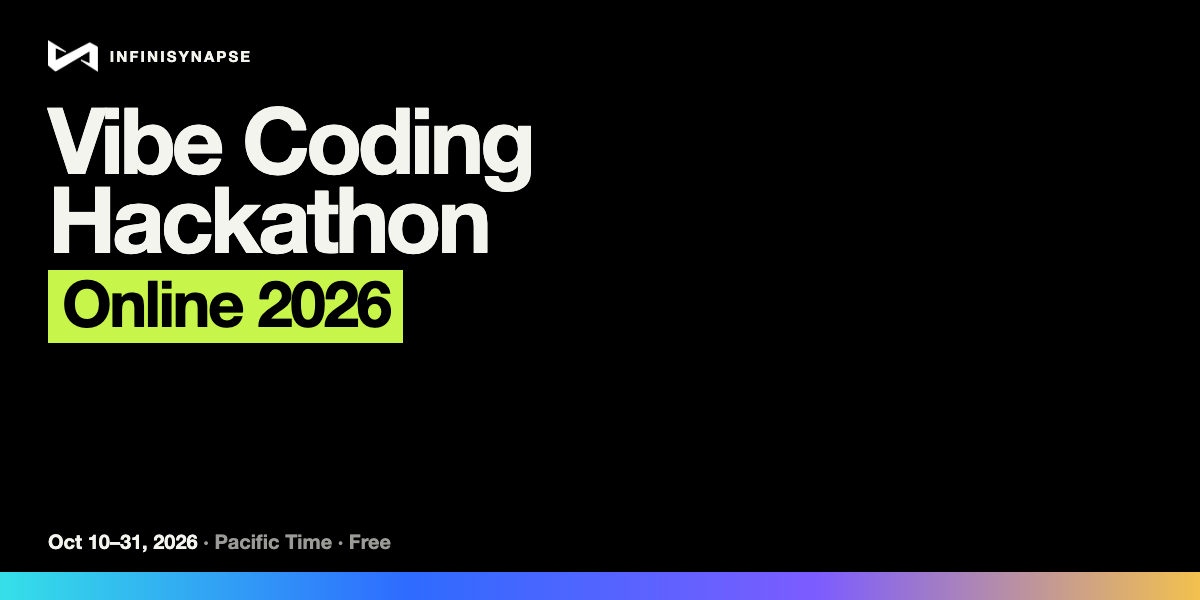
Vibe CodingHackathon
Online 2026
Oct 10–31, 2026 · Pacific Time
Free · Global
$900 / $600 / $300
Use InfiniSynapse to ship an app a real small business could open and use. It needs a data path — inputs in, a decision or next action out — not a demo with no data behind it.
Replenishment desk
A store view that flags SKUs at risk of stocking out and suggests what to reorder first.
Course operations
A school or training view that shows which classes are losing learners and who should be contacted next.
Operator growth
A small-team view that compares channels by conversion or retention and points to the next action worth taking.
TL;DR
Hackathon projects for the InfiniSynapse Vibe Coding Hackathon 2026 are working apps a reviewer can open and try. InfiniSynapse hosts the event. It is online and free. There is no public hall. The build window runs from October 10, 2026, at 12:00 AM through October 31, 2026, at 11:59 PM Pacific Time. During that window Pacific Time is PDT, UTC−7. The start is 07:00 UTC on October 10. The end is 06:59 UTC on November 1. Hackathon projects on this page are clients, not topics for a slide night.
A reviewer should use a working web, mobile, or desktop app. Slide-only pitches, notebooks with no app around them, fake JSON standing in for a live path, and a generic chat box on a spreadsheet are not rewarded. Six tracks are starting points on one registration: Education, Retail & Replenishment, Hit-product Analysis, SMB Operations, Growth for Operators, and Open Industry. The cash pool is $3,000. One first prize is $900, two second prizes are $600 each, and three third prizes are $300 each. Judging is scenario value 40%, technical completeness 35%, and innovation 25%. GitHub stars are not scored. William Zhu, Co-founder of InfiniSynapse, is a confirmed judge. Age, region, and team size are not published on the event page. Payout timing, tax handling, judging dates, a winner date, capacity, and a submission deadline separate from the build window are not published. Register only on Luma. Hackathon projects below are illustrative directions, not customer case studies.
What a reviewer can open
Hackathon projects earn the name when a stranger can start the client and reach a next action without your narration.
Software a person runs
Application software is the public name for programs an end user runs to complete a task, as distinct from the system layer underneath. That distinction is the brief. Hackathon projects here are the program the operator runs, not a memo about a future program. A store buyer, a course coordinator, or a small-team owner should see the question, the fields, and the recommended move on the same surface.
Register only at the official Luma listing for this event. The Discord join stays on that listing. This page does not publish a separate invite. The InfiniSynapse Vibe Coding Guide is the product guide. Read it before you freeze the client. Hackathon projects get their interface help there. The event page has not published a required stack.
One client is enough
Web, mobile, or desktop: any one form can satisfy the brief. You do not need three clients. Pick the surface where the operator already decides. Hackathon projects that split effort across a phone app and a browser app usually finish neither. Ship the one a reviewer can install or load.
The file label sits on the screen
Use data you are allowed to use, or a clearly labeled synthetic set. The event page has not published a shared dataset or a data-use rulebook. If the rows are synthetic, say so before the rank. Hackathon projects that hide the source make the result impossible to trust, even when the chart looks finished.
Browser, phone, or desk
A web application is software a person uses through a browser. If that is your client, the reviewer should load a page, see fields, and take the action. The React learn guide is one public tutorial for building interface components and state in the browser. It is not a required stack, and this event does not score you for choosing it. Hackathon projects on the web still have to answer when the reviewer opens them.
If the client is a phone app, the Android developer guide is a public starting point for app structure on that platform. You may ship a different phone stack, or skip phones entirely and ship desktop. Hackathon projects are judged on the running client, not on which vendor tutorial you opened. Desktop is the third accepted form. One finished path beats a gallery of screenshots.
Tracks as project scenes
Hackathon projects keep the same shape across tracks. What changes is the operator and the weekly decision. The six names are one registration.
Scenes, not six contests
The event page lists who each track is for, which data it needs, and what the demo must show. Starting points for the question itself are on ideas you can demo for an operator. How those builds get scored is on the published rubric for a win. Hackathon projects on this page stay with the artifact: something a reviewer can open.
| Track | Operator | What the project should let them do |
|---|---|---|
| Education | School or training provider | Intervene, change a course, or assign people and seats |
| Retail & Replenishment | Store operator | Reorder now, wait, or raise a SKU's priority |
| Hit-product Analysis | Merchandiser | Restock, feature, or watch a product that jumped |
| SMB Operations | Small-business operator | Take the next operational move the numbers support |
| Growth for Operators | Small team | Pick the channel or step for the next week |
| Open Industry | An operator you can name | Repeat a concrete next step |
Fields that belong in the client
Education needs enrollment, attendance or completion, the course list, and assessment results. Retail needs on-hand inventory, recent sales, and supplier lead time. Hit-product analysis needs sales over time, category, and a price or promotion flag you may use. SMB operations needs orders, costs, and sales for the same period. Growth needs leads or visits by channel, conversion events, and repeat activity. Open Industry asks you to define the user, the data, the analysis, and the action. Hackathon projects that omit the action are unfinished, even when the chart is pretty.
An illustrative pair
This is an illustrative direction, not a customer case study. Question: which courses lose learners before they finish? Input: a roster with attendance and completion, labeled synthetic if you built it. Output: courses ordered by drop-off, plus a suggested follow-up. The follow-up might read "contact the cohort in week three of course A," with the gap printed beside the sentence. Hackathon projects in Education fail when they stop at a bar of averages.
A second illustrative direction, still not a case study: on-hand units, unit sales, and lead time in days. The app ranks SKUs by stockout risk and marks the top rows "reorder now." Show both inputs so a buyer can disagree. Hackathon projects that output only a score, with no unit and no verb, leave the buyer where they started.
Forms that are not projects
Read the exclusions before you polish the wrong file. Hackathon projects have a negative list, and a clean story does not cancel it.
Decks and notebooks
A deck can name the operator. It cannot replace the app. If the file a reviewer opens is only slides, it sits outside the rewarded set. A notebook can be how you explore rows. Charts in a notebook, with no screen an operator would open on Monday, do not meet the brief. Hackathon projects wrap that exploration so someone who did not write the cells can ask the same question.
Fake files and a bare chat
Static JSON that pretends to be a live path is outside the brief. So is a generic chat window on a CSV with no named user, no stated question, and no next step. Canned lines that ignore the rows fail the same test. Hackathon projects have to show inputs, a retraceable result, and an action a person can accept or reject.
What to cut on purpose
One upload, one question, one ranked list, one verb. A filter stays only when it changes the verb. A login wall that blocks the sample file is a defect, because the reviewer cannot try the path. The sample can be small: twenty courses, fifty SKUs, or a hundred order lines. Hackathon projects with a small labeled file beat a large file that only draws a chart. Put the reason next to the row if you would otherwise say it out loud.
Score, cash, and the clock
Hackathon projects are reviewed as the operator would use them. Popularity is not a column on the sheet.
Three weights
Real-world scenario value is 40%. Technical completeness is 35%. Innovation is 25%. Scenario value asks whether a named operator has a real question. Completeness asks whether the app runs and shows inputs, a result, and a next step. Innovation asks whether the approach adds something beyond a stock layout. Tie-break rules are not published. Hackathon projects are not given a fourth weight for stars.
Stars and prize seats
GitHub stars are not part of the score. A popular repository does not add points, and a quiet one does not subtract them. William Zhu, Co-founder of InfiniSynapse, is a confirmed judge. A full judge list beyond that confirmation is not the subject of this page. Hackathon projects under that judge follow the published rubric.
| Place | Award | Seats |
|---|---|---|
| First | $900 | 1 |
| Second | $600 | 2 |
| Third | $300 | 3 |
The pool is $3,000. Payout timing and tax handling are not published. The six seats are not a cap on registration. Capacity is not published. Judging dates and a winner announcement date are not published. Hackathon projects do not change because cash is attached. The brief stays a working app.
The window opens October 10, 2026, at 12:00 AM Pacific Time and closes October 31, 2026, at 11:59 PM Pacific Time. That is 07:00 UTC on the first day and 06:59 UTC on November 1. Free tickets on the current Luma listing open on October 10. An earlier open date is not published. A submission deadline separate from the window is not published. There is no submit button until an official entry point is live. Eastern Daylight Time is three hours ahead during this window, so the close is 2:59 AM Eastern on November 1. Hackathon projects should be cold-open ready before that instant.
Scope you can finish
Hackathon projects shrink cleanly when you write the survivor in one line and delete the rest.
Freeze the question
Write three candidate questions and delete two. The survivor is the one you can demo with a file you can explain in a minute. Education survives when you have a roster shape. Retail survives when you have units, sales, and lead time. Hit-product analysis survives when you have a week column and a promotion flag. Operations survives when revenue and cost share an order line. Growth survives when a channel column sits next to a conversion count. Open Industry survives when you can name the person and the weekly decision in one breath. Hackathon projects you cannot feed with a small labeled file belong to a later effort, outside this window.
Rehearse without notes
Read the result out loud once. If a caveat about the data is only in your head, type it under the file label. Then do the cold open on another day, in Pacific Time, without notes. Fix only the step that stopped the stranger. Hackathon projects that need a spoken tour are not done. The screen has to carry the operator, the fields, and the verb.
Age, region, and team size are not published. Do not borrow those limits from another event. Hackathon projects you can start now need the track, the client, the guide, and the window.
Before you call the client done, open it the way a reviewer will: no notes, no tour, Pacific Time in mind if your laptop zone differs. The first screen should name the operator and the question. The next screen, or the same one, should show the labeled file and the fields the rank uses. The last control should be the verb, with the figure beside it. If you need a spoken sentence to make that verb make sense, the sentence belongs on the screen. If a panel does not change the verb, remove the panel. A merchandiser should see restock, feature, or watch. An owner should see the order and the move. A small team should see one channel for the next week. Hackathon projects that survive that cold open are the ones the brief describes. A gallery of extra charts is not a second project. It is unfinished scope.
Questions about the artifact
Is a slide deck with a demo video enough?
No. Hackathon projects for this event are working web, mobile, or desktop apps. A deck can sit beside the build. It does not replace the client a reviewer opens.
Does a notebook count if the charts are clear?
Charts help you find the pattern. The rewarded artifact is still an app. A notebook with no application around it is on the exclusion list.
Do I have to use React or Android?
No. Those public guides are optional references if you choose a browser or a phone. Desktop is accepted too. One running client is the requirement.
Where do I register?
Register only on the Luma listing. Entry is free. The Discord join stays on that listing. There is no second signup form on this page.
Are age and team size published?
The event page has not published age, region, or team-size rules. Capacity, judging dates, a winner announcement date, and payout timing are not published either.