InfiniSynapse Vibe Coding Hackathon 2026
How to Win a Hackathon on the Published Rubric
How to win a hackathon on the published rubric: scenario value 40%, completeness 35%, and innovation 25%. GitHub stars are not part of that published score.
By InfiniSynapse · Last updated October 2, 2026
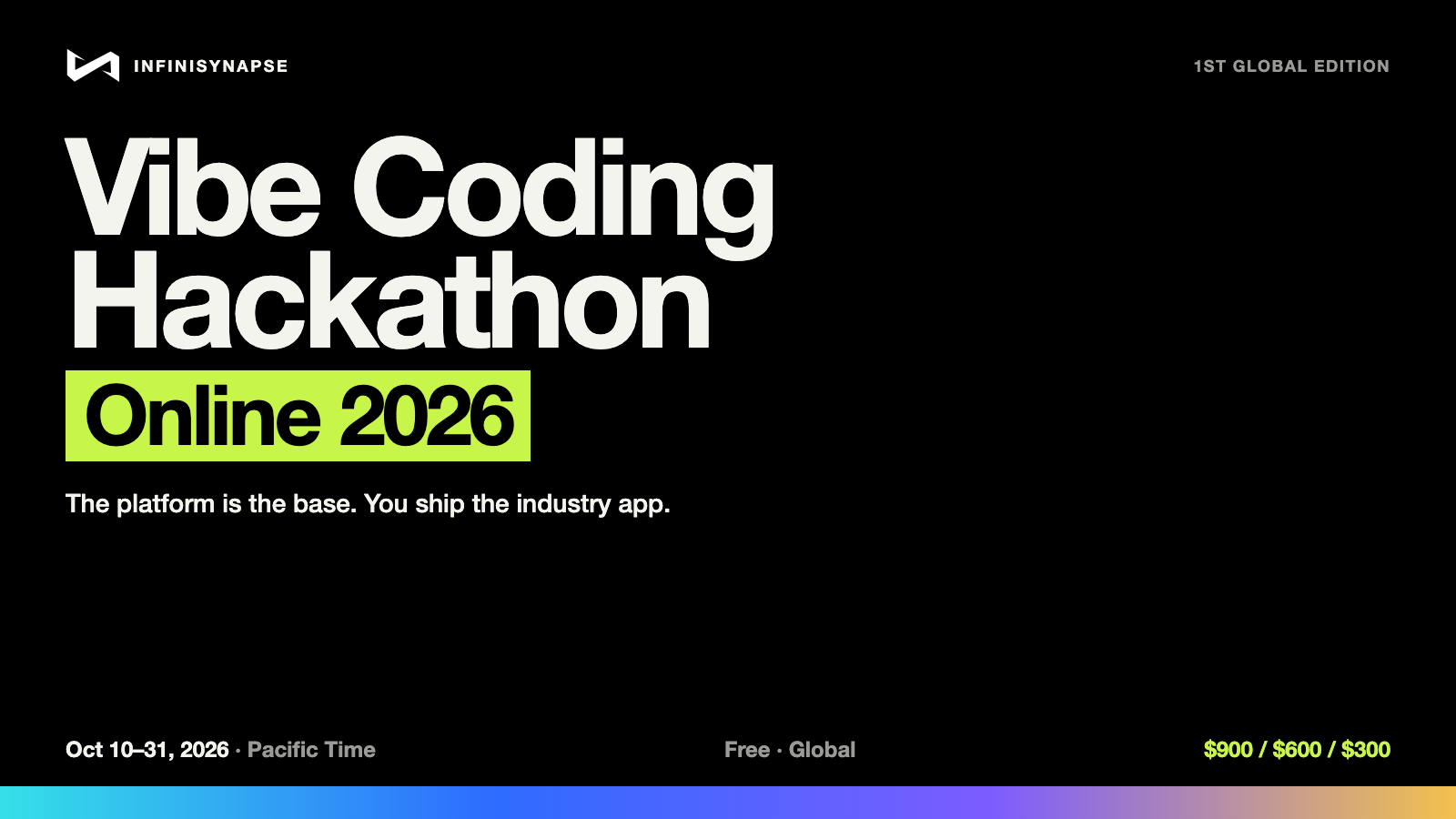
1st Global Edition
Vibe CodingHackathon
Online 2026
Oct 10–31, 2026 · Pacific Time
Free · Global
$900 / $600 / $300
Prize pool
$3,000
| Place | Award | Seats |
|---|---|---|
| 1st | $900 | 1 |
| 2nd | $600 | 2 |
| 3rd | $300 | 3 |
Repository stars are not part of the score.
TL;DR
How to win a hackathon at the InfiniSynapse Vibe Coding Hackathon 2026 is to score well on the published rubric, not to collect stars. InfiniSynapse hosts the event. It is online and free. There is no public hall. The build window runs from October 10, 2026, at 12:00 AM through October 31, 2026, at 11:59 PM Pacific Time. During that window Pacific Time is PDT, UTC−7. The start is 07:00 UTC on October 10. The end is 06:59 UTC on November 1. How to win a hackathon on this page means a working app a reviewer can try inside that window.
The weights are real-world scenario value 40%, technical completeness 35%, and innovation 25%. The rewarded form is a working web, mobile, or desktop app. Slide-only pitches, notebooks with no app, fake JSON, and a generic chat box on a spreadsheet are not rewarded. Six tracks are starting points on one registration: Education, Retail & Replenishment, Hit-product Analysis, SMB Operations, Growth for Operators, and Open Industry. The cash pool is $3,000: one prize of $900, two of $600, and three of $300. GitHub stars are not scored. William Zhu, Co-founder of InfiniSynapse, is a confirmed judge. Age, region, and team size are not published on the event page. Payout timing, taxes, judging dates, a winner date, capacity, and a submission deadline separate from the build window are not published. Register only on Luma. Examples below are illustrative directions, not customer case studies. How to win a hackathon does not add a secret fourth weight.
The three weights
How to win a hackathon starts by reading the sheet you will actually be scored on. Tie-break rules are not published, so the three weights are the whole public story.
Scenario value at 40 percent
Real-world scenario value is the largest share. A reviewer should recognize the operator and the weekly question. A course coordinator, a buyer, a merchandiser, an owner, or a small team lead is specific enough. "Users" is not. How to win a hackathon on this weight means the situation is one a person already faces, and the app recommends a move that person can do this week.
A key performance indicator is a measured value that shows how well an activity is meeting an objective. You do not need a corporate KPI program. You do need the figure the verb rests on: drop-off, days of cover, margin, or conversion. Print it beside the action. How to win a hackathon with a naked score, and no unit, is unlikely, because the reviewer cannot see why the move follows.
Name the person first
Write the job and the pain in one sentence before you design the screen. If you cannot, switch tracks. How to win a hackathon is harder when the scenario is a slogan. Education, retail, hit products, operations, growth, and an open industry you can name are the published starts. They are one registration.
Show the question on the first screen
The reviewer should not hunt. Put the question, the file label, and the verb where a cold open lands. How to win a hackathon at 40% is that recognition, not a longer backstory in a separate deck.
Completeness at 35 percent
Technical completeness asks whether the app runs and shows inputs, a result, and a next step. Web, mobile, or desktop: one client is enough. A path that only works while you narrate it is incomplete. How to win a hackathon on this weight is a stranger retrying the same question without you.
Use data you may use, or a synthetic file labeled as synthetic. The event page has not published a shared dataset. Hidden columns that the rank depends on are a completeness miss. How to win a hackathon includes letting the reviewer see the fields the action cites.
Innovation at 25 percent
Innovation asks whether the approach adds something beyond a stock layout. A useful twist on the path counts. A novel logo does not. You are not required to invent a new model class. How to win a hackathon on this smaller weight is a choice the reviewer did not see in a generic template: a better ranking rule, a clearer caveat, or a next step that fits the operator's week.
The three weights sum to 100%. Do not spend the window chasing the 25% while the 40% operator is still vague. How to win a hackathon is mostly scenario and a finished path, with novelty as the remainder.
What the rubric ignores
How to win a hackathon also means knowing what adds zero points, so you stop building it.
Stars, decks, and canned files
GitHub stars are not part of the score. A popular repository does not add points, and a quiet one does not subtract them. A slide deck can explain the operator. It cannot replace the app. A notebook with no application around it is not rewarded. Fake JSON that pretends to be a live path is not rewarded. A generic chat box on a spreadsheet, with no named user and no next step, is not rewarded. How to win a hackathon by polishing those artifacts is a miss even when the story is clear.
Models you can question
If your path uses a model, treat the output as something a person can check. The NIST artificial intelligence topic is a public home for NIST's AI work, including measurement and evaluation themes. This event does not ask you to file a NIST report, and it does not require a model at all. How to win a hackathon with a model still requires the inputs, a retraceable result, and an action. A chat window that ignores the rows fails completeness no matter how fluent it sounds.
The NIST risk management project page is a public entry point for thinking about risk in information systems. You are not being scored on a risk register. The useful habit is narrower: do not present a guess as a certainty, and do not hide the assumption the rank uses. How to win a hackathon includes a caveat the reviewer can read on the screen.
Privacy of the file
The NIST Privacy Framework is a public voluntary tool for improving privacy practices. It is not an entry requirement. Do not paste private customer records into a demo to look serious. Label synthetic rows as synthetic. How to win a hackathon does not depend on exposing someone else's data. It depends on a path the reviewer is allowed to try.
Apply the weights to a track
How to win a hackathon looks different by operator and identical by score. The event page lists the tracks. The weight definitions sit on how judging is split. The cash seats sit on the prize breakdown. Read those neighbors when you want the sheet or the money in more detail. This page stays on how the weights change what you build.
A recognizable Tuesday
This is an illustrative direction, not a customer case study. Education: a roster with attendance and completion, courses ordered by drop-off, and a follow-up for the worst row. Retail: on-hand units, recent sales, and lead time, with "reorder now" where days of cover fall short. Hit products: sales by week, category, and a promotion flag, then restock, feature, or watch. Operations: orders with revenue and cost, then review, reprice, or stop, with margin beside the verb. Growth: channel, visits, and conversions, then one focus for next week. How to win a hackathon in each row is the same four parts: user, data, analysis, action.
Open industry, same sheet
Open Industry is for a loop the other five do not cover. Define the person and the weekly decision yourself. Illustrative direction, not a case study: an office manager rebalances sessions from appointment volume and no-show rates. The app lists which sessions to change and why. How to win a hackathon in that open row is still 40, 35, and 25. An unusual industry name does not replace the verb.
| Weight | Share | What raises it |
|---|---|---|
| Scenario value | 40% | A named operator and a weekly question |
| Technical completeness | 35% | A running client with inputs, result, and action |
| Innovation | 25% | A twist beyond a stock layout |
One client, visible fields
Pick web, mobile, or desktop. Ship one. Put the file label above the rank. Keep the sample small enough to explain in a minute: twenty courses, fifty SKUs, or a hundred order lines. How to win a hackathon with three half-built clients is rare, because completeness wants one path that finishes.
Clock, signup, and cash
How to win a hackathon is impossible against a deadline you missed, so clock the window before you add scope.
Pacific Time, then stop
The window opens October 10, 2026, at 12:00 AM Pacific Time and closes October 31, 2026, at 11:59 PM Pacific Time. That is 07:00 UTC on the first day and 06:59 UTC on November 1. Free tickets on the current listing open on October 10. An earlier open date is not published. A submission deadline separate from the window is not published. There is no submit button until an entry point is live. Eastern Daylight Time is three hours ahead during this window, so the close is 2:59 AM Eastern on November 1. How to win a hackathon includes a cold open before that close, not a feature added after it.
Register only at the official Luma listing for this event. The Discord join stays on that listing. This page does not publish a separate invite. The InfiniSynapse Vibe Coding Guide is the product guide. How to win a hackathon uses that guide for the build, not as a second scoring document.
Six cash seats
The pool is $3,000. One prize is $900, two are $600, and three are $300. Payout timing and tax handling are not published. The six seats are not a registration cap. Capacity is not published. Judging dates and a winner announcement date are not published. William Zhu, Co-founder of InfiniSynapse, is a confirmed judge. How to win a hackathon under that judge is the rubric above. Age, region, and team size are not published. Do not invent them.
| Place | Award | Seats |
|---|---|---|
| First | $900 | 1 |
| Second | $600 | 2 |
| Third | $300 | 3 |
A build order that matches the sheet
How to win a hackathon is a sequence you can follow without guessing unpublished dates.
Raise the 40 percent first
Freeze the operator and the question in the opening days. Delete two alternate ideas. Keep the question a small labeled file can answer. If the verb is not obvious, you do not have a scenario yet. How to win a hackathon slips when the interface starts before the decision is named.
Then the 35, then the 25
Load the file. Show every field the rank uses. Attach one verb. Cut panels that do not change the verb. Only then look for a twist: a comparison the operator actually uses, or a caveat that stops a bad reorder. Rehearse without notes. How to win a hackathon on the last days is that rehearsal. A login wall in front of the sample is a completeness defect, because the reviewer cannot try the path.
One upload, one question, one ranked list, one verb. That shape can carry scenario value and completeness together. Innovation is the extra the reviewer notices after the path already works. How to win a hackathon is that order, inside October, on a client that answers.
Check the sheet once more before you add anything. Can a stranger name the operator from the first screen? Can they see whether the file is operational or synthetic? Can they point to the fields the rank uses, and to the verb those fields support? If any answer is no, that gap is completeness or scenario value, which together are 75% of the score. Fix the gap before you restyle the page. A twist belongs after the path already runs: a comparison the buyer already makes, a caveat that stops a bad reorder, or a follow-up line a coordinator can send. Stars will not fill a missing verb. A second client will not fill a missing question. How to win a hackathon on the last weekend is subtraction plus one rehearsal, still before 11:59 PM Pacific on October 31.
Questions about the score
Do GitHub stars help?
No. Stars are not scored. How to win a hackathon on the published sheet ignores repository popularity. Spend the window on the operator, the fields, and a client a reviewer can open.
Is innovation the main criterion?
No. Innovation is 25%. Scenario value is 40% and technical completeness is 35%. A clever layout with no operator decision loses to a plain app that recommends a real next step.
Do I need a machine-learning model?
No. A model is optional. If you use one, show inputs, a result someone can retrace, and a next action. A generic chat on a spreadsheet is not the brief.
Where is the rubric written down?
Scenario value, completeness, and innovation are the published weights. Judging dates are not published. A longer pass over the same weights is the judging guide linked above.
Are age and team size published?
The event page has not published age, region, or team-size rules. Payout timing and a submission deadline separate from the build window are not published either.